
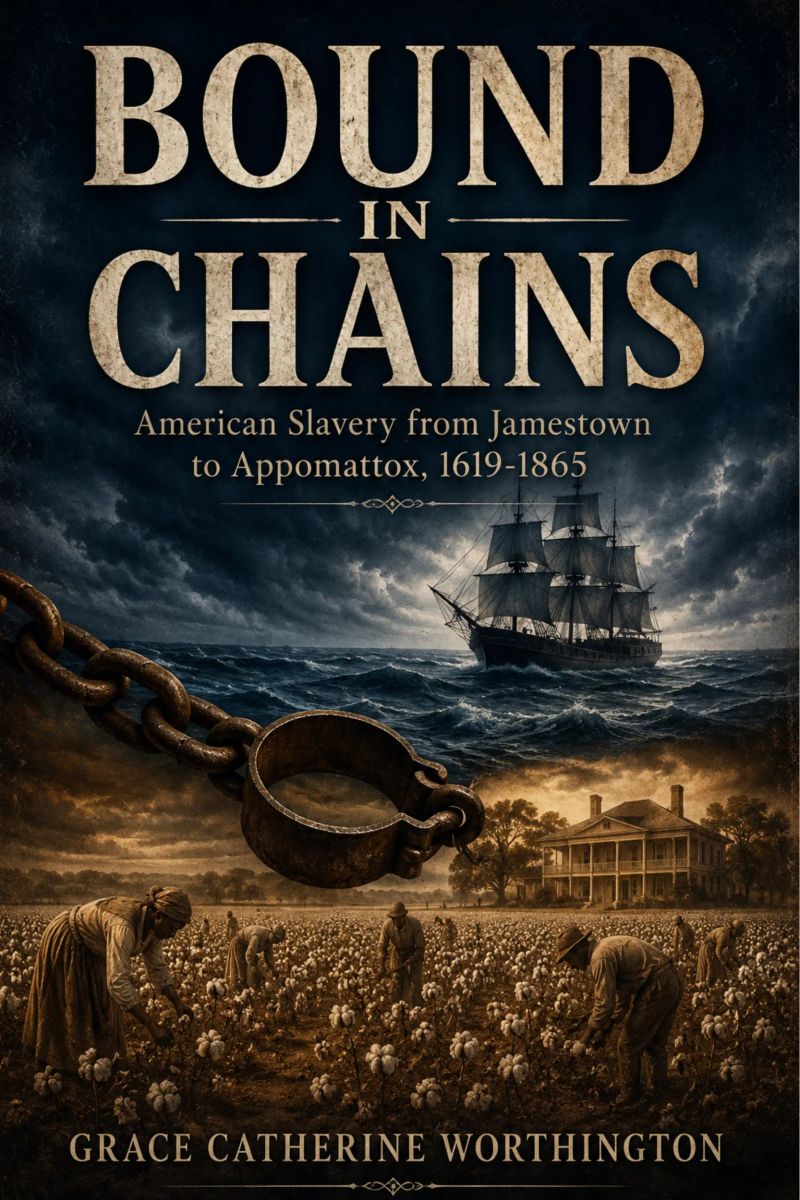
BOUND IN CHAINS
American Slavery from Jamestown to Appomattox, 1619-1865By Grace Catherine Worthington


Length5h 54m
About this audiobook
How did a nation founded on liberty hold millions of human beings in bondage for 246 years?
It began with a single ship at Jamestown in 1619. It did not end until Appomattox in 1865. In between lies the hardest — and most important — story in American history, and most of us were only ever taught a fraction of it.
If slavery has always felt like scattered names and dates — Jamestown, the Middle Passage, the Civil War — without the full human truth connecting them, Bound in Chains gives you the complete story of American slavery, from its first day to its last, told with unflinching honesty and deep humanity.
This is not a sanitized textbook. It's the lived reality of the people who endured it, resisted it, and finally broke it.
Inside, you'll discover:
* **How American slavery was built** — the laws, the lies, and the Cotton Kingdom economy that turned human beings into property.
* **The truth about resistance** — from everyday defiance to the uprisings of Nat Turner, and the courage of Frederick Douglass and Harriet Tubman.
* **How slavery pushed a nation toward war** — Dred Scott, the Fugitive Slave Act, John Brown, and the road to Appomattox.
* **Why slavery's long shadow still falls on America** — Reconstruction, memory, and the reckoning we're still living through.
By the end, you won't just know the dates of American slavery — you'll understand how it happened, who fought it, and why it still matters.
This is the honest, unforgettable history every American should read.
Scroll up, click "Buy Now," and meet the people who refused to stay bound in chains.
Audiobook details
GenreOther, Historical Fiction
Length5 hrs 54 mins
Narrated byListen with 1,000+ voices
FormateBook with Audio
LanguageEnglish
Table of contents
1Introduction
2Author’s Note
3Prologue: The Middle Passage
4PART ONE: THE ORIGINS AND GROWTH OF AMERICAN SLAVERY (1619-1750)
5Chapter 1: The First Africans — Jamestown, 1619, and the Beginning
Show all chaptersShow less
6Chapter 2: The Slave Trade — Africa, the Middle Passage, and the Atlantic System
7Chapter 3: From Servant to Slave — How Racial Slavery Was Built in Law
8Chapter 4: The Plantation System — Rice, Tobacco, and the Slave Economy
9PART TWO: THE SLAVE SOCIETY (1750-1820)
10Chapter 5: The Cotton Kingdom — Eli Whitney, the Gin, and Slavery's Expansion
11Chapter 6: The Domestic Slave Trade — Selling People from the Upper to the Deep South
12Chapter 7: The Master Class — Planters, Paternalism, and the Ideology of Slavery
13Chapter 8: The Enslaved Community — Family, Religion, and Culture Under Bondage
14PART THREE: RESISTANCE AND CONTROL
15Chapter 9: Everyday Resistance — Slowing Down, Feigning Illness, and Breaking Tools
16Chapter 10: Gabriel's Rebellion, Denmark Vesey, and Nat Turner — Three Uprisings
17Chapter 11: The Slave Patrol — Control, Surveillance, and the Origins of Policing
18Chapter 12: Free Black Communities — The Complicated Freedom of the Non-Enslaved
19PART FOUR: THE ABOLITIONIST CHALLENGE (1820-1860)
20Chapter 13: William Lloyd Garrison and The Liberator — The Radical Abolitionism
21Chapter 14: Frederick Douglass — The Escaped Slave Who Became the Movement's Voice
22Chapter 15: Harriet Tubman and the Underground Railroad — Resistance Made Physical
23Chapter 16: Uncle Tom's Cabin — Literature, Sympathy, and the Antislavery Cause
24PART FIVE: SLAVERY AND THE COMING OF WAR
25Chapter 17: The Compromise of 1850 and the Fugitive Slave Act
26Chapter 18: Kansas-Nebraska and Bleeding Kansas — Slavery in the Territories
27Chapter 19: Dred Scott — The Supreme Court and the Rights of Enslaved People
28Chapter 20: John Brown's Raid — Harpers Ferry and the Road to Disunion
29PART SIX: SLAVERY'S END AND LEGACIES
30Chapter 21: Slavery and the Civil War — Contrabands, Black Soldiers, and Emancipation
31Chapter 22: The Thirteenth Amendment — The Legal End of American Slavery
32Chapter 23: Reconstruction and Its Collapse — The Unfinished Revolution
33Chapter 24: Slavery's Long Shadow — Reparations, Memory, and America's Ongoing Reckoning
34Epilogue: The Freedom That Came
35Acknowledgments
36Selected Bibliography
37About the Author
More from Grace Catherine Worthington
Mere ChristianityC. S. Lewis7h 7m4.4 (519.7K)$24 · $0.00

Her Daily BreadKate Wood12h 57m4.6 (153)$33 · $0.00
The Holy Bible - 1 SamuelKing James2h 13m4.8 (1.6K)$3 · $0.00

The American Standard Bible — The Gospel of MatthewMatthew3h 56m4.7 (3K)$2 · $0.00

Bad Fat Black GirlSesali Bowen6h 32m4.7 (2.8K)$24 · $0.00
The King James Audio Bible New Testament CompleteChristopher Glyn20h 2m4.7 (2.6K)$12 · $0.00
Faiths CheckbookCharles Spurgeon12h 44m4.7 (3.2K)$11 · $0.00

Ten Things I Wish You Knew About Your Child's Mental HealthDr. Billy Garvey4h 53m4.7 (2.4K)$20 · $0.00

Designing Terry Pratchett’s DiscworldPaul Kidby3h 52m4.7 (343)$20 · $0.00
The Chosen Book OneAmanda Jenkins, Kristen Hendricks, Dallas Jenkins3h 8m4.6 (4.9K)$10 · $0.00

The Lives of BrianBrian Johnson9h 45m4.6 (3.5K)$29 · $0.00
Expository Thoughts on the Gospel of LukeJ.C. Ryle27h 13m4.7 (536)$18 · $0.00
CrossroadsKaleb Dahlgren7h 56m4.6 (4.9K)$26 · $0.00

Across the RiverKent Babb11h 40m4.6 (927)$29 · $0.00

Brain Training for RidersAndrea Monsarrat Waldo5h 56m4.7 (550)$19 · $0.00

My Effin' LifeGeddy Lee17h 11m4.6 (13.1K)$40 · $0.00
Kings and PawnsHoward Bryant10h 9m4.6 (678)$29 · $0.00

The Elementia Chronicles #2: The New OrderSean Fay Wolfe11h 17m4.6 (841)$29 · $0.00
The ActsLuke2h 55m4.6 (19.7K)$12 · $0.00

New Testament - Easy NavigationWorld English Bible19h 35m4.6 (1.3K)$1.30 · $0.00

The Things We Cannot SayKelly Rimmer13h 48m4.5 (359.1K)$33 · $0.00

Lieutenant Hornblower (Annotated)C. S. Forester11h 41m4.5 (2.9K)$2 · $0.00

A Christmas Carol (Illustrated Edition)Charles Dickens3h 23m4.5 (21.2K)$1.99 · $0.00

Rilla of InglesideLucy Maud Montgomery11h 44m4.5 (48.2K)$2 · $0.00

The Viennese DressmakerKathryn Gauci11h 46m4.5 (2.1K)$23 · $0.00
The Man in the Brown Suit & They Came to BaghdadAgatha Christie15h 43m4.6 (495)$33 · $0.00

Under the Light of the Italian MoonJennifer Anton12h 28m4.5 (5.3K)$23 · $0.00

Jubilee, 50th Anniversary EditionMargaret Walker15h 43m4.5 (9.5K)$25 · $0.00

Pride and PrejudiceJane Austen14h 44m4.4 (4.7M)$2 · $0.00

Flying Colours (Annotated)Cecil Louis Troughton Smith9h 26m4.4 (10.1K)$2 · $0.00
With Love from HarlemReShonda Tate13h 48m4.5 (2K)$6 · $0.00

Sweet Home Highland ChristmasMay McGoldrick, Jan Coffey2h 54m4.5 (1.4K)$7 · $0.00

Rilla of InglesideL. M. Montgomery12h 25m4.4 (67.5K)$2 · $0.00

Death Comes for the Archbishop (Annotated)Willa Cather9h 13m4.4 (4.7K)$2 · $0.00

The Alice NetworkKate Quinn15h 7m4.4 (887.1K)$33 · $0.00

The Goddess of WarsawLisa Barr13h 4m4.4 (36.4K)$33 · $0.00

The Ohio River Trilogy: Betty Zane, The Spirit of the Border & The Last TrailZane Grey29h 8m4.4 (1.8K)$1 · $0.00

The Attic ChildLola Jaye14h 46m4.4 (21K)$33 · $0.00

Martyr of the CatacombsJames De Mille3h 41m4.5 (744)$1 · $0.00

Quo VadisHenryk Sienkiewicz22h 52m4.4 (62K)$21 · $0.00
You may also like

We Crossed a Bridge and It TrembledWendy Pearlman6h4.6 (5.2K)$24 · $0.00

The Baghdad EucharistSinan Antoon4h 39m3.9 (5.9K)$15

GerminalÉmile Zola17h 36m4.3 (54.7K)$32

Crear en peligroEdwidge Danticat5h 53m4.3 (4.7K)$12 · $0.00

A Rebel War Clerk's Diary at the Confederate States CapitalJ. B. Jones38h 11m4.3 (517)$2 · $0.00

Guerrilla Warfare (Annotated)Ernesto Che Guevara6h 15m4.1 (5.7K)$2 · $0.00

Worlds Beyond The PolesFrancis Amadeo Giannini7h 50m3.7 (1.4K)$3.50 · $0.00

History of the Commune of 1871Lissagaray20h 6m4.4 (1.7K)$2 · $0.00
Kingdom of Olives and AshMichael Chabon, Ayelet Waldman16h 5m4.3 (760)$33 · $0.00

Cursed VictoryAhron Bregman13h 15m4.4 (296)$23

GoliathMax Blumenthal22h 19m4.3 (1.6K)$30

GerminalEmile Zola19h 41m4.3 (53.9K)$3.50 · $0.00
Fifty Years in Chains; or, the Life of an American SlaveCharles Ball11h 21m4.4 (351)$2 · $0.00
BOUND IN CHAINSGrace Catherine Worthington4h 49m$9 · $0.00

THE FORGOTTEN WARThomas Andrew Buckley5h 3m$10 · $0.00

Living in Palestine between tablets, walls, the Bible and the KoranGiovanni Verga3h 5m5.0 (1)$2.30 · $0.00
Slavery and the Coming of the Civil WarChristopher Collier, James Lincoln Collier1h 47m3.9 (149)$15

Reminiscences of Peace and WarSara Agnes Rice Pryor11h 56m$2 · $0.00

The 86th VillageSena Desai Gopal8h 52m3.8 (64)$20

Cetywayo and his White NeighboursH. Rider Haggard11h 46m3.9 (23)$2.30