
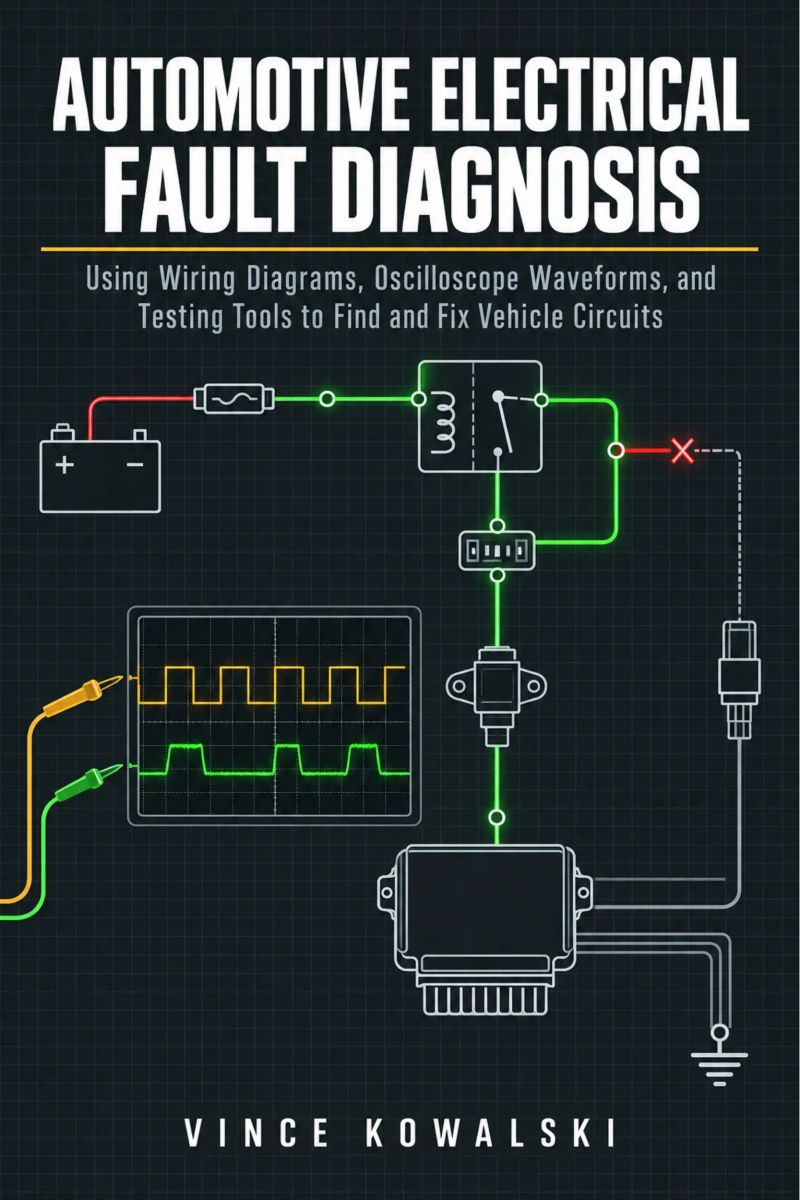
Automotive Electrical Fault Diagnosis
Using Wiring Diagrams, Oscilloscope Waveforms, and Testing Tools to Find and Fix Vehicle CircuitsBy Vince Kowalski

Length12h 48m
About this audiobook
Parts cannon or proof: the difference is method. This book gives you the method.
Stop guessing and start proving. In automotive electrical diagnosis, the difference between a parts cannon and a precise repair is a repeatable method. This book teaches you that method, from the electrical rules that govern every circuit to the advanced techniques used by professional diagnosticians. You will learn why a resistance reading lies and a loaded voltage drop tells the truth, how to trace a circuit through a factory diagram using connector face views and ground distribution, and how to plan a test before you pierce a wire.
Moving from fundamentals to advanced systems, the book shows you how to set up an oscilloscope so the capture is usable, ramp injector and starter current to find shorted windings and mechanical drag, and read crank, cam, mass airflow, oxygen, injector, and ignition patterns with confidence. Later chapters take on network faults, alternator ripple, staged parasitic draw testing, and safe isolation and insulation testing on hybrid and electric vehicles. Every chapter builds on the last, giving you a logical framework that works on any vehicle, any circuit, any fault.
What you will learn:
• The electrical rules that diagnosis depends on, including Ohm's law, series and parallel circuits, and voltage drop
• How to choose and use tools within their limits, from multimeters to amp clamps and oscilloscopes
• How to read wiring diagrams, including connector face views, ground distribution, and power flow
• A repeatable diagnostic strategy that takes you from symptom to root cause without wasted steps
• Voltage drop and load testing techniques that reveal resistance faults a standard meter misses
• Oscilloscope setup and capture technique for clean, usable waveforms every time
• Current ramping and amp clamp diagnostics to identify shorted windings, dragging starters, and fuel pump issues
• How to interpret sensor and actuator waveforms, including crank, cam, MAF, oxygen, injector, and ignition patterns
• Network diagnostics, starting and charging system tests, parasitic draw hunting, and high-voltage safety on hybrid and electric vehicles
Written for apprentice and working technicians, mobile diagnosticians, and serious home mechanics, this book assumes you want to understand why a test works, not just follow a recipe. If you are ready to leave the parts cannon behind and diagnose with confidence, this is your guide.
Audiobook details
GenreTechnology, Other
Length12 hrs 48 mins
Narrated byListen with 1,000+ voices
FormateBook with Audio
Publish dateSep 27, 2026
LanguageEnglish
Table of contents
1Automotive Electrical Fault Diagnosis
2Foreword
3Preface
4About This Book
5Important Safety Notice
Show all chaptersShow less
6Chapter 1: The Electrical Rules That Diagnosis Depends On
71.1 Voltage, Current, Resistance and Ohm’s Law Under Load
81.2 Available Voltage, Applied Voltage and Voltage Drop
91.3 Series Circuits and the Voltage Divider
101.4 Parallel Circuits and Shared Returns
111.5 Resistance Readings That Deceive
121.6 Work, Power and Heat in Faulted Circuits
131.7 Kirchhoff’s Laws as a Diagnostic Tool
14Chapter 2: Tools and Their Limits
152.1 Digital Multimeters and Input Impedance
162.2 Test Leads, Probes and Back-Probing Technique
172.3 Test Lights and Power Probes
182.4 Current Clamps and Amp Probes
192.5 Scan Tool Data Versus Direct Measurement
202.6 Where Each Tool Must Not Be Used
21Chapter 3: Reading Wiring Diagrams
223.1 Diagram Types and What Each Is For
233.2 Symbols, Conventions and Circuit Numbering
243.3 Connector Face Views and Terminal Identification
253.4 Splices, Ground Distribution and Ground Packs
263.5 Tracing a Circuit from Power to Load to Ground
273.6 Component and Connector Location Tables
28Chapter 4: Power Distribution, Grounds, Fuses and Relays
294.1 Battery Feed Paths and Power Distribution Centers
304.2 Ignition-Switched and Controlled Feeds
314.3 Fuses, Circuit Breakers and Fusible Links
324.4 Relay Internal Circuits and Operation
334.5 Bench Testing Relays and Switches
344.6 Ground Offset and Its Symptoms
35Chapter 5: A Repeatable Diagnostic Strategy
365.1 Verifying the Complaint and Gathering Evidence
375.2 From Symptom to Suspect Circuit
385.3 Half-Splitting and Choosing the Fastest Access Point
395.4 Writing a Test Plan Before Touching a Probe
405.5 Confirming the Repair and Documenting the Result
41Chapter 6: Voltage Drop and Load Testing
426.1 Why Loaded Testing Beats Resistance Measurement
436.2 Feed-Side Drop Limits and How to Apply Them
446.3 Ground-Side Drop Limits and Ground Testing
456.4 Testing Switches, Connectors and Terminals in Place
466.5 Building a Load Bank and Using It Safely
47Chapter 7: Oscilloscope Setup and Capture Technique
487.1 Time Base, Volts per Division and Vertical Scaling
497.2 Trigger Types, Levels and Single-Shot Capture
507.3 Probe Grounding, Lead Dress and Noise

Hands of TimeRebecca Struthers8h 8m4.4 (1.3K)$26 · $0.00

Never Lost AgainBill Kilday10h 1m4.4 (805)$29 · $0.00

How the Internet HappenedBrian McCullough13h 28m4.3 (2.7K)$23 · $0.00

Collected Writings of Nikola TeslaNikola Tesla, Thomas Commerford Martin21h 50m4.3 (1.7K)$1 · $0.00

Just AspireAjai Chowdhry9h 13m4.4 (260)$29 · $0.00

The Little Book of AliensAdam Frank8h 20m4.3 (1.3K)$26 · $0.00

The inventions, researches and writings of Nikola Tesla (Annotated)Thomas Commerford Martin16h 59m4.3 (1.3K)$2 · $0.00

KargilV.P. Malik15h 18m4.3 (2K)$24 · $0.00

Experiments with Alternating CurrentsNikola Tesla9h 16m4.3 (874)$1.99 · $0.00

Fire on the HorizonTom Shroder, John Konrad8h 23m4.3 (858)$26 · $0.00

The Smell of Kerosene (Annotated)National Aeronautics and Space Administration, Donald L. Mallick, Peter W. Merlin11h 32m4.3 (523)$2 · $0.00

The Boy Who Harnessed the WindWilliam Kamkwamba, Bryan Mealer10h 5m4.2 (78.9K)$29 · $0.00

Across the Airless WildsEarl Swift10h 8m4.3 (1.3K)$29 · $0.00

Console WarsBlake J. Harris20h 41m4.2 (13.7K)$46 · $0.00

Improvised Munitions HandbookU.S. Department of Defense4h 49m4.3 (1.6K)$0.99 · $0.00

Escaping GravityLori Garver10h 54m4.2 (2.2K)$20 · $0.00

Wireless WarsJonathan Pelson8h 2m4.3 (418)$20 · $0.00

Let There Be WaterSeth M. Siegel8h 36m4.2 (2.3K)$20 · $0.00

The PerfectionistsSimon Winchester11h 46m4.2 (9.9K)$29 · $0.00
Rethinking NarcissismDr. Craig Malkin6h 7m4.2 (3.4K)$24 · $0.00

Mere ChristianityC. S. Lewis7h 7m4.4 (519.7K)$24 · $0.00

Her Daily BreadKate Wood12h 57m4.6 (153)$33 · $0.00

The Holy Bible - 1 SamuelKing James2h 13m4.8 (1.6K)$3 · $0.00

The American Standard Bible — The Gospel of MatthewMatthew3h 56m4.7 (3K)$2 · $0.00

Bad Fat Black GirlSesali Bowen6h 32m4.7 (2.8K)$24 · $0.00

The King James Audio Bible New Testament CompleteChristopher Glyn20h 2m4.7 (2.6K)$12 · $0.00

Faiths CheckbookCharles Spurgeon12h 44m4.7 (3.2K)$11 · $0.00

Ten Things I Wish You Knew About Your Child's Mental HealthDr. Billy Garvey4h 53m4.7 (2.4K)$20 · $0.00

Designing Terry Pratchett’s DiscworldPaul Kidby3h 52m4.7 (343)$20 · $0.00

The Chosen Book OneAmanda Jenkins, Kristen Hendricks, Dallas Jenkins3h 8m4.6 (4.9K)$10 · $0.00

The Lives of BrianBrian Johnson9h 45m4.6 (3.5K)$29 · $0.00
Expository Thoughts on the Gospel of LukeJ.C. Ryle27h 13m4.7 (536)$18 · $0.00

CrossroadsKaleb Dahlgren7h 56m4.6 (4.9K)$26 · $0.00

Across the RiverKent Babb11h 40m4.6 (927)$29 · $0.00

Brain Training for RidersAndrea Monsarrat Waldo5h 56m4.7 (550)$19 · $0.00

My Effin' LifeGeddy Lee17h 11m4.6 (13.1K)$40 · $0.00

Kings and PawnsHoward Bryant10h 9m4.6 (678)$29 · $0.00

The Elementia Chronicles #2: The New OrderSean Fay Wolfe11h 17m4.6 (841)$29 · $0.00

The ActsLuke2h 55m4.6 (19.7K)$12 · $0.00

New Testament - Easy NavigationWorld English Bible19h 35m4.6 (1.3K)$1.30 · $0.00
You may also like

Pete the Cat and the Easter Basket BanditJames Dean, Kimberly Dean7m4.4 (2.2K)$4 · $0.00

The Sign of the FourArthur Conan Doyle4h 35m4.0 (386.4K)$1 · $0.00

Have His CarcaseDorothy L. Sayers15h 40m4.2 (21.9K)$2 · $0.00

The Case of the Murdered MuckrakerCarola Dunn8h 3m3.7 (3.9K)$20

The Complete Charlie Chan Series – All 6 Mystery Novels in One Edition (Annotated)Earl Derr Biggers56h 17m4.3 (391)$2 · $0.00

The Mystery of the Yellow RoomGaston Leroux8h 19m3.8 (18.2K)$2.30

The Middle Temple MurderJ. S. Fletcher8h 25m3.9 (1.1K)$2 · $0.00

Father Brown: The Complete Mystery Series (Annotated)G. K. Chesterton40h 44m4.5 (1.3K)$1.99 · $0.00

Dead Man's FollyAgatha Christie6h 2m4.0 (50K)$24 · $0.00

Fancy Nancy: Heart to HeartJane O'Connor4m4.3 (1.6K)$4 · $0.00

Information Products Creation and MarketingAnthony Ekanem48m$5 · $0.00

How to Make Money Flipping Used Cars - A Beginner's Guide to Finding Deals, Estimating Costs, and Selling Safely for ProfitJACK FLIPWELL4h 24m$7.70 · $0.00

Why Is This PC So SlowDesmond Sandoval7h 27m$5 · $0.00

Troubleshooting Process Instruments and ControlsRonald Petrosyan15h$80

The Complete Works of St. AugustineSaint Augustine of Hippo461h 24m4.6 (130)$0.99 · $0.00

How Watson Learnt the TrickArthur Conan Doyle3m4.0 (347)$2 · $0.00

Little Ash Party Problem!Ash Barty, Jasmin McGaughey19m4.2 (19)$7 · $0.00
Inspector HopperDoug Cushman17m4.2 (208)$7 · $0.00

Detective BookCarujo3h 43m$6 · $0.00

A Primer of Mayan HieroglyphicsDaniel G. Brinton4h 44m3.8 (23)$1 · $0.00