
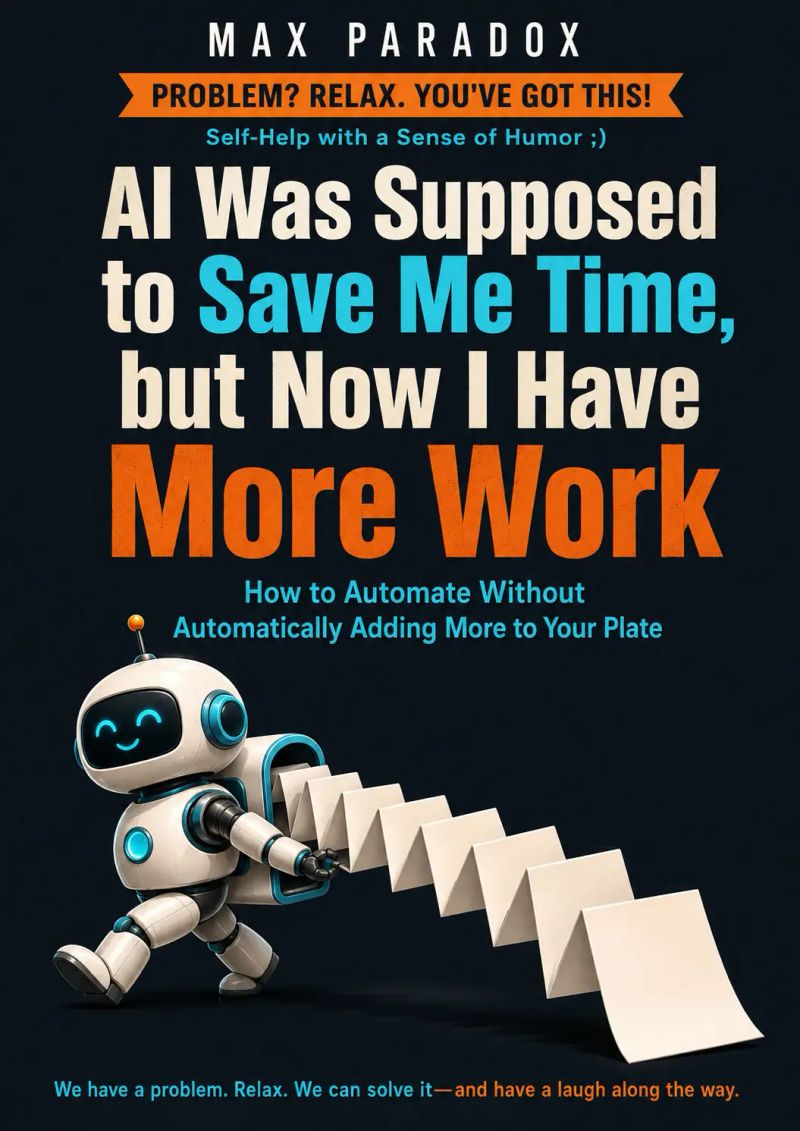
AI Was Supposed to Save Me Time, but Now I Have More Work - How to Automate Without Automatically Adding More to Your Plate
By Max Paradox


Length7h 16m
About this audiobook
AI was supposed to save you time.
So why are you now maintaining prompts, checking summaries, fixing automations, testing new tools, reviewing generated drafts, reading AI digests, and attending meetings about dashboards created by systems designed to reduce meetings?
Technology did not necessarily fail.
You may simply have used every minute it saved to create more work.
AI Was Supposed to Save Me Time, but Now I Have More Work: How to Automate Without Automatically Adding More to Your Plate is a practical, funny guide to using artificial intelligence and automation without accidentally turning yourself into the unpaid manager of a small software department.
Max Paradox takes on one of the strangest productivity problems of the AI era: the tools are getting faster, but your workload somehow keeps growing.
Inside, you will learn how to:
identify which tasks are actually worth automating;
calculate whether an automation saves real time after setup, review, and maintenance;
stop automating tasks that should simply be deleted;
find the repetitive core inside messy work;
avoid tool sprawl and subscription overload;
build small workflows that do one useful thing well;
prevent AI from creating too many drafts, options, reports, and decisions;
design clear review points and safe manual fallbacks;
automate handoffs, routine preparation, and information movement without outsourcing important judgment;
recognize when a once-useful workflow has quietly become another job;
protect the time automation saves instead of immediately filling it with more obligations.
This is not a book about building the most advanced AI system possible. It is about reducing low-value effort.
No guru rituals. No demand that you wake at 4:30 a.m. and optimize your breakfast. No assumption that every repetitive click needs an autonomous agent with a dramatic name.
Instead, you will get practical rules, minimum viable solutions, realistic examples, Plan B options, and a large number of uncomfortable moments when you realize you have spent two hours automating a task that took twelve minutes.
Because the real measure of successful automation is not how futuristic your workflow looks.
It is what no longer requires your time.
If AI makes you faster but you simply increase your workload until you are exhausted again, nothing meaningful has improved. This book will show you how to keep the benefit.
Automate less.
Automate better.
And occasionally accept the shocking possibility that finishing early is allowed.
This publication was prepared with the assistance of tools that support the creative process, including artificial intelligence-based solutions. The final concept, structure, and editing belong to the author.
Audiobook details
GenreTechnology
Length7 hrs 16 mins
Narrated byListen with 1,000+ voices
FormateBook with Audio
Publish dateAug 29, 2026
LanguageEnglish
Table of contents
1INTRO
2Chapter 1 - You Didn’t Save Time. You Created Capacity.
3Chapter 2 - The Work Behind the Work
4Chapter 3 - You Are Automating the Wrong Things
5Chapter 4 - Your New Hobby Is Managing Tools
Show all chaptersShow less
6Chapter 5 - Stop Automating Your Anxiety
7Chapter 6 - Faster Is Not the Same as Better
8Chapter 7 - You Built a Machine to Avoid One Click
9Chapter 8 - AI Made It Easier to Say Yes
10Chapter 9 - Automate the Bottleneck, Not the Decoration
11Chapter 10 - Define “Done” Before the Robot Arrives
12Chapter 11 - Build the Smallest Useful Workflow
13Chapter 12 - Bad Input Creates Expensive Output
14Chapter 13 - Automate the Handoff
15Chapter 14 - Build a Workflow That Ends
16Chapter 15 - When the Automation Breaks at 4:47 P.M.
17Chapter 16 - When You Do Not Have the Energy to Be Efficient
18Chapter 17 - When Other People Change the Rules
19Chapter 18 - The Work Will Try to Grow Back
20Chapter 19 - Notice the Return Before It Becomes Normal
21Chapter 20 - Let the Machine Finish First

The Brutal Truth About Love - Romance Ends Where Bills, Ego and Daily Choices BeginMax Paradox6h$7.70 · $0.00

How to Stop Avoiding Difficult ConversationsMax Paradox6h 51m$7.70 · $0.00
I Have to Call. I’d Rather Send a Pigeon - How to Stop Putting Off Phone Calls, Prepare for Difficult Conversations, and Get Things Done Without Staring at the Call Button for an HourMax Paradox7h 8m$7.70 · $0.00

Nie umiem przyjmować komplementów - Jak powiedzieć „dziękuję” zamiast natychmiast udowadniać, że wcale nie jesteś taki fajnyMax Paradox4h 51m$7.70 · $0.00

Nie chcę nigdzie wychodzić, a potem żałuję, że zostałem w domu - Jak dogadać się z własną baterią społecznąMax Paradox4h 55m$7.70 · $0.00

Przeczytałem wszystkie wiadomości i teraz boję się wszystkiego - Jak przestać doomscrollować, nie wyprowadzając się do jaskiniMax Paradox5h 47m$7.70 · $0.00

I Can't Relax Without a Screen - How to Remember What People Did Before Everything Started ScrollingMax Paradox7h 22m$7.70 · $0.00

Próbuję zoptymalizować całe swoje życie - Jak przestać mierzyć sen, kroki, wodę, produktywność i własną wartośćMax Paradox5h 57m$7.70 · $0.00

I Lost My Job. Great, Just What I Needed - How to Handle the First Few Weeks, Money, Your CV, and the Job Search Without Treating Losing Your Job Like the End of the WorldMax Paradox7h 12m$7.70 · $0.00

The TV Is Always On - How Television Explains Nothing, Controls Everything, and Never Turns Itself OffMax Paradox2h 50m$7.70 · $0.00

Nie potrafię być w czymś początkujący - Jak robić coś źle wystarczająco długo, żeby w końcu robić to dobrzeMax Paradox5h 59m$7.70 · $0.00

Nie odpisuję, bo minęło już za dużo czasu - Jak wyjść z wiadomościowego długu bez zmiany numeru telefonuMax Paradox5h 51m$7.70 · $0.00

Moja praca składa się ze spotkań o kolejnych spotkaniach - Jak odzyskać dzień z kalendarza pełnego prostokątówMax Paradox5h 29m4.6 (30)$7.70 · $0.00

I Only Learned Today That Filters Need Cleaning Too - How to Handle Basic Home and Appliance Maintenance Before a Small Neglect Turns Into a Bill with an Extra ZeroMax Paradox6h 20m$7.70 · $0.00

Vacation with Friends Sounded Better in the Group Chat - How to Agree on the Budget, Pace, Accommodation, and Expectations Before a Trip So You Come Home Still FriendsMax Paradox5h 18m$7.70 · $0.00

Mam Pełną Szafę i Nic do Ubrania - Jak uporządkować ubrania, kupować mniej i wreszcie wiedzieć, co założyć bez porannego kryzysu przed lustremMax Paradox5h 5m$7.70 · $0.00

Zacząłem Nowy Nawyk. Skończyłem We Wtorek - Jak budować małe zmiany, które przetrwają gorszy dzień, brak motywacji i tydzień, w którym życie nie przeczytało twojego planuMax Paradox4h 52m$7.70 · $0.00

The Brutal Truth About Bolesław the Brave - Wars, Wives, Passions, and the Ruthless Road of Poland’s First King to the CrownMax Paradox6h$7.70 · $0.00

Brutalna prawda o licealistach - Oceny, presja, miłość, bunt i życie, którego dorośli prawie nigdy nie widząMax Paradox5h 46m$7.70 · $0.00
How to Beat Perfectionism and Start Finishing What You StartMax Paradox7h 36m$7.70 · $0.00

Operation PedestalMax Hastings12h 29m4.4 (5.2K)$29 · $0.00

When the Heavens Went on SaleAshlee Vance18h 20m4.4 (3K)$40 · $0.00

Everybody Has a Podcast (Except You)Justin McElroy, Travis McElroy, Griffin McElroy5h 9m4.3 (2.3K)$24 · $0.00

Hands of TimeRebecca Struthers8h 8m4.4 (1.3K)$26 · $0.00

Never Lost AgainBill Kilday10h 1m4.4 (805)$29 · $0.00

How the Internet HappenedBrian McCullough13h 28m4.3 (2.7K)$23 · $0.00

Collected Writings of Nikola TeslaNikola Tesla, Thomas Commerford Martin21h 50m4.3 (1.7K)$1 · $0.00

Just AspireAjai Chowdhry9h 13m4.4 (260)$29 · $0.00

The Little Book of AliensAdam Frank8h 20m4.3 (1.3K)$26 · $0.00

The inventions, researches and writings of Nikola Tesla (Annotated)Thomas Commerford Martin16h 59m4.3 (1.3K)$2 · $0.00

KargilV.P. Malik15h 18m4.3 (2K)$24 · $0.00

Experiments with Alternating CurrentsNikola Tesla9h 16m4.3 (874)$1.99 · $0.00

Fire on the HorizonTom Shroder, John Konrad8h 23m4.3 (858)$26 · $0.00

The Smell of Kerosene (Annotated)National Aeronautics and Space Administration, Donald L. Mallick, Peter W. Merlin11h 32m4.3 (523)$2 · $0.00

The Boy Who Harnessed the WindWilliam Kamkwamba, Bryan Mealer10h 5m4.2 (78.9K)$29 · $0.00

Across the Airless WildsEarl Swift10h 8m4.3 (1.3K)$29 · $0.00

Console WarsBlake J. Harris20h 41m4.2 (13.7K)$46 · $0.00

Improvised Munitions HandbookU.S. Department of Defense4h 49m4.3 (1.6K)$1.99 · $0.00
Escaping GravityLori Garver10h 54m4.2 (2.2K)$20 · $0.00

Wireless WarsJonathan Pelson8h 2m4.3 (418)$20 · $0.00
You may also like
Prompts That Sell: The Power Of Words In Artificial IntelligenceKael Novera50m$7 · $0.00

ITIL® 4 Create, Deliver and Support (CDS)Claire Agutter3h 36m4.6 (23)$40 · $0.00
Software Structure by DesignRohan Dasgupta14h 44m4.8 (10)$75

ITIL® 4 Essentials: Your essential guide for the ITIL 4 Foundation exam and beyond, second editionClaire Agutter4h4.2 (50)$40 · $0.00

HorizonsJames Poskett15h 18m3.7 (472)$33 · $0.00
Numerical Analysis Using MATLAB, Excel and VBAOmar Halabi12h 9m$75
Airfoils, Lift and Drag IllustratedPatrick Zwolinska11h 22m$50
Statistical Methods for Engineers and ScientistsPriya Ramanathan15h 5m$95

How to Profit from Google AdSenseAnthony Ekanem37m$4 · $0.00

AP Computer Science Principles Exam Study GuideMarie Peterson8h 32m$10

Invisible IncomeSara Melo1h 34m$1.80 · $0.00

From Zero To AutomaticSara Melo1h 25m$1.80 · $0.00
Self Publishing: Optimize Your Entire Publishing Business With AI Assistants (How to Rise to the Top in Book Sales Through Creative Disruption)Peter Felts1h 8m$3.50 · $0.00

Algorithms in Java, Coded and TestedBianca Zielinski7h 25m$5 · $0.00
Machine Learning in the CloudLionel Jansen8h 21m$5 · $0.00

Build a 2.5D RPG with Godot 4 and C#Gregory Whitlock7h 8m$5 · $0.00

Bio-Inspired AI in C++Zoe Becker7h 10m$5 · $0.00
Python Programming Made PracticalAustin Gray7h 21m5.0 (1)$6.50 · $0.00

Ethical Hacking Practice LabAaron Blake7h 51m$6.50 · $0.00
C++ for Natural Language ProcessingRoland Kessler7h 10m$5 · $0.00