
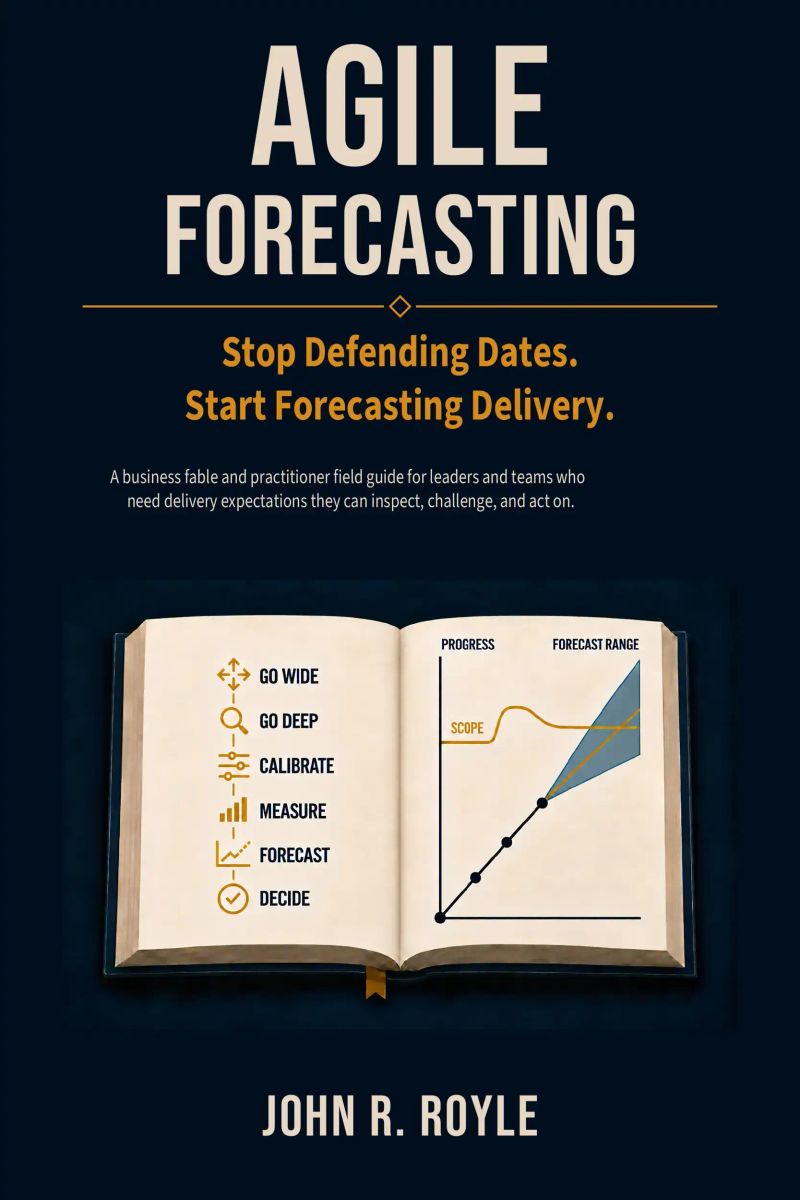
Agile Forecasting
Stop Defending Dates, Start Forecasting DeliveryBy John R. Royle


Length6h 21m
About this audiobook
Agile Forecasting: Stop Defending Dates. Start Forecasting Delivery. challenges traditional software delivery commitments and introduces a practical, evidence-based approach to forecasting.
Part business fable and part practitioner field guide, the book shows how teams and leaders can replace unreliable fixed-date promises with transparent forecasts based on scope discovery, representative estimation, actual delivery performance, uncertainty, and progressive reforecasting.
Drawing on more than 35 years of technology leadership experience, John R. Royle provides a practical approach to making better decisions about capacity, schedules, investment, risk, and delivery outcomes.
For Agile practitioners, Scrum Masters, product owners, project managers, technology executives, and anyone responsible for software delivery.
Audiobook details
GenreBusiness and Economics, Technology
Length6 hrs 21 mins
Narrated byListen with 1,000+ voices
FormateBook with Audio
Publish dateOct 20, 2026
LanguageEnglish
Table of contents
1Title Page
2Acknowledgments
3Preface: Why This Book Exists
4How the practice developed
5What the method does not promise
Show all chaptersShow less
6How to Use This Book
7Reading Paths
8A Simple Reading Test
9Part I: The Forecasting Fable
10Overview
11Prologue: Four Boxes
12Chapter 1: Boxes, Wine, and the Luxury of Being Done
13Chapter 2: 7:13 A.M.
14Chapter 3: What Did We Actually Promise?
15Chapter 4: The Wall
16Chapter 5: Two Teams, One Promise
17Chapter 6: Hope Is Not a Strategy
18Chapter 7: Buying the Quarter
19Chapter 8: The Week After Winning
20Chapter 9: A Good Month
21Chapter 10: Friday at Four
22Chapter 11: One Date, Four Meanings
23Chapter 12: A Quiet Quarter
24Epilogue: Coffee Can Just Be Coffee
25Part II: The Practitioner Guide
26Overview
27Section 1: Agile Forecasting at a Glance
28Section 2: The Six Actions of Agile Forecasting
29Section 3: The Three Forecasting Levels
30Section 4: Forecasting Patterns and Pitfalls
31Section 5: Visual Tools for Applying Agile Forecasting
32Section 6: One Scaling Principle: Preserve Local Truth, Integrate Through Time and Dependencies
33Section 7: Program and Portfolio Governance
34Part II Conclusion: Forecasting Is a Behavior
35Part III: Advanced Practice and Reference
36Overview
37Appendix A: Evidence and Measurement
38The question your evidence has to answer
391. Keep scope history and delivery history separate
402. Measure what actually moves the forecast boundary
413. Preserve all history, but select representative evidence deliberately
424. Use burn-up views to separate scope movement from delivery movement
435. Reconcile before forecasting
446. Evidence quality should match the consequence of the decision
457. Evidence accumulates continuously; reforecasting remains decision-driven
468. What better evidence changes
47Appendix B: Building Better Local Forecasts
48Match the method to the local question
491. Begin with a simple supported range
502. Improve the evidence before improving the model
Never Split the DifferenceChris Voss, Tahl Raz8h 7m4.4 (277.7K)$26 · $0.00
The Intelligent Investor Rev Ed.Benjamin Graham17h 48m4.3 (191.5K)$40 · $0.00
The Hard Thing About Hard ThingsBen Horowitz7h 57m4.2 (134.3K)$26 · $0.00
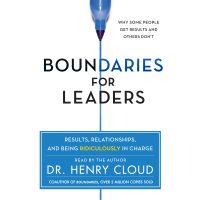
Boundaries for LeadersHenry Cloud7h 36m4.3 (3.6K)$26 · $0.00
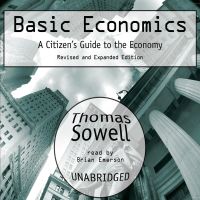
Basic EconomicsThomas Sowell18h 32m4.5 (29.3K)$28 · $0.00

Poor Charlie’s AlmanackGrover Gardener, Charles T. Munger13h 9m4.5 (24.7K)$18 · $0.00

The Ambuja StoryNarotam Sekhsaria13h 59m4.5 (830)$33 · $0.00

The Secret Door to SuccessFlorence Scovel Shinn2h 25m4.5 (2.1K)$1.20 · $0.00

This Is Going to HurtAdam Kay5h 47m4.4 (444.7K)$24 · $0.00

Big TrustShadé Zahrai, Fayçal Sekkouah8h 36m4.6 (406)$26 · $0.00
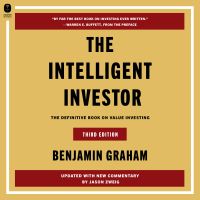
The Intelligent Investor Third EditionBenjamin Graham, Jason Zweig20h4.4 (156.6K)$46 · $0.00

Bottle of LiesKatherine Eban14h 25m4.4 (12K)$33 · $0.00

The Antiracist Business BookTrudi Lebrón6h 10m4.6 (275)$17 · $0.00
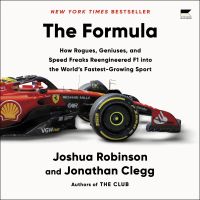
The FormulaJoshua Robinson, Jonathan Clegg10h 41m4.4 (6.9K)$29 · $0.00

Let Them LeadJohn U. Bacon7h 10m4.5 (1.4K)$24 · $0.00

Secrets of the Millionaire MindT. Harv Eker5h 11m4.4 (301.4K)$24 · $0.00

The Person You Mean to BeDolly Chugh9h 6m4.4 (7.2K)$29 · $0.00
BoundlessNick Kostov, Sean McLain9h 17m4.5 (1.1K)$29 · $0.00

Everyday DharmaSuneel Gupta5h 2m4.5 (761)$20 · $0.00

Let's Talk Mutual FundsMonika Halan7h 5m4.4 (2.4K)$16 · $0.00

Hands of TimeRebecca Struthers8h 8m4.4 (1.3K)$26 · $0.00
Never Lost AgainBill Kilday10h 1m4.4 (805)$29 · $0.00
How the Internet HappenedBrian McCullough13h 28m4.3 (2.7K)$23 · $0.00

Collected Writings of Nikola TeslaNikola Tesla, Thomas Commerford Martin21h 50m4.3 (1.7K)$1 · $0.00

Just AspireAjai Chowdhry9h 13m4.4 (260)$29 · $0.00

The Little Book of AliensAdam Frank8h 20m4.3 (1.3K)$26 · $0.00
The inventions, researches and writings of Nikola Tesla (Annotated)Thomas Commerford Martin16h 59m4.3 (1.3K)$2 · $0.00

KargilV.P. Malik15h 18m4.3 (2K)$24 · $0.00

Experiments with Alternating CurrentsNikola Tesla9h 16m4.3 (874)$1.99 · $0.00

Fire on the HorizonTom Shroder, John Konrad8h 23m4.3 (858)$26 · $0.00

The Smell of Kerosene (Annotated)National Aeronautics and Space Administration, Donald L. Mallick, Peter W. Merlin11h 32m4.3 (523)$2 · $0.00

The Boy Who Harnessed the WindWilliam Kamkwamba, Bryan Mealer10h 5m4.2 (78.9K)$29 · $0.00

Across the Airless WildsEarl Swift10h 8m4.3 (1.3K)$29 · $0.00

Console WarsBlake J. Harris20h 41m4.2 (13.7K)$46 · $0.00

Improvised Munitions HandbookU.S. Department of Defense4h 49m4.3 (1.6K)$1.99 · $0.00

Escaping GravityLori Garver10h 54m4.2 (2.2K)$20 · $0.00

Wireless WarsJonathan Pelson8h 2m4.3 (419)$20 · $0.00

Let There Be WaterSeth M. Siegel8h 36m4.2 (2.3K)$20 · $0.00

The PerfectionistsSimon Winchester11h 46m4.2 (9.9K)$29 · $0.00
Rethinking NarcissismDr. Craig Malkin6h 7m4.2 (3.4K)$24 · $0.00
You may also like
PoliticsAristotle10h 15m4.2 (50.2K)$3 · $0.00

Acres of DiamondsRussell Conwell1h 32m4.1 (13.2K)$2 · $0.00

ACRES OF DIAMONDSRussell Conwell1h 33m4.2 (15.3K)$2 · $0.00

Think and Grow RichNapoleon Hill8h 36m4.2 (1.2M)$27 · $0.00

I Have an Idea, but No One's Backing It - How to Build Internal Alliances, Show the Benefits, and Move an Idea Through an Organization Without Political AcrobaticsMax Paradox6h 19m$7.60

Word for SeniorsWalter Hemsley3h 45m$5
Making a DifferenceChesley B. Sullenberger11h 16m4.0 (243)$29 · $0.00

SUCCESS AT YOUR DOORSTEPSRussell Conwell7h 24m$1.99 · $0.00

Selected Mathematical Works: Symbolic Logic + The Game of Logic + Feeding the Mind: by Charles Lutwidge Dodgson, alias Lewis Carroll (Annotated)Lewis Carroll8h 35m$2 · $0.00

In the MomentJen Munson5h 33m4.4 (29)$20
LSAT LOGIC GAMES MASTERY GUIDE 2026/2027Adrian Hartwell12h 18m$10

How to Make Money Flipping Jewelry - How to Test Metals and Stones, Spot Fakes, Value Pieces, and Sell SafelyJACK FLIPWELL8h 7m$7.80 · $0.00

Advertising OnlineNola D. Fenwright2h 39m$2.30 · $0.00

How to Make Money Flipping Used Cars - A Beginner's Guide to Finding Deals, Estimating Costs, and Selling Safely for ProfitJACK FLIPWELL4h 24m$7.80 · $0.00

Mathematical Marvels: 4 Classic Books on the Foundations and Fun of MathHenry Ernest Dudeney, Greg Fee, David Slowinski30h 56m$1.99 · $0.00

The First Month at a New Job Is One Long “Where Is That?” - How to Ask Questions, Map People and Processes, and Become Independent Faster Without Pretending You Know Where the Company Keeps Everything from Day OneMax Paradox6h 26m$7.70 · $0.00
Affiliate Marketing: Proven Strategy for Christmas Affiliate Marketing (Unlock the Secrets to Passive Income and Financial Freedom Through Affiliate Marketing)Charles Coon2h 19m$3.50 · $0.00

The Senior-Friendly Guide to Android PhonesWalter Hemsley3h 42m$15
The Philosophical Theory of the StateBernard Rosanquet10h 19m$2.30

Aestheticism in ArtWilliam Hogarth4h 38m$18 · $0.00