
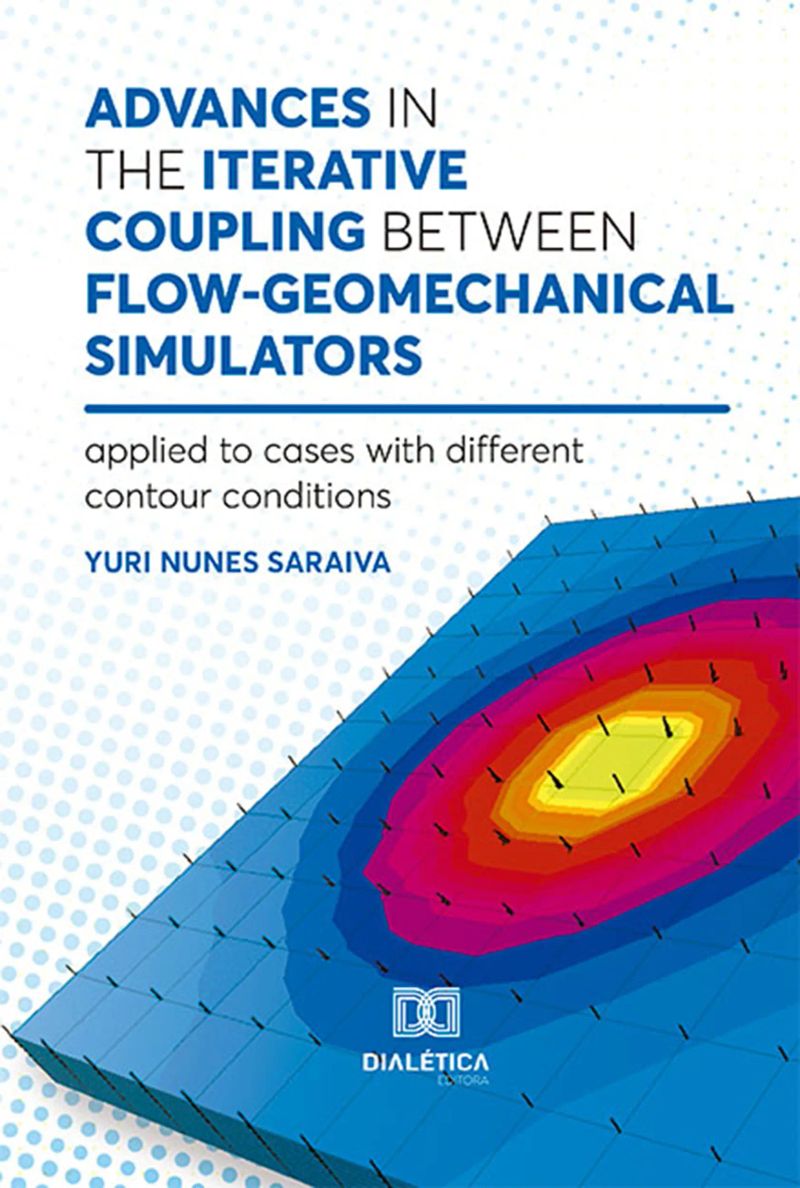
Advances in the iterative coupling between flow-geomechanical simulators
applied to cases with different contour conditionsBy Yuri Nunes Saraiva


Length2h 46m
About this audiobook
Numerical analysis for reservoir engineering scenarios is necessary due to the importance of predict the consequences and products of water or oil exploitation, as well as the vast quantity of variables that are associated with hydraulic engineering, oil, and rock geomechanics. Due to this, the present work consists to show the relative activities for geomechanical coupling and flux simulation based on paper SPE – 79709 of Dean et al. (2006). This way, the used software for coupling was IMEX (2019), in the explicit iterative coupling, with geomechanics and flux model of the same simulator and, posteriorly, was used the geomechanics simulator FLAC3D 6.0 associated with the flux model of IMEX and programming with MATLAB and FISH to transfer the data between simulators. In addition, the results demonstrate the satisfactory obtention of convergence of the problems proposed by Dean et al. (2006), in IMEX with geomechanics. For iterative coupling between FLAC3D and IMEX was obtained good behavior convergence of problem 1. At the end of the simulations, a reservoir model is elaborated based on this problem with the inclusion of a horizontal fracture near the region of the producing well. This type of coupling allows an accurate study with the highest level of complexity and inclusion of variables to reservoir behavior, as the inclusion of fractures and constitutive models.
Audiobook details
GenreTechnology
Length2 hrs 46 mins
Narrated byListen with 1,000+ voices
FormateBook with Audio
Publish dateFeb 8, 2022
LanguageEnglish
Table of contents
1Introduction
263.1. PROBLEMS DESCRIPTION
21 INTRODUCTION
273.1.1. Problem 1
31.2. TOPIC AND JUSTIFICATION
283.1.2. Problem 2
41.3. GENERAL AND SPECIFIC PURPOSE
293.1.3. Problem 3
52 THEORETICAL BACKGROUND
303.1.4. Problem 4
Show all chaptersShow less
62.1. STRESS
313.2. IMEX 2019 EXPLICIT ITERATIVE COUPLING
72.2. EFFECTS OF FLUIDS ON PORES
323.2.1. Problem 1
82.3. BASIC PHASE BEHAVIOR
333.2.2. Problem 2
92.4. WETTABILITY
343.2.3. Problem 3
102.5. STATE EQUATIONS
353.2.4. Problem 4
112.6. SCALE EFFECT
363.3. EXTERNAL EXPLICIT ITERATIVE COUPLING WITH FLAC3D 6.0, IMEX E MATLAB
122.7. POROSITY
373.3.1. Mesh design
132.8. COMPRESSIBILITY
383.3.2. Initial conditions
142.9. PERMEABILITY
393.3.3. Master file
152.10. CONSTITUTIVE MODELS OF FAILURE CRITERIA
403.3.4. Initial pore pressure list
162.10.1 Von-Mises criteria:
413.3.5. FISH programming
172.10.2 Mohr-Coulomb criteria:
423.4 FRACTURED MODEL
182.10.3 Hoek-Brown Criteria:
434 RESULTS
192.11. SUBSIDENCE
444.1. DESCRIPTION OF RESULTS OF DEAN ET AL. (2006)
202.12. RESERVOIR CLASSIFICATION
454.1.1. Problem 1
212.13. RESERVOIR WELLS
464.1.2. Problem 2
222.14. RESERVOIR BEHAVIOR
474.1.3. Problem 3
232.15. RESERVOIR SIMULATION MODEL
484.1.4. Problem 4
242.16. NEW POROSITY AND PERMEABILITY CALCULATION THROUGH ITERATIVE COUPLING
494.2. IMEX 2019 RESULTS
253 METHODOLOGY
504.2.1. Problem 1

When the Heavens Went on SaleAshlee Vance18h 20m4.4 (3K)$40 · $0.00

Everybody Has a Podcast (Except You)Justin McElroy, Travis McElroy, Griffin McElroy5h 9m4.3 (2.3K)$24 · $0.00

Hands of TimeRebecca Struthers8h 8m4.4 (1.3K)$26 · $0.00

Never Lost AgainBill Kilday10h 1m4.4 (805)$29 · $0.00

How the Internet HappenedBrian McCullough13h 28m4.3 (2.7K)$23 · $0.00

Collected Writings of Nikola TeslaNikola Tesla, Thomas Commerford Martin21h 50m4.3 (1.7K)$1 · $0.00

Just AspireAjai Chowdhry9h 13m4.4 (260)$29 · $0.00

The Little Book of AliensAdam Frank8h 20m4.3 (1.3K)$26 · $0.00

The inventions, researches and writings of Nikola Tesla (Annotated)Thomas Commerford Martin16h 59m4.3 (1.3K)$2 · $0.00

KargilV.P. Malik15h 18m4.3 (2K)$24 · $0.00

Experiments with Alternating CurrentsNikola Tesla9h 16m4.3 (874)$1.99 · $0.00

Fire on the HorizonTom Shroder, John Konrad8h 23m4.3 (858)$26 · $0.00
The Smell of Kerosene (Annotated)National Aeronautics and Space Administration, Donald L. Mallick, Peter W. Merlin11h 32m4.3 (523)$2 · $0.00

The Boy Who Harnessed the WindWilliam Kamkwamba, Bryan Mealer10h 5m4.2 (78.9K)$29 · $0.00

Across the Airless WildsEarl Swift10h 8m4.3 (1.3K)$29 · $0.00

Console WarsBlake J. Harris20h 41m4.2 (13.7K)$46 · $0.00

Improvised Munitions HandbookU.S. Department of Defense4h 49m4.3 (1.6K)$1.99 · $0.00
Escaping GravityLori Garver10h 54m4.2 (2.2K)$20 · $0.00

Wireless WarsJonathan Pelson8h 2m4.3 (418)$20 · $0.00

Let There Be WaterSeth M. Siegel8h 36m4.2 (2.3K)$20 · $0.00
You may also like
New Pacific Coast Cynipidæ (Hymenoptera)Alfred Charles Kinsey48m$2 · $0.00
The Amphibians and Reptiles of Michoacán, MéxicoWilliam Edward Duellman4h 34m$2 · $0.00

Insect ManufacturesAnonymous2h 34m$2.40
Vertebrates from the Barrier Island of Tamaulipas, MéxicoRichard F. Johnston, B. J. Wilks, Robert K. Selander, Gerald G. Raun1h 28m$2 · $0.00

Guide to the study of animal ecologyCharles C. Adams4h 34m$1 · $0.00

Force and Energy; A Theory of DynamicsGrant Allen3h 38m$1 · $0.00

Meteorology: The Science of the AtmosphereCharles Fitzhugh Talman9h 42m$1 · $0.00

Prehistoric Textile Art of Eastern United StatesWilliam Henry Holmes2h 24m$2 · $0.00

The useful trees of northern NigeriaHugh Vandervaes Lely6h 4m$1 · $0.00

Windmills, Picturesque and Historic: The Motors of the PastF. H. Shelton42m$2 · $0.00

Pleistocene Soricidae from San Josecito Cave, Nuevo Leon, MexicoJames S. Findley11m$1 · $0.00

A New Genus of Pennsylvanian Fish (Crossopterygii, Coelacanthiformes) from KansasJoan Echols59m$1 · $0.00

Mushroom Culture: Its Extension and ImprovementW. Robinson3h 37m4.2 (40)$1 · $0.00
The Preparation & Mounting of Microscopic ObjectsThomas microscopist Davies6h$1 · $0.00

Welcome To VolcanoTheobaldo Veira Monteiro11m$8 · $0.00

Anatomy of the CatJacob Reighard, H. S. Jennings16h 28m4.0 (11)$1 · $0.00
Ducks and Geese: Standard Breeds and ManagementGeorge E. Howard1h 50m$2 · $0.00

Fur Farming for Profit, with Especial Reference to Skunk RaisingHermon Basil Laymon2h 10m$2 · $0.00

The History of AnimalsAristotle13h 35m3.7 (57)$1.20 · $0.00

A Manual of Philippine BirdsRichard C. McGregor41h 24m$2 · $0.00