
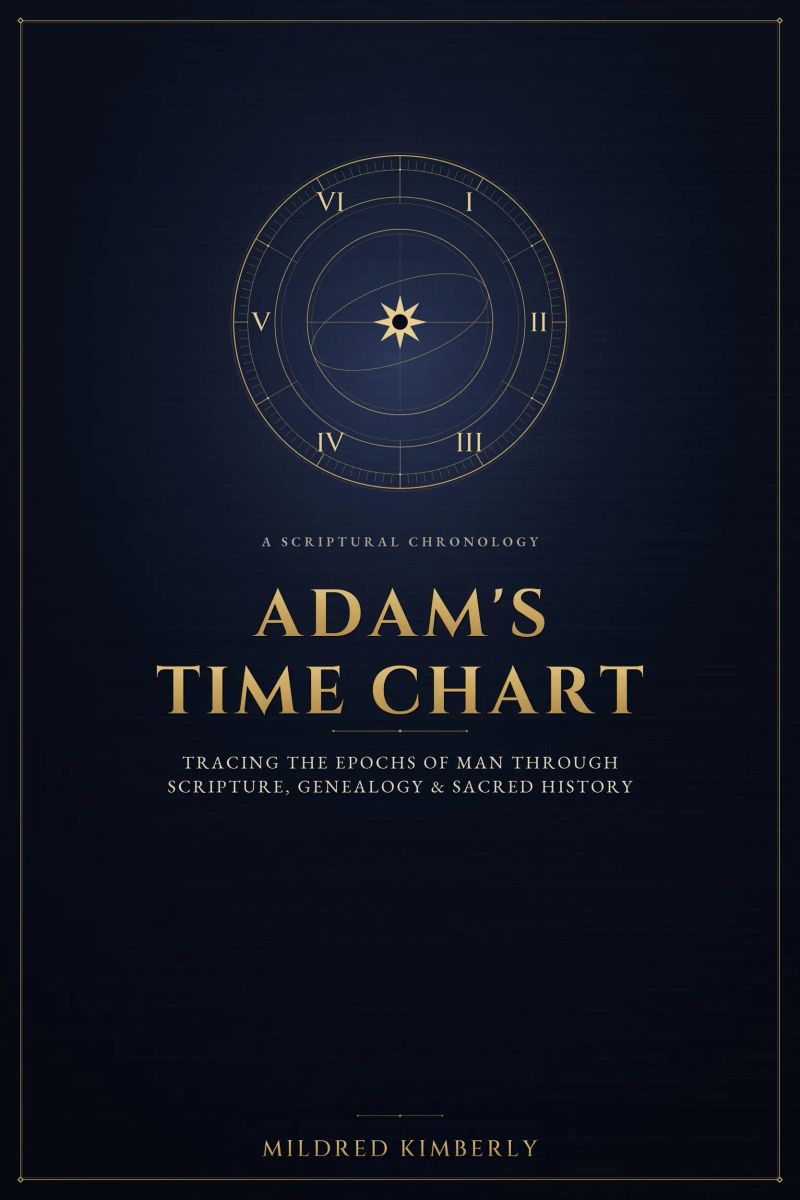
ADAM'S TIME CHART
Tracing the Epochs of Man Through Scripture, Genealogy, and Sacred HistoryBy Mildred Kimberly


Length19h 20m
About this audiobook
The whole timeline of Scripture, in one place
From the dust of Eden to the fullness of time, every generation has its place in the divine order. Adam's Time Chart follows the genealogical thread of the Bible from the first man to the promised Messiah, reconstructing the chronology of redemption with clarity and reverence.
Drawing on the genealogies of Genesis, the reigns of the kings, the witness of the prophets, and the labors of sacred history, this volume charts the years of biblical history so the reader can see the grand architecture of God's appointed times.
Across six epochs of human history, you will trace:
◆ The patriarchal lifespans and the years from Creation to the Flood
◆ The line from Noah to Abraham and the call of the covenant
◆ The Exodus, the Judges, and the united kingdom of Israel
◆ The divided monarchy, the exile, and the return
◆ The silent years and the dawn of the New Covenant
A reference you will return to again and again
Rigorous yet accessible, with chronological tables and clear charts throughout, this is an essential companion for students of the Bible, teachers, small-group leaders, and every reader who longs to understand how the story of redemption fits together.
Anchored in Scripture. Ordered for understanding. Written for the reader who wants the whole picture.
Audiobook details
GenreSpirituality and Religion
Length19 hrs 20 mins
Narrated byListen with 1,000+ voices
FormateBook with Audio
LanguageEnglish
Table of contents
1INTRODUCTION: WHY SACRED TIME MATTERS
2PART ONE — FOUNDATIONS OF BIBLICAL CHRONOLOGY
3CHAPTER ONE: THE IDEA OF SACRED TIME: HOW SCRIPTURE MEASURES HISTORY
4I. The Creation of Time: A Theological Foundation
5II. Linear Time and the Teleological Shape of Biblical History
Show all chaptersShow less
6III. The Hebrew and Greek Vocabulary of Time
7V. The Theology of Appointed and Fulfilled Time
8VI. Scholarly Agreement and Genuine Contestation
9VII. Sacred Time as the Foundation of Biblical Chronology
10Chapter Summary
11CHAPTERTWO: READING THE GENEALOGIES: GENESIS 5 AND 11 AS CHRONOLOGICAL RECORDS
12I. The Literary Structure of the Genealogies
13II. The Data of Genesis 5: From Adam to Noah
14III. The Overlapping Generations: Witnesses Across the Centuries
15IV. The Data of Genesis 11: From Shem to Abraham
16VI. The Continuity Debate: Are the Genealogies Complete or Selective?
17VII. The Genealogies in the History of Interpretation
18Chapter Summary
19CHAPTER THREE: THE WORK OF JAMES USSHER AND THE 4004 BC TRADITION
20I. James Ussher: Life, Learning, and Intellectual Formation
21II. The Method of the Annals of the World
22III. The Key Dates of the Ussher Chronology
23Table 1: Key Dates in the Ussher Chronology Event Ussher's D
24IV. Ussher in the Context of the Broader Chronological Tradition
25V. The Reception of the Ussher Chronology: From Canonical Status to Controversy
26VI. Principal Scholarly Challenges to the 4004 BC Tradition
27VII. A Balanced Assessment: Ussher's Enduring Value and Genuine Limitations
28VIII. The Ussher Tradition and the Chronology of This Book
29Chapter Summary
30CHAPTER FOUR: MASORETIC, SEPTUAGINT, AND SAMARITAN TEXTS: WHY THE NUMBERS DIFFER
31I. The Three Textual Traditions: Origins and Character
32II. The Pattern of the Numerical Differences in Genesis 5
33III. The Pattern of the Numerical Differences in Genesis 11
34IV. The Second Cainan: A Problem at the Intersection of Text and Chronology
35Table 3: The Second Cainan across the Ancient Textual Witnes
36V. The Chronological Implications of Each Tradition
37Table 4: Total Chronological Periods by Textual Tradition Ch
38VI. Why This Book Adopts the Masoretic Text as Primary Witness
39VII. Implications for the Chronological Framework of This Book
40Chapter Summary
41CHAPTER FIVE: METHODS, ASSUMPTIONS, AND THE LIMITS OF PRECISION
42I. The Seven Methods of Biblical Chronology
43II. The Anchor of the Ancient World: Fixed Points and Absolute Dates
44III. Key Assumptions and Their Consequences
45IV. Precision, Certainty, and the Epistemology of Ancient Chronology
46V. The Misrepresentation of Biblical Chronology: Common Errors and How to Avoid Them
47VI. The Role of Faith and Scholarship in Biblical Chronology
48VII. Preparing for the Detailed Investigation: A Methodological Charter
49Chapter Summary and Bridge to Part Two
50PART TWO — THE FIRST EPOCH: FROM ADAM TO THE FLOOD
More from Mildred Kimberly


The Holy Qur-an: Text, Translation and CommentaryAbdullah Yusuf Ali22h 16m4.7 (133K)$1 · $0.00

All of Grace (Annotated)Charles Spurgeon5h 1m4.7 (1.3K)$1.99 · $0.00

Steps to ChristEllen G. White3h 12m4.7 (13.8K)$2 · $0.00

The Doctrine and Covenants of the Church of Jesus Christ of Latter Day Saints (Annotated)Joseph Smith13h 57m4.7 (575)$2 · $0.00

Sinners in the Hands of an Angry God & Other Sermons (Annotated)Jonathan Edwards7h 51m4.7 (1.5K)$2 · $0.00

Swayam Ki AwaazPrem Rawat8h 34m4.7 (1.1K)$26 · $0.00

Behind the BadgeAdam Davis10h 18m4.7 (2.7K)$10 · $0.00

The New Human Revolution, vol. 1Daisaku Ikeda7h 46m4.7 (669)$12 · $0.00

You Are Worth ItKyle Carpenter, Don Yaeger8h 53m4.7 (4.8K)$29 · $0.00

Praying GraceDavid A. Holland3h 2m4.7 (658)$10 · $0.00

Evidence Not SeenDarlene Deibler Rose11h 11m4.6 (11.9K)$29 · $0.00

The Christ KeyChad Bird, Chad Bird7h 33m4.7 (592)$17.40 · $0.00

He and IGabrielle Bossis10h 12m4.7 (554)$17 · $0.00

Your Body Already KnowsNidhi Pandya Bhanshali9h 7m4.7 (360)$16 · $0.00

The Complete WorksFlorence Scovel Shinn7h 59m4.6 (6.6K)$2 · $0.00

Driven by EternityJohn Bevere3h 50m4.6 (3.2K)$10 · $0.00

Spiritual AnatomyDaaji Kamlesh D. Patel9h 47m4.7 (319)$29 · $0.00

The Mahabharata of Krishna-Dwaipayana Vyasa Translated into English ProseAnonymous8h 1m4.7 (1.9K)$2 · $0.00

The Chosen Book OneAmanda Jenkins, Kristen Hendricks, Dallas Jenkins3h 8m4.6 (4.9K)$10 · $0.00

The Grace MessageAndrew Farley8h 49m4.7 (433)$20 · $0.00
You may also like

TPT The Book of ActsBrian Simmons4h 36m4.8 (451)$10 · $0.00

The Great Apostasy, Considered in the Light of Scriptural and Secular History (Annotated)James E. Talmage6h 14m4.4 (3.6K)$2 · $0.00

A Voice of WarningParley P. Pratt4h 34m4.3 (279)$1 · $0.00

TetrabiblosClaudius Ptolemy7h 35m4.2 (433)$21 · $0.00

History of Joseph Smith, the Prophet and the Church of Jesus Christ of Latter-day SaintsJoseph Smith188h 42m4.6 (1.5K)$2 · $0.00

A Harmony of the Gospels for Students of the Life of ChristA. T. Robertson, John Albert Broadus13h 10m4.4 (422)$1 · $0.00
Expository Thoughts on the Gospel of LukeJ.C. Ryle27h 13m4.7 (536)$18 · $0.00

The Passion Translation New Testament (2020 Edition) BrownBrian Simmons65h 34m4.6 (1.3K)$10 · $0.00

Life and Times of Jesus the Messiah (Annotated)Alfred Edersheim84h 40m4.6 (1.3K)$1.99 · $0.00

Jesus the Christ (Annotated)James E. Talmage33h 57m4.5 (516)$1.99 · $0.00

The QuranAllah23h 7m4.7 (136.1K)$1 · $0.00

A Night to RememberWalter Lord5h 20m4.2 (37.9K)$14

The Four MillionO. Henry5h 46m4.0 (1.3K)$2.30

The Pianoforte SonataJ. S. Shedlock3h 48m$2 · $0.00

The Kingdom of Promise and ProphecyRobertson L. Whiteside3h 50m$1 · $0.00

A New Witness for God (Complete 3 Volumes)B. H. Roberts52h 49m$1 · $0.00

Taking Care of BusinessGene Allen4h 46m$10 · $0.00

Chapters of Bible StudyHerman J. Heuser5h 3m$2 · $0.00
The Truth Of ChristianityJohn Warwick Montgomery10h 8m$24 · $0.00

The Holy Quran (Summarized Edition)Abdullah Yusuf Ali5h 10m$2