
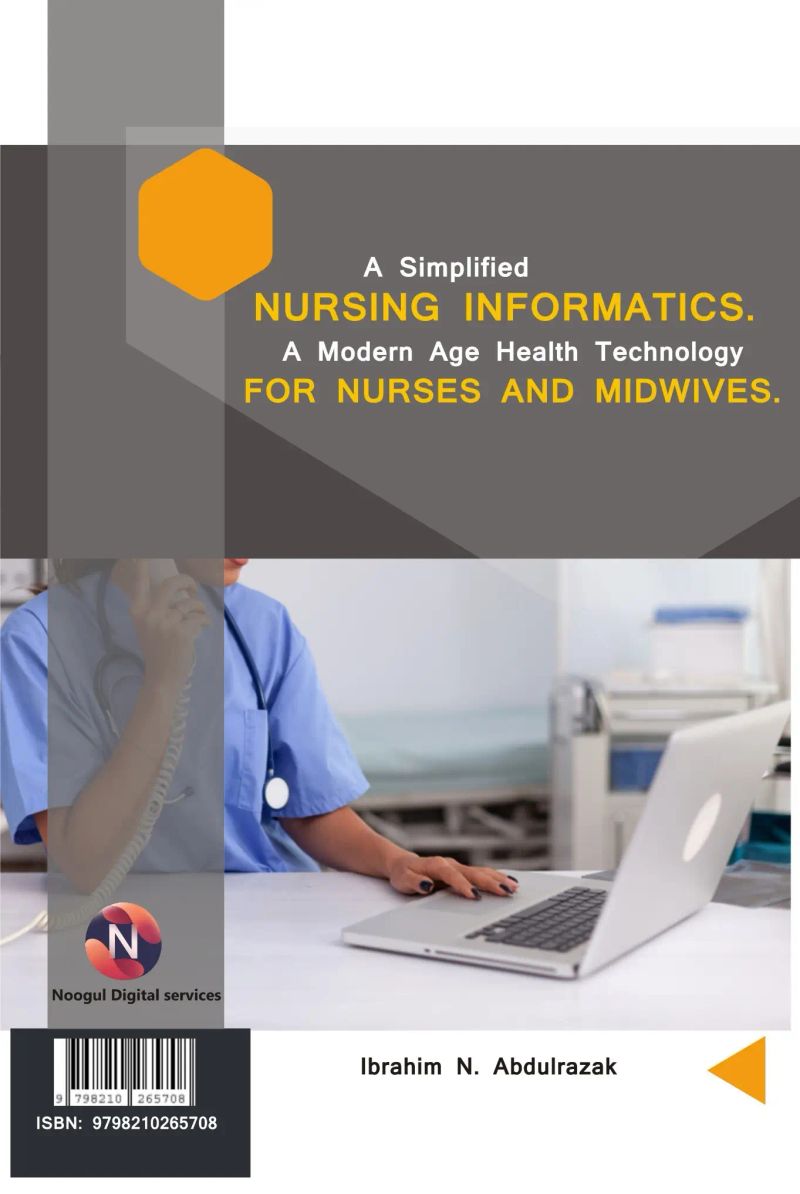
A simplified Nursing Informatics. A Modern Age Health Technology for Nurses and Midwives
By Ibrahim Nugwa Abdulrazak


Length1h 59m
About this audiobook
Healthcare is changing fast and nurses and midwives are at the very heart of that transformation. A Simplified Nursing Informatics: A Modern Age Health Technology for Nurses and Midwives is a timely, practical, and reader-friendly guide designed to empower today’s nursing and midwifery professionals with the knowledge they need to thrive in a technology-driven healthcare environment.
Developed from revised lecture notes, this book bridges the gap between theory and real-world practice. It simplifies complex informatics concepts, making them easy to understand and immediately applicable regardless of prior technical background.
Written with clarity and purpose, the book provides nurses and midwives with a solid foundation in nursing informatics and health information technology, demonstrating how digital tools can enhance clinical decision-making, improve patient safety, and elevate the overall quality of care.
More than just a textbook, this work is a career-shaping resource. By embracing informatics as an essential component of modern healthcare delivery, nurses, midwives, and other healthcare professionals can position themselves for improved patient outcomes, professional growth, and lifelong learning.
This book is an essential companion for students, educators, practicing nurses, midwives, and healthcare administrators who want to stay relevant, confident, and effective in the digital age of healthcare.
Audiobook details
GenreHealth and Wellness
Length1 hr 59 mins
Narrated byListen with 1,000+ voices
FormateBook with Audio
Publish dateApr 24, 2026
LanguageEnglish
Table of contents
1Introduction
21.2 Information Science
3CONCEPTS, THEORETICAL MODELS AND FRAMEWORKS IN NURSING INFORMATICS
42.1 Theoretical model
5The Novice “to Expert Theory,
Show all chaptersShow less
64.3 Categories of Competencies
7Basic computer skills, information literacy, and information management are some of the competencies involved in nursing informatics. Nursing informatics helps nurses interact with other clinical disciplines, coordinate patient care, and manage patient care and nursing process information (HIMSS, 2012).
84.4 Competencies of Nursing Informatics
9The Technology Informatics Guiding Education Reform (TIGER) Initiative was founded in 2004 to work with nursing stakeholders to develop a vision, plan of action, and strategies for using health information technology to improve nursing education, practice, and patient care. The Informatics Competency Collaborative was founded by TIGER to describe the competencies that are suggested for the NI discipline (TIGER, 2010).
104.5 Competency: Basic Computer Skills
11Specific competencies for basic computer skills identified by TIGER include:
12- Information and communication technology concepts
13- Computer use and managing files
14- Word processing
15- Spreadsheets
16- Database use
17- Presentation
18- Communication and web browsing
194.6 Competency: Information Literacy
20TIGER found the following information literacy competencies:
21- Determine the nature and scope of the information required
22- Obtain information quickly and efficiently
23- Critically evaluate information and sources, and incorporate relevant information into one's knowledge base and value system
24- As an individual or as part of a team, efficiently use knowledge to achieve a certain goal.
25- Assess the results of information use
264.7 Competency: Information Management
27The competencies recognized for the category of information management.
28- Verbalize the role of health information systems in clinical practice,
29- Understand the different types of health information systems and how they are used in clinical and administrative settings.
30- Maintain the privacy of secured patient health information.
31- Ensure that access to health information systems is controlled.
32- Ensure that health information systems are secure.
33- Possess user abilities, such as navigation, decision support, and report output.
34- Recognize the principles on which healthcare professionals and consumers use health information systems.
354.8 Responsibilities within Nursing Informatics
36Nurse informatics has a variety of tasks and duties in healthcare, each of which adds value to patient care. Nursing informatics has been identified as having the following roles (HIMSS, 2012):
37- Examine both clinical and financial data
38- Approve and make resource and reference access easier
39- Provide nursing information in standardized languages
40- Enhance ties between doctors and patients
41- Improve continuity of care
42- Encourage cost-cutting and productivity targets
43- Using technology, maintain nursing work procedures
44- Assist with change management by redesigning clinical process
45- Encourage the delivery of high-quality, evidence-based care
46- Make true multidisciplinary care more accessible
47List of Computer Hardware
485.5 Relevance of Informatics to nursing
49An INS's specific skill set is crucial when it comes to dealing with an institution's technology. The INS gives a nursing perspective to the adoption and integration of clinical applications into nursing workflow and patient care by applying nursing clinical knowledge and understanding of computer and information sciences. The INS can communicate to the technical team about the continuous needs of nurses who use the EMR system because of his or her insight into clinical demands and thorough grasp of the EMR technology. In problems regarding the EMR and other applications of technology to nursing care, the INS serves as an advocate and voice for nurses.
50When a documentation issue or requirement develops, the INS can engage with systems analysts and information services to undertake a needs assessment using its experience and abilities in working with information systems. The INS then matches the nursing process to the right tool or system, or assists in the development of a tool to suit the nursing demand, such as a tool to improve patient handoff during shift changes.
More from Ibrahim Nugwa Abdulrazak
Educating Exceptional Needs Youngsters. A Resource For Educators, Parents, And Healthcare Practitioners: Counseling RamificationsIbrahim Nugwa Abdulrazak5h 50m$17 · $0.00

Abuse and Misuse of Psychedelic Substances: Its Implications on Health and Wellness.Ibrahim Nugwa Abdulrazak1h 17m$12 · $0.00
JavaScript. A Comprehensive manual for creating dynamic, responsive websites and applicationsIbrahim Nugwa Abdulrazak8h 38m$17 · $0.00

Cannabinoid Abuse And Misuse: Its Connected Impact On Health And Well-BeingIbrahim Nugwa Abdulrazak1h 27m$17 · $0.00
Drug Abuse and Misuse of StimulantsIbrahim Nugwa Abdulrazak1h 25m$12 · $0.00

Opioid Use Disorders: Therapeutic Manuals for Healing and RecuperationIbrahim Nugwa Abdulrazak1h 46m$13 · $0.00
Substance Abuse and Substance Use Disorders.Ibrahim Nugwa Abdulrazak8h 41m$27 · $0.00
Comprehensive Hypertext Markup Language (HTML). A Tutorial Guide to Editing and Developing a Responsive and Dynamic Website for Beginners.Ibrahim Nugwa Abdulrazak4h 43m$18 · $0.00

The Yoga Sutras of PatanjaliPatanjali4h 8m4.5 (18.5K)$6 · $0.00

The Lost VoiceGreta Morgan8h 30m4.7 (285)$26 · $0.00

Healthy Kids, Happy KidsElisa Song14h 18m4.6 (760)$33 · $0.00

Eat It!Jordan Syatt, Michael Vacanti4h 40m4.6 (1.5K)$20 · $0.00

Consent Laid BareChanel Contos7h 11m4.5 (1.7K)$24 · $0.00
How to Make Disease DisappearRangan Chatterjee5h 26m4.5 (3.5K)$24 · $0.00

The Complete Herbal (Annotated)Nicholas Culpeper29h 8m4.5 (1.4K)$2 · $0.00

A Plague Upon Our HouseScott W. Atlas MD10h 37m4.5 (3.4K)$20 · $0.00

The Cancer CodeDr. Jason Fung10h 48m4.5 (5.3K)$29 · $0.00

The Gift of TherapyIrvin Yalom7h 39m4.5 (38.8K)$26 · $0.00

EarlySarah DiGregorio9h 47m4.5 (1.3K)$29 · $0.00

Bottle of LiesKatherine Eban14h 25m4.4 (12K)$33 · $0.00
The 36-Hour DayNancy L. Mace, Peter V. Rabins17h 13m4.4 (9.2K)$28 · $0.00

FlooredSara Reardon10h 36m4.5 (1K)$29 · $0.00
Radical RemissionKelly A. Turner9h 26m4.4 (8.1K)$29 · $0.00
The Sinatra SolutionStephen T. Sinatra MD9h4.5 (899)$20 · $0.00

The Songaminute ManSimon McDermott6h 12m4.5 (280)$24 · $0.00

Sometimes BrilliantLarry Brilliant12h 27m4.5 (954)$29 · $0.00

Live Your LifeAmanda Kloots, Anna Kloots10h 54m4.4 (13.7K)$29 · $0.00

All in Her HeadElizabeth Comen13h 25m4.4 (18.2K)$33 · $0.00
You may also like
Change by DesignTim Brown6h 48m4.0 (12.9K)$24 · $0.00

Fast This WayDave Asprey8h 3m4.1 (6K)$7 · $0.00

The Collected WorksNikola Tesla50h 9m4.3 (2.1K)$1 · $0.00

A Buddhist BibleDwight Goddard7h 53m4.2 (1.3K)$1.20 · $0.00
The Hormone Balance BibleShawn Tassone15h 38m4.0 (646)$33 · $0.00

Letters That Have Helped MeWilliam Quan Judge6h 15m4.4 (563)$1.20 · $0.00

The Essential DruckerPeter F. Drucker10h 57m4.3 (11K)$29 · $0.00

The Wellness ProjectPhoebe Lapine7h 34m3.9 (2.4K)$20 · $0.00

Hustle from HomeLaura Stack CSP, MBA, Chris Widener, Sharon Lechter, Krish Dhanam, various authors15h 18m$30

Love RulesJoanna Coles6h 28m3.6 (487)$24 · $0.00
No One Has To Know - Smart Anti-Ageing for Indian SkinDr. Jamuna Pai6h 3m4.1 (121)$8
The Neuroscience of MindfulnessStan Rodski5h 28m3.7 (522)$24 · $0.00

Ego: The Inner Compass of Conscious Leadership (How Transactional Analysis Helps You Understand Yourself)Daniel Sexton1h 2m$3.50 · $0.00
Alchemy Of ConsciousnessOran Vestra / Luiz Santos5h 25m$7 · $0.00

Heavily MeditatedDave Asprey9h 58m3.9 (248)$29 · $0.00
The Future YouBrian David Johnson6h 38m3.9 (139)$24 · $0.00
Dopamine Fasting: A Journey to Reclaiming Your Focus and Well-BeingMei Lin Zhang6h 9m$3.50 · $0.00
Forget That!Roger Flax PhD6h 44m$23

A New Era of ThoughtCharles Howard Hinton7h 56m3.9 (42)$1 · $0.00

Your Best ShotAshley Koff, RD9h 8m4.1 (32)$29 · $0.00