
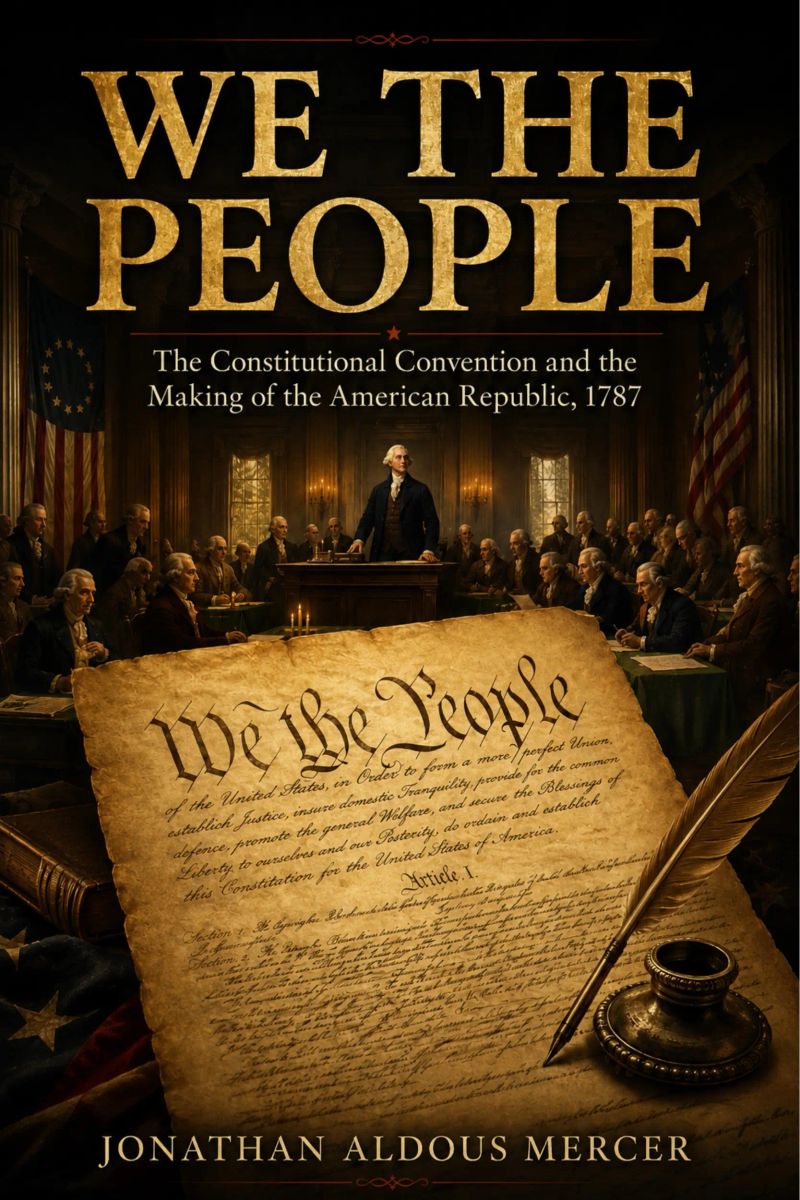
WE THE PEOPLE
The Constitutional Convention and the Making of the American Republic, 1787By Jonathan Aldous Mercer


Length5h 53m
About this audiobook
The complete narrative history of the Constitutional Convention — Madison, Hamilton, Washington, the Federalist Papers, and the founding of the American republic in Philadelphia, 1787.
On June 15, 1787, William Paterson rose to present the small states' counter-proposal. The Convention was in deadlock. Several delegates had threatened to leave. Benjamin Franklin proposed sessions begin with prayer — the delegates declined, noting they had no chaplain and no funds to hire one. What saved the Convention was Roger Sherman of Connecticut: a self-educated shoemaker-turned-lawyer who proposed the bicameral solution giving large states proportional representation in the House and equal-state votes in the Senate, breaking the impasse that had threatened to end the republic before it began.
Historian Jonathan Aldous Mercer traces the full arc of the Constitutional Convention across 24 chapters: Shays' Rebellion and the crisis that forced the call to Philadelphia; Madison's Virginia Plan, drafted after he read every treatise on confederations from the Achaean League to the Dutch Republic; the Great Compromise; the Three-Fifths Compromise that embedded slavery into the republic's foundation; the ratification battles in Virginia and New York; and the Federalist Papers that James Madison and Alexander Hamilton produced to win public opinion.
Inside this Constitutional Convention history:
• Shays' Rebellion — Massachusetts veterans who had fought at Valley Forge tried to seize the Springfield arsenal in January 1787, shocking reluctant states into sending serious delegations (Chapters 2-3)
• Madison's Virginia Plan — a blueprint for a genuinely national government that Madison arrived with eleven days early, framing the entire summer's debate (Chapter 5)
• The Great Compromise — Roger Sherman's bicameral solution to the large-state/small-state deadlock that had delegates threatening to walk out (Chapter 7)
• Slavery and the Three-Fifths Compromise — how southern delegates shaped the Constitution's structure to protect slavery, the founding moral failure (Chapter 8)
• The Federalist Papers and ratification — Madison and Hamilton's 85-essay argument for the Constitution, and the close battles in Virginia and New York (Chapters 13-15)
The founding of the American republic was a political invention without precedent — fifty-five men designing institutions for a future they couldn't foresee, in a Philadelphia July, with Washington's silent authority holding the room. Mercer's narrative American history traces the genius and the moral compromise of the framers, and the 240-year experiment their arguments produced.
For readers of David McCullough's 1776 and Ron Chernow's ALEXANDER HAMILTON.
Audiobook details
GenreHistory, Politics and Government
Length5 hrs 53 mins
Narrated byListen with 1,000+ voices
FormateBook with Audio
Publish dateJun 1, 2026
LanguageEnglish
Table of contents
1Introduction
2Prologue: The Crisis of the Confederation
3PART ONE: THE CRISIS OF THE CONFEDERATION (1781-1787)
4Chapter 1: The Articles of Confederation — What the First Government Lacked
5Chapter 2: Shays' Rebellion — Debt, Democracy, and the Alarm That Called the Convention
Mostrar todos os capítulosVer menos
6Chapter 3: The Call to Philadelphia — Madison's Vision and Washington's Reluctant Return
7Chapter 4: The Delegates — Who Came to Philadelphia and What They Brought
8PART TWO: THE GREAT DEBATES (MAY-SEPTEMBER 1787)
9Chapter 5: The Virginia Plan — Madison's Blueprint for a Strong National Government
10Chapter 6: The New Jersey Plan — Small States, Large States, and the Fundamental Conflict
11Chapter 7: The Great Compromise — Bicameralism and the Connecticut Solution
12Chapter 8: Slavery and the Constitution — The Three-Fifths Compromise and the Slave Trade
13PART THREE: THE STRUCTURE OF GOVERNMENT
14Chapter 9: The Presidency — Designing the Executive Power
15Chapter 10: The Congress — Powers, Limits, and the Legislative Design
16Chapter 11: The Federal Judiciary — The Supreme Court and the Judicial Article
17Chapter 12: Federalism — State and National Power and the Balance Between Them
18PART FOUR: RATIFICATION AND ITS BATTLES
19Chapter 13: The Federalist Papers — Madison, Hamilton, Jay, and the Case for Ratification
20Chapter 14: The Anti-Federalists — The Opposition and Their Arguments
21Chapter 15: The Key State Battles — Virginia, New York, and the Close Calls
22Chapter 16: The Bill of Rights — The First Ten Amendments and the Promise That Clinched Ratification
23PART FIVE: THE FRAMERS
24Chapter 17: James Madison — The Father of the Constitution
25Chapter 18: Alexander Hamilton — Nationalist, Financier, and Constitutional Visionary
26Chapter 19: George Washington — The Presiding Presence and the Indispensable Man
27Chapter 20: Benjamin Franklin — Wisdom, Compromise, and the Oldest Framer
28PART SIX: LEGACIES
29Chapter 21: The Amendment Process — How the Constitution Changes
30Chapter 22: Judicial Review — Marbury v. Madison and the Constitution's Living Interpretation
31Chapter 23: The Constitution in Crisis — Civil War, the New Deal, and Constitutional Stress
32Chapter 24: The World's Oldest Written Constitution — America's Founding Document at 240 Years
33Epilogue: The Living Constitution
34Acknowledgments
35Selected Bibliography
36About the Author
More from Jonathan Aldous Mercer


A Brief History of IntelligenceMax S. Bennett12h 18m4.6 (6.6K)$29 · $0.00

The Daughter of AuschwitzTova Friedman, Malcolm Brabant7h 54m4.6 (16.7K)$26 · $0.00

Lily's PromiseLily Ebert, Dov Forman8h 54m4.6 (16.1K)$29 · $0.00

On Democracies and Death CultsDouglas Murray10h 38m4.6 (6.5K)$29 · $0.00

Across the RiverKent Babb11h 40m4.6 (927)$29 · $0.00

Balcony Over Jerusalem: A Middle East Memoir - Israel, Palestine and BeyondJohn Lyons12h 37m4.6 (1.4K)$33 · $0.00

BeyondStephen Walker15h 39m4.6 (3.2K)$33 · $0.00

Kings and PawnsHoward Bryant10h 9m4.6 (678)$29 · $0.00

No EscapeNury Turkel9h 30m4.6 (809)$28 · $0.00

Jubal Stone: U.S. Marshal: Blood Trail To Hell: A Western Adventure NovelCasey Nash3h 42m4.6 (3.2K)$18 · $0.00

Fall and RiseMitchell Zuckoff17h 23m4.6 (9.8K)$40 · $0.00

The SurvivorJosef Lewkowicz, Michael Calvin9h 22m4.6 (2.5K)$29 · $0.00

Always FaithfulThomas Schueman, Zainullah Zaki12h 12m4.6 (977)$29 · $0.00

The State of Society in France Before the Revolution of 1789 (Annotated)Alexis de Tocqueville17h 25m4.6 (1.2K)$2 · $0.00

All the Gallant MenDonald Stratton, Ken Gire5h 55m4.6 (11.8K)$24 · $0.00
Saint Joan (Annotated)George Bernard Shaw6h 20m4.6 (1.2K)$1.20 · $0.00
Medgar and MyrlieJoy-Ann Reid10h 52m4.5 (27.8K)$29 · $0.00

The History of the Peloponnesian War (Annotated)Thucydides24h 3m4.6 (1.1K)$2 · $0.00

Where the Birds Never SingJack Sacco10h 31m4.6 (3.8K)$29 · $0.00

Serviceman J: The Untold Story of an NZSAS SoldierJamie Pennell5h 51m4.6 (452)$24 · $0.00
Balcony Over Jerusalem: A Middle East Memoir - Israel, Palestine and BeyondJohn Lyons12h 37m4.6 (1.4K)$33 · $0.00

RiggedMollie Hemingway12h 48m4.6 (4.2K)$23 · $0.00

SledgehammerDavid Friedman8h 21m4.7 (589)$26 · $0.00
Citizenship in a Republic (Annotated)Theodore Roosevelt2h 44m4.6 (1.4K)$2 · $0.00
No EscapeNury Turkel9h 30m4.6 (809)$28 · $0.00
Always FaithfulThomas Schueman, Zainullah Zaki12h 12m4.6 (977)$29 · $0.00

UnthinkableJamie Raskin15h 8m4.5 (9.3K)$8 · $0.00

My Fourth Time, We DrownedSally Hayden13h 59m4.6 (2.9K)$23 · $0.00

A Revolution of Common SenseScott Jennings9h 29m4.6 (528)$29 · $0.00

Statement From the Dock at the Rivonia TrialNelson Mandela2h 18m4.6 (1.3K)$1 · $0.00

Lessons from the EdgeMarie Yovanovitch17h 11m4.5 (5.9K)$40 · $0.00

To Rescue the American SpiritBret Baier10h 12m4.5 (2.7K)$8 · $0.00

StonewalledSharyl Attkisson15h 19m4.5 (4.3K)$33 · $0.00
The World According to Orwell: 1984 & Animal FarmGeorge Orwell15h 42m4.6 (1.1K)$1 · $0.00
Basic EconomicsThomas Sowell18h 32m4.5 (29.3K)$28 · $0.00

To Rescue the RepublicBret Baier, Catherine Whitney11h 42m4.5 (8.6K)$29 · $0.00

Modern WarriorsPete Hegseth7h 10m4.5 (4.7K)$24 · $0.00
Philosophy and Opinions of Marcus Garvey (Annotated)Marcus Mosiah Garvey4h 42m4.5 (1.7K)$1.99 · $0.00

A Plague Upon Our HouseScott W. Atlas MD10h 37m4.5 (3.4K)$20 · $0.00

One Bright MoonAndrew Kwong12h 21m4.5 (813)$29 · $0.00
You may also like

Rebel in the RanksBrad S. Gregory9h 46m4.1 (502)$29 · $0.00

Rock Me on the WaterRonald Brownstein16h 15m4.0 (2.4K)$33 · $0.00

AnarchyErrico Malatesta2h 11m4.2 (2.2K)$1.99 · $0.00

AnarchyErrico Malatesta2h 31m4.1 (2K)$2 · $0.00

Look Away!William C. Davis23h 39m4.0 (662)$30

AnarchyErrico Malatesta2h4.2 (2.3K)$2 · $0.00
On The Duty of Civil DisobedienceDavid Thoreau1h 6m4.0 (115K)$1 · $0.00

Now & AfterAlexander Berkman11h 28m3.9 (1.7K)$2 · $0.00

The French Revolution and NapoleonJean-Jacques Rousseau, Alexis de Tocqueville, Montesquieu, Charles Downer Hazen62h 54m4.1 (574)$2 · $0.00
The Communist ManifestoKarl Marx, Friedrich Engels2h 13m3.9 (252.7K)$2 · $0.00

HISTORY OF WOMEN'S SUFFRAGE Trilogy – Part 2 (Annotated)Susan B. Anthony, Ida H. Harper129h 53m$1.99 · $0.00

The Rise of the Dutch Kingdom, 1795-1813Hendrik Willem Van Loon6h 29m$2 · $0.00
Freedom! Equality!! Justice!!! These Three; but the Greatest of These Is JusticeVictoria C. Woodhull2h 18m$2 · $0.00

The reformation in Poland : Some social and economic aspectsPaul Fox6h 34m$2 · $0.00

Ireland Since ParnellD. D. Sheehan9h 21m$2 · $0.00
Pictures of Southern Life, Social, Political, and MilitaryWilliam Howard Sir Russell8h 7m$1 · $0.00

Deportation Its Meaning and Menace: Last Message to the People of AmericaEmma Goldman, Alexander Berkman2h 10m4.0 (28)$1 · $0.00

Who fears to speak of '98Anonymous54m$1 · $0.00
The Early History of the Scottish Union QuestionGeorge W. T. Omond2h 55m$2 · $0.00

The Place of Anarchism in Socialistic Evolutionkniaz Petr Alekseevich Kropotkin1h 20m3.7 (82)$1 · $0.00