
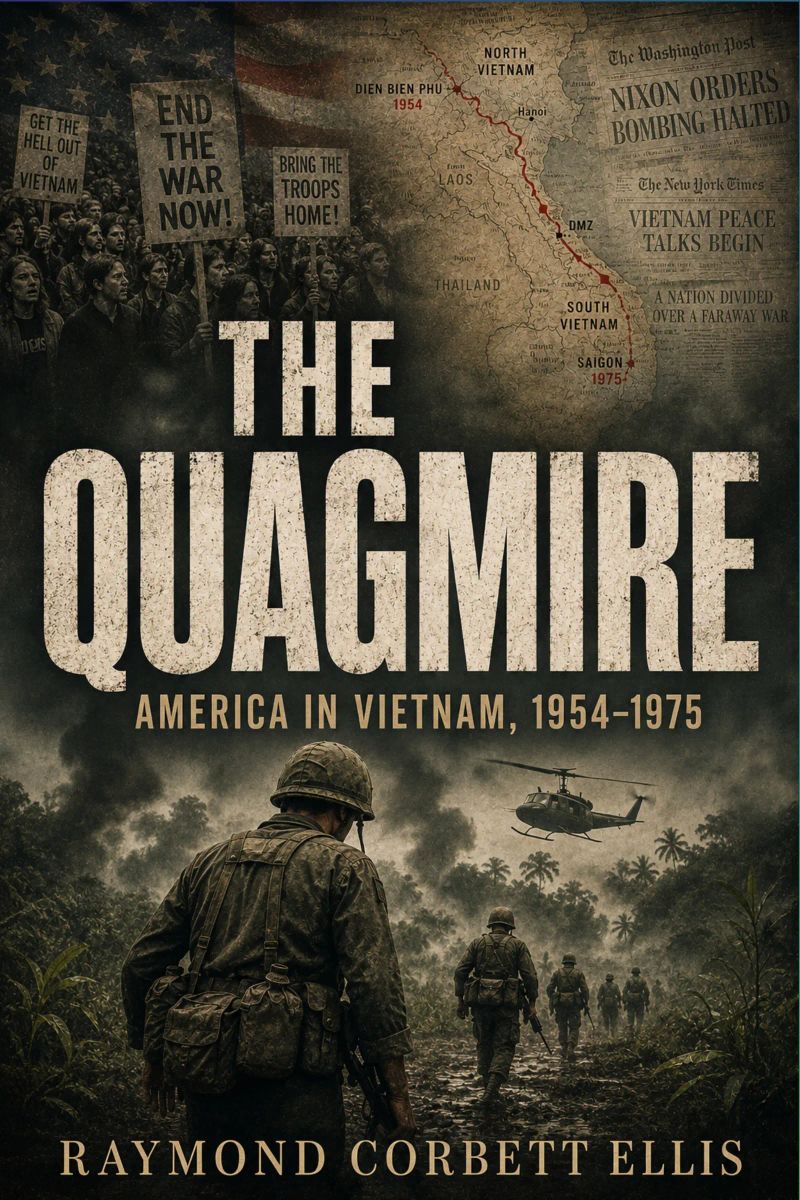
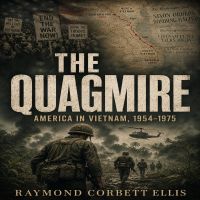
THE QUAGMIRE
America in Vietnam, 1954–1975By Raymond Corbett Ellis


Length5h 56m
About this audiobook
The complete narrative history of the Vietnam War — Ho Chi Minh, the Tet Offensive, the draft, My Lai, the fall of Saigon, and America's longest war, 1954-1975.
On the morning of March 16, 1968, soldiers of Charlie Company entered a Vietnamese hamlet called My Lai 4 with orders to engage a Viet Cong stronghold. They found unarmed civilians—elderly men, women, children. By midday they had killed up to 504 of them. One officer, Warrant Officer Hugh Thompson Jr., landed his helicopter between American soldiers and fleeing villagers and threatened to fire on the Americans if they did not stop. The massacre was covered up for more than a year. When journalist Seymour Hersh revealed it in November 1969, the image of what the war required permanently changed.
Raymond Corbett Ellis traces the full arc of the Vietnam War across twenty-four chapters—from Ho Chi Minh's 1919 petition to Woodrow Wilson at the Paris Peace Conference (ignored) through the last helicopter leaving a Saigon rooftop on April 29, 1975. This is the story of how a Vietnamese revolutionary nationalist movement that American policymakers consistently misread as a Soviet instrument outlasted the most powerful military force in human history, at a cost of 58,220 American names on a black wall and between one and three million Vietnamese dead.
Inside this Vietnam War history:
• Ho Chi Minh and the roots of resistance — a man who quoted the Declaration of Independence in Hanoi's Ba Dinh Square in 1945 while American OSS officers worked alongside his forces, and why the relationship that might have been never was (Chapter 1)
• The Gulf of Tonkin deception — the incident, the resolution, and how a disputed event became the blank check for escalation (Chapter 5)
• The draft's class inequity — the Selective Service system conscripted more than 2.2 million men while college deferments, National Guard slots, and political connections shielded others; Black soldiers accounted for more than 20 percent of combat deaths in 1965-66 while representing 11 percent of the population (Chapter 13)
• Tet and the credibility gap — a military operation the North Vietnamese considered a failure became the political turning point that destroyed Lyndon Johnson's presidency (Chapter 8)
• The ground war's human cost — triple-canopy jungle, booby traps, the rotation system that disrupted unit cohesion, heroin used by an estimated 30 percent of American soldiers by 1971, and the fragging of officers (Chapter 14)
• The lessons not learned — how the institutional culture of optimistic reporting, body-count metrics, and political deception that produced Vietnam reappeared in Iraq and Afghanistan (Chapter 24)
The Vietnam War was America's longest war and its most consequential defeat — not because the military failed to fight, but because the political and strategic framework was wrong from the beginning. Ellis delivers the full Vietnam War history: the decision-makers who escalated, the soldiers who fought, the Vietnamese who endured, and the country that has still not finished reckoning with what it did.
For readers of Neil Sheehan's A BRIGHT SHINING LIE and David Halberstam's THE BEST AND THE BRIGHTEST.
Audiobook details
GenreHistory
Length5 hrs 56 mins
Narrated byListen with 1,000+ voices
FormateBook with Audio
Publish dateJun 1, 2026
LanguageEnglish
Table of contents
1Introduction
2Prologue: A Land Called Vietnam
3PART ONE: THE ROOTS OF AMERICAN INVOLVEMENT (1945–1964)
4Chapter 1: Ho Chi Minh and the Viet Minh — Vietnam Before America
5Chapter 2: The French War — Dien Bien Phu and the Geneva Accords
Mostrar todos os capítulosVer menos
6Chapter 3: Eisenhower's Vietnam — The Domino Theory and Diem
7Chapter 4: Kennedy's Commitment — Special Forces and the Deepening War
8PART TWO: ESCALATION (1964–1968)
9Chapter 5: The Gulf of Tonkin — The Incident and the Resolution
10Chapter 6: Johnson's War — The Ground Troop Decision
11Chapter 7: Search and Destroy — Westmoreland's Attrition Strategy
12Chapter 8: The Tet Offensive — Military Victory, Political Defeat
13PART THREE: THE HOME FRONT AND THE WAR'S POLITICS (1965–1972)
14Chapter 9: The Anti-War Movement — From Campus to the Streets
15Chapter 10: The Media War — Television and the Credibility Gap
16Chapter 11: 1968 — The Year America Broke
17Chapter 12: Nixon's War — Vietnamization and the Secret Bombing
18PART FOUR: THE SOLDIERS' WAR (1965–1972)
19Chapter 13: The Draft — Who Served and Who Didn't
20Chapter 14: The Ground War — Combat, Attrition, and Morale
21Chapter 15: My Lai — Atrocity, Cover-Up, and Moral Reckoning
22Chapter 16: The Soldiers Come Home — Veterans, PTSD, and a Divided Society
23PART FIVE: THE END OF THE WAR (1969–1975)
24Chapter 17: Cambodia and Kent State — The War's Widening
25Chapter 18: The Paris Peace Accords — Kissinger, Le Duc Tho, and the Deal
26Chapter 19: The Fall of Saigon — April 30, 1975
27Chapter 20: The Vietnamese Experience — The War from the Other Side
28PART SIX: LEGACIES
29Chapter 21: The Vietnam Syndrome — America's Military Caution After the War
30Chapter 22: The Wall — Memory, Healing, and the Vietnam Veterans Memorial
31Chapter 23: Agent Orange, PTSD, and the Veterans' Long Crisis
32Chapter 24: Vietnam's Lessons — What America Learned and What It Didn't
33Epilogue: The Last Helicopter
34Acknowledgments
35Selected Bibliography
36About the Author
More from Raymond Corbett Ellis

A Brief History of IntelligenceMax S. Bennett12h 18m4.6 (6.6K)$29 · $0.00

The Daughter of AuschwitzTova Friedman, Malcolm Brabant7h 54m4.6 (16.7K)$26 · $0.00

Lily's PromiseLily Ebert, Dov Forman8h 54m4.6 (16.1K)$29 · $0.00

On Democracies and Death CultsDouglas Murray10h 38m4.6 (6.5K)$29 · $0.00

Across the RiverKent Babb11h 40m4.6 (927)$29 · $0.00

Balcony Over Jerusalem: A Middle East Memoir - Israel, Palestine and BeyondJohn Lyons12h 37m4.6 (1.4K)$33 · $0.00

BeyondStephen Walker15h 39m4.6 (3.2K)$33 · $0.00
Kings and PawnsHoward Bryant10h 9m4.6 (678)$29 · $0.00

No EscapeNury Turkel9h 30m4.6 (809)$28 · $0.00

Jubal Stone: U.S. Marshal: Blood Trail To Hell: A Western Adventure NovelCasey Nash3h 42m4.6 (3.2K)$18 · $0.00

Fall and RiseMitchell Zuckoff17h 23m4.6 (9.8K)$40 · $0.00
The SurvivorJosef Lewkowicz, Michael Calvin9h 22m4.6 (2.5K)$29 · $0.00

Always FaithfulThomas Schueman, Zainullah Zaki12h 12m4.6 (977)$29 · $0.00

The State of Society in France Before the Revolution of 1789 (Annotated)Alexis de Tocqueville17h 25m4.6 (1.2K)$2 · $0.00

All the Gallant MenDonald Stratton, Ken Gire5h 55m4.6 (11.8K)$24 · $0.00
Saint Joan (Annotated)George Bernard Shaw6h 20m4.6 (1.2K)$1.20 · $0.00

Medgar and MyrlieJoy-Ann Reid10h 52m4.5 (27.8K)$29 · $0.00

The History of the Peloponnesian War (Annotated)Thucydides24h 3m4.6 (1.1K)$2 · $0.00

Where the Birds Never SingJack Sacco10h 31m4.6 (3.8K)$29 · $0.00

Serviceman J: The Untold Story of an NZSAS SoldierJamie Pennell5h 51m4.6 (452)$24 · $0.00
You may also like

Homage to CataloniaGeorge Orwell8h 40m4.2 (105.1K)$1.20 · $0.00

The Jewish WarsFlavius Josephus28h 18m4.2 (7K)$2 · $0.00

The Wars of the Jews; Or, The History of the Destruction of JerusalemFlavius Josephus25h 58m4.2 (6K)$2 · $0.00

Six Days of WarMichael B. Oren17h 54m4.4 (15.5K)$32

Enduring VietnamJames Wright15h 33m4.3 (290)$23

Balcony Over Jerusalem: A Middle East Memoir - Israel, Palestine and BeyondJohn Lyons12h 37m4.6 (1.4K)$33 · $0.00

Homage to CataloniaEric Arthur Blair9h 49m4.2 (99.5K)$1 · $0.00

A Diary From Dixie (Civil War Memoir)Mary Boykin Chesnut15h 50m4.0 (1.9K)$1.99 · $0.00

The History of the Peloponnesian WarThucydides21h 50m4.2 (52.7K)Free

The Damned of PetersburgRalph Peters13h 43m4.3 (553)$23

Idiot AmericaCharles P. Pierce9h 46m3.9 (5.2K)$20

History of the American Civil War (Annotated)James Ford Rhodes16h4.1 (875)$2 · $0.00

O Jerusalem!Larry Collins, Dominique Lapierre23h 42m4.4 (7.7K)$30

UnbelievableKaty Tur7h 45m4.0 (17.8K)$26 · $0.00

The Invasion of Europe by the Barbarians (Annotated)J. B. Bury8h 41m4.0 (697)$2 · $0.00

Warriors: A Starless Clan #6: StarErin Hunter8h 53m4.4 (1.5K)$29 · $0.00

The Civil War: A Narrative, Vol. 2Shelby Foote52h 41m4.6 (11.7K)$30

140 Days to HiroshimaDavid Dean Barrett13h 8m4.5 (548)$23
THE QUAGMIRERaymond Corbett Ellis5h 34m$10 · $0.00
The Night of the JaguarMichael McDowell, John Preston4h 48m$20