
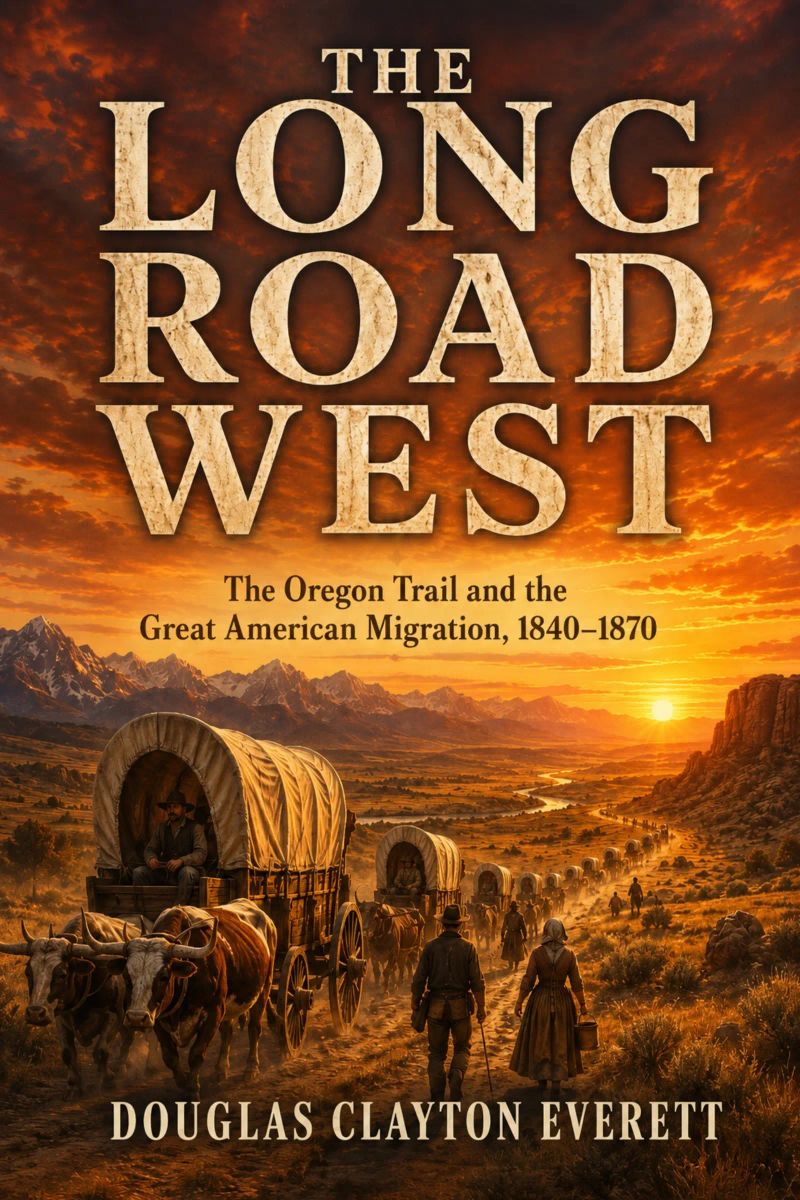
The Long Road West
The Oregon Trail and the Great American Migration, 1840-1870By Douglas Clayton Everett


Length5h 33m
About this audiobook
Oregon Trail history, westward expansion, overland migration — 300,000 emigrants, the Donner Party, Mormon handcart tragedies, and the Native peoples displaced by two thousand miles of ruts, 1840-1870.
In the spring of 1843, approximately a thousand people gathered at the jumping-off towns — Independence, St. Joseph, Council Bluffs — and set out into an emptiness of two thousand miles. They were called the Great Migration, and they proved a wagon journey to Oregon was possible. Within a decade, 300,000 to 400,000 people had followed, leaving furniture and books behind at the Missouri River, watching cholera sweep through Platte River camps, and arriving — those who survived — in a Willamette Valley that promoter Hall Jackson Kelley had declared paradise without ever setting foot there.
This is the complete narrative history of the overland trail era. Historian Douglas Clayton Everett traces the full arc across six parts and twenty-four chapters: the Oregon fever spreading through Illinois farm communities, the trail from Fort Laramie to South Pass, women's diaries recording reluctant migrations they had not been asked to make, and the Pawnee, Sioux, and Cayuse whose world the ruts were erasing. The Fort Laramie Treaty promised protection; the transcontinental railroad made the trail obsolete — what came between was the largest peacetime migration in American history.
Inside this westward expansion history:
• Oregon fever and the 1843 Great Migration — Kelley's pamphlets, the thousand-person departure that proved the journey possible, and the community networks that transformed individual decisions into continental movement (Chapters 1-4)
• The Whitman mission and massacre — Narcissa and Marcus Whitman at Waiilatpu, the November 1847 killings that ended the mission era, and how Cayuse accountability customs collided with a measles epidemic (Chapter 2)
• Life on the trail — cholera on the Platte, women's diary accounts of grief at leaving parents forever, the specific equipment of the wagon, and the death toll that hundreds of diaries recorded (Chapters 9-12)
• The Donner Party — Hastings's misleading guidebook, James Clyman's ignored warning, three weeks hacking the Wasatch, the Forlorn Hope snowshoe party, and forty-eight survivors from eighty-seven (Chapter 19)
• The Mormon exodus — Brigham Young's 1847 pioneer company and the Willie and Martin handcart companies of 1856, whose 25-percent death rate was the worst single loss in trail history (Chapter 18)
• Native nations and the ecological reckoning — the Fort Laramie Treaty's broken promises, the trail's impact on the buffalo herds, and the Kalapuya dispossession behind every Willamette Valley farm (Chapters 13-16)
Everett's overland trail history does not end at the Willamette. It follows the California forty-niners, the Applegate Trail's southern Oregon branch, and the Oregon Treaty's 49th-parallel settlement — then reckons with what was destroyed to build what was built. This westward expansion narrative is the most complete account of the trail era in print.
For readers of Stephen Ambrose's UNDAUNTED COURAGE and David McCullough's THE PIONEERS.
Audiobook details
GenreHistory
Length5 hrs 33 mins
Narrated byListen with 1,000+ voices
FormateBook with Audio
Publish dateJun 2, 2026
LanguageEnglish
Table of contents
1Introduction
2Prologue: Jumping-Off Places
3PART ONE: THE PUSH AND THE PULL
4Chapter 1: Oregon Fever — What Drew Americans West in the 1840s
5Chapter 2: The Missionaries — Jason Lee, Marcus Whitman, and the First Emigrants
Mostrar todos os capítulosVer menos
6Chapter 3: The Jumping-Off Towns — Independence, St. Joseph, and Council Bluffs
7Chapter 4: Who Went — Farmers, Merchants, and the Composition of the Trail Companies
8PART TWO: THE TRAIL ITSELF
9Chapter 5: The First 500 Miles — The Platte River Road Across the Prairie
10Chapter 6: Fort Laramie — The Midpoint and the Military Presence
11Chapter 7: The Rockies — South Pass and the Continental Divide
12Chapter 8: The Final Push — The Snake River Plain and the Blue Mountains
13PART THREE: LIFE ON THE TRAIL
14Chapter 9: The Wagon — Equipment, Oxen, and the Technology of Migration
15Chapter 10: Provisioning — Food, Water, and the Logistics of Two Thousand Miles
16Chapter 11: Disease and Death — Cholera, Accidents, and the Trail's Toll
17Chapter 12: Women on the Trail — Diaries, Duties, and the Female Experience of Migration
18PART FOUR: THE NATIVE PEOPLES OF THE TRAIL
19Chapter 13: The Pawnee, Sioux, and Shoshone — Tribes Along the Route
20Chapter 14: Trade, Conflict, and Diplomacy — Emigrant and Native Interaction
21Chapter 15: The Fort Laramie Treaty — Promises Made and Broken
22Chapter 16: The Trail's Impact on the Buffalo and the Plains Ecology
23PART FIVE: THE VARIANTS AND DISASTERS
24Chapter 17: The California Trail — The Gold Rush Detour
25Chapter 18: The Mormon Trail — Brigham Young and the Latter-Day Saint Migration
26Chapter 19: The Donner Party — The Most Famous Disaster in Trail History
27Chapter 20: The Applegate Trail and the Southern Routes
28PART SIX: LEGACIES
29Chapter 21: Oregon Achieved — American Settlement and the 54-40 or Fight Dispute
30Chapter 22: The Trail's End — The Transcontinental Railroad and the Trail's Decline
31Chapter 23: The Oregon Country — Northwest States and the Trail's Political Legacy
32Chapter 24: The Oregon Trail in Memory — National Historic Trail and American Myth
33Epilogue: The Trail's End
34Acknowledgments
35Selected Bibliography
36About the Author
More from Douglas Clayton Everett

A Brief History of IntelligenceMax S. Bennett12h 18m4.6 (6.6K)$29 · $0.00

The Daughter of AuschwitzTova Friedman, Malcolm Brabant7h 54m4.6 (16.7K)$26 · $0.00

Lily's PromiseLily Ebert, Dov Forman8h 54m4.6 (16.1K)$29 · $0.00

On Democracies and Death CultsDouglas Murray10h 38m4.6 (6.5K)$29 · $0.00

Across the RiverKent Babb11h 40m4.6 (927)$29 · $0.00

Balcony Over Jerusalem: A Middle East Memoir - Israel, Palestine and BeyondJohn Lyons12h 37m4.6 (1.4K)$33 · $0.00

BeyondStephen Walker15h 39m4.6 (3.2K)$33 · $0.00
Kings and PawnsHoward Bryant10h 9m4.6 (678)$29 · $0.00

No EscapeNury Turkel9h 30m4.6 (809)$28 · $0.00
Jubal Stone: U.S. Marshal: Blood Trail To Hell: A Western Adventure NovelCasey Nash3h 42m4.6 (3.2K)$18 · $0.00

Fall and RiseMitchell Zuckoff17h 23m4.6 (9.8K)$40 · $0.00
The SurvivorJosef Lewkowicz, Michael Calvin9h 22m4.6 (2.5K)$29 · $0.00

Always FaithfulThomas Schueman, Zainullah Zaki12h 12m4.6 (977)$29 · $0.00

The State of Society in France Before the Revolution of 1789 (Annotated)Alexis de Tocqueville17h 25m4.6 (1.2K)$2 · $0.00

All the Gallant MenDonald Stratton, Ken Gire5h 55m4.6 (11.8K)$24 · $0.00
Saint Joan (Annotated)George Bernard Shaw6h 20m4.6 (1.2K)$1.20 · $0.00

Medgar and MyrlieJoy-Ann Reid10h 52m4.5 (27.8K)$29 · $0.00

The History of the Peloponnesian War (Annotated)Thucydides24h 3m4.6 (1.1K)$2 · $0.00

Where the Birds Never SingJack Sacco10h 31m4.6 (3.8K)$29 · $0.00

Serviceman J: The Untold Story of an NZSAS SoldierJamie Pennell5h 51m4.6 (452)$24 · $0.00
You may also like
Life Among the IndiansGeorge Catlin10h 1m4.2 (331)$1 · $0.00

My Life as an Indian (Annotated)James Willard Schultz14h 19m4.4 (1.1K)$2 · $0.00

The Amur RiverColin Thubron10h 13m4.1 (1.8K)$29 · $0.00
The Happy Isles of OceaniaPaul Theroux24h 8m4.1 (8.6K)$53 · $0.00
Life Among the Indians (Annotated)George Catlin10h 6m4.2 (332)$2 · $0.00
The Pioneers, or, The Sources of the SusquehannaJames Fenimore Cooper18h 48m3.7 (4.4K)$2.40
The Last Fish TaleMark Kurlansky6h 20m4.0 (1.2K)$14
SacajaweaJoseph Bruchac6h 15m3.8 (1.4K)$20
Life among the ApachesJohn Carey Cremony10h 47m4.0 (843)$2 · $0.00
The Oregon TrailFrancis Parkman13h 41m3.8 (6K)$20 · $0.00

FreedomSebastian Junger3h 7m4.0 (7.9K)$24 · $0.00

FrostlinesNeil Shea6h 8m4.2 (544)$24 · $0.00

The Indian War of 1864 (Annotated)Eugene Fitch Ware16h 42m4.3 (647)$1.99 · $0.00

Odd People: Being a Popular Description of Singular Races of ManMayne Reid14h 11m3.5 (10)$2 · $0.00

WalesW. Watkins Davies4h 3m$2.30

The PondCarl Ewald2h 38m$2 · $0.00

The History of Cuba (Vol. 1-5) (Annotated)Willis Fletcher Johnson64h 7m4.1 (29)$2 · $0.00

Three Visitors to Early Plymouth (Annotated)John Pory, Emmanuel Altham, Isaack de Rasieres3h 14m3.9 (61)$2 · $0.00

American History to 1877Robert D. Geise MEd5h 37m3.7 (39)$14

Englisch lernen Audio - Den passenden Englischkurs findenSpotlight Verlag59m$13