
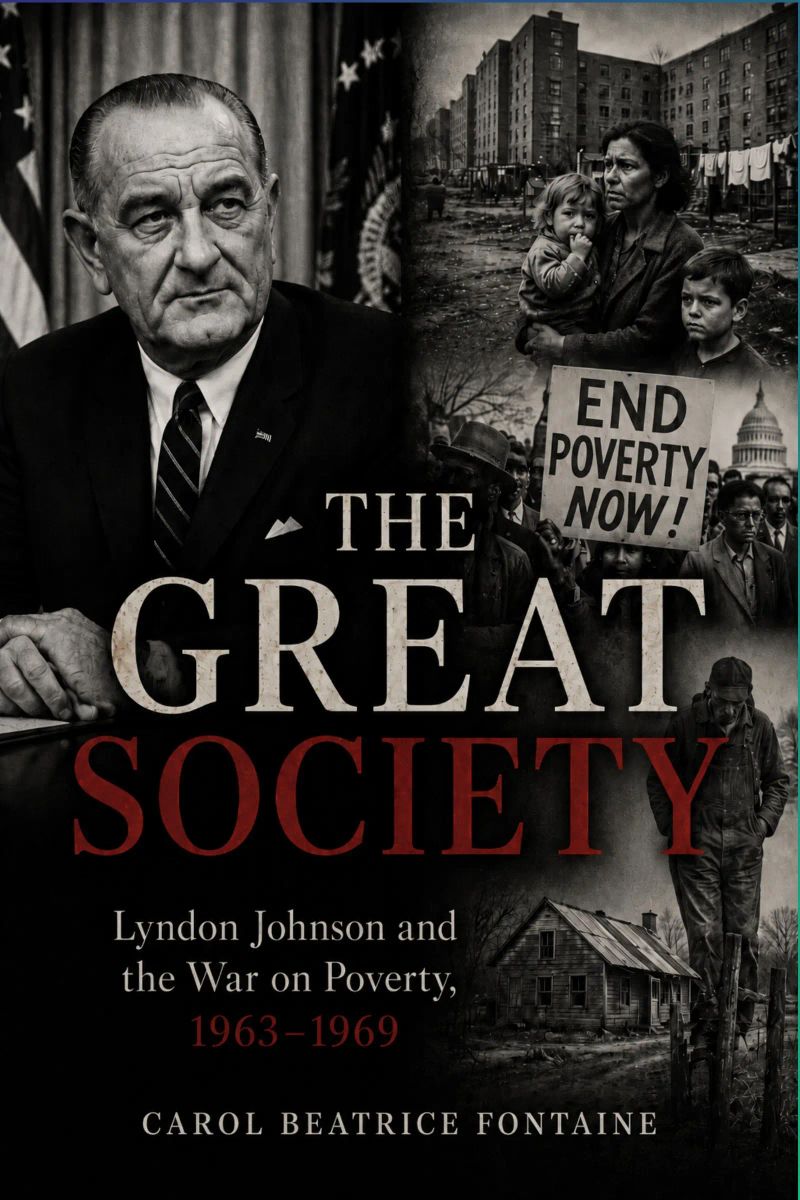
THE GREAT SOCIETY
Lyndon Johnson and the War on Poverty, 1963-1969By Carol Beatrice Fontaine

Length6h 23m
About this audiobook
The complete narrative history of Lyndon Johnson's Great Society — Medicare, the Civil Rights Act, the War on Poverty, and the unfinished fight to build a just America, 1963-1969.
On the evening of July 2, 1964, Lyndon Johnson signed the Civil Rights Act in the East Room of the White House, handing out seventy-two pens as souvenirs. Afterward, he told an aide that he believed he had just delivered the South to the Republican Party for a generation. He signed it anyway. That gesture — triumph shadowed by political reckoning — captures the man and the era this book chronicles.
This is the story of how Lyndon Johnson, Sargent Shriver, Lady Bird Johnson, Robert McNamara, Hubert Humphrey, and Martin Luther King Jr. built and then watched fracture the most ambitious domestic legislative program since the New Deal. Across twenty-four chapters in six parts, historian Carol Beatrice Fontaine traces the full arc of the Great Society from Johnson's oath of office aboard Air Force One on November 22, 1963, through his anguished withdrawal from the 1968 race — and forward to Medicare's sixtieth anniversary, when the program covers sixty-seven million Americans.
Inside this Great Society history:
• The Civil Rights Act of 1964 — how Johnson deployed the "Johnson Treatment" and a sixty-day Senate filibuster to pass the most sweeping civil rights law since Reconstruction, knowing it would cost his party the South (Chapter 3)
• Medicare and Medicaid — Johnson's trip to Independence, Missouri to enroll Harry Truman as Medicare's first beneficiary, and the AMA's record starring Ronald Reagan that tried and failed to stop him (Chapter 5)
• The War on Poverty — Sargent Shriver's OEO, Head Start classrooms, and the memory of Cotulla, Texas, where a young LBJ taught hungry Mexican American children whose faces drove every poverty program he signed (Chapter 9)
• The Voting Rights Act of 1965 — Selma, the Pettus Bridge, and the legislative response that transformed Black voter registration across the South within a single election cycle (Chapter 6)
• The Urban Rebellions — Watts, Newark, and Detroit; the Kerner Commission's verdict that America was dividing into two societies; and the long hot summer that consumed Johnson's domestic coalition (Chapters 14-15)
• Vietnam's fatal intrusion — the Gulf of Tonkin Resolution, the sixteen thousand advisors Johnson inherited from Kennedy, and the war that destroyed the presidency that built the Great Society (Chapter 13)
• The honest reckoning — Reagan's assault, the survival of Medicare's core constituency, and why sixty years of conservative politics has not undone what Johnson built in 1965 (Chapters 22-23)
The Great Society left behind institutions that still govern American life — the Medicare card in every senior's wallet, the Head Start classroom in every state, the civil rights enforcement framework that protects millions. It also left behind the question Johnson asked himself in Cotulla: can democratic government make real the promise of equal opportunity, or does inequality always reconstitute itself? His answer was partial. The argument continues.
For readers of Robert Caro's THE YEARS OF LYNDON JOHNSON and Doris Kearns Goodwin's LYNDON JOHNSON AND THE AMERICAN DREAM.
Audiobook details
GenreBiography and Memoir, Other
Length6 hrs 23 mins
Narrated byListen with 1,000+ voices
FormateBook with Audio
Publish dateJun 2, 2026
LanguageEnglish
Table of contents
1Introduction
2Prologue: All We Have Inherited
3PART ONE: LBJ'S AMERICA (1963-1964)
4Chapter 1: From the Hill Country — Lyndon Johnson's Texas Roots and Political Rise
5Chapter 2: November 22, 1963 — Johnson Takes the Oath
Mostrar todos os capítulosVer menos
6Chapter 3: The Civil Rights Act of 1964 — Johnson's First Great Achievement
7Chapter 4: The Election of 1964 — The Landslide and Its Mandate
8PART TWO: BUILDING THE GREAT SOCIETY (1965)
9Chapter 5: Medicare and Medicaid — Health Care for the Elderly and the Poor
10Chapter 6: The Voting Rights Act of 1965 — Selma and the Legislative Response
11Chapter 7: The Elementary and Secondary Education Act — Federal Aid to Schools
12Chapter 8: Immigration Reform — The Hart-Celler Act and Its Consequences
13PART THREE: THE GREAT SOCIETY IN FULL (1965-1968)
14Chapter 9: The War on Poverty — OEO, Head Start, and Community Action
15Chapter 10: Public Housing and Urban Renewal — The Cities and Federal Intervention
16Chapter 11: Environmental Legislation — Clean Air, Clean Water, and Wilderness
17Chapter 12: Arts and Culture — the NEA, NEH, and Public Broadcasting
18PART FOUR: THE WARS — FOREIGN AND DOMESTIC
19Chapter 13: Vietnam Intrudes — The Gulf of Tonkin and Escalation
20Chapter 14: The Urban Rebellions — Watts, Newark, Detroit, and the Long Hot Summer
21Chapter 15: The Kerner Commission — Race, Poverty, and American Cities
22Chapter 16: 1968 — The Year That Broke Lyndon Johnson
23PART FIVE: THE GREAT SOCIETY'S PEOPLE
24Chapter 17: Sargent Shriver — The War on Poverty's General
25Chapter 18: Robert McNamara — The Defense Secretary and the Vietnam Trap
26Chapter 19: Lady Bird Johnson — Conservation, Beautification, and First Lady Power
27Chapter 20: The Reformers — Social Scientists, Activists, and the Great Society's Staff
28PART SIX: LEGACIES
29Chapter 21: What the Great Society Achieved — Poverty, Health, and Education
30Chapter 22: The Conservative Backlash — Reagan and the Assault on the Great Society
31Chapter 23: Medicare at Sixty — Health Care and the Great Society's Longest Legacy
32Chapter 24: Lyndon Johnson's Place in History — Tragedy, Greatness, and Vietnam
33Epilogue: The Unfinished War
34Acknowledgments
35Selected Bibliography
36About the Author
More from Carol Beatrice Fontaine


You Are Worth ItKyle Carpenter, Don Yaeger8h 53m4.7 (4.8K)$29 · $0.00

The Happiest Man on EarthEddie Jaku3h 48m4.6 (178K)$7 · $0.00

MotherlandJulia Ioffe17h 52m4.7 (2.5K)$40 · $0.00
Evidence Not SeenDarlene Deibler Rose11h 11m4.6 (11.9K)$29 · $0.00

Where Cowards Go to DieBenjamin Sledge8h 42m4.7 (351)$20 · $0.00

Will You Love Me?Cathy Glass9h 5m4.6 (9.3K)$29 · $0.00

Designing Terry Pratchett’s DiscworldPaul Kidby3h 52m4.7 (343)$20 · $0.00

HostageEli Sharabi5h 25m4.6 (10.8K)$24 · $0.00

Finding MeViola Davis9h 15m4.6 (256.4K)$29 · $0.00

The Dangerous Truth about Today’s MarijuanaLaura Stack CSP, MBA9h 57m4.7 (385)$20 · $0.00

Birdie & HarlowTaylor Wolfe7h 50m4.6 (6.5K)$26 · $0.00
The Lives of BrianBrian Johnson9h 45m4.6 (3.5K)$29 · $0.00

I Am The StormJanice Dean9h4.6 (1.5K)$8 · $0.00
Black History CollectionFrederick Douglass, Harriet Ann Jacobs, Booker T. Washington, W.E.B. Du Bois27h 9m4.6 (2.6K)$18 · $0.00
Just as I AmCicely Tyson16h 8m4.6 (99K)$33 · $0.00

Unbroken Bonds of BattleJohnny Joey Jones8h 31m4.6 (2.6K)$8 · $0.00

The Daughter of AuschwitzTova Friedman, Malcolm Brabant7h 54m4.6 (16.7K)$26 · $0.00
My Bondage and My Freedom (Annotated)Frederick Douglass15h 30m4.6 (2.4K)$2 · $0.00

Lily's PromiseLily Ebert, Dov Forman8h 54m4.6 (16.1K)$29 · $0.00

CrossroadsKaleb Dahlgren7h 56m4.6 (4.9K)$26 · $0.00
Mere ChristianityC. S. Lewis7h 7m4.4 (519.7K)$24 · $0.00

Her Daily BreadKate Wood12h 57m4.6 (153)$33 · $0.00
The Holy Bible - 1 SamuelKing James2h 13m4.8 (1.6K)$3 · $0.00
The American Standard Bible — The Gospel of MatthewMatthew3h 56m4.7 (3K)$2 · $0.00

Bad Fat Black GirlSesali Bowen6h 32m4.7 (2.8K)$24 · $0.00
The King James Audio Bible New Testament CompleteChristopher Glyn20h 2m4.7 (2.6K)$12 · $0.00
Faiths CheckbookCharles Spurgeon12h 44m4.7 (3.2K)$11 · $0.00

Ten Things I Wish You Knew About Your Child's Mental HealthDr. Billy Garvey4h 53m4.7 (2.4K)$20 · $0.00
Designing Terry Pratchett’s DiscworldPaul Kidby3h 52m4.7 (343)$20 · $0.00
The Chosen Book OneAmanda Jenkins, Kristen Hendricks, Dallas Jenkins3h 8m4.6 (4.9K)$10 · $0.00
The Lives of BrianBrian Johnson9h 45m4.6 (3.5K)$29 · $0.00
Expository Thoughts on the Gospel of LukeJ.C. Ryle27h 13m4.7 (536)$18 · $0.00
CrossroadsKaleb Dahlgren7h 56m4.6 (4.9K)$26 · $0.00

Across the RiverKent Babb11h 40m4.6 (927)$29 · $0.00

Brain Training for RidersAndrea Monsarrat Waldo5h 56m4.7 (550)$19 · $0.00

My Effin' LifeGeddy Lee17h 11m4.6 (13.1K)$40 · $0.00
Kings and PawnsHoward Bryant10h 9m4.6 (678)$29 · $0.00

The Elementia Chronicles #2: The New OrderSean Fay Wolfe11h 17m4.6 (841)$29 · $0.00
The ActsLuke2h 55m4.6 (19.7K)$12 · $0.00

New Testament - Easy NavigationWorld English Bible19h 35m4.6 (1.3K)$1.30 · $0.00
You may also like
Amazing GraceEric Metaxas10h 26m4.2 (17.6K)$29 · $0.00
To Rescue the RepublicBret Baier, Catherine Whitney11h 42m4.5 (8.6K)$29 · $0.00
By the Light of Burning DreamsDavid Talbot, Margaret Talbot13h 57m4.3 (269)$33 · $0.00
SmoketownMark Whitaker13h 29m4.5 (676)$23
Bearing the CrossDavid J. Garrow34h 22m4.3 (2.5K)$28

Read & RiotNadya Tolokonnikova6h 42m4.2 (1.6K)$24 · $0.00
I've Been to the MountaintopMartin Luther King48m4.7 (1.4K)$11 · $0.00
RFKRobert F. Kennedy, C. Richard Allen, Edwin O. Guthman14h 7m4.5 (363)$33 · $0.00
Strong VoicesTonya Bolden, Cokie Roberts3h 5m4.3 (353)$18 · $0.00
The Courage to Be FreeRon DeSantis9h4.1 (6.3K)$29 · $0.00

AnarchyErrico Malatesta2h 31m4.1 (2K)$2 · $0.00

Warriors of Non-ViolenceIra Saxena6h 4m$16 · $0.00
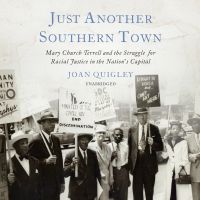
Just Another Southern TownJoan Quigley13h 9m3.9 (47)$23

The DeanJohn David Dingell, David Bender9h 4m4.1 (180)$29 · $0.00

The Crucifixion of Philip StrongCharles M. Sheldon7h 48m4.3 (30)$1 · $0.00
Stories of Achievement: Orators and ReformersElihu Burritt, Frederick Douglass, Booker T. Washington, Henry Ward Beecher, Desmosthenes, John B. Gough, Benjamin B. Lindsey3h 43m$1 · $0.00
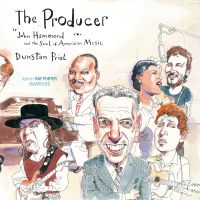
The ProducerDunstan Prial12h 22m4.1 (106)$23 · $0.00
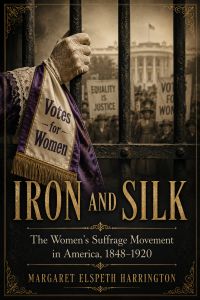
IRON AND SILKMargaret Elspeth Harrington4h 57m$6 · $0.00
The Republicansthe Speech Resource Company10h 9m$20
Redeeming the DreamDavid Boies, Theodore B. Olson12h 28m4.4 (237)$23