
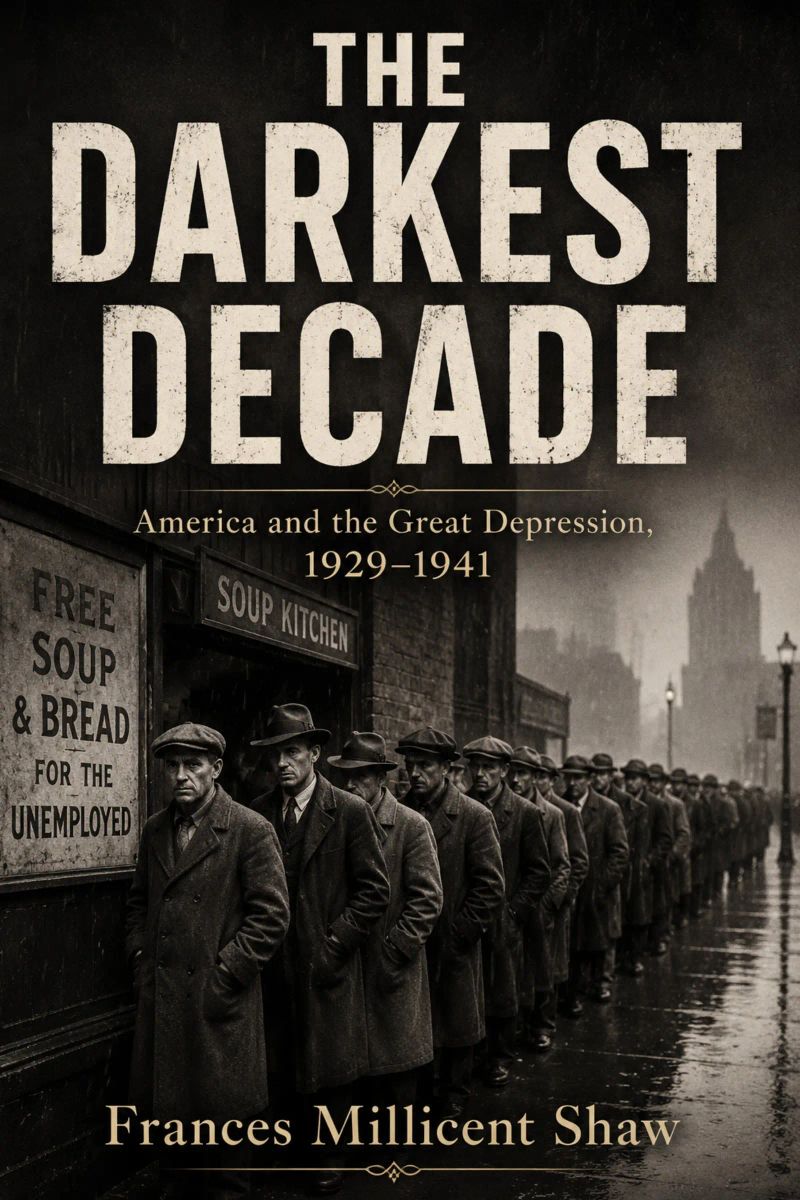
THE DARKEST DECADE
America and the Great Depression, 1929–1941By Frances Millicent Shaw


Length5h 58m
About this audiobook
The complete narrative history of the Great Depression, 1929–1941 — Black Tuesday, the New Deal, FDR, the Dust Bowl Okies, and the human cost of America's darkest decade.
On October 29, 1929, 16.4 million shares changed hands on the New York Stock Exchange. General Electric lost $1.7 billion in a single day. Radio Corporation of America fell from $505 per share to $26 before the year was out. American stocks shed $14 billion in one week — more than four times the entire federal budget. The ticker tape ran until midnight, still printing transactions from a world that had ceased to exist.
This is the story of what followed. Frances Millicent Shaw traces the full arc of America's Great Depression history across twenty-four chapters — from the structural causes of collapse, through Hoover's principled but catastrophic response, through FDR's Hundred Days and the New Deal's experiments, to the human stories statistics cannot tell. Named throughout: FDR, Eleanor Roosevelt, Frances Perkins, Dorothea Lange, and the 400,000 depositors of the Bank of the United States who lost everything on December 11, 1930.
Inside this Great Depression history:
Black Tuesday and its causes — margin calls, 30,000 undiversified banks, Smoot-Hawley, and Mellon's "liquidate everything" philosophy (Chapters 1–4)
The banking crisis and FDR's response — the national banking holiday, the Emergency Banking Act passed in 38 minutes, and the Fireside Chat that put deposits back in banks (Chapter 4)
Social Security and the Second New Deal — Frances Perkins, the first female cabinet member, who drove both landmark laws through twelve years as Labor Secretary (Chapter 11)
The New Deal and race — Walter White on anti-lynching, Mary McLeod Bethune's NYA division, and 100,000 Black sharecroppers evicted under AAA controls (Chapter 15)
The WPA cultural explosion — Orson Welles in Harlem, John Cheever and Ralph Ellison on the Writers' Project payroll, Dorothea Lange's "Migrant Mother" (Chapter 16)
Women and survival — women's employment rose from 10.7 to 13 million despite dismissal campaigns; flour-sack clothing, "Depression cake," and boarders kept families alive (Chapter 17)
The honest reckoning — court-packing, the 1937 Roosevelt Recession, and why World War II — not the New Deal — ended the Depression (Chapters 21–24)
The New Deal left behind the FDIC, Social Security, the SEC, and the TVA. It left behind, too, an unfinished question: how much can democratic government do when markets fail? The Depression decade's answer was provisional. The debate has never ended.
For readers of David Kennedy's FREEDOM FROM FEAR and Jonathan Alter's THE DEFINING MOMENT.
Audiobook details
GenreHistory
Length5 hrs 58 mins
Narrated byListen with 1,000+ voices
FormateBook with Audio
Publish dateJun 2, 2026
LanguageEnglish
Table of contents
1Introduction
2Prologue: The Party Ends
3PART ONE: THE CRASH AND ITS CAUSES (1929)
4Chapter 1: Black Tuesday — The Stock Market Collapses
5Chapter 2: The Structural Weaknesses — Why the Economy Failed
Mostrar todos os capítulosVer menos
6Chapter 3: Hoover's Response — The Limits of Republican Orthodoxy
7Chapter 4: The Banking Crisis — When the Banks Failed
8PART TWO: THE DEPRESSION DEEPENS (1930–1932)
9Chapter 5: Unemployment and Breadlines — The Human Cost
10Chapter 6: The Dust Bowl — Drought, Displacement, and the Okies
11Chapter 7: Hoovervilles — Shanty Towns and Broken Dreams
12Chapter 8: The Bonus Army — Veterans March on Washington
13PART THREE: FRANKLIN ROOSEVELT AND THE NEW DEAL (1933–1935)
14Chapter 9: The Hundred Days — Roosevelt's Emergency Response
15Chapter 10: The First New Deal — Relief, Recovery, and Reform
16Chapter 11: The Second New Deal — Social Security and the Wagner Act
17Chapter 12: Opposition to the New Deal — Business, Courts, and the Left
18PART FOUR: NEW DEAL AMERICA (1933–1939)
19Chapter 13: The CCC and PWA — Putting America to Work
20Chapter 14: The TVA — Government Power and Regional Development
21Chapter 15: The New Deal and Race — Promises and Limits
22Chapter 16: Cultural Depression — Art, Literature, and the WPA
23PART FIVE: THE DEPRESSION'S HUMAN STORIES (1930–1940)
24Chapter 17: Women and the Depression — Gender, Work, and Survival
25Chapter 18: The Midwestern Exiles — From Oklahoma to California
26Chapter 19: Labor Rising — The CIO and the Sit-Down Strikes
27Chapter 20: Voices of the Depression — Photographers, Writers, and Radio
28PART SIX: END AND LEGACY
29Chapter 21: Court-Packing and the Conservative Turn — 1937
30Chapter 22: The Roosevelt Recession — The Limits of New Deal Economics
31Chapter 23: The Depression Ends — World War II and Economic Recovery
32Chapter 24: The New Deal Legacy — What It Changed and What It Didn't
33Epilogue: What the Depression Made
34Acknowledgments
35Selected Bibliography
36About the Author
More from Frances Millicent Shaw



A Brief History of IntelligenceMax S. Bennett12h 18m4.6 (6.6K)$29 · $0.00

The Daughter of AuschwitzTova Friedman, Malcolm Brabant7h 54m4.6 (16.7K)$26 · $0.00

Lily's PromiseLily Ebert, Dov Forman8h 54m4.6 (16.1K)$29 · $0.00

On Democracies and Death CultsDouglas Murray10h 38m4.6 (6.5K)$29 · $0.00

Across the RiverKent Babb11h 40m4.6 (927)$29 · $0.00

Balcony Over Jerusalem: A Middle East Memoir - Israel, Palestine and BeyondJohn Lyons12h 37m4.6 (1.4K)$33 · $0.00

BeyondStephen Walker15h 39m4.6 (3.2K)$33 · $0.00
Kings and PawnsHoward Bryant10h 9m4.6 (678)$29 · $0.00

No EscapeNury Turkel9h 30m4.6 (809)$28 · $0.00

Jubal Stone: U.S. Marshal: Blood Trail To Hell: A Western Adventure NovelCasey Nash3h 42m4.6 (3.2K)$18 · $0.00

Fall and RiseMitchell Zuckoff17h 23m4.6 (9.8K)$40 · $0.00

The SurvivorJosef Lewkowicz, Michael Calvin9h 22m4.6 (2.5K)$29 · $0.00

Always FaithfulThomas Schueman, Zainullah Zaki12h 12m4.6 (977)$29 · $0.00

The State of Society in France Before the Revolution of 1789 (Annotated)Alexis de Tocqueville17h 25m4.6 (1.2K)$2 · $0.00

All the Gallant MenDonald Stratton, Ken Gire5h 55m4.6 (11.8K)$24 · $0.00

Saint Joan (Annotated)George Bernard Shaw6h 20m4.6 (1.2K)$1.20 · $0.00

Medgar and MyrlieJoy-Ann Reid10h 52m4.5 (27.8K)$29 · $0.00

The History of the Peloponnesian War (Annotated)Thucydides24h 3m4.6 (1.1K)$2 · $0.00

Where the Birds Never SingJack Sacco10h 31m4.6 (3.8K)$29 · $0.00

Serviceman J: The Untold Story of an NZSAS SoldierJamie Pennell5h 51m4.6 (452)$24 · $0.00
You may also like

The American Heritage History of the Civil WarBruce Catton8h4.4 (1.7K)$20

Look Away!William C. Davis23h 39m4.0 (662)$30
Capitalism, Socialism and DemocracyJoseph A. Schumpeter18h 23m4.1 (4.3K)$8 · $0.00
Rock Me on the WaterRonald Brownstein16h 15m4.0 (2.4K)$33 · $0.00

Rebel in the RanksBrad S. Gregory9h 46m4.1 (502)$29 · $0.00

The FormulaJoshua Robinson, Jonathan Clegg10h 41m4.4 (6.9K)$29 · $0.00

The History of the Reformation in the Sixteenth Century (Vol.1-5)Jean-Henri Merle d'Aubigné93h 51m4.6 (743)$1.99 · $0.00

The Story of Christianity, Vol. 2, Revised and UpdatedJusto L. González18h 26m4.4 (6K)$30

On the Duty of Civil DisobedienceHenry David Thoreau52m4.1 (27.5K)$5

The Secret of Chanel No. 5Tilar J. Mazzeo7h 59m3.7 (2K)$26 · $0.00

Gita Press and the Making of Hindu IndiaAkshaya Mukul20h 7m4.2 (1.6K)$21

The Collected WorksW.E.B. Du Bois35h 35m4.6 (53)$2 · $0.00

The History of the Confederate War, Its Causes and Its Conduct (Vol.1&2) (Annotated)George Cary Eggleston22h 56m4.0 (37)$1.99 · $0.00

Fichte (Annotated)Robert Adamson7h 28m$1.99 · $0.00

Issues In Health CareJohn Warwick Montgomery, John Warwick Montgomery3h 34m$12 · $0.00

Marxism & Human RightsJohn Warwick Montgomery44m$3 · $0.00

Readings on Fascism and National SocialismVarious2h 33m4.1 (28)$2 · $0.00

Ireland Since ParnellD. D. Sheehan9h 21m$2 · $0.00

The Candidate Losersthe Speech Resource Company9h 25m$20

MARTIN LUTHER Premium Collection: Theological Works, Sermons & HymnsMartin Luther126h 26m4.2 (147)$2 · $0.00