
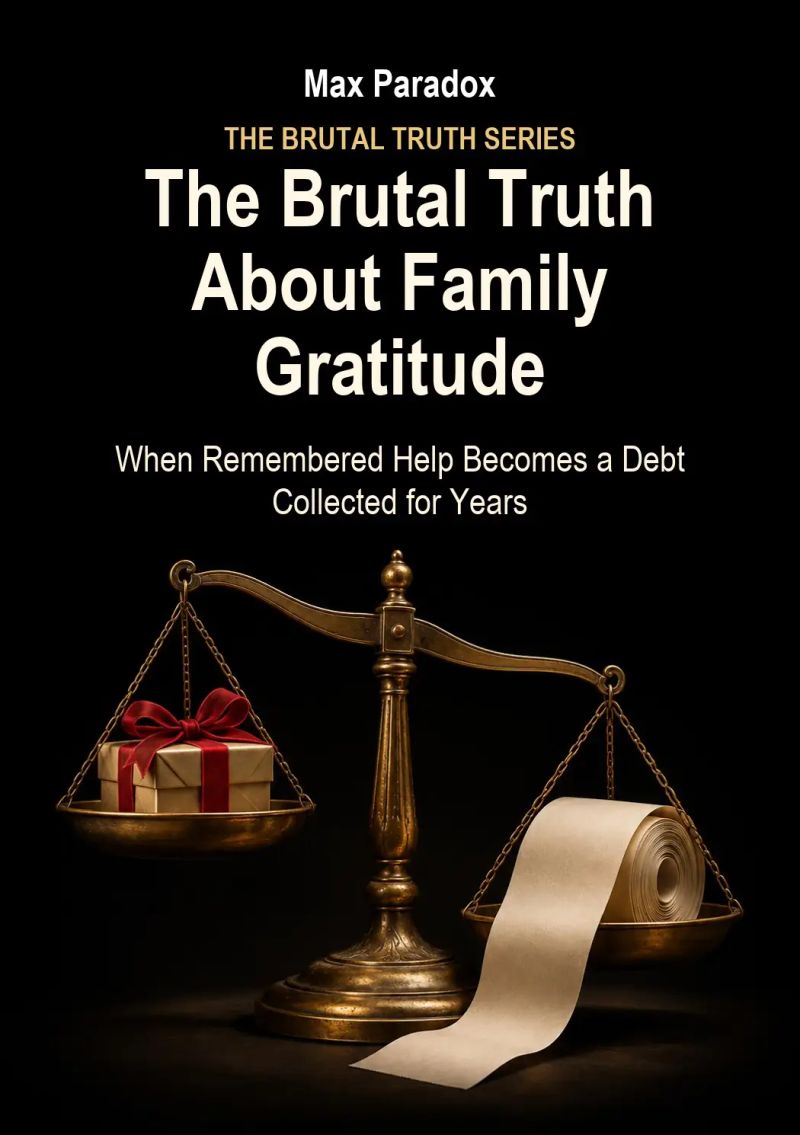
The Brutal Truth About Family Gratitude - When Remembered Help Becomes a Debt Collected for Years
De Max Paradox


Duração6h 53m
Sobre este audiolivro
A generous act can become an account that is never closed. Max Paradox looks at what changes when a memory of help starts being used to decide who may disagree, move away or make a choice the family dislikes.
From the introduction
Three plates from Sunday lunch sit on the table, alongside cups of half-finished coffee and an envelope that nobody has placed there by accident. An aunt slides it towards her nephew as casually as if she were offering him some sugar. Inside is an invoice for car repairs from four years earlier. It is not an invoice in the accounting sense. It is a printed record of memory: the amount, the date, the circumstances and, above all, a reminder that without that money, the young man would not have made it to work, would not have kept his apartment and might never have managed to get back on his feet. The aunt is not asking him to pay it back. She says that family does not keep score. Then she adds that some people have a remarkable ability to forget who once reached out a helping hand.
This is an illustrative scene, not a description of a particular family or a documented event. Its details are nevertheless familiar in many households, because family accounting rarely begins with a formal demand for payment. More often, it appears in a half-finished sentence, a sigh, a joke at the dinner table or a story whose ending everyone already knows. Help is presented as unconditional, yet its history begins to function like a document of ownership. Someone gave money, lent a room, collected a child from kindergarten, arranged a job or stayed overnight during a crisis. Years later, that gesture is still expected to generate interest, although nobody ever agreed on the rate.
Gratitude itself is not suspicious. It is a response to kindness that cannot be reduced to an ordinary exchange of services. Within a family, accepting help without an immediate calculation comes naturally because relationships involve history, dependency and mutual presence, none of which can be priced like a plumber's work. The trouble begins when the memory of a favour stops being something two people share and becomes a tool of influence. At that point, the words "I helped you" establish a hierarchy in the present and suggest that the person who received help must continue to occupy the appropriate position within it.
This publication was prepared using tools that support the creative process, including artificial intelligence solutions. The final concept, structure and editing are the responsibility of the author.
Detalhes do audiolivro
GêneroSelf-Help
Duração6 h 53 min
Narrado porOuça com mais de 1.000 vozes
FormatoeBook com áudio
Data de publicação29 de nov. de 2026
IdiomaInglês
Sumário
1INTRO
2Chapter 1 - It's Nothing, Really
3Chapter 2 - The Story Told at Every Family Table
4Chapter 3 - The Gift Nobody Asked For
5Chapter 4 - When Saying No Sounds Like Betrayal
Mostrar todos os capítulosVer menos
6Chapter 5 - Not Everyone Receives the Same Help
7Chapter 6 - The Money Came Back, but the Debt Remained
8Chapter 7 - After All I've Done, I Deserve the Final Say
9Chapter 8 - When There Is Always Someone to Rescue
10Chapter 9 - Everyone Remembers How Much They Gave
11Chapter 10 - The Debt Passed on to Someone Else
12Chapter 11 - One Family Home, Separate Accounts
13Chapter 12 - The Money Comes with a Full Account of Your Life
14Chapter 13 - I Shouldn't Have It Better
15Chapter 14 - The Person Who Sacrificed Something All Their Life
16Chapter 15 - When Closeness Becomes Uncomfortable
17Chapter 16 - I'm No Longer Sure I Am Entitled to Anything
18Chapter 17 - I'm Only Doing It Out of Love
19Chapter 18 - That's Just How Our Family Does Things
20Chapter 19 - I Don't Want Anything from Anyone
21Chapter 20 - The Account No One Ever Managed to Close

Brutalna prawda o dziedziczeniu ról rodzinnych - Dlaczego przy tym samym stole znowu stajemy się dziećmiMax Paradox5h 52min$7.40

The Brutal Truth About Supercars on Display - How Speed, Scarcity, and Other People's Eyes Drive the Prestige MarketMax Paradox7h 11min$7.40

Die brutale Wahrheit über Entschuldigungen ohne Veränderung - Warum es leicht ist, Schuld einzugestehen, wenn jemand anderes weiterhin den Preis zahltMax Paradox7h 47min$7.40

The Brutal Truth About Apologies Without Change - Why It's Easy to Admit Fault When Someone Else Still Pays the PriceMax Paradox6h 49min$7.40

Brutalna prawda o superautach na pokaz - Jak prędkość, rzadkość i cudze spojrzenia napędzają rynek prestiżuMax Paradox6h 53min$7.40

Die brutale Wahrheit über die gleichberechtigte Aufgabenverteilung zu Hause - Wer plant, an alles denkt und die Arbeit erfasst, von der nur die Hälfte sichtbar istMax Paradox7h 12min$7.40

Brutalna prawda o równym podziale w domu - Kto planuje, pamięta i rozlicza pracę, której widać tylko połowęMax Paradox5h 51min$7.40

Brutalna prawda o rozstaniach bez rozmowy - Jak technologia ułatwia znikanie i komu zostawia pracę nad zakończeniemMax Paradox6h 13min$7.40

Brutalna prawda o nieopłaconej trosce - Kto płaci czasem, gdy opieka w rodzinie zostaje nazwana miłościąMax Paradox6h 13min$7.40

The Brutal Truth About Inheriting Family Roles - Why We Become Children Again at the Same TableMax Paradox6h 27min$7.40

The Brutal Truth About Unpaid Care - Who Pays in Time When Family Care Is Called LoveMax Paradox6h 51min$7.40

The Brutal Truth About Dating Like a Job Interview - What Happens to Intimacy When Every Person Is Just Another OptionMax Paradox7h 22min$7.40

Die brutale Wahrheit über vererbte Familienrollen - Warum wir am selben Tisch wieder zu Kindern werdenMax Paradox7h 14min$7.40

The Brutal Truth About Owning a Supercar - What the Dream Costs Once It Leaves the Showroom for the Garage, the Workshop and the TrackMax Paradox6h 3min$7.40

The Brutal Truth About Breakups Without a Conversation - How Technology Makes Disappearing Easier and Leaves Someone Else to Do the Work of Ending ThingsMax Paradox7h 35min$7.40

Brutalna prawda o posiadaniu superauta - Ile kosztuje marzenie, gdy z salonu trafia do garażu, serwisu i na torMax Paradox5h 42min$7.40

The Brutal Truth About an Equal Share at Home - Who Plans, Remembers, and Keeps Track of the Work Only Half SeenMax Paradox6h 25min$7.40

Die brutale Wahrheit über Eltern, die gute Eltern nur zur Schau stellen - Wie der Ruf, ein guter Elternteil zu sein, die Aufmerksamkeit verdrängt, die eigentlich dem Kind gehören sollteMax Paradox7h 26min$7.40

Die brutale Wahrheit über unbezahlte Fürsorge - Wer mit seiner Zeit bezahlt, wenn familiäre Pflege Liebe genannt wirdMax Paradox7h 38min$7.40

Learning to PrayJames Martin13h 24min4.5 (3.4K)$33 · $0.00

A Different WayChristopher A. Hall10h 45min4.5 (165)$29 · $0.00

The Hard Thing About Hard ThingsBen Horowitz7h 57min4.2 (134.3K)$26 · $0.00

10% Happier 10th AnniversaryDan Harris9h 28min4.1 (137.1K)$29 · $0.00

The Power of the OtherHenry Cloud5h 52min4.2 (3.5K)$24 · $0.00

What You Are Looking For Is in the LibraryMichiko Aoyama7h 19min4.1 (156.7K)$24 · $0.00

The Way of ExcellenceBrad Stulberg6h 46min4.2 (1.1K)$24 · $0.00

The AlchemistPaulo Coelho4h 1min4.1 (3.9M) · 1326$23 · $0.00

Change the RecipeJosé Andrés, Richard Wolffe4h 57min4.1 (2K)$20 · $0.00

The Lucky RideYasushi Kitagawa4h 26min4.1 (1.8K)$20 · $0.00

Be ExceptionalJoe Navarro, Toni Sciarra Poynter9h 11min4.0 (1.3K)$29 · $0.00

The Subtle Art of Not Giving a F*ckMark Manson5h 18min3.9 (1.7M)$24 · $0.00

HomeschooledStefan Merrill Block7h 10min3.6 (18.5K)$28 · $0.00

Autoimmunity and the Good GirlsSara Hirsh Bordo7h 51min$26 · $0.00

The Purpose Driven® Liferick warren9h 23min4.0 (896.8K) Só no Ultra

Your Desired FutureHenry Cloud6h 43min$24 · $0.00

Spiritual AnatomyDaaji Kamlesh D. Patel9h 47min4.7 (319)$29 · $0.00

The Dangerous Truth about Today’s MarijuanaLaura Stack CSP, MBA9h 57min4.7 (385)$20 · $0.00

The Gospel according to Spiritualism (Translated)Allan Kardec14h 39min4.6 (3.9K)$5.70 · $0.00

Birdie & HarlowTaylor Wolfe7h 50min4.6 (6.5K)$26 · $0.00
Você também pode gostar

Bogie & BacallWilliam J. Mann27h 34min4.0 (1K)$53 · $0.00

Live WireKelly Ripa9h 59min4.1 (18.5K)$29 · $0.00

The Bishop and Other StoriesAnton Pavlovich Chekhov8h 10min4.1 (597)$2.30 · $0.00

Women Holding ThingsMaira Kalman26min4.5 (2.3K)$7 · $0.00

The Professor's HouseWilla Cather6h 27min3.9 (14.8K)$2.30

The Last SeptemberElizabeth Bowen9h 4min3.6 (5.6K)$20 · $0.00

To the LighthouseVirginia Woolf8h 42min4.0 (260.1K)$2 · $0.00

Second PlaceRachel Cusk6h 18min3.6 (34.8K)$24 · $0.00

Letter to My FatherFranz Kafka2h 2min4.2 (76.4K)$0.99 · $0.00
The Brutal Truth About Inheriting Family Roles - Why We Become Children Again at the Same TableMax Paradox6h 27min$7.40

Raising an Organized ChildDamon Korb6h 51min4.0 (440)$17 · $0.00

The Free Trial Has Lasted Three Years - How to Find, Organize, and Successfully Cancel Forgotten SubscriptionsMax Paradox5h 46min$7.40

The Family Gathering Turned Into an Interrogation Again - How to Set Boundaries with Your Family, Answer Uncomfortable Questions, and Get Through the Holidays Without Needing Three Days to RecoverMax Paradox7h 38min$7.50

I'm 40 and One Sentence from My Parent Still Turns Me Back Into a Teenager - How to Recognize Old Family Roles, Respond Like an Adult, and Stop Reliving Sunday Dinner Until WednesdayMax Paradox4h 30min$7.50

My Home Is a Warehouse for “Someday” - How to Let Go of Excess Stuff, Make Decisions, and Reclaim Your Space Without Purging Your Life in One WeekendMax Paradox3h 7min$7.50

The Brutal Truth About Performative Parents - How the Reputation of Being a Good Parent Takes Attention Away from the ChildMax Paradox6h 40min$7.40

No Regrets Parenting, Updated and Expanded EditionHarley A. Rotbart MD6h 1min4.1 (55)$17

His Family (Annotated)Ernest Poole10h 39min4.1 (153)$1.20 · $0.00

One Day MoreJoseph Conrad2h 8min3.2 (478)$2 · $0.00

Pushkin and the Queen of SpadesAlice Randall12h 35min3.5 (289)$23 · $0.00