
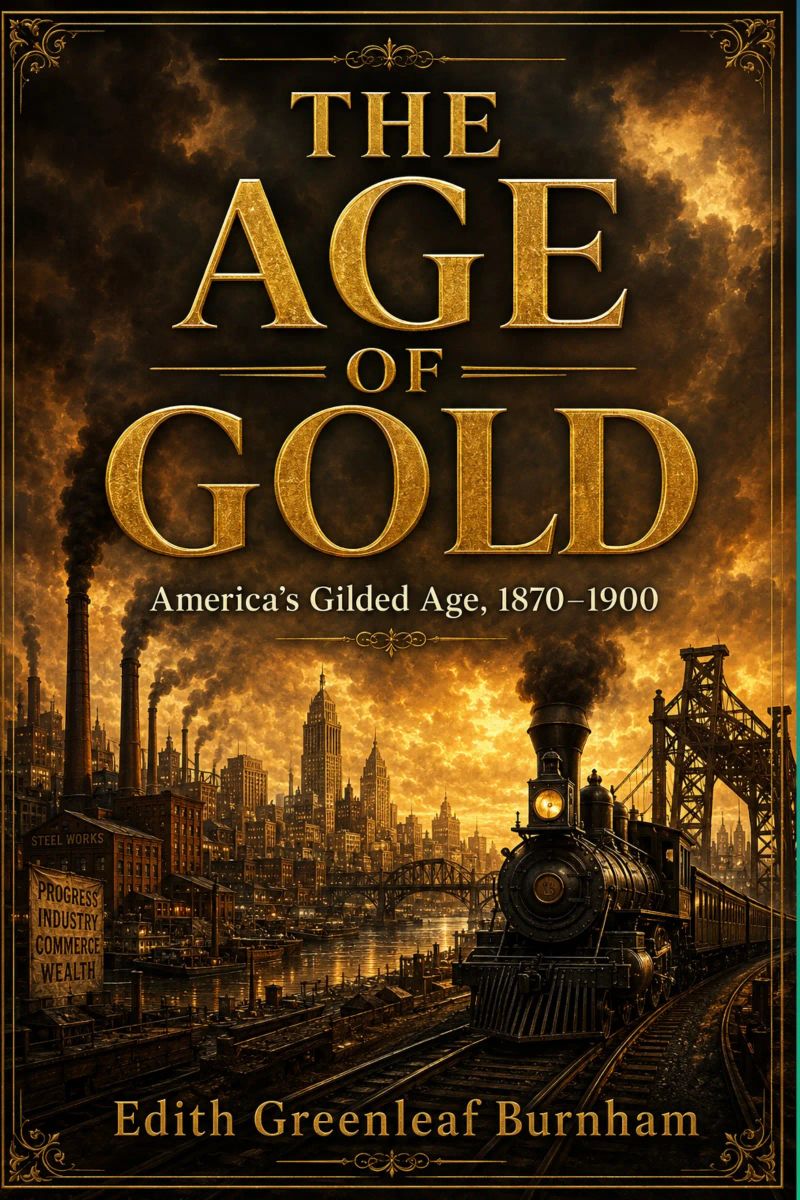
The age of gold
America's Gilded Age, 1870–1900By Edith Greenleaf Burnham


Length5h 28m
About this audiobook
The complete narrative history of America's Gilded Age — Vanderbilt, Rockefeller, Carnegie, J.P. Morgan, the robber barons, the Haymarket bomb, and the birth of modern America, 1870-1900.
On May 24, 1883, President Chester Arthur stood at the Brooklyn Bridge as 150,300 pedestrians crossed in a single day. The bridge cost $15 million and killed twenty-seven men — including engineer John Roebling, who died of tetanus after a ferry crushed his foot during the survey work. Ten blocks east, families of eight slept in two-room tenements without windows, at densities exceeding 1,000 people per acre. Mark Twain coined the era's name for a reason: not golden, but gilded — brilliant on the surface, corrupt and suffering beneath.
This is the full story of that America — of Cornelius Vanderbilt, John D. Rockefeller, Andrew Carnegie, J.P. Morgan, Jay Gould, Jacob Riis, Jane Addams, Mary Elizabeth Lease, and William Jennings Bryan — across twenty-four chapters in six parts. Historian Edith Greenleaf Burnham traces the complete arc of the Gilded Age from the end of Reconstruction through the election of Theodore Roosevelt, covering the robber barons, the immigrant city, the Populist revolt, Jim Crow, and the reform movements that shaped the Progressive Era.
Inside this Gilded Age history:
The Erie War — Jay Gould, Jim Fisk, and Daniel Drew printed 100,000 shares of watered stock and fled to Jersey City with $7 million, then paid $500,000 to bribe the Albany legislature to legalize the fraud (Chapter 1)
Rockefeller's Cleveland Massacre — Standard Oil's secret railroad rebates bought out 22 of Cleveland's 26 independent refineries in six weeks in 1872; Ida Tarbell's 19-installment McClure's series brought it to public reckoning (Chapter 2)
The Great Upheaval and Haymarket — 350,000 workers striking for the eight-hour day in 1886, a dynamite bomb killing seven police officers in Haymarket Square, and four hangings that broke the Knights of Labor's 700,000-member peak (Chapter 8)
The Populist revolt — Mary Elizabeth Lease giving 160 speeches in Kansas to "raise less corn and more hell," James Weaver winning 22 electoral votes in 1892, and Bryan's "cross of gold" speech at the Chicago convention in 1896 (Chapters 10-11)
Hull House and the Social Gospel — Jane Addams at 800 South Halsted Street with 19 nationalities, Florence Kelley surveying 645 garment workshops, and the Illinois Factory Act that made Kelley America's first female industrial regulator (Chapter 12)
The Pullman Strike and its aftermath — Eugene Debs, 250,000 workers on twenty-nine railroads, a federal injunction issued under the Sherman Antitrust Act, and the six prison months that turned Debs into America's leading socialist (Chapter 22)
The Gilded Age produced Carnegie's libraries and the Homestead dead, the transcontinental railroad and the dispossession that built it. Burnham delivers the complete picture — achievement and exploitation, genius and corruption — and the reform tradition that the era's contradictions made inevitable.
For readers of T.J. Stiles's THE FIRST TYCOON and Ron Chernow's TITAN.
Audiobook details
GenreHistory
Length5 hrs 28 mins
Narrated byListen with 1,000+ voices
FormateBook with Audio
Publish dateJun 2, 2026
LanguageEnglish
Table of contents
1Introduction
2Prologue: Glitter and Grime
3PART ONE: THE TITANS (1865–1900)
4Chapter 1: Cornelius Vanderbilt — The Commodore and the Railroad Empire
5Chapter 2: John D. Rockefeller — Standard Oil and the Modern Corporation
Mostrar todos os capítulosVer menos
6Chapter 3: Andrew Carnegie — Steel, Libraries, and the Gospel of Wealth
7Chapter 4: J. P. Morgan — The Banker Who Ruled America
8PART TWO: THE NEW INDUSTRIAL ORDER (1865–1900)
9Chapter 5: The Railroad Nation — Building the National Economy
10Chapter 6: The Rise of the City — Urbanization and the Urban Crisis
11Chapter 7: The New Immigration — From Ellis Island to the Factory Floor
12Chapter 8: Working Class America — Labor, Capital, and Conflict
13PART THREE: POLITICS AND REFORM (1870–1900)
14Chapter 9: The Spoils System — Corruption, Bosses, and Machine Politics
15Chapter 10: The Populist Revolt — Farmers Against the Gilded Age
16Chapter 11: The Money Question — Gold, Silver, and the Currency Wars
17Chapter 12: The Social Gospel — Reform, Religion, and Jane Addams
18PART FOUR: RACE, GENDER, AND EMPIRE (1877–1900)
19Chapter 13: Jim Crow Rising — The Architecture of Segregation
20Chapter 14: Women in the Gilded Age — Domesticity, Suffrage, and Work
21Chapter 15: The Spanish-American War — America's Imperial Moment
22Chapter 16: The Anti-Imperialists — Mark Twain and the Critics of Empire
23PART FIVE: THE CULTURE OF THE GILDED AGE (1870–1900)
24Chapter 17: Consumer Culture — Department Stores, Advertising, and Mass Markets
25Chapter 18: The Press — Hearst, Pulitzer, and Yellow Journalism
26Chapter 19: Technology and Invention — Edison, Bell, and the Second Industrial Revolution
27Chapter 20: Education and Ideas — Universities, Science, and American Thought
28PART SIX: CRISIS AND LEGACY (1890–1907)
29Chapter 21: The Panic of 1893 — Economic Collapse and Political Crisis
30Chapter 22: Coxey's Army and the Pullman Strike — Protest at the System's Limits
31Chapter 23: The Progressive Response — Reform After the Gilded Age
32Chapter 24: Mark Twain's Verdict — The Gilded Age in History and Memory
33Epilogue: What the Gilded Age Made
34Acknowledgments
35Selected Bibliography
36About the Author
More from Edith Greenleaf Burnham

A Brief History of IntelligenceMax S. Bennett12h 18m4.6 (6.6K)$29 · $0.00

Black AF HistoryMichael Harriot15h 43m4.7 (14.6K)$33 · $0.00

The Gulag Archipelago Volume 3Aleksandr I. Solzhenitsyn21h 56m4.7 (8.9K)$46 · $0.00

Pearl of Great PriceJoseph Smith3h 8m4.7 (7.2K)$1.20 · $0.00

The Happiest Man on EarthEddie Jaku3h 48m4.6 (178K)$7 · $0.00

MotherlandJulia Ioffe17h 52m4.7 (2.5K)$40 · $0.00

Where Cowards Go to DieBenjamin Sledge8h 42m4.7 (351)$20 · $0.00

RevolutionariesSanjeev Sanyal11h 23m4.6 (2.6K)$29 · $0.00

We Crossed a Bridge and It TrembledWendy Pearlman6h4.6 (5.2K)$24 · $0.00

Unbroken Bonds of BattleJohnny Joey Jones8h 31m4.6 (2.6K)$8 · $0.00

The Daughter of AuschwitzTova Friedman, Malcolm Brabant7h 54m4.6 (16.7K)$26 · $0.00

Lily's PromiseLily Ebert, Dov Forman8h 54m4.6 (16.1K)$29 · $0.00

On Democracies and Death CultsDouglas Murray10h 38m4.6 (6.5K)$29 · $0.00

Across the RiverKent Babb11h 40m4.6 (927)$29 · $0.00

Balcony Over Jerusalem: A Middle East Memoir - Israel, Palestine and BeyondJohn Lyons12h 37m4.6 (1.4K)$33 · $0.00

BeyondStephen Walker15h 39m4.6 (3.2K)$33 · $0.00
Kings and PawnsHoward Bryant10h 9m4.6 (678)$29 · $0.00

No EscapeNury Turkel9h 30m4.6 (809)$28 · $0.00

Jubal Stone: U.S. Marshal: Blood Trail To Hell: A Western Adventure NovelCasey Nash3h 42m4.6 (3.2K)$18 · $0.00

Fall and RiseMitchell Zuckoff17h 23m4.6 (9.8K)$40 · $0.00
You may also like

The Iron HeelJack London7h 26m3.9 (19.1K)$17 · $0.00
The Iron HeelJack London8h 32m4.0 (17.8K)$1.20 · $0.00
BehemothJoshua B. Freeman13h 43m4.0 (1.4K)$23

Manifesto of the Communist PartyKarl Marx1h 23m3.9 (248.8K)Free
How to Survive AmericaD. L. Hughley, Doug Moe4h 4m4.3 (1K)$20 · $0.00

How the Other Half BanksMehrsa Baradaran9h 35m4.2 (961)$20 · $0.00
The Essential Karl MarxKarl Marx, Florence Kelley, N.I. Stone128h4.1 (1.2K)$1 · $0.00

The Communist ManifestoKarl Marx1h 36m3.9 (239.6K)$5 · $0.00

Manifesto of the Communist PartyFriedrich Engels, Karl Marx2h 34m3.8 (255.7K)$1 · $0.00
Critique of the Gotha Programme (Annotated)Karl Marx2h 44m4.3 (12.1K)$1.99 · $0.00
A Collective BargainJane McAlevey9h 21m4.4 (1.2K)$29 · $0.00

THE IRON HEEL (Political Dystopian Classic)Jack London11h 1m3.9 (16.3K)$1 · $0.00

The Battle for ParadiseNaomi Klein1h 43m4.3 (3.6K)$15 · $0.00

Labor Day ChroniclesRafat Allam1h 59m$7 · $0.00

The Great Presidential DebatesSpeechWorks7h 55m4.3 (11)$20

Thirteenth State of the Nation AddressFerdinand Marcos1h 1m$2 · $0.00

Reconstructing Regulation for DecarbonizationGiovani Loss6h 35m$13 · $0.00

A Diversity of CreaturesRudyard Kipling12h4.0 (643)$2.30

THE AGE OF GOLDEdith Greenleaf Burnham5h 39m$7 · $0.00

Phi Beta Kappa Oration at HarvardCarl Schurz1h 32m$2 · $0.00