
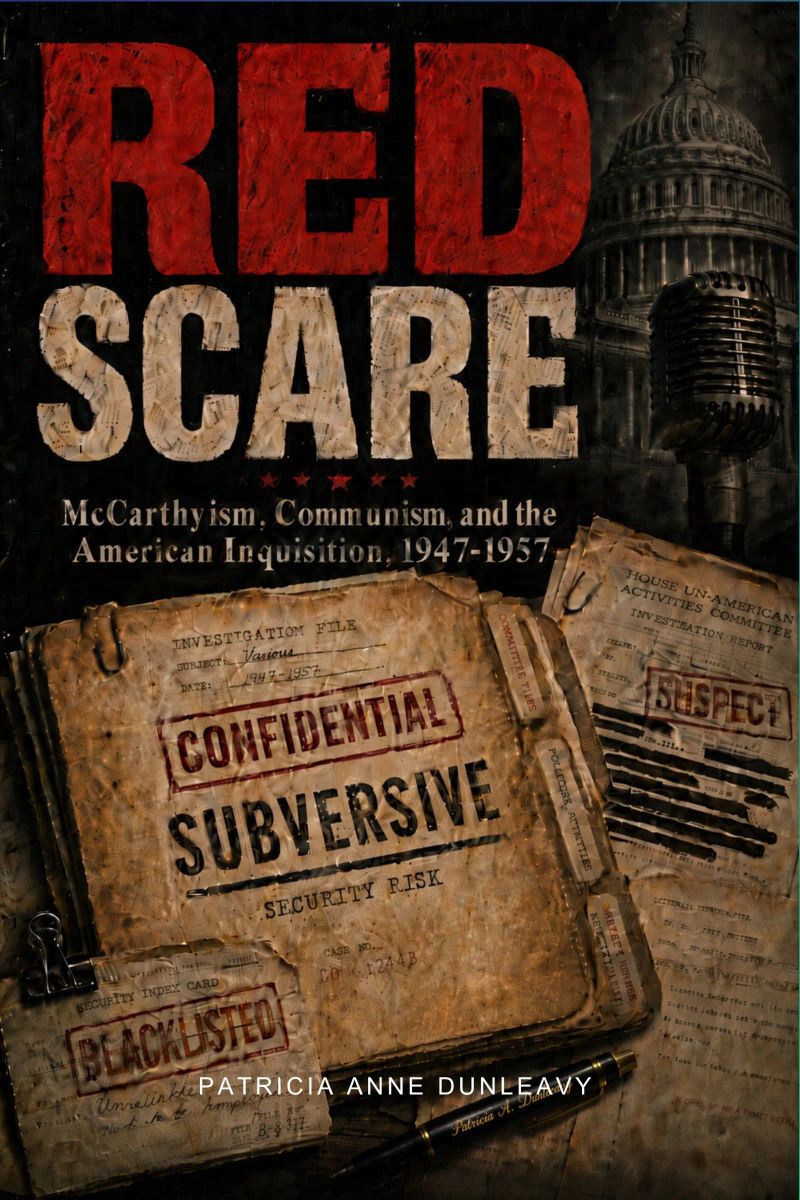
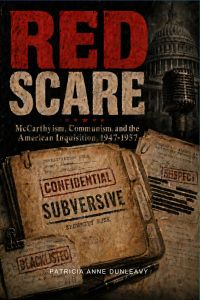
Red Scare
McCarthyism, Communism, and the American Inquisition, 1947-1957By Patricia Anne Dunleavy


Length5h 51m
About this audiobook
McCarthyism history, Red Scare, HUAC, Cold War America — the complete narrative of the American inquisition 1947-1957: the Hollywood blacklist, the Rosenberg execution, Joseph Welch's question, Edward R. Murrow, and the democracy that survived by the narrowest of margins.
Fear arrived in America before Joseph McCarthy did. By the time the junior senator from Wisconsin stood up in Wheeling, West Virginia on February 9, 1950, and claimed to hold a list of communist subversives, Americans had already spent five years learning to be afraid. The Soviet Union had the atomic bomb. China had fallen to Mao. Alger Hiss had been convicted of perjury. Julius and Ethel Rosenberg were awaiting trial. And soldiers were dying in Korea against an army no one had expected.
Patricia Anne Dunleavy traces the full arc of the American inquisition across twenty-four chapters — from the VENONA intercepts that documented real Soviet espionage, through HUAC's Hollywood investigations, the Rosenberg execution in 1953, McCarthy's claim of 205 communists in the State Department, Dalton Trumbo writing Oscar-winning screenplays under a false name, J. Robert Oppenheimer's security clearance stripped from the man who built the atomic bomb, the Lavender Scare that purged an estimated 5,000-10,000 gay federal employees alongside suspected communists, and finally Joseph Welch's live television question — "Have you no sense of decency?" — that ended McCarthy's career in a single afternoon.
Inside this McCarthyism history:
• The real Soviet threat — VENONA's decoded cables, the genuine atomic spies, and the critical distinction between espionage and political opinion that McCarthyism deliberately destroyed (Chapter 1)
• HUAC and the Hollywood Ten — the public hearing as theater, Dalton Trumbo's blacklisted Oscar win under the name "Robert Rich," and the Waldorf Statement by which studio heads voluntarily surrendered their employees (Chapters 2-3)
• The Alger Hiss case — the pumpkin papers, Richard Nixon's prosecution that made his career, and VENONA evidence that shifted the historical consensus toward guilt (Chapter 4)
• McCarthy's Wheeling speech — how a first-term senator built national power from a list that did not exist, and why the Senate's procedural rules could not stop him (Chapter 5)
• The Lavender Scare — the parallel gay purge within the Red Scare, Roy Cohn's irony, and Frank Kameny's refusal to accept dismissal quietly (Chapter 16)
• Edward R. Murrow and the Army-McCarthy hearings — the television broadcast that changed public opinion, and the moment McCarthy destroyed himself on live TV (Chapters 10-11)
• The permanent security state — how the Cold War apparatus survived McCarthy's censure, and McCarthyism's lessons about demagoguery and democratic resilience (Chapters 21-24)
McCarthyism was not merely a senator's excess. It was a democracy's near-failure — a systematic destruction of careers, civil liberties, and political trust that the country recovered from only slowly, and incompletely. Understanding how it happened, and what ended it, is the essential preparation for recognizing it the next time.
For readers of David Oshinsky's A CONSPIRACY SO IMMENSE and Ellen Schrecker's MANY ARE THE CRIMES.
Audiobook details
GenreHistory, Politics and Government
Length5 hrs 51 mins
Narrated byListen with 1,000+ voices
FormateBook with Audio
Publish dateJun 2, 2026
LanguageEnglish
Table of contents
1Introduction
2Prologue: The Red Menace
3PART ONE: ORIGINS (1945-1950)
4Chapter 1: The Soviet Threat — Espionage, the Atomic Bomb, and American Fear
5Chapter 2: HUAC — The House Un-American Activities Committee and Its Methods
Mostrar todos os capítulosVer menos
6Chapter 3: The Hollywood Ten — The Film Industry and the Blacklist
7Chapter 4: Alger Hiss — Espionage, Perjury, and the Case That Made Nixon
8PART TWO: McCARTHY'S RISE (1950-1952)
9Chapter 5: Wheeling, West Virginia — McCarthy's Speech and the List
10Chapter 6: The Tactics — Innuendo, Accusation, and the Big Lie
11Chapter 7: The Rosenbergs — Espionage, Trial, and Execution
12Chapter 8: The Korean War and the Red Scare — Fear at Home and Abroad
13PART THREE: THE INQUISITION AT ITS HEIGHT (1952-1954)
14Chapter 9: McCarthy vs. the State Department — Loyalty Investigations
15Chapter 10: The Army-McCarthy Hearings — Television and the Turning Point
16Chapter 11: Edward R. Murrow — Journalism and the Challenge to McCarthy
17Chapter 12: McCarthyism in the States — Local Red Scares Across America
18PART FOUR: THE VICTIMS
19Chapter 13: The Blacklist — Hollywood, Broadway, and the Entertainment Industry
20Chapter 14: Academia and the Red Scare — Universities and the Loyalty Oath
21Chapter 15: Government Workers — Purges, Investigations, and Ruined Careers
22Chapter 16: The Gay Purge — The Lavender Scare Within the Red Scare
23PART FIVE: RESISTANCE AND COLLAPSE
24Chapter 17: Those Who Fought Back — Lawyers, Journalists, and Civil Libertarians
25Chapter 18: The ACLU, the NAACP, and Civil Liberties Under Pressure
26Chapter 19: McCarthy's Fall — Censure and the Senate's Verdict
27Chapter 20: Eisenhower and McCarthyism — The President's Complicated Role
28PART SIX: LEGACIES
29Chapter 21: The Permanent Security State — Surveillance After McCarthy
30Chapter 22: The Cold War Consensus — Anticommunism and American Politics
31Chapter 23: The Rehabilitation — Clearing the Names of McCarthy's Victims
32Chapter 24: McCarthyism's Lessons — Demagoguery, Fear, and Democratic Resilience
33Epilogue: Have You No Sense of Decency?
34Acknowledgments
35Selected Bibliography
36About the Author
More from Patricia Anne Dunleavy

A Brief History of IntelligenceMax S. Bennett12h 18m4.6 (6.6K)$29 · $0.00

Black AF HistoryMichael Harriot15h 43m4.7 (14.6K)$33 · $0.00

The Gulag Archipelago Volume 3Aleksandr I. Solzhenitsyn21h 56m4.7 (8.9K)$46 · $0.00

Pearl of Great PriceJoseph Smith3h 8m4.7 (7.2K)$1.20 · $0.00

The Happiest Man on EarthEddie Jaku3h 48m4.6 (178K)$7 · $0.00

MotherlandJulia Ioffe17h 52m4.7 (2.5K)$40 · $0.00

Where Cowards Go to DieBenjamin Sledge8h 42m4.7 (351)$20 · $0.00
RevolutionariesSanjeev Sanyal11h 23m4.6 (2.6K)$29 · $0.00

We Crossed a Bridge and It TrembledWendy Pearlman6h4.6 (5.2K)$24 · $0.00

Unbroken Bonds of BattleJohnny Joey Jones8h 31m4.6 (2.6K)$8 · $0.00

The Daughter of AuschwitzTova Friedman, Malcolm Brabant7h 54m4.6 (16.7K)$26 · $0.00
Lily's PromiseLily Ebert, Dov Forman8h 54m4.6 (16.1K)$29 · $0.00

On Democracies and Death CultsDouglas Murray10h 38m4.6 (6.5K)$29 · $0.00

Across the RiverKent Babb11h 40m4.6 (927)$29 · $0.00

Balcony Over Jerusalem: A Middle East Memoir - Israel, Palestine and BeyondJohn Lyons12h 37m4.6 (1.4K)$33 · $0.00

BeyondStephen Walker15h 39m4.6 (3.2K)$33 · $0.00
Kings and PawnsHoward Bryant10h 9m4.6 (678)$29 · $0.00

No EscapeNury Turkel9h 30m4.6 (809)$28 · $0.00

Jubal Stone: U.S. Marshal: Blood Trail To Hell: A Western Adventure NovelCasey Nash3h 42m4.6 (3.2K)$18 · $0.00

Fall and RiseMitchell Zuckoff17h 23m4.6 (9.8K)$40 · $0.00
RiggedMollie Hemingway12h 48m4.6 (4.2K)$23 · $0.00

SledgehammerDavid Friedman8h 21m4.7 (589)$26 · $0.00

Citizenship in a Republic (Annotated)Theodore Roosevelt2h 44m4.6 (1.4K)$2 · $0.00
No EscapeNury Turkel9h 30m4.6 (809)$28 · $0.00

Always FaithfulThomas Schueman, Zainullah Zaki12h 12m4.6 (977)$29 · $0.00
UnthinkableJamie Raskin15h 8m4.5 (9.3K)$8 · $0.00

My Fourth Time, We DrownedSally Hayden13h 59m4.6 (2.9K)$23 · $0.00

A Revolution of Common SenseScott Jennings9h 29m4.6 (528)$29 · $0.00

Statement From the Dock at the Rivonia TrialNelson Mandela2h 18m4.6 (1.3K)$1 · $0.00

Lessons from the EdgeMarie Yovanovitch17h 11m4.5 (5.9K)$40 · $0.00
To Rescue the American SpiritBret Baier10h 12m4.5 (2.7K)$8 · $0.00

StonewalledSharyl Attkisson15h 19m4.5 (4.3K)$33 · $0.00
The World According to Orwell: 1984 & Animal FarmGeorge Orwell15h 42m4.6 (1.1K)$1 · $0.00

Basic EconomicsThomas Sowell18h 32m4.5 (29.3K)$28 · $0.00

To Rescue the RepublicBret Baier, Catherine Whitney11h 42m4.5 (8.6K)$29 · $0.00
Modern WarriorsPete Hegseth7h 10m4.5 (4.7K)$24 · $0.00
Philosophy and Opinions of Marcus Garvey (Annotated)Marcus Mosiah Garvey4h 42m4.5 (1.7K)$1.99 · $0.00

A Plague Upon Our HouseScott W. Atlas MD10h 37m4.5 (3.4K)$20 · $0.00

One Bright MoonAndrew Kwong12h 21m4.5 (813)$29 · $0.00
CredibleDeborah Tuerkheimer8h 5m4.6 (551)$26 · $0.00
You may also like

Seven Things You Can't Say About ChinaTom Cotton4h 34m4.4 (1.2K)$20 · $0.00

Under Western EyesJoseph Conrad10h 53m4.0 (22.8K)$1 · $0.00
Abuse and PowerCarter Page9h 16m4.3 (2.5K)$20

CompromisedPeter Strzok14h 2m4.4 (11.3K)$33 · $0.00

TrumpocracyDavid Frum7h 47m4.0 (5.1K)$26 · $0.00
The CIA as Organized CrimeDouglas Valentine16h 51m4.3 (712)$23

The Invisible CoupPeter Schweizer7h 14m4.4 (1.3K)$24 · $0.00
IT CAN'T HAPPEN HERE (Political Dystopia) (Annotated)Sinclair Lewis16h 8m4.1 (59K)$2 · $0.00

The BrothersStephen Kinzer13h 27m4.2 (7K)$23 · $0.00
The MissionTim Weiner17h 7m4.1 (1.5K)$40 · $0.00
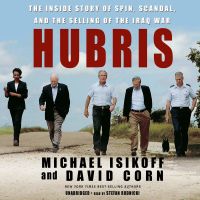
HubrisMichael Isikoff, David Corn18h 55m4.0 (2.3K)$32
50 Things They Don't Want You to KnowJerome Hudson7h 45m4.2 (323)$26 · $0.00
The Devil's ChessboardDavid Talbot25h 23m4.3 (10.4K)$53 · $0.00
Legacy of AshesTim Weiner21h 37m4.2 (16.9K)$28

The Real Anthony FauciKennedy Jr., Robert F27h 50m4.4 (34.2K)Free
UNDER WESTERN EYESJoseph Conrad36h 41m3.7 (5.7K)$1 · $0.00

How to Lose the Information WarNina Jankowicz9h 26m4.0 (615)$20
Internet Research Agency IndictmentRobert S. Mueller III2h 18m$1 · $0.00
Thirty Years of Treason, Vol. 1Eric Bentley13h 17m4.4 (49)$23
Red ScarePatricia Anne Dunleavy5h 1m$10 · $0.00