
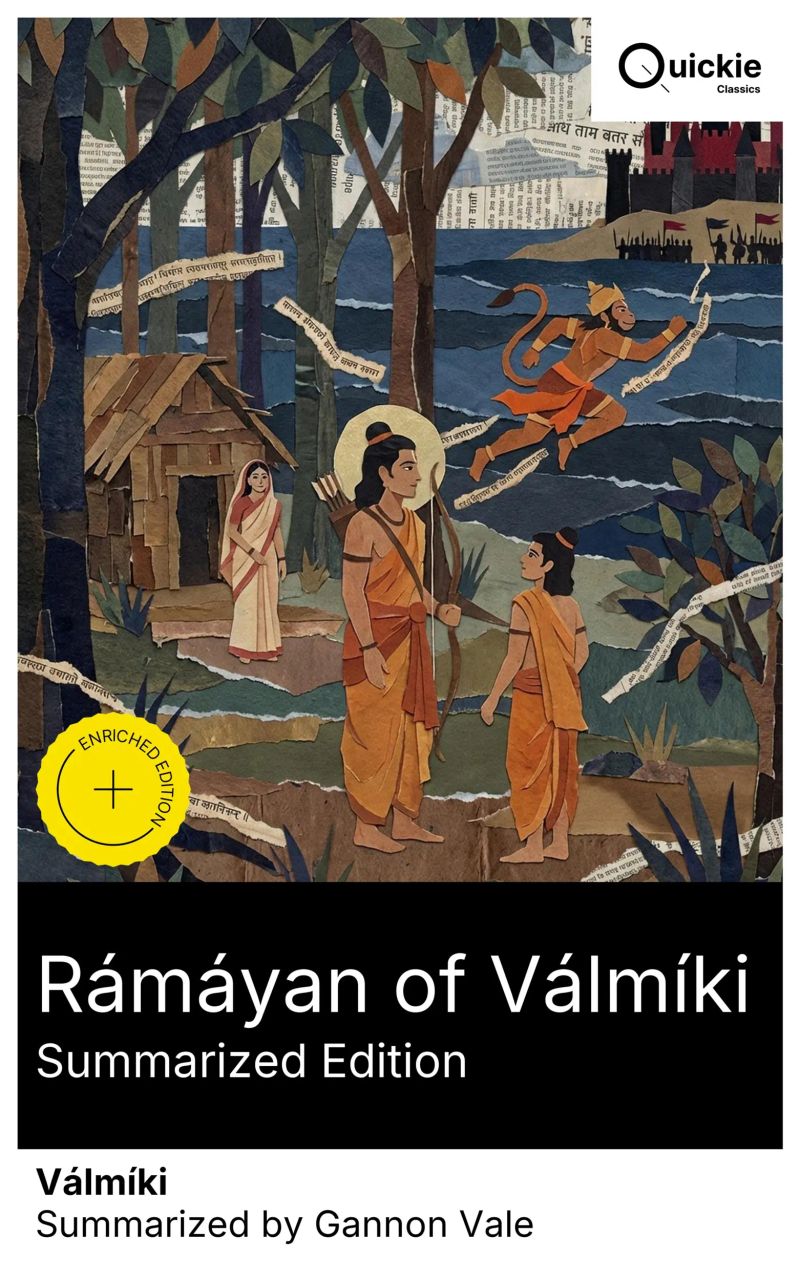
Rámáyan of Válmíki (Summarized Edition)
Enriched edition. Ancient Sanskrit epic of dharma and devotion: Ayodhya's exile, Sita's abduction, Hanuman's feat, and Lanka's siege - Griffith's translationDe Válmíki


Duração7h 26m
Sobre este audiolivro
The Rámáyan of Válmíki, the Sanskrit ādi-kāvya, narrates Rāma's exile, Sītā's abduction, alliance with the vānaras, Hanumān's leap to Laṅkā, and Rāvaṇa's defeat across seven kāṇḍas. In lucid anuṣṭubh ślokas, it marries itihāsa and kāvya, exploring dharma, kingship, and fidelity. Its disciplined similes and symmetrical design shaped aesthetics from classical India to Southeast Asian performance and devotion. Little is certain of Válmíki beyond tradition naming him Ādi Kavi. Legend recasts the reformed bandit Ratnākara, whose grief at a felled krauñca births the first śloka. The poem's frame—Sītā sheltered at the hermitage; the twins Lava and Kuśa taught to sing before Rāma—locates authorship in an ascetic witness attuned to speech, justice, and the cost of virtue. Readers of epic literature, ethics, and political thought will find this work inexhaustible: a rigorously patterned narrative that invites close comparison with later retellings and commentarial traditions. In Sanskrit or translation, the Rámáyan of Válmíki rewards attentive reading, stirring reflection on right action amid love, loyalty, violence, and statecraft.
Quickie Classics summarizes timeless works with precision, preserving the author's voice and keeping the prose clear, fast, and readable—distilled, never diluted. Enriched Edition extras: Introduction · Synopsis · Historical Context · Author Biography · Brief Analysis · 4 Reflection Q&As · Editorial Footnotes.
Detalhes do audiolivro
GêneroPoetry
Duração7 h 26 min
Narrado porOuça com mais de 1.000 vozes
FormatoeBook com áudio
Data de publicação12 de jan. de 2026
IdiomaInglês
Sumário
1Introduction
9Book 3.
2Introduction
10Book 4.
3Synopsis
11Book 5.
4Historical Context
12Book 6.
5Author Biography
13Appendix.
Mostrar todos os capítulosVer menos
6Invocation.
14Additional Notes.
7Book 1.
15Analysis
8Book 2.
16Reflection
Mais de Válmíki

The Complete Poetry (The Classic Illustrated Edition)Samuel Taylor Coleridge26h 23min4.6 (1.3K)$1.99 · $0.00

The Weary Blues (Annotated)Langston Hughes2h 13min4.5 (4.6K)$2 · $0.00

The Complete Poetical Works of Edgar Allan Poe (Illustrated)Edgar Allan Poe18h 27min4.5 (4.2K)$2 · $0.00

The Complete Poetry (Annotated)Oscar Wilde6h 44min4.5 (15.5K)$2 · $0.00
Saundarya LahariUnknown Author3h 16min4.6 (256)$18 · $0.00
The Mesnevi (Annotated)Maulana Jalal al-Din Rumi18h 41min4.5 (4.2K)$2 · $0.00

Songs of a SourdoughRobert W. Service2h 13min4.5 (13.6K)$1 · $0.00
Little Flower of Jesus (Annotated)Thérèse of Lisieux5h 4min4.5 (1.4K)$1.99 · $0.00

The Poems of LeopardiGiacomo Leopardi3h 9min4.5 (3.6K)$2 · $0.00

Nikki Giovanni: Love Poems & A Good CryNikki Giovanni2h 44min4.6 (405)$18 · $0.00

The Complete Poetry of Walt Whitman (Annotated)Walt Whitman19h 58min4.5 (4.2K)$1.99 · $0.00
A Year with RumiColeman Barks5h 56min4.5 (2.6K)$24 · $0.00
Complete Poetry of Rudyard Kipling (Annotated)Rudyard Kipling22h 50min4.5 (2.6K)$3.99 · $0.00
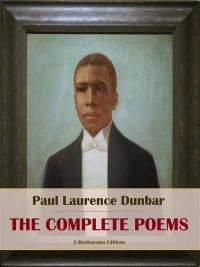
The Complete PoemsPaul Laurence Dunbar12h 40min4.5 (1.5K)$21 · $0.00

The Odes of John Keats - Complete CollectionJohn Keats22h 16min4.5 (1.3K)$1 · $0.00

PoemsEdna St. Vincent Millay2h 39min4.5 (1.3K)$2 · $0.00
PoemsW. B. Yeats5h 6min4.4 (46.9K)$1 · $0.00
Metamorphoses (Annotated)Ovid28h 37min4.3 (80.8K)$2 · $0.00

THE FLOWERS OF EVILCharles Baudelaire2h 28min4.3 (94.6K)$1.99 · $0.00
A Book of Strife in the Form of The Diary of an Old SoulGeorge MacDonald2h 9min4.4 (839)$2 · $0.00
Você também pode gostar
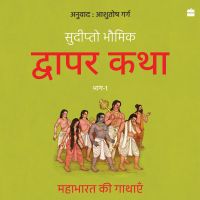
Dwapar KathaSudipta Bhawmik11h 56min4.5 (294)$29 · $0.00
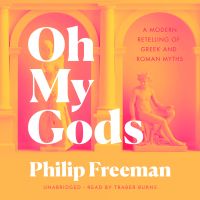
Oh My GodsPhilip Freeman13h 12min3.9 (1.1K)$23
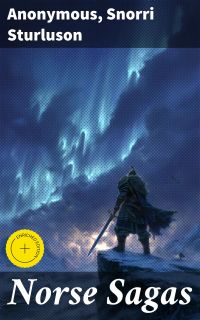
Norse SagasAnonymous, Snorri Sturluson101h 14min4.4 (2K)$1 · $0.00

Le Morte d'Arthur (Annotated)Thomas Malory35h 53min4.1 (45.7K)$2 · $0.00
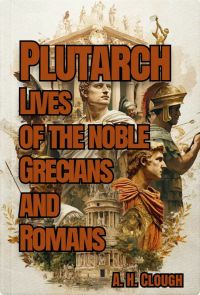
Plutarch: Lives of the noble Grecians and RomansBy A. H. Clough78h 16min4.2 (2.1K)Grátis

The Kebra NagastAnonymous10h 26min4.3 (3.2K)$1.99 · $0.00

The Kebra NagastAnonymous10h 20min4.2 (1.4K)$1 · $0.00
Indian Fairy TalesJoseph Jacobs, John Dickson Batten6h 10min3.8 (1.5K)$2.30
Dwapar KathaSudipta Bhawmik11h 30min4.3 (298)$29 · $0.00
The RamayanaValmiki58h 18min4.3 (21K)$2.30
The Story of the Grail and the Passing of ArthurHoward Pyle9h 10min4.1 (635)$20

HeimskringlaSnorri Sturluson33h 17min4.4 (2.7K)$1.99 · $0.00

The Book of RomanceVarious6h 32min4.0 (1.4K)$2 · $0.00
The History of the Kings of BritainGeoffrey of Monmouth10h 25min4.0 (9.9K)$21 · $0.00
Wonder Book & Tanglewood Tales – Greatest Stories from Greek Mythology for Children (Illustrated Unabridged Edition)Nathaniel Hawthorne12h 47min4.3 (1.3K)$2 · $0.00
The OdysseyHomer11h 45min4.1 (1.4M)$2
Three Tales: A Simple Heart, Saint Julian the Hospitalier and Herodias (Complete Edition) (Annotated)Gustave Flaubert5h 14min3.8 (11.7K)$1.99 · $0.00

The Mabinogion (Annotated)Lady Charlotte Guest11h 38min4.1 (8.5K)$1.99 · $0.00
The Myths & Legends of Ancient Greece and RomeE.M. Berens13h 20min4.0 (3.4K)$1.99 · $0.00
Norse LegendsSnorri Sturluson, Anonymous101h 26min4.3 (1.2K)$1.99 · $0.00