
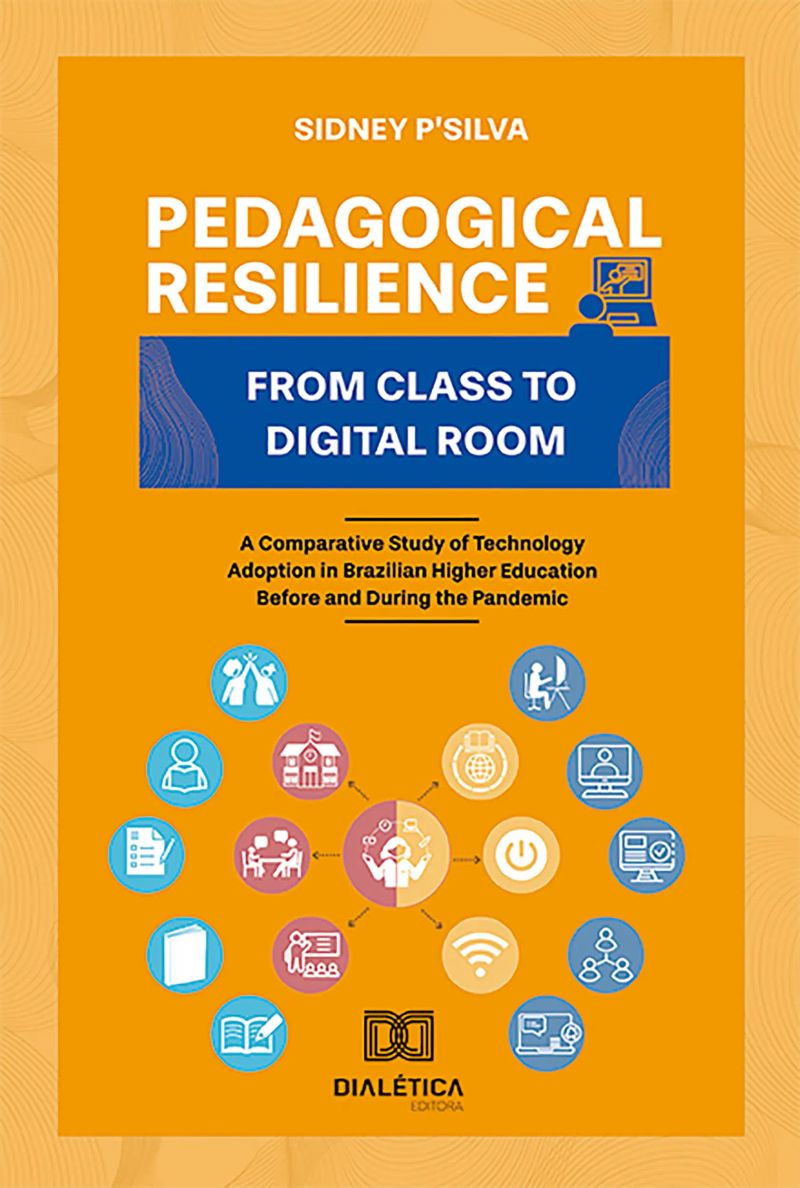
Pedagogical Resilience, from Class to Digital Room
a Comparative Study of Technology Adoption in Brazilian Higher Education Before and During the PandemicDe Sidney Pereira Da Silva


Duração4h 44m
Sobre este audiolivro
With the rise of digital technology, educators must adapt quickly, especially in higher education. "Pedagogical Resilience, from Class to Digital Room" examines how Brazilian educators addressed technology adoption during the pandemic. It sheds light on their experiences, challenges, and innovative strategies for integrating technology into higher education during COVID-19.
The book provides insights into local and international educational landscapes by placing Brazil in the global discussion. The research reveals how educators' preferences, subject matter, and institutional policies influence technology adoption. These aspects help us understand how pedagogy and technology intersect in different contexts and open for discussion about how decision-makers may impact students' development.
This research also led to the development of the "Inverted Mirror" instrument. This tool helps visualize comparisons and uncover hidden aspects in qualitative and comparative studies. Initiated at Stockholm University as part of a master's degree in International and Comparative Education, the research received support from professors who confirmed the instrument's relevance. A dedicated section in the book explains the "Inverted Mirror" instrument's functionalities and components.
This book invites readers to learn from Brazilian educators' experiences and explore how technology is changing teaching methods.
Detalhes do audiolivro
GêneroEducation and Learning
Duração4 h 44 min
Narrado porOuça com mais de 1.000 vozes
FormatoeBook com áudio
Data de publicação27 de jun. de 2024
IdiomaInglês
Sumário
1I. ACKNOWLEDGEMENTS
2II. FOREWORD
3III. PREFACE
4IV. LIST OF ABBREVIATIONS
5V. LIST OF FIGURES
Mostrar todos os capítulosVer menos
6VI. LIST OF TABLES
7PART ONE
8A STEP BEFORE THE CREATION
9THE RISE OF AN IDEA AND THE STIMULUS OF IMAGINATION
10CREATING THE INVERTED MIRROR INSTRUMENT
11THE COMPONENTS OF THE ‘INVERTED MIRROR’ INSTRUMENT
12PART TWO: OVERVIEW
13OVERVIEW
14I. INTRODUCTION
15AIMS, OBJECTIVES AND RESEARCH QUESTIONS
16RELEVANCE OF STUDY
17LIMITATIONS OF THE STUDY
18II. KEY CONCEPTS AND BACKGROUND
19TECHNOLOGICAL RESOURCES
20INFORMATION AND COMMUNICATIONS TECHNOLOGY AND TECHNOLOGY ENHANCED LEARNING
21THE LEARNING FORMS: DISTANCE, BLENDED AND HYBRID LEARNING
22THE BRAZILIAN CONTEXT
23III. PREVIOUS RESEARCH
24LITERATURE REVIEW IN NUMBERS
25COMMON ASPECTS HIGHLIGHTED BY PREVIOUS STUDIES
26MYTHS ABOUT THE PEDAGOGICAL USE OF TECHNOLOGY IN EDUCATION
27PEDAGOGY AND THE ROLE OF THE TEACHER
28IV. METHODOLOGY
29ONTOLOGICAL AND EPISTEMOLOGICAL ASSUMPTIONS
30RESEARCH DESIGN AND RESEARCH STRATEGY
31SAMPLING
32THE INSTRUMENT
33DATA COLLECTION
34DATA ANALYSIS
35QUALITY CRITERIA
36ETHICAL CONSIDERATIONS
37MIXED METHODS INTEGRATION
38INVERTED MIRROR INSTRUMENT
39V. RESULTS AND DISCUSSION
40PARTICIPANTS’ PROFILES
41COMPARING BEFORE AND DURING THE PANDEMIC
42TECHNOLOGICAL RESOURCES INTEGRATION
43PROFESSIONAL DEVELOPMENT AND SUPPORT PROVIDED BY THE INSTITUTIONS
44TEACHERS’ PERCEPTIONS ENGAGEMENT ABOUT STUDENTS’ ENGAGEMENT
45WORKFLOW AND ORGANIZATION
46CHALLENGES, POSITIVE AND NEGATIVE IMPACT
47VI. CONCLUSION: CONNECTING THE RESULTS AND RESEARCH QUESTION
48VII. FUTURE RESEARCH
49PART THREE
50INTERVIEW GUIDE

A Brief History of IntelligenceMax S. Bennett12h 18min4.6 (6.6K)$29 · $0.00

HomeschooledStefan Merrill Block7h 10min3.6 (18.5K)$28 · $0.00

The State Must ProvideAdam Harris7h 15min4.5 (775)$24 · $0.00

The Call of the Wild and FreeAinsley Arment9h 7min4.4 (21.2K)$29 · $0.00
The Freelance WayRobert Vlach19h 48min4.5 (528)$40 · $0.00

Race to the BottomLuke Rosiak9h 20min4.5 (600)$29 · $0.00

They Came for the SchoolsMike Hixenbaugh9h 5min4.5 (2.6K)$8 · $0.00

Find Me UnafraidKennedy Odede, Jessica Posner11h 11min4.5 (2.7K)$29 · $0.00

World's Best Inspirational Books to Change Your Life (3 Books)Napoleon Hill, Joseph Murphy, Dale Carnegie29h 38min4.5 (1.3K)$20 · $0.00

Asking for ItKate Harding8h 55min4.4 (5.3K)$20 · $0.00

MeditationsMarcus Aurelius4h 26min4.4 (456.8K)$1 · $0.00

Defining Moments in Black HistoryDick Gregory7h 37min4.4 (6K)$26 · $0.00

Learning AmericaLuma Mufleh6h 37min4.4 (564)$24 · $0.00
Math-ishJo Boaler7h 21min4.4 (588)$24 · $0.00

Daddy-Long-LegsJean Webster12h 18min4.2 (91K)$0.99 · $0.00
It Worked For MeColin Powell7h 42min4.3 (9.8K)$26 · $0.00

Grammar-land; Or, Grammar in Fun for the Children of Schoolroom-shireM. L. Nesbitt2h 36min4.4 (488)$1 · $0.00

Financial FeministTori Dunlap8h 3min4.2 (22.2K)$8 · $0.00

DarkwaterWilliam Edward Burghardt Du Bois6h 40min4.3 (1.4K)$11 · $0.00

The Highway Code UKDepartment for Transport3h 33min4.2 (36.6K)$11 · $0.00
Você também pode gostar

The Law of SuccessNapoleon Hill24h 4min4.4 (18.2K)$10 · $0.00
The Art of ImpossibleSteven Kotler9h 17min4.2 (10K)$29 · $0.00

Your Invisible PowerGeneviève Behrend4h 58min4.2 (5.5K)$0.99 · $0.00
The Personal Correspondence of George Sand & Gustave FlaubertGustave Flaubert, George Sand14h 46min4.1 (300)$0.99 · $0.00

ACRES OF DIAMONDSRussell Conwell1h 33min4.2 (15.3K)$2 · $0.00

Rules for the Direction of the MindRené Descartes1h 34min3.9 (1K)$2 · $0.00

The Ethics of Immanuel KantImmanuel Kant22h 12min4.2 (274)$1.99 · $0.00

The Life of Reason: The Phases of Human ProgressGeorge Santayana23h 18min4.3 (340)$1 · $0.00
The Master CoachGregg Thompson6h 3min4.1 (652)$30

Once Upon a StrangerDr. Gillian Sandstrom8h 31min4.3 (467)$26 · $0.00
The law of success - Lesson Six IMAGINATIONNapoleon Hill1h 57min4.4 (859)$4.60 · $0.00
Think and Grow RichNapoleon Hill13h 1min4.2 (513.9K)$20

How To Master High-Level ThinkingElton Thomas6h 48min4.2 (22)$9.99
Creativity RulesTina Seelig5h 12min3.9 (535)$24 · $0.00

The Greatest Works of Immanuel KantImmanuel Kant83h 28min4.4 (142)$0.99 · $0.00
JOHN DEWEY Premium Collection – 40+ Books in One Single Volume: Works on Psychology, Education, Philosophy & Politics (Annotated)John Dewey168h 33min4.4 (44)$1.99 · $0.00
Improvisation, Inc.Robert Lowe8h 48min$20

The Power of Sympathy: Politics and Moral Sentimentalism - A Conversation with Michael FrazerHoward Burton2h 5min$3

John Dewey: The Philosophy of EducationJohn Dewey33h 59min4.0 (64)$1 · $0.00

The Job Hunt BlueprintAmelia L. Kingsley6h 19min$4.10 · $0.00