
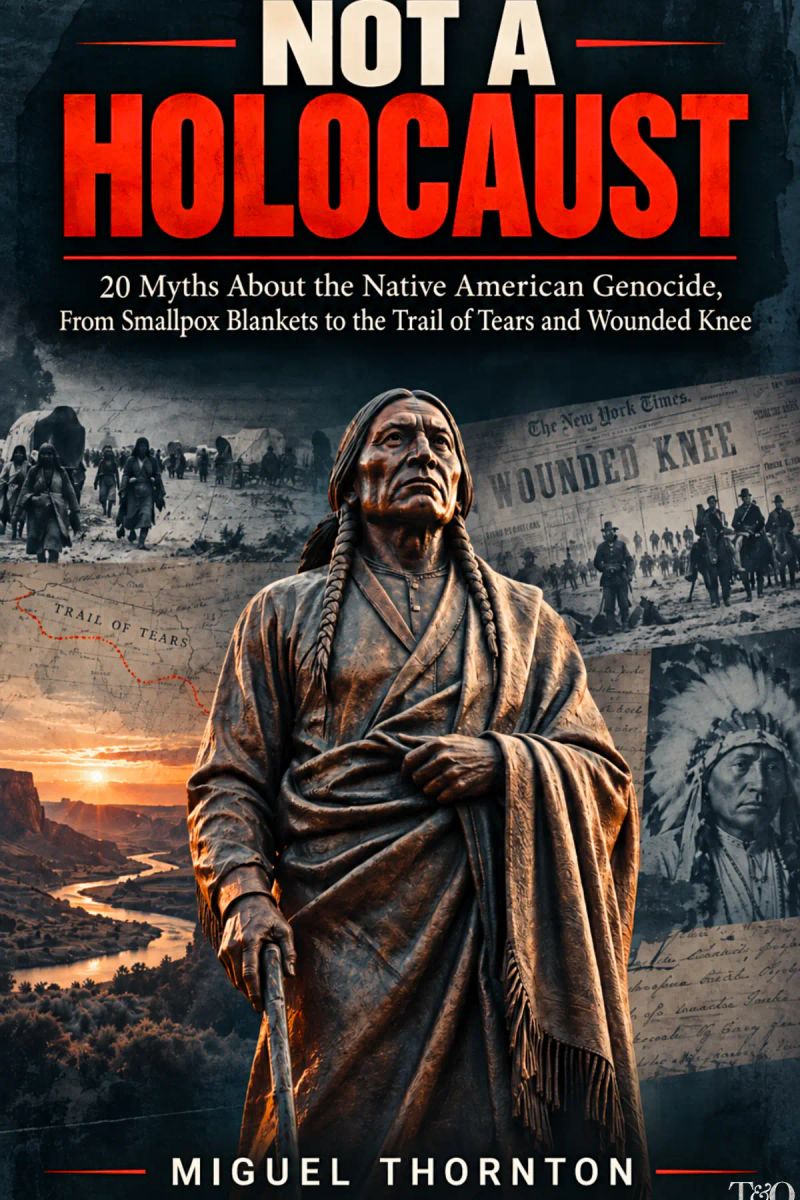
Not a Holocaust
20 Myths About the Native American Genocide, From Smallpox Blankets to the Trail of Tears and Wounded KneeDe Miguel Thornton


Duração3h 47m
Sobre este audiolivro
Classrooms and documentaries now describe the conquest of Native America as a planned extermination on the model of the Holocaust. Critics of that charge often dismiss the suffering along with the label. The archives support neither position.
This book tests the most repeated claims against letters, treaties, court rulings and census counts, and separates what the record proves from what it refutes.
The smallpox-blanket letters are real, but British officers wrote them at Fort Pitt in 1763, thirteen years before independence. The American version, set among the Mandan in 1837, rests largely on an account a University of Colorado committee found fabricated in 2006. General Sherman urged war on the Sioux “even to their extermination,” yet in 1869 President Grant told Congress that a system aimed at the extinction of a race was “too horrible” to adopt.
Detalhes do audiolivro
GêneroHistory, True Crime
Duração3 h 47 min
Narrado porOuça com mais de 1.000 vozes
FormatoeBook com áudio
Data de publicação25 de nov. de 2026
IdiomaInglês
Sumário
1Opening
2Introduction
3Chapter 1: A Planned, Nazi-Style Extermination
4Chapter 2: Smallpox Blankets
5Chapter 3: The Myth of the Peaceful Continent
Mostrar todos os capítulosVer menos
6Chapter 4: Columbus and the Origins of Genocide
7Chapter 5: The Trail of Tears
8Chapter 6: Treaties, Purchases, and the Land Question
9Chapter 7: Wounded Knee
10Chapter 8: The Buffalo and the Plains Tribes
11Chapter 9: The Boarding Schools
12Chapter 10: An Exception in World History?
13Chapter 11: Violence on Both Sides of the Frontier
14Chapter 12: What Population Numbers Actually Prove
15Chapter 13: Thanksgiving and the Wampanoag Alliance
16Chapter 14: The Five Civilized Tribes as Victims
17Chapter 15: Treaties Broken on Both Sides
18Chapter 16: Was the West Simply Stolen?
19Chapter 17: Empires Before Columbus
20Chapter 18: Reading the Actual Policy Record
21Chapter 19: The Horse, the Pueblo, and the Myth of Original Peace
22Chapter 20: History, Guilt, and What Comes Next
23Conclusion
24About the Publisher
Séries
Mais de Miguel Thornton

Blame It on LBJMiguel Thornton 4h 54min$4.99 · $0.00

No Plank, No Parrot, No Peg LegMiguel Thornton3h 41min$4.99 · $0.00
The Poverty MythMiguel Thornton5h 8min$4.99 · $0.00

Trump, Out of ContextMiguel Thornton3h 19min$4.99 · $0.00
Everything You Know About the Samurai Is WrongMiguel Thornton2h 51min$4.99 · $0.00
The JFK They Sold YouMiguel Thornton2h 49min$4.99 · $0.00

Area 51: What They Were Really HidingMiguel Thornton4h 3min$4.99 · $0.00

America Won More Wars Than You ThinkMiguel Thornton4h 48min$4.99 · $0.00

The Real Opus DeiMiguel Thornton3h 45min$4.99 · $0.00

Trump UnmaskedMiguel Thornton3h 47min$4.99 · $0.00

Reagan VindicatedMiguel Thornton2h 10min$4.99 · $0.00

20 Myths About White Americans and SlaveryMiguel Thornton 4h 48min$4.99 · $0.00

Serial Killers Aren’t Who You ThinkMiguel Thornton 3h 58min$4.99 · $0.00

Why Serial Killers DisappearedMiguel Thornton 3h 43min$4.99 · $0.00

A Brief History of IntelligenceMax S. Bennett12h 18min4.6 (6.6K)$29 · $0.00

Ghosts of HiroshimaCharles Pellegrino8h 59min4.5 (877)$23

Medium RawAnthony Bourdain9h4.1 (65.6K)$29 · $0.00

Suicidal EmpathyGad Saad8h 24min4.1 (736)$28 · $0.00

How Soccer Explains the WorldFranklin Foer7h 22min3.9 (14.9K)$24 · $0.00
The Assassination of Leon TrotskyH. Keith Melton, Nigel West14h 8min$33 · $0.00

All American PatriotismRachel Campos-Duffy8h 53min$29 · $0.00

History of the Decline and Fall of the Roman Empire — Volume 1Edward Gibbon20h 18min4.3 (14.6K) · 1334Grátis

We Crossed a Bridge and It TrembledWendy Pearlman6h4.6 (5.2K)$24 · $0.00

Unbroken Bonds of BattleJohnny Joey Jones8h 31min4.6 (2.6K)$8 · $0.00

The Daughter of AuschwitzTova Friedman, Malcolm Brabant7h 54min4.6 (16.7K)$26 · $0.00

Lily's PromiseLily Ebert, Dov Forman8h 54min4.6 (16.1K)$29 · $0.00

On Democracies and Death CultsDouglas Murray10h 38min4.6 (6.5K)$29 · $0.00

Across the RiverKent Babb11h 40min4.6 (927)$29 · $0.00

Balcony Over Jerusalem: A Middle East Memoir - Israel, Palestine and BeyondJohn Lyons12h 37min4.6 (1.4K)$33 · $0.00

BeyondStephen Walker15h 39min4.6 (3.2K)$33 · $0.00
Kings and PawnsHoward Bryant10h 9min4.6 (678)$29 · $0.00

No EscapeNury Turkel9h 30min4.6 (809)$28 · $0.00
Jubal Stone: U.S. Marshal: Blood Trail To Hell: A Western Adventure NovelCasey Nash3h 42min4.6 (3.2K)$18 · $0.00

Fall and RiseMitchell Zuckoff17h 23min4.6 (9.8K)$40 · $0.00
The Assassination of Leon TrotskyH. Keith Melton, Nigel West14h 8min$33 · $0.00

The Cause of DeathCynric Temple-Camp8h 59min4.4 (1.4K)$29 · $0.00

GanglandJared Savage9h 21min4.4 (1.4K)$29 · $0.00
Riding with EvilKen Croke, Dave Wedge9h 42min4.3 (3.4K)$29 · $0.00

The Two FBIsNicole Parker10h 8min4.4 (499)$29 · $0.00
I Catch KillersGary Jubelin15h 32min4.3 (6.6K)$33 · $0.00
The Redemption Of Bobby LoveBobby Love, Cheryl Love9h 13min4.4 (956)$29 · $0.00

The Life We ChoseMatt Birkbeck8h 57min4.4 (1K)$29 · $0.00

The Truth About AaronJonathan Hernandez5h 15min4.3 (2.5K)$24 · $0.00

No Ordinary BirdArtis Henderson6h 23min4.4 (597)$24 · $0.00

I'll Be Gone in the DarkMichelle McNamara10h 7min4.3 (302.5K)$29 · $0.00

Beyond the Body FarmBill Bass, Jon Jefferson6h 17min4.3 (10.2K)$24 · $0.00

The Killer Across the TableJohn E. Douglas, Mark Olshaker11h 7min4.3 (37.5K)$8 · $0.00

Inside the CartelMartin Suarez, Ian Frisch10h 50min4.4 (583)$29 · $0.00

White Hot HateDick Lehr12h 27min4.3 (1.4K)$29 · $0.00
Scarface and the UntouchableMax Allan Collins, A. Brad Schwartz18h 35min4.3 (2.4K)$40 · $0.00

Hack AttackNick Davies18h 7min4.3 (2.4K)$23 · $0.00

Russians Among UsGordon Corera12h 48min4.3 (4.1K)$33 · $0.00

Broken FaithMitch Weiss, Holbrook Mohr12h 19min4.2 (5K)$27 · $0.00

Member of the FamilyDianne Lake, Deborah Herman12h 30min4.2 (11.8K)$33 · $0.00
Você também pode gostar
Recollections of a Confederate Staff OfficerG. Moxley Sorrel8h 37min4.3 (563)$1.99 · $0.00
Co. AytchSam R. Watkins9h 3min4.3 (7.4K)$20

The Civil War: A Narrative, Vol. 2Shelby Foote52h 41min4.6 (11.7K)$30

The Polar Bear ExpeditionJames Carl Nelson8h 7min3.8 (1.1K)$26 · $0.00

Memoirs of a Confederate Staff OfficerGilbert Moxley Sorrel9h 40min4.3 (749)$1 · $0.00

Recollections of a Private Soldier in the Army of the PotomacFrank Wilkeson5h 8min4.2 (593)$20
Four Years in the Stonewall BrigadeJohn O. Casler11h 20min4.3 (614)$23

Paris under the CommuneJohn Leighton14h 53min$2 · $0.00

Napoleon in Russia: A Multi-Faceted Historical ViewCarl Von Clausewitz, Edward Foord, Vasily Vereshchagin, Comte de Philippe-Paul Ségur, Adrien Bourgogne64h 19min$1.99 · $0.00

Destruction and Reconstruction: Civil War MemoirsRichard Taylor10h 34min3.9 (108)$1.99 · $0.00

Destruction and Reconstruction: Personal Experiences from the Civil War (Annotated)Richard Taylor10h 37min3.9 (108)$2 · $0.00

British Campaigns in Flanders 1690-1794J. W. Sir Fortescue13h 12min$2 · $0.00

Chancellorsville and GettysburgAbner Doubleday6h 55min3.9 (482)$7.40

Indian WarsAlexander Scott Withers, Joseph Kossuth Dixon, Black Hawk, Charles M. Scanlan, Enoch Lawrence Lee36h 26min4.1 (17)$1.99 · $0.00

Ladysmith The Diary Of A SiegeHenry Woodd Nevinson6h 33min$2.30

The Battle of Ezra Church and the Struggle for AtlantaEarl J. Hess8h 29min4.2 (54)$20

Calcutta: Past and PresentKathleen Blechynden5h 29min3.9 (36)$1 · $0.00

Reminiscences of the Civil War, 1861-1865Preston Lafayette Ledford2h 54min$1 · $0.00

Vietnam War: A Complete History of Conflict, Politics, and Human CostRaymond Webb57min$3.40 · $0.00

The History of the Black Hawk War & Autobiography of the Sauk Leader, the Great Black HawkBlack Hawk, Charles M. Scanlan9h 6min4.7 (11)$1.99 · $0.00