
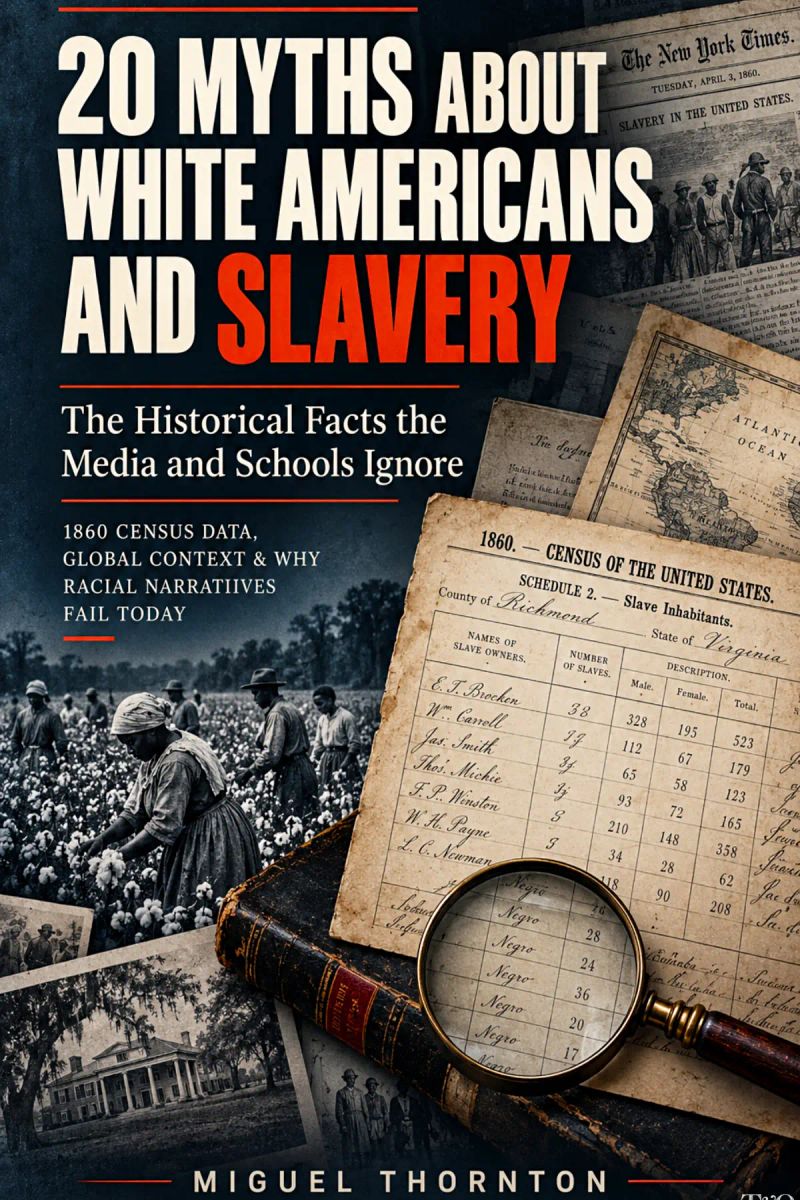
20 Myths About White Americans and Slavery
The Historical Facts the Media and Schools Ignore — 1860 Census Data, Global Context & Why Racial Narratives Fail TodayDe Miguel Thornton

Duração4h 47m
Sobre este audiolivro
Most arguments about slavery and race in America are won by whoever sounds more certain. The documents that could settle them rarely enter the conversation.
This book brings them in. Twenty widely repeated claims, from the progressive account and the conservative one alike, are each traced to the record behind them, so you can answer a claim with its source instead of another slogan.
The 1860 slave schedules list 393,975 slaveholders. Divided by the national population, slaveholding looks marginal; counted by free families in the eleven Confederate states, it comes close to 31 percent. Alexander Stephens told a Savannah crowd, three weeks before Fort Sumter, that the Confederacy’s cornerstone was Black inferiority, then spent his postwar years recasting the war as a contest over state sovereignty.
Detalhes do audiolivro
GêneroHistory, Politics and Government
Duração4 h 47 min
Narrado porOuça com mais de 1.000 vozes
FormatoeBook com áudio
Data de publicação24 de nov. de 2026
IdiomaInglês
Sumário
1Opening
2Introduction
3Chapter 1: Who Actually Owned Slaves in 1860
4Chapter 2: A World Built on Bondage Long Before Jamestown
5Chapter 3: The Rebellion Inside the Rebellion
Mostrar todos os capítulosVer menos
6Chapter 4: 1776 and the Argument That Outlived Its Authors
7Chapter 5: What the Men Who Started It Said They Were Fighting For
8Chapter 6: A Southern System, Not a National One
9Chapter 7: What the Roll Call Actually Says
10Chapter 8: The Lynching No One Remembers
11Chapter 9: What the Income Data Actually Shows
12Chapter 10: Before and After
13Chapter 11: A Slogan, Two Reports, and a Retraction
14Chapter 12: The Numbers a Genocide Would Have to Produce
15Chapter 13: The Ruling, the Ratings, and What King Actually Wrote
16Chapter 14: A Legal Theory, a Bestseller, and a Study From Harvard's Own Sociology Department
17Chapter 15: The Task Force's Own Vote
18Chapter 16: The Word That Never Appears
19Chapter 17: A Painting Preference Was Enough
20Chapter 18: Four Percent to Ninety-Four
21Chapter 19: The Numbers, the Law, and the Word That Shouldn't Get Used Loosely
22Chapter 20: The Gap Between What We Believe and What We Think Everyone Else Believes
23Conclusion
24About the Publisher
Mais de Miguel Thornton

Blame It on LBJMiguel Thornton 4h 54min$4.99 · $0.00

No Plank, No Parrot, No Peg LegMiguel Thornton3h 41min$4.99 · $0.00
The Poverty MythMiguel Thornton5h 8min$4.99 · $0.00

Trump, Out of ContextMiguel Thornton3h 19min$4.99 · $0.00

Everything You Know About the Samurai Is WrongMiguel Thornton2h 51min$4.99 · $0.00

Not a HolocaustMiguel Thornton3h 47min$4.99 · $0.00

The JFK They Sold YouMiguel Thornton2h 49min$4.99 · $0.00

Area 51: What They Were Really HidingMiguel Thornton4h 3min$4.99 · $0.00

America Won More Wars Than You ThinkMiguel Thornton4h 48min$4.99 · $0.00

The Real Opus DeiMiguel Thornton3h 45min$4.99 · $0.00

Trump UnmaskedMiguel Thornton3h 47min$4.99 · $0.00

Reagan VindicatedMiguel Thornton2h 10min$4.99 · $0.00

Serial Killers Aren’t Who You ThinkMiguel Thornton 3h 58min$4.99 · $0.00

Why Serial Killers DisappearedMiguel Thornton 3h 43min$4.99 · $0.00

A Brief History of IntelligenceMax S. Bennett12h 18min4.6 (6.6K)$29 · $0.00

Ghosts of HiroshimaCharles Pellegrino8h 59min4.5 (877)$23
Medium RawAnthony Bourdain9h4.1 (65.6K)$29 · $0.00

Suicidal EmpathyGad Saad8h 24min4.1 (736)$28 · $0.00

How Soccer Explains the WorldFranklin Foer7h 22min3.9 (14.9K)$24 · $0.00
The Assassination of Leon TrotskyH. Keith Melton, Nigel West14h 8min$33 · $0.00

All American PatriotismRachel Campos-Duffy8h 53min$29 · $0.00

History of the Decline and Fall of the Roman Empire — Volume 1Edward Gibbon20h 18min4.3 (14.6K) · 1334Grátis

We Crossed a Bridge and It TrembledWendy Pearlman6h4.6 (5.2K)$24 · $0.00

Unbroken Bonds of BattleJohnny Joey Jones8h 31min4.6 (2.6K)$8 · $0.00

The Daughter of AuschwitzTova Friedman, Malcolm Brabant7h 54min4.6 (16.7K)$26 · $0.00

Lily's PromiseLily Ebert, Dov Forman8h 54min4.6 (16.1K)$29 · $0.00

On Democracies and Death CultsDouglas Murray10h 38min4.6 (6.5K)$29 · $0.00

Across the RiverKent Babb11h 40min4.6 (927)$29 · $0.00

Balcony Over Jerusalem: A Middle East Memoir - Israel, Palestine and BeyondJohn Lyons12h 37min4.6 (1.4K)$33 · $0.00

BeyondStephen Walker15h 39min4.6 (3.2K)$33 · $0.00
Kings and PawnsHoward Bryant10h 9min4.6 (678)$29 · $0.00

No EscapeNury Turkel9h 30min4.6 (809)$28 · $0.00

Jubal Stone: U.S. Marshal: Blood Trail To Hell: A Western Adventure NovelCasey Nash3h 42min4.6 (3.2K)$18 · $0.00

Fall and RiseMitchell Zuckoff17h 23min4.6 (9.8K)$40 · $0.00
Suicidal EmpathyGad Saad8h 24min4.1 (736)$28 · $0.00

Unreasonable WomenJustine van der Leun10h 45min4.9 (13)$29 · $0.00
Unbroken Bonds of BattleJohnny Joey Jones8h 31min4.6 (2.6K)$8 · $0.00
On Democracies and Death CultsDouglas Murray10h 38min4.6 (6.5K)$29 · $0.00
Balcony Over Jerusalem: A Middle East Memoir - Israel, Palestine and BeyondJohn Lyons12h 37min4.6 (1.4K)$33 · $0.00
RiggedMollie Hemingway12h 48min4.6 (4.2K)$23 · $0.00

SledgehammerDavid Friedman8h 21min4.7 (589)$26 · $0.00

Citizenship in a Republic (Annotated)Theodore Roosevelt2h 44min4.6 (1.4K)$2 · $0.00
No EscapeNury Turkel9h 30min4.6 (809)$28 · $0.00

Always FaithfulThomas Schueman, Zainullah Zaki12h 12min4.6 (977)$29 · $0.00

UnthinkableJamie Raskin15h 8min4.5 (9.3K)$8 · $0.00

My Fourth Time, We DrownedSally Hayden13h 59min4.6 (2.9K)$23 · $0.00

A Revolution of Common SenseScott Jennings9h 29min4.6 (528)$29 · $0.00

Statement From the Dock at the Rivonia TrialNelson Mandela2h 18min4.6 (1.3K)$1 · $0.00

Lessons from the EdgeMarie Yovanovitch17h 11min4.5 (5.9K)$40 · $0.00
To Rescue the American SpiritBret Baier10h 12min4.5 (2.7K)$8 · $0.00

StonewalledSharyl Attkisson15h 19min4.5 (4.3K)$33 · $0.00
The World According to Orwell: 1984 & Animal FarmGeorge Orwell15h 38min4.6 (1.1K)$1.99 · $0.00

Basic EconomicsThomas Sowell18h 32min4.5 (29.3K)$28 · $0.00

To Rescue the RepublicBret Baier, Catherine Whitney11h 42min4.5 (8.6K)$29 · $0.00
Você também pode gostar

Slavery’s CapitalismSven Beckert, Seth Rockman13h 50min4.3 (836)$23

From Manassas to Appomattox: Memoirs of the Civil War in America (Illustrated Edition)James Longstreet24h 49min4.2 (1.3K)$2 · $0.00

Backwards and in HeelsAlicia Malone8h 10min4.2 (1.2K)$20

Voices of a People’s History of the United States, 10th Anniversary EditionHoward Zinn, Anthony Arnove31h 13min4.4 (1.2K)$30

The Collected WorksThomas Paine78h 17min4.3 (1.8K)$2 · $0.00

The Renaissance: Studies in Art and PoetryWalter Pater5h 48min4.0 (2.6K)$2 · $0.00

From Manassas to AppomattoxJames Longstreet20h 48min4.2 (1.7K)$4.99 · $0.00

A Brief History of EqualityThomas Piketty8h 44min4.2 (4.1K)$20 · $0.00

Mind is a MythU. G. Krishnamurti5h 53min4.4 (422)$2 · $0.00

AutobiographyThomas Jefferson9h 6min4.0 (2K)$2 · $0.00

Between Past and FutureHannah Arendt11h 57min4.2 (3.8K)$20
Lives of the Signers to the Declaration of Independence (Annotated)Charles Augustus Goodrich18h 54min4.2 (297)$1.99 · $0.00

Recollections of a Confederate Staff OfficerG. Moxley Sorrel8h 37min4.3 (563)$1.99 · $0.00

Du Bois: The Gift of Black Folk to AmericaW. E. B. Du Bois10h 4min4.4 (924)$1.99 · $0.00
Reform or RevolutionRosa Luxemburg2h 47min4.3 (6.8K)$5 · $0.00

Memoirs of a Confederate Staff Officer (Annotated)Gilbert Moxley Sorrel9h 45min4.3 (425)$2 · $0.00

Verizon UntetheredIvan Seidenberg, others, Scott McMurray10h 38min4.0 (83)$23 · $0.00

The DoorsGreil Marcus4h 46min3.5 (538)$14 · $0.00

The Doctrine of the Lord's Supper. As Taught by the Church of EnglandEdward Hoare1h 22min$2 · $0.00

The News Coverage Of Jb And Globo About The Fall Of The Berlin Wall (1989) And The End Of Soviet Union (1991)Célio Azevedo3h 21min$7 · $0.00