
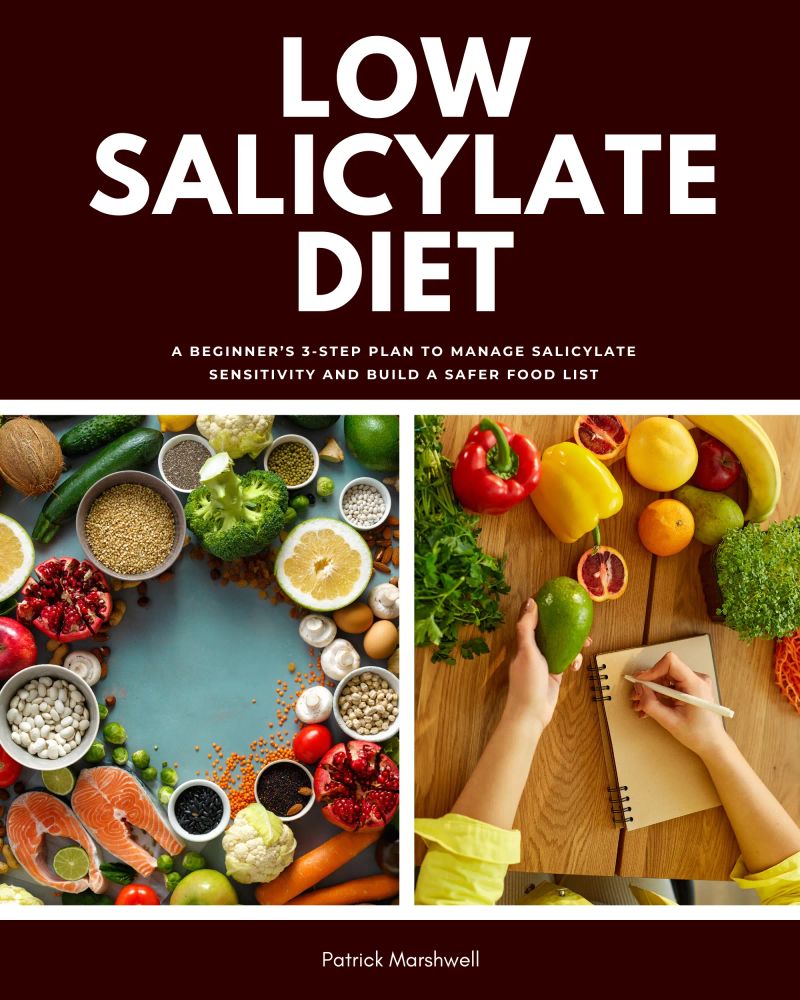
Low Salicylate Diet
A Beginner’s 3-Step Plan to Manage Salicylate Sensitivity and Build a Safer Food ListDe Patrick Marshwell


Duração2h 5m
Sobre este audiolivro
For many people struggling with unexplained physical reactions and finding little clarity through conventional allergy or intolerance testing, the idea of salicylate sensitivity often surfaces as a possible cause. Yet, when searching for reliable diagnostic criteria or clear dietary guidance, beginners are frequently met with confusion and inconsistency. Salicylate sensitivity remains an under-recognized condition, and because there are no universally agreed laboratory markers or formal medical tests, identifying it relies heavily on careful symptom tracking and dietary experimentation.
Salicylate sensitivity can influence daily life through a variety of persistent symptoms that often seem unrelated at first. Commonly reported issues include recurrent headaches, unpredictable skin rashes, respiratory symptoms such as wheezing or nasal congestion, as well as gastrointestinal discomfort like bloating or abdominal pain. For some, these flare-ups can be mild but persistent, while for others, the symptoms may be disruptive enough to affect work, sleep, or social activities. The unpredictable nature of these reactions makes living with unmanaged sensitivity both stressful and isolating.
Successfully managing salicylate sensitivity with dietary intervention requires several key skills and habits. It’s essential to become familiar with foods that naturally contain high or low salicylate levels. Some fruits, vegetables, spices, and processed foods carry significant amounts, while others remain relatively safe. Without this knowledge, even well-intended elimination efforts can be undermined, resulting in continued symptoms. Second, adopting a structured, stepwise plan makes the process manageable; this typically involves an elimination phase, careful symptom monitoring, and systematic reintroduction to establish personal tolerance thresholds. Finally, as individual tolerances may vary, constructing and updating a personalized “safe foods” list becomes central to long-term success.
It’s important to clarify the boundaries of this guide from the outset. The focus here is strictly on dietary salicylate restriction with practical guidance on minimizing intake from foods and supplements. This guide does not cover other forms of food sensitivities, such as gluten or FODMAP intolerance, nor does it address pharmacological use of salicylate-containing medications like aspirin. Additionally, detailed exploration of non-dietary exposures (such as cosmetics or household products) falls outside the intended scope, although brief mention may help readers consider these as possible variables.
In this guide, you will discover:
Clear explanations of what salicylate sensitivity is and how it manifests
Practical tools for navigating a low salicylate diet
A simple three-step elimination and reintroduction protocol to help you identify which foods are well tolerated
Methods for evaluating the salicylate content of foods, with strategies to build and maintain your own safe foods list
A 1-week meal planner, practical low-salicylate recipes, and meal-prep tips for everyday application
Troubleshooting advice for common pitfalls
Strategies for maintaining the diet when eating out or traveling
Suggestions for when to seek professional support
If you are starting this journey after years of unexplained symptoms, or if you are just exploring salicylate reduction as a next step, this guide aims to offer clear, actionable steps for self-management and greater dietary confidence.
Detalhes do audiolivro
GêneroHealth and Wellness, Self-Help
Duração2 h 5 min
Narrado porOuça com mais de 1.000 vozes
FormatoeBook com áudio
Data de publicação20 de fev. de 2026
IdiomaInglês
Sumário
1Introduction 8
2Understanding Salicylate Sensitivity (Fundamentals) 11
3Definition and Diagnostic Criteria for Salicylate Sensitivity 11
4Mechanisms: How Salicylates Cause Adverse Reactions in Sensitive Individuals 13
5Demarcation Between Food-Based and Pharmaceutical Salicylate Exposure 14
Mostrar todos os capítulosVer menos
6Prevalence Estimates and Common Risk Factors for Developing Sensitivity 15
7Artifact: Salicylate Sensitivity Self-Assessment Rule Set 17
8Foundations of the Low Salicylate Diet (Fundamentals) 20
9Key Principles: Salicylate Content Variability and the Value of Up-to-Date Food Lists 20
10Core Features Checklist: Permitted, Restricted, and Avoid Categories with Quantifiable Thresholds 22
11Overview of Nutritional Sufficiency: Meeting Essential Vitamins and Minerals on a Restricted Diet 25
12Comparison Table: Low Salicylate Diet Versus Other Elimination Diets 27
13Foundations Reference Sheet for Quick-Start Guidance 28
14Step 1 – Identifying and Tracking Dietary Salicylate Sources (Mechanisms) 31
15Taxonomy of Salicylate-Containing Foods and Beverages: Ranking the Risk 31
16Checklist for Common Hidden Salicylate Sources: Processed, Packaged, and Prepared Foods 33
17Tracking Template: 7-Day Food and Symptom Log 35
18Criteria for Identifying Potential Cross-Reactive Foods and Supplements 37
19Salicylate Source Mapping Table 38
20Practical Execution: From Identification to Baseline Assessment 39
21Step 2 – Elimination Phase Implementation (Application) 41
22Detailed 2-Week Elimination Diet Protocol with Timeline 41
23Framework: High, Moderate, and Negligible Salicylate Content Zones 43
24Initial Grocery Shopping List Builder for Elimination-Phase Compliance 45
25Checklist of Common Elimination Phase Pitfalls and Avoidance Strategies 48
26Elimination Phase Daily Compliance Checklist 51
27Step 3 – Reintroduction and Personal Threshold Testing (Application) 54
28Structured Protocol for Sequential Reintroduction 54
29Decision Framework for Interpreting Symptom Recurrence 58
30Rules of Thumb: Pacing, Rest Periods, and Minimizing Confounding Variables 59
31Building and Updating Your Safe Foods List (Execution) 61
32Stepwise Method for Compiling a Safe Foods Inventory 61
33Editable Safe Foods List Template 63
34Boundary Conditions: Evaluating Changing Food Sources, Brands, or Product Formulations 64
35Change Management Checklist for Adapting Your Safe Foods List 66
36Reference Table: Reliable Sources for Food Salicylate Content Updates 67
371-Week Low Salicylate Meal Plan (Execution) 72
38Structured 7-Day Meal Planner Grid 72
39Ingredient Selection Guide Referencing Safe Foods List 75
40Sample Meal-Prep Timeline for Batching and Reducing Contamination Risk 79
411-Week Meal Plan with Adjustable Meal Slots 81
42Sample Low Salicylate Recipes 83
43Low Salicylate Sample Recipes: Breakfast, Lunch, Dinner, and Snacks 84
44Creamy Rice Porridge (Breakfast) 85
45Egg and Chive Omelet (Breakfast or Snack) 87
46Quinoa and Chicken Salad (Lunch) 89
47Roast Turkey and Potato Medley (Lunch or Dinner) 90
48White Fish with Steamed Rice and Cabbage (Dinner) 91
49Rice Noodle and Chicken Soup (Lunch or Dinner) 92
50Mashed Potato with Chive and Turkey Sausage (Dinner) 94

What I Talk about When I Talk about RunningHaruki Murakami4h 24min4.0 (245.4K)$12

Autoimmunity and the Good GirlsSara Hirsh Bordo7h 51min$26 · $0.00

The Lost VoiceGreta Morgan8h 30min4.7 (285)$26 · $0.00

Healthy Kids, Happy KidsElisa Song14h 18min4.6 (760)$33 · $0.00
Eat It!Jordan Syatt, Michael Vacanti4h 40min4.6 (1.5K)$20 · $0.00

Consent Laid BareChanel Contos7h 11min4.5 (1.7K)$24 · $0.00

How to Make Disease DisappearRangan Chatterjee5h 26min4.5 (3.5K)$24 · $0.00

The Complete Herbal (Annotated)Nicholas Culpeper29h 8min4.5 (1.4K)$2 · $0.00

A Plague Upon Our HouseScott W. Atlas MD10h 37min4.5 (3.4K)$20 · $0.00

The Gift of TherapyIrvin Yalom7h 39min4.5 (38.8K)$26 · $0.00

EarlySarah DiGregorio9h 47min4.5 (1.3K)$29 · $0.00
Bottle of LiesKatherine Eban14h 25min4.4 (12K)$33 · $0.00
The 36-Hour DayNancy L. Mace, Peter V. Rabins17h 13min4.4 (9.2K)$28 · $0.00

FlooredSara Reardon10h 36min4.5 (1K)$29 · $0.00
Radical RemissionKelly A. Turner9h 26min4.4 (8.1K)$29 · $0.00
The Sinatra SolutionStephen T. Sinatra MD9h4.5 (899)$20 · $0.00

The Songaminute ManSimon McDermott6h 12min4.5 (280)$24 · $0.00

Sometimes BrilliantLarry Brilliant12h 27min4.5 (954)$29 · $0.00

Live Your LifeAmanda Kloots, Anna Kloots10h 54min4.4 (13.7K)$29 · $0.00

All in Her HeadElizabeth Comen13h 25min4.4 (18.2K)$33 · $0.00

A Different WayChristopher A. Hall10h 45min4.5 (165)$29 · $0.00

The Hard Thing About Hard ThingsBen Horowitz7h 57min4.2 (134.3K)$26 · $0.00

10% Happier 10th AnniversaryDan Harris9h 28min4.1 (137.1K)$29 · $0.00
The Power of the OtherHenry Cloud5h 52min4.2 (3.5K)$24 · $0.00

What You Are Looking For Is in the LibraryMichiko Aoyama7h 19min4.1 (156.7K)$24 · $0.00
The Way of ExcellenceBrad Stulberg6h 46min4.2 (1.1K)$24 · $0.00
The AlchemistPaulo Coelho4h 1min4.1 (3.9M) · 1254$23 · $0.00

Change the RecipeJosé Andrés, Richard Wolffe4h 57min4.1 (2K)$20 · $0.00

The Lucky RideYasushi Kitagawa4h 26min4.1 (1.8K)$20 · $0.00
Be ExceptionalJoe Navarro, Toni Sciarra Poynter9h 11min4.0 (1.3K)$29 · $0.00
The Subtle Art of Not Giving a F*ckMark Manson5h 18min3.9 (1.7M)$24 · $0.00

HomeschooledStefan Merrill Block7h 10min3.6 (18.5K)$28 · $0.00
Autoimmunity and the Good GirlsSara Hirsh Bordo7h 51min$26 · $0.00

The Purpose Driven® Liferick warren9h 23min4.0 (896.8K) Só no Ultra

Your Desired FutureHenry Cloud6h 43min$24 · $0.00
Learning to PrayJames Martin13h 24min4.5 (3.4K)$33 · $0.00

Forever BoyKate Swenson9h 27min4.7 (5K)$29 · $0.00

You Are Worth ItKyle Carpenter, Don Yaeger8h 53min4.7 (4.8K)$29 · $0.00

The Happiest Man on EarthEddie Jaku3h 48min4.6 (178K)$7 · $0.00

Finding MeViola Davis9h 15min4.6 (256.4K)$29 · $0.00