
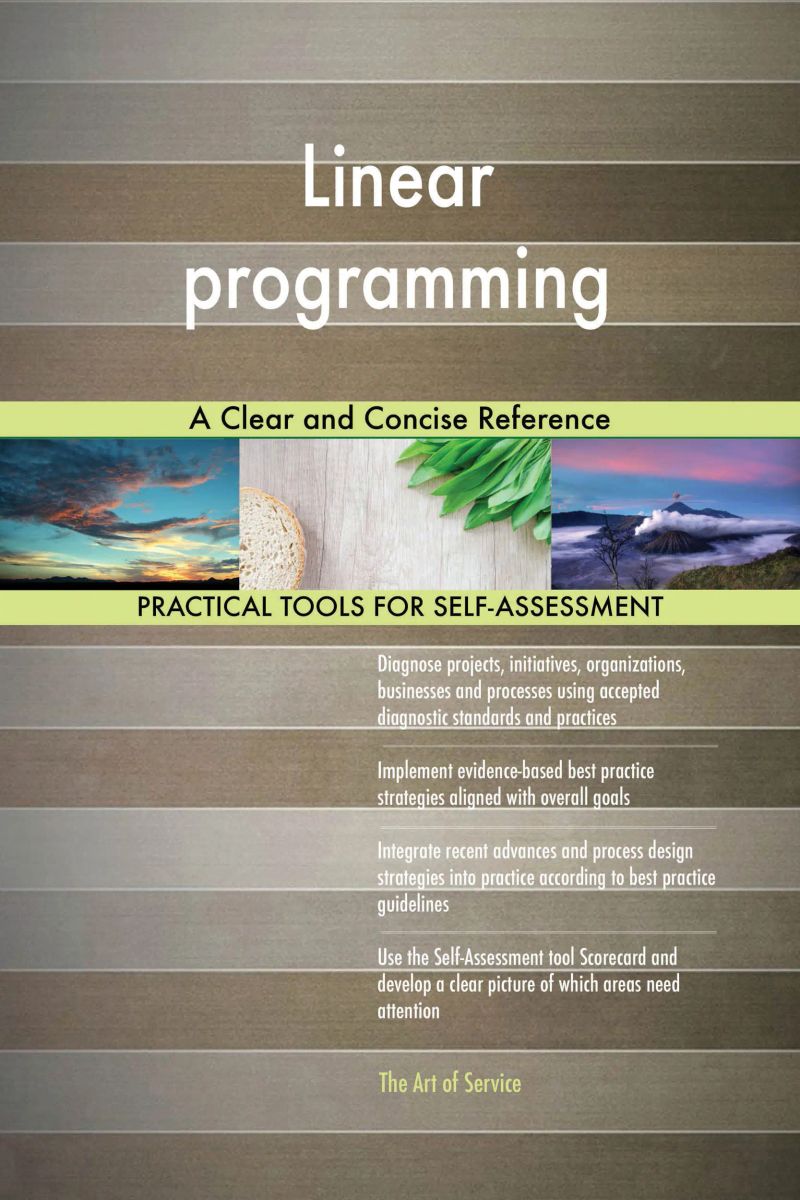
Linear programming A Clear and Concise Reference
De Gerardus Blokdyk


Duração3h 7m
Sobre este audiolivro
How do we manage Linear programming Knowledge Management (KM)? What are your results for key measures or indicators of the accomplishment of your Linear programming strategy and action plans, including building and strengthening core competencies? What threat is Linear programming addressing? Are there any disadvantages to implementing Linear programming? There might be some that are less obvious? How will the Linear programming team and the organization measure complete success of Linear programming?
Defining, designing, creating, and implementing a process to solve a challenge or meet an objective is the most valuable role… In EVERY group, company, organization and department.
Unless you are talking a one-time, single-use project, there should be a process. Whether that process is managed and implemented by humans, AI, or a combination of the two, it needs to be designed by someone with a complex enough perspective to ask the right questions. Someone capable of asking the right questions and step back and say, 'What are we really trying to accomplish here? And is there a different way to look at it?'
This Self-Assessment empowers people to do just that - whether their title is entrepreneur, manager, consultant, (Vice-)President, CxO etc... - they are the people who rule the future. They are the person who asks the right questions to make Linear programming investments work better.
This Linear programming All-Inclusive Self-Assessment enables You to be that person.
All the tools you need to an in-depth Linear programming Self-Assessment. Featuring 680 new and updated case-based questions, organized into seven core areas of process design, this Self-Assessment will help you identify areas in which Linear programming improvements can be made.
In using the questions you will be better able to:
- diagnose Linear programming projects, initiatives, organizations, businesses and processes using accepted diagnostic standards and practices
- implement evidence-based best practice strategies aligned with overall goals
- integrate recent advances in Linear programming and process design strategies into practice according to best practice guidelines
Using a Self-Assessment tool known as the Linear programming Scorecard, you will develop a clear picture of which Linear programming areas need attention.
Your purchase includes access details to the Linear programming self-assessment dashboard download which gives you your dynamically prioritized projects-ready tool and shows your organization exactly what to do next. Your exclusive instant access details can be found in your book.
Detalhes do audiolivro
GêneroBusiness and Economics
Duração3 h 7 min
Narrado porOuça com mais de 1.000 vozes
FormatoeBook com áudio
Data de publicação18 de jun. de 2018
IdiomaInglês
Sumário
1About The Art of Service
2Acknowledgments
3Included Resources - how to access
4Your feedback is invaluable to us
5Purpose of this Self-Assessment
Mostrar todos os capítulosVer menos
6How to use the Self-Assessment
7Linear programmingScorecard Example
8Linear programmingScorecard
9BEGINNING OF THE SELF-ASSESSMENT:
10CRITERION #1: RECOGNIZE
11CRITERION #2: DEFINE:
12CRITERION #3: MEASURE:
13CRITERION #4: ANALYZE:
14CRITERION #5: IMPROVE:
15CRITERION #6: CONTROL:
16CRITERION #7: SUSTAIN:
17Linear programming and Managing Linear programming Projects, Criteria for Linear programming Project Managers:
18Linear programming: Requirements Documentation
19Linear programming: Roles and Responsibilities
20Linear programming: Linear programming Project Portfolio management
21Linear programming: Duration Estimating Worksheet
22Linear programming: Activity Cost Estimates
23Linear programming: Network Diagram
24Linear programming: Human Resource Management Plan
25Linear programming: Activity Attributes
26Linear programming: Scope Management Plan
27Linear programming: Activity Resource Requirements
28Linear programming: Quality Metrics
29Linear programming: Quality Management Plan
30Linear programming: Activity List
31Linear programming: Linear programming Project Schedule
32Linear programming: Cost Baseline
33Linear programming: WBS Dictionary
34Linear programming: Responsibility Assignment Matrix
35Linear programming: Communications Management Plan
36Linear programming: Assumption and Constraint Log
37Linear programming: Process Improvement Plan
38Linear programming: Risk Register
39Linear programming: Planning Process Group
40Linear programming: Stakeholder Register
41Linear programming: Initiating Process Group
42Linear programming: Linear programming Project Management Plan
43Linear programming: Milestone List
44Linear programming: Linear programming Project Charter
45Linear programming: Cost Estimating Worksheet
46Linear programming: Cost Management Plan
47Linear programming: Resource Breakdown Structure
48Linear programming: Schedule Management Plan
49Linear programming: Stakeholder Analysis Matrix
50Linear programming: Requirements Management Plan
It Operations Analytics Itoa A Complete Guide - 2020 EditionGerardus Blokdyk4h 38min$78
Server Room A Complete Guide - 2020 EditionGerardus Blokdyk4h 30min$78
Utilities Analysis A Complete Guide - 2019 EditionGerardus Blokdyk4h 27min$71
MDM Strategy Professional Services A Complete Guide - 2020 EditionGerardus Blokdyk4h 44min$78
Employer Branding A Complete Guide - 2021 EditionGerardus Blokdyk4h 37min$78
IT Environment Security A Complete Guide - 2019 EditionGerardus Blokdyk4h 39min$71
Agile Environments A Complete Guide - 2019 EditionGerardus Blokdyk4h 35min$71
Endpoint Protection A Complete Guide - 2019 EditionGerardus Blokdyk4h 32min$71
Vendor-Managed Inventory A Complete Guide - 2019 EditionGerardus Blokdyk4h 48min$71
Materials Data Management A Complete Guide - 2020 EditionGerardus Blokdyk4h 39min$78
Contextualized Analytics A Complete Guide - 2020 EditionGerardus Blokdyk4h 34min$71
Datacenter A Complete Guide - 2020 EditionGerardus Blokdyk4h 23min$78

Functional Safety A Complete Guide - 2021 EditionGerardus Blokdyk4h 41min$78
Business Impact and Risk Analysis A Complete Guide - 2019 EditionGerardus Blokdyk4h 34min$71
Enterprise Report Management A Complete Guide - 2020 EditionGerardus Blokdyk4h 42min$78
Technology And Service Provider A Complete Guide - 2019 EditionGerardus Blokdyk4h 45min$71
Transportation Engineering A Complete Guide - 2020 EditionGerardus Blokdyk4h 41min$78
organizational culture A Complete Guide - 2019 EditionGerardus Blokdyk4h 28min$71
Distribution software Third EditionGerardus Blokdyk1h 56min$42
Storage Software A Complete Guide - 2019 EditionGerardus Blokdyk4h 42min$71
Never Split the DifferenceChris Voss, Tahl Raz8h 7min4.4 (277.7K)$26 · $0.00
The Intelligent Investor Rev Ed.Benjamin Graham17h 48min4.3 (191.5K)$40 · $0.00
The Hard Thing About Hard ThingsBen Horowitz7h 57min4.2 (134.3K)$26 · $0.00
Boundaries for LeadersHenry Cloud7h 36min4.3 (3.6K)$26 · $0.00
Good to GreatJim Collins9h 59min4.1 (325.2K)$29 · $0.00
The Way of ExcellenceBrad Stulberg6h 46min4.2 (1.1K)$24 · $0.00
Trillion Dollar CoachEric Schmidt, Jonathan Rosenberg, Alan Eagle5h 40min4.1 (22.2K)$24 · $0.00
Be ExceptionalJoe Navarro, Toni Sciarra Poynter9h 11min4.0 (1.3K)$29 · $0.00
The Power of the OtherHenry Cloud5h 52min4.2 (3.5K)$24 · $0.00
BuildTony Fadell11h 5min4.5 (14.3K)$8 · $0.00
The Joys Of CompoundingGautam Baid17h 34min4.5 (2.5K)$18 · $0.00
Basic EconomicsThomas Sowell18h 32min4.5 (29.3K)$28 · $0.00

The Ambuja StoryNarotam Sekhsaria13h 59min4.5 (830)$33 · $0.00

The Secret Door to SuccessFlorence Scovel Shinn2h 25min4.5 (2.1K)$1.20 · $0.00

This Is Going to HurtAdam Kay5h 47min4.4 (444.7K)$24 · $0.00

Big TrustShadé Zahrai, Fayçal Sekkouah8h 36min4.6 (406)$26 · $0.00
The Intelligent Investor Third EditionBenjamin Graham, Jason Zweig20h4.4 (156.6K)$46 · $0.00

Bottle of LiesKatherine Eban14h 25min4.4 (12K)$33 · $0.00

The Antiracist Business BookTrudi Lebrón6h 10min4.6 (275)$17 · $0.00

The FormulaJoshua Robinson, Jonathan Clegg10h 41min4.4 (6.9K)$29 · $0.00
Você também pode gostar

Collected Writings of Nikola TeslaThomas Commerford Martin, Nikola Tesla19h 42min4.4 (2.8K)$1.99 · $0.00
The PerfectionistsSimon Winchester11h 46min4.2 (9.9K)$29 · $0.00
Cloud Service Brokerage A Complete Guide - 2019 EditionGerardus Blokdyk4h 35min$71
Automotive Demand Chain and Supply Chain Technologies A Complete GuideGerardus Blokdyk4h 34min$71
Eft Investing: A Comprehensive Guide to Researching and Investing (The Intelligent Investor's Guide to Using Free Online Stock Screeners to Find Winning Stocks)Matthew Nagel2h 7min$3.50 · $0.00
DigitalBradley J Sugars5h 11min4.8 (10)Grátis
ScaleBradley J Sugars3h 27min4.6 (52)Grátis
Python For BeginnersCélio Azevedo35min$8 · $0.00

The In-Car-Nation CodeDr. Engelbert Wimmer20h 15min$21 · $0.00
RepluggedSatnam Bains13h 47min$14 · $0.00
Machine-to-Machine Complete Self-Assessment GuideGerardus Blokdyk4h 7min$71
Python For BeginnersCélio Azevedo35min$8 · $0.00
The 9 AI Powers: How to Build Digital Wealth in 2025Yasin Ali 1h 41min4.7 (12) Só no Ultra

In Our Own ImageGeorge Zarkadakis13h 48min3.8 (341)$23 · $0.00
Execution Speed A Complete Guide - 2019 EditionGerardus Blokdyk4h 27min$71
Digital Banking Transformation A Complete Guide - 2020 EditionGerardus Blokdyk7h 4min$21
The AI Strategy Framework for Business LeadersDavid M. Patel9h 18min$22 · $0.00
Digital Twin A Complete Guide - 2020 EditionGerardus Blokdyk4h 40min$71

Artificial IntelligenceJ.C.Lesko2h 43min$15 · $0.00
Data Governance A Complete Guide - 2021 EditionGerardus Blokdyk4h 37min$78