
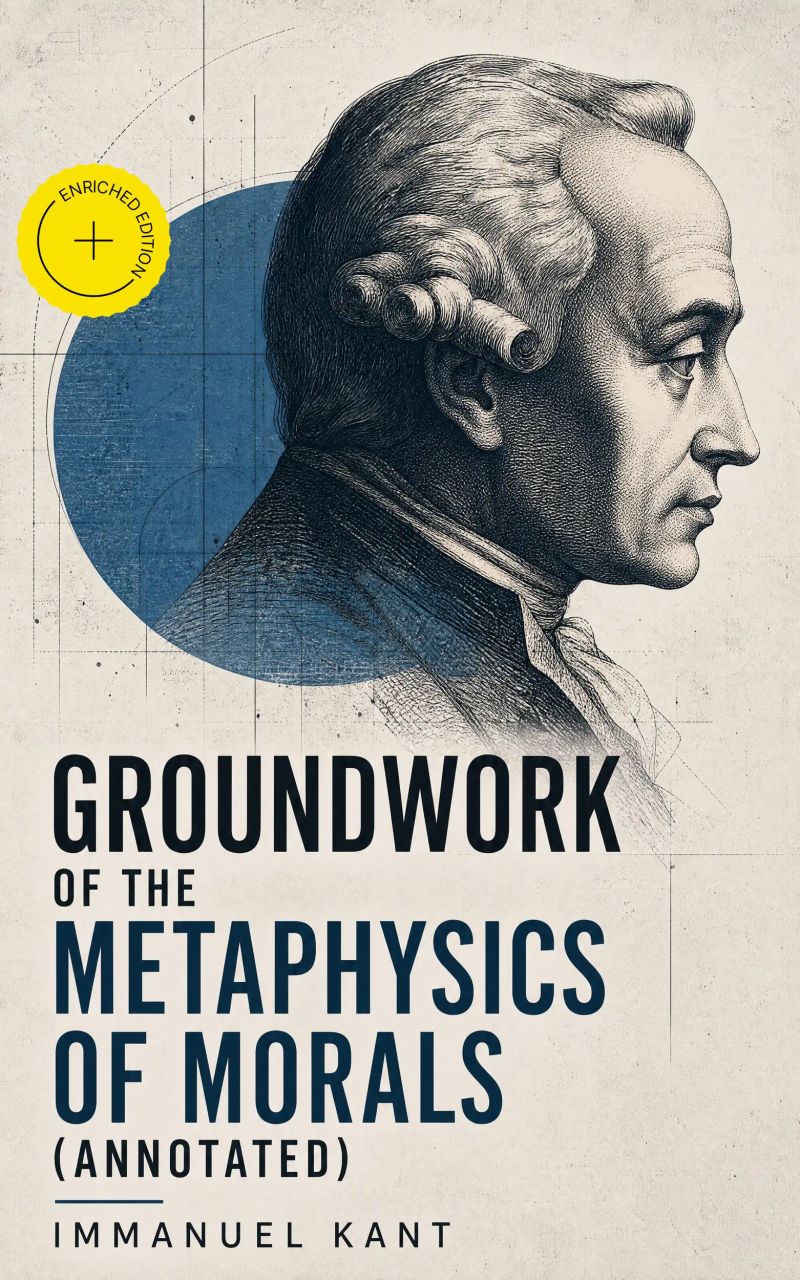
Groundwork of the Metaphysics of Morals (Annotated)
Enriched Edition. A Concise Inquiry into Duty, Autonomy, Practical Reason, and the Categorical ImperativeDe Immanuel Kant


Duração5h 5m
Sobre este audiolivro
Immanuel Kant's Groundwork of the Metaphysics of Morals is a concise yet momentous inquiry into the supreme principle of morality. Written with the rigorous architecture characteristic of Enlightenment philosophy, the work moves from ordinary moral consciousness to the formulation of the categorical imperative, seeking a foundation for ethics independent of inclination, theology, or consequence. Its style is austere, analytic, and cumulative, situating it among the defining texts of modern moral philosophy. Kant, the Prussian philosopher of Königsberg, wrote this book after transforming metaphysics and epistemology in the Critique of Pure Reason. His lifelong concern with reason's authority, human freedom, and the dignity of persons shaped the Groundwork's central claim: that rational beings are autonomous legislators of moral law. The intellectual climate of the eighteenth century—marked by Newtonian science, Pietist seriousness, and debates over empiricism—deeply informs his project. This book is indispensable for readers seeking to understand duty, autonomy, and moral obligation at their most demanding level. Though difficult, it rewards careful reading with extraordinary clarity about why persons must never be treated merely as means. It is essential for students of philosophy, law, theology, and political thought.
This enriched edition has been carefully crafted to add value to your reading experience.
- A succinct Introduction situates the work's timeless appeal and themes.
- The Synopsis outlines the central plot, highlighting key developments without spoiling critical twists.
- A detailed Historical Context immerses you in the era's events and influences that shaped the writing.
- An Author Biography reveals milestones in the author's life, illuminating the personal insights behind the text.
- A thorough Analysis dissects symbols, motifs, and character arcs to unearth underlying meanings.
- Reflection questions prompt you to engage personally with the work's messages, connecting them to modern life.
- Hand‐picked Memorable Quotes shine a spotlight on moments of literary brilliance.
- Interactive footnotes clarify unusual references, historical allusions, and archaic phrases for an effortless, more informed read.
Detalhes do audiolivro
GêneroPhilosophy
Duração5 h 5 min
Narrado porOuça com mais de 1.000 vozes
FormatoeBook com áudio
Data de publicação12 de dez. de 2023
IdiomaInglês
Sumário
1Introduction
2Introduction
3Synopsis
4Historical Context
5Author Biography
Mostrar todos os capítulosVer menos
6Preface
7First Section: Transition from the common rational knowledge of morality to the philosophical
8Second Section: Transition from popular moral philosophy to the metaphysic of morals
9The Autonomy of the Will as the Supreme Principle of Morality
10Heteronomy of the Will as the Source of all spurious Principles of Morality
11Classification of all Principles of Morality which can be founded on the Conception of Heteronomy
12Third Section: Transition from the metaphysic of morals to the critique of pure practical reason
13The Concept of Freedom is the Key that explains the Autonomy of the Will.
14Freedom must be presupposed as a Property of the Will of all Rational Beings
15Of the Interest attaching to the Ideas of Morality.
16How is a Categorical Imperative Possible?
17Of the Extreme Limits of all Practical Philosophy.
18Concluding Remark
19Analysis
20Reflection
21Memorable Quotes

Kritik der reinen VernunftImmanuel Kant22h 32min4.2 (40.2K)$2 · $0.00

Ausgewählte Schriften zur Geschichtsphilosophie, Ethik und PolitikImmanuel Kant8h 44min4.5 (29)$1 · $0.00

Über PädagogikImmanuel Kant2h 46min4.0 (1.7K)$2 · $0.00

Die Metaphysik der SittenImmanuel Kant12h 20min4.1 (3.9K)$1 · $0.00

Kritik der UrteilskraftImmanuel Kant14h 10min4.2 (18.4K)$1 · $0.00

Von der Macht des Gemüts, durch den bloßen Vorsatz seiner krankhaften Gefühle Meister zu seinImmanuel Kant51min4.1 (241)$1 · $0.00

Kritik der praktischen VernunftImmanuel Kant7h 36min4.1 (14.7K)$1 · $0.00

Kritik der reinen VernunftImmanuel Kant22h 32min4.2 (51K)$1 · $0.00

Anthropologie in pragmatischer HinsichtImmanuel Kant11h 5min3.9 (1.6K)$1 · $0.00

LogikImmanuel Kant5h 17min4.0 (576)$1 · $0.00

Beantwortung der Frage: Was ist Aufklärung?Immanuel Kant1h 53min4.1 (3.9K)$1 · $0.00

Die Metaphysik der SittenImmanuel Kant12h 20min4.1 (3.9K)$1 · $0.00

Beantwortung der Frage: Was ist Aufklärung?Immanuel Kant21min4.0 (4.1K)$1 · $0.00

Was heißt: sich im Denken orientieren?Immanuel Kant43min4.3 (508)$1 · $0.00

Von der Macht des Gemüts, durch den bloßen Vorsatz seiner krankhaften Gefühle Meister zu seinImmanuel Kant51min4.6 (125)$1 · $0.00

Zum ewigen Frieden: Ein philosophischer EntwurfImmanuel Kant3h 9min3.9 (3.3K)$1 · $0.00

Zum ewigen FriedenImmanuel Kant, Sam Rokbuhm1h 18min$12 · $0.00

The Greatest Works of Immanuel KantImmanuel Kant83h 28min4.4 (142)$1.99 · $0.00

Untersuchung über die Deutlichkeit der Grundsätze der natürlichen Theologie und der MoralImmanuel Kant2h 49min4.0 (41)$1 · $0.00

Kant: Kritik der praktischen Vernunft, Kritik der reinen Vernunft & Kritik der UrteilskraftImmanuel Kant46h 31min4.5 (1.4K)$1 · $0.00
Metaphysics (Annotated)Aristotle13h 30min4.6 (1.2K)$2 · $0.00

Sceptical Essays (Annotated)Bertrand Russell9h 16min4.6 (1K)$2 · $0.00

WitnessAriel Burger8h 1min4.6 (1.3K)$20 · $0.00

Kahlil Gibran. Classic CollectionKahlil Gibran2h 55min4.5 (4K)$10 · $0.00

The Magic PresenceGodfré Ray King10h 21min4.6 (307)$1.20 · $0.00

The Art of LivingThich Nhat Hanh5h 1min4.5 (14.2K)$24 · $0.00
Moral Letters to LuciliusLucius Annaeus Seneca24h 26min4.5 (71.7K)$1.99 · $0.00
Complete Works of Marcus AureliusMarcus Aurelius5h 1min4.5 (2.4K)$10 · $0.00

Lessons in TruthH. Emilie Cady3h 50min4.5 (2.4K)$20 · $0.00
Letters from a StoicSeneca6h 5min4.4 (80.4K)$6 · $0.00
The Discourses of EpictetusP. E. MATHESOM12h 47min4.4 (17.7K)$1.20 · $0.00

IlluminationsWalter Benjamin10h 12min4.4 (16.2K)$20 · $0.00
The Awakening of IntelligenceJ. Krishnamurti19h 1min4.5 (2.7K)$7 · $0.00

That Bird Has My WingsJarvis Jay Masters9h 49min4.4 (13.7K)$29 · $0.00

Tâo Teh KingLaozi2h 34min4.4 (230.9K)$2 · $0.00

SymposiumPlato3h 26min4.4 (97.9K)$1.20 · $0.00

Buddhist Boot CampTimber Hawkeye2h 39min4.4 (8.4K)$18 · $0.00
Commentaries On Living 2J Krishnamurti9h 58min4.5 (606)$6 · $0.00
Enchiridion & The Discourses of Epictetus (Annotated)Arrian Epictetus18h 9min4.4 (3.5K)$2 · $0.00

The Meditations of the Emperor Marcus Aurelius AntoninusEmperor of Rome Marcus Aurelius5h 41min4.4 (1.8M)$1 · $0.00
Você também pode gostar

Hegel: The Science of LogicGeorg Wilhelm Friedrich Hegel17h 53min4.3 (4.5K)$1.99 · $0.00
The Principle of RelativityAlbert Einstein, H. Minkowski7h 43min4.4 (1.4K)$1 · $0.00

Marie Curie: The Radio-Active SubstancesMarie Curie5h 50min4.3 (288)$1.99 · $0.00
Kant's Prolegomena to Any Future MetaphysicsImmanuel Kant4h 21min4.1 (12.1K)$1 · $0.00

Neutrino HuntersRay Jayawardhana6h 4min4.1 (955)$17

The FieldLynne McTaggart10h 13min4.2 (8.8K)$29 · $0.00
Tertium Organum: The Third Canon of ThoughtP. D. Ouspensky14h 48min4.3 (688)$1.99 · $0.00

Science of LogicGeorg Wilhelm Friedrich Hegel17h 39min4.3 (2.4K)$1 · $0.00

LucyDonald C. Johanson, Maitland Edey14h 56min4.3 (3K)$23

1434Gavin Menzies9h 53min3.6 (2.4K)$29 · $0.00

Who We Are and How We Got HereDavid Reich10h 51min4.3 (10.5K)$23

Before The Big BangLaura Mersini-Houghton5h 46min4.1 (1.3K)$24 · $0.00

Cathode RaysJoseph John Thomson2h 21min$1 · $0.00

On the Philosophy of Discovery, Chapters Historical and CriticalWilliam Whewell21h 23min$1 · $0.00

The Origin of VertebratesWalter Holbrook Gaskell22h 22min$2 · $0.00

Manual on Music FormPercy Goetschius5h 14min4.2 (126)$1.99 · $0.00

How to Make Money Flipping Used Cars - A Beginner's Guide to Finding Deals, Estimating Costs, and Selling Safely for ProfitJACK FLIPWELL4h 24min$5.10

How to Make Money Flipping Houses - How to Find Undervalued Properties, Control Renovation Costs, and Sell at the Right PriceJACK FLIPWELL4h 31min$5.10

The Declaration of the Rights of Man and of Citizens (Annotated)Georg Jellinek2h 43min4.0 (25)$2 · $0.00

Early Printed BooksE. Gordon Duff5h 55min3.7 (18)$2.30