
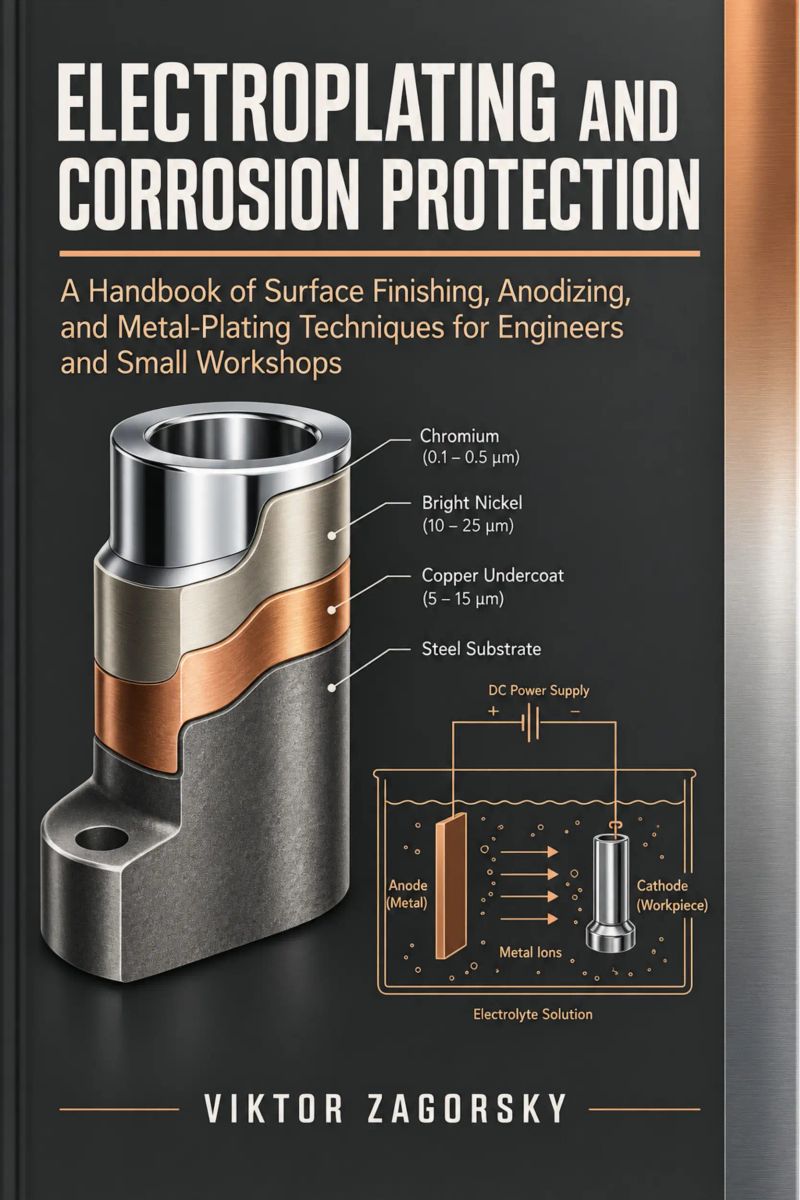
Electroplating and Corrosion Protection
A Handbook of Surface Finishing, Anodizing, and Metal-Plating Techniques for Engineers and Small WorkshopsBy Viktor Zagorsky


Length13h 27m
About this audiobook
Plating is arithmetic wrapped around chemistry: amp-hours in, micrometres out—provided the surface was clean and the current went where you wanted it.
This handbook teaches both halves of that equation. You will calculate deposit thickness from Faraday's laws, understand why a recess plates thin and how anode placement, thieves, and shields correct it, and prepare surfaces properly so nothing blisters a week later. Nickel, copper, chromium, zinc, tin, precious metals, and electroless nickel each get bath conditions, operating ranges, and their characteristic defects. Anodising and conversion coatings are covered for aluminium and steel. Hull cell work, contamination analysis, and a defect-to-cause troubleshooting chapter follow, closing with corrosion mechanisms, coating selection, and cathodic protection.
Written for engineers, finishers, and small workshops, the book moves from first principles to bench practice without skipping the arithmetic or the chemistry. Whether you are setting up a plating line, diagnosing a blistering deposit, or specifying a coating for a corrosive environment, the chapters give you the calculations, the operating windows, and the diagnostic logic to get repeatable results.
What you will learn:
• Electrochemical principles of deposition and how to calculate deposit thickness from current density and time
• Current distribution and throwing power—why recesses plate thin and how anodes, thieves, and shields fix it
• Setting up a plating area safely, including tank layout, ventilation, and electrical requirements
• Surface preparation and adhesion, from degreasing and pickling to the causes of blistering and peeling
• Bath conditions and operating ranges for nickel, copper, brass, chromium, zinc, tin, silver, gold, and electroless nickel
• Anodising and conversion coatings on aluminium, plus sacrificial coatings for steel
• Bath control and analysis, including Hull cell testing and contamination diagnosis
• Defect-to-cause troubleshooting for pits, roughness, poor adhesion, and uneven deposits
• Corrosion mechanisms, coating selection strategy, and cathodic protection
Who it is for: This book is for engineers, plating technicians, and small workshop operators who need practical, calculation-based guidance on electroplating, anodising, and corrosion protection. It assumes no prior plating experience but does not shy away from the formulas and chemistry required for professional results.
Audiobook details
GenreTechnology
Length13 hrs 27 mins
Narrated byListen with 1,000+ voices
FormateBook with Audio
Publish dateSep 27, 2026
LanguageEnglish
Table of contents
1Electroplating and Corrosion Protection
2Foreword
3Preface
4About This Book
5Important Safety Notice
Mostrar todos os capítulosVer menos
6Chapter 1: Electrochemical Principles of Deposition
71.1 Ions, Electrodes and the Plating Cell
81.2 Faraday’s Laws and Deposit Thickness
91.3 Electrode Potentials and the Nernst Equation
101.4 Current Efficiency and Hydrogen Evolution
111.5 Polarization, Overpotential and Bath Conductivity
121.6 Bench Procedure: Measuring Efficiency and Deposit Mass
13Chapter 2: Current Distribution and Throwing Power
142.1 Primary and Secondary Current Distribution
152.2 Throwing Power and the Haring-Blum Concept
162.3 Anode Placement, Thieves and Shields
172.4 Plating into Recesses, Blind Holes and Internal Surfaces
182.5 Bench Procedure: Mapping Distribution with a Coupon Array
19Chapter 3: Setting Up a Plating Area
203.1 Tanks, Linings and Materials of Construction
213.2 Anodes, Bags and Anode Maintenance
223.3 Rectifiers, Ripple and Electrical Practice
233.4 Agitation, Filtration and Heating
243.5 Racking, Contacts and Jigging
253.6 Ventilation and Personal Protection
263.7 Effluent Handling at Small Scale
27Chapter 4: Surface Preparation and Adhesion
284.1 The Case for Preparation and the Nature of Adhesion
294.2 Solvent and Alkaline Degreasing
304.3 Electrocleaning, Pickling and Descaling
314.4 Activation and Strike Layers
324.5 Adhesion Testing and Failure Diagnosis
33Chapter 5: Nickel Plating
345.1 Watts Bath Composition and Operating Conditions
355.2 Brighteners, Levellers and Their Control
365.3 Internal Stress and Its Measurement
375.4 Sulphamate and Other Nickel Baths
385.5 Multilayer Nickel for Corrosion Performance
395.6 Bench Procedure and Defect-to-Cause Table for Nickel
40Chapter 6: Copper and Brass Plating
416.1 Acid Copper Sulphate Baths
426.2 Alkaline and Cyanide-Free Copper Baths
436.3 Brass Plating and Alloy Deposition
446.4 Throwing Power Comparison and Undercoat Strategy
456.5 Bench Procedure and Defect-to-Cause Table for Copper
46Chapter 7: Chromium, Zinc and Sacrificial Coatings
477.1 Decorative Chromium Plating
487.2 Hard Chromium and Trivalent Alternatives
497.3 Zinc Plating from Acid and Alkaline Baths
507.4 Chromate and Passivate Conversion Coatings

The Honey BusMeredith May9h 31m4.4 (16.6K)$25 · $0.00

Collected Writings of Nikola TeslaThomas Commerford Martin, Nikola Tesla19h 42m4.4 (2.8K)$1.99 · $0.00

Operation PedestalMax Hastings12h 29m4.4 (5.2K)$29 · $0.00

When the Heavens Went on SaleAshlee Vance18h 20m4.4 (3K)$40 · $0.00

Everybody Has a Podcast (Except You)Justin McElroy, Travis McElroy, Griffin McElroy5h 9m4.3 (2.3K)$24 · $0.00

Hands of TimeRebecca Struthers8h 8m4.4 (1.3K)$26 · $0.00

Never Lost AgainBill Kilday10h 1m4.4 (805)$29 · $0.00

How the Internet HappenedBrian McCullough13h 28m4.3 (2.7K)$23 · $0.00

Collected Writings of Nikola TeslaNikola Tesla, Thomas Commerford Martin21h 50m4.3 (1.7K)$1 · $0.00

Just AspireAjai Chowdhry9h 13m4.4 (260)$29 · $0.00

The Little Book of AliensAdam Frank8h 20m4.3 (1.3K)$26 · $0.00

The inventions, researches and writings of Nikola Tesla (Annotated)Thomas Commerford Martin16h 59m4.3 (1.3K)$2 · $0.00

KargilV.P. Malik15h 18m4.3 (2K)$24 · $0.00

Experiments with Alternating CurrentsNikola Tesla9h 16m4.3 (874)$1.99 · $0.00

Fire on the HorizonTom Shroder, John Konrad8h 23m4.3 (858)$26 · $0.00

The Smell of Kerosene (Annotated)National Aeronautics and Space Administration, Donald L. Mallick, Peter W. Merlin11h 32m4.3 (523)$2 · $0.00

The Boy Who Harnessed the WindWilliam Kamkwamba, Bryan Mealer10h 5m4.2 (78.9K)$29 · $0.00

Across the Airless WildsEarl Swift10h 8m4.3 (1.3K)$29 · $0.00

Console WarsBlake J. Harris20h 41m4.2 (13.7K)$46 · $0.00

Improvised Munitions HandbookU.S. Department of Defense4h 49m4.3 (1.6K)$1.99 · $0.00
You may also like

The Mystery of the Yellow RoomGaston Leroux8h 19m3.8 (18.2K)$2.30

The Complete Charlie Chan Series – All 6 Mystery Novels in One Edition (Annotated)Earl Derr Biggers56h 17m4.3 (391)$2 · $0.00

A Study in ScarletArthur Conan Doyle3h 58m4.2 (567.9K)$12 · $0.00

A Study in ScarletArthur Conan Doyle4h 51m4.2 (585.4K)$6.99 · $0.00

Dead Man's FollyAgatha Christie6h 2m4.0 (50K)$24 · $0.00
The Templeton CaseVictor L. Whitechurch6h 41m4.0 (287)$23

History of the Rise and Influence of the Spirit of Rationalism in Europe (Vol.1&2) (Annotated)William Edward Hartpole Lecky28h 57m4.3 (258)$2 · $0.00
Troubleshooting Process Instruments and ControlsRonald Petrosyan15h$80
Information Products Creation and MarketingAnthony Ekanem48m$5 · $0.00

20 Top Tips (Tips to Increase Sales)David Salmon41m$3 · $0.00
Why Is This PC So SlowDesmond Sandoval7h 27m$5 · $0.00

How Watson Learnt the TrickArthur Conan Doyle3m4.0 (347)$2 · $0.00

Little Ash Party Problem!Ash Barty, Jasmin McGaughey19m4.2 (19)$7 · $0.00

Maine Security Guard License Exam Prep 2026/2027Corwin Maddox10h 44m$20
Inspector HopperDoug Cushman17m4.2 (208)$7 · $0.00
THE CANTERBURY PUZZLES & OTHER CURIOUS PROBLEMSHenry Ernest Dudeney6h 21m3.4 (76)$1.99 · $0.00
The Flip Side of HistorySteve Silverman5h 42m3.9 (209)$17

Dragnet, Vol. 2Hollywood 3605h 55m$17

Lords of the Housetops: Thirteen Cat Tales by Balzac, Poe, Twain and othersWilliam Livingston Alden, Honoré de Balzac, Peggy Bacon7h 23m3.5 (66)$1.99 · $0.00

Agent of InfluenceJason Hanson7h 8m3.8 (494)$24 · $0.00