
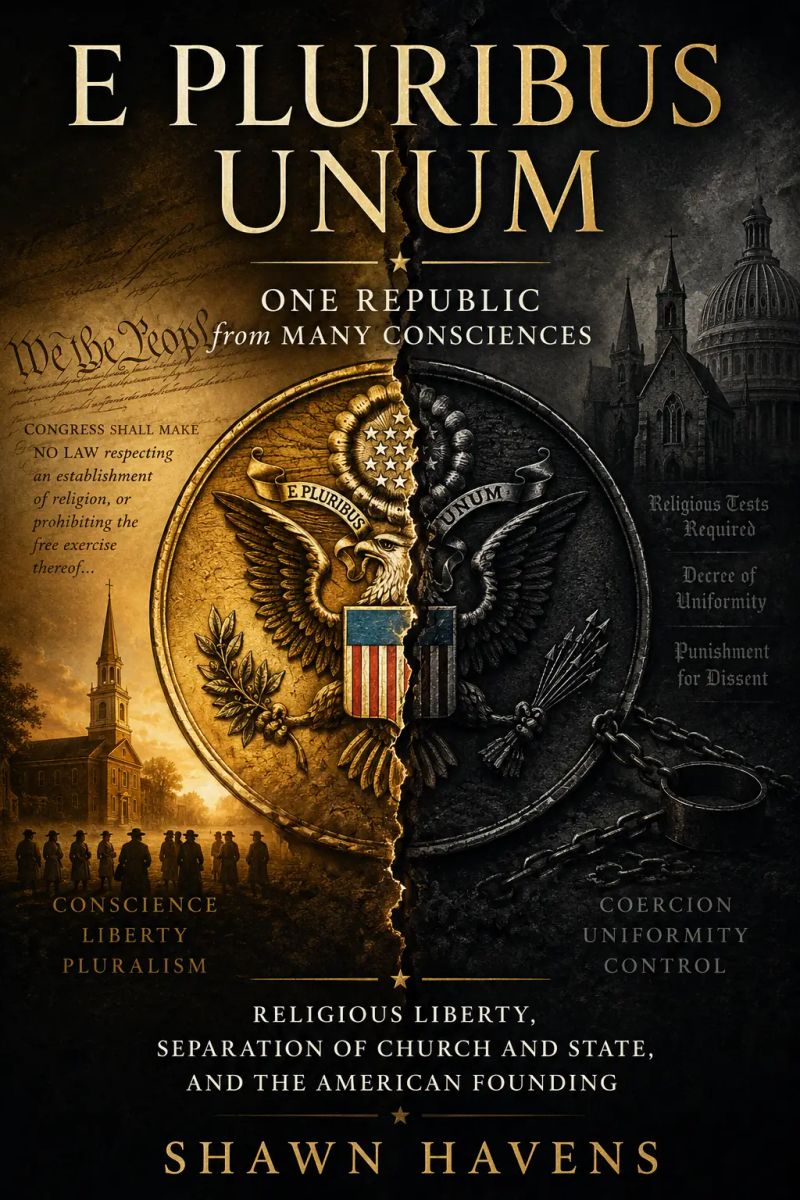


Length9h 25m
About this audiobook
E Pluribus Unum: One Republic from Many Consciences examines how religious liberty, separation of church and state, and freedom of conscience developed from centuries of religious conflict into core principles of the American constitutional system. Drawing on historical documents, founding-era debates, and the experiences of religious dissenters, the book explores why the United States rejected a national religious establishment while protecting the right to believe, worship, doubt, and dissent.
At its center is a simple question: Can one republic remain united without requiring one religious conscience? The book argues that the American founding sought unity through constitutional liberty rather than enforced religious conformity—E Pluribus Unum: out of many, one.
Audiobook details
GenreHistory
Length9 hrs 25 mins
Narrated byListen with 1,000+ voices
FormateBook with Audio
Publish dateAug 25, 2020
LanguageEnglish
Table of contents
1E Pluribus Unum
2Dedication
3Epigraph
4A Preacher in a Cage
5Preface
Mostrar todos os capítulosVer menos
6One Republic from Many Consciences
7Why Liberty Required Separation Part 1
8Why Liberty Required Separation Part 2
9Why Liberty Required Separation Part 3
10Chapter 11
11The First Amendment: What “Congress Shall Make No Law Respecting an Establishment of Religion” Actually Means
12The Text
13The Problem the First Amendment Answered
14Madison’s Original Proposal
15The House Debate
16The Senate and Final Language
17Establishment as an Institution
18Free Exercise as the Companion Protection
19Federalism and the States
20Original Public Meaning
21Neutrality Without Indifference
22Establishment and Free Exercise Together
23The First Amendment and Religious Dissent
24What the First Amendment Did Not Mean
25What the First Amendment Did Mean
26The First Amendment and Personal Autonomy
27The First Amendment and E Pluribus Unum
28Conclusion: Neutrality as Liberty
29Chapter 12
30What the Founders Did NOT Create: Misconceptions About the Founders’ Intentions
31Cultural Christianity and Constitutional Establishment
32The Constitution’s Silence
33Article VI and the Legal Meaning of Public Trust
34The First Amendment’s Double Limit
35Theocracy and Religious Society
36Public Morality Was Not State Religion
37The Treaty of Tripoli and Its Proper Use
38Diversity Among the Founders
39Jefferson Was Not the Whole Founding
40Madison Was Not Anti-Religion
41The Founders Did Not Create Modern Secularism
42State Establishments Do Not Prove Federal Establishment
43The Declaration of Independence Is Not a Church Constitution
44Sorting the Evidence
45The Incomplete Achievement
46Conclusion: What They Created
47Chapter 13
48The Addition of “Under God”: Why the Phrase Was Added in 1954
49The Pledge Before “Under God”
50The 1954 Law
More from Shawn Havens

Resilience Training or Murder Shawn Havens12h 19m$2.99 · $0.00

Two Wars, Two SocietiesShawn Havens5h 33m$2.99

Leading Change That LastsShawn Havens6h 33m Only with Ultra

Exerted Fear Theory Shawn Havens16h 2m$2.99 · $0.00

Interrupted by GraceShawn Havens7h 54m$2.99

Carried By the CrossShawn Havens14h 7m$2.99

A Brief History of IntelligenceMax S. Bennett12h 18m4.6 (6.6K)$29 · $0.00

The Daughter of AuschwitzTova Friedman, Malcolm Brabant7h 54m4.6 (16.7K)$26 · $0.00

Lily's PromiseLily Ebert, Dov Forman8h 54m4.6 (16.1K)$29 · $0.00

On Democracies and Death CultsDouglas Murray10h 38m4.6 (6.5K)$29 · $0.00

Across the RiverKent Babb11h 40m4.6 (927)$29 · $0.00

Balcony Over Jerusalem: A Middle East Memoir - Israel, Palestine and BeyondJohn Lyons12h 37m4.6 (1.4K)$33 · $0.00

BeyondStephen Walker15h 39m4.6 (3.2K)$33 · $0.00
Kings and PawnsHoward Bryant10h 9m4.6 (678)$29 · $0.00

No EscapeNury Turkel9h 30m4.6 (809)$28 · $0.00

Jubal Stone: U.S. Marshal: Blood Trail To Hell: A Western Adventure NovelCasey Nash3h 42m4.6 (3.2K)$18 · $0.00

Fall and RiseMitchell Zuckoff17h 23m4.6 (9.8K)$40 · $0.00

The SurvivorJosef Lewkowicz, Michael Calvin9h 22m4.6 (2.5K)$29 · $0.00

Always FaithfulThomas Schueman, Zainullah Zaki12h 12m4.6 (977)$29 · $0.00

The State of Society in France Before the Revolution of 1789 (Annotated)Alexis de Tocqueville17h 25m4.6 (1.2K)$2 · $0.00

All the Gallant MenDonald Stratton, Ken Gire5h 55m4.6 (11.8K)$24 · $0.00

Saint Joan (Annotated)George Bernard Shaw6h 20m4.6 (1.2K)$1.20 · $0.00

Medgar and MyrlieJoy-Ann Reid10h 52m4.5 (27.8K)$29 · $0.00

The History of the Peloponnesian War (Annotated)Thucydides24h 3m4.6 (1.1K)$2 · $0.00

Where the Birds Never SingJack Sacco10h 31m4.6 (3.8K)$29 · $0.00

Serviceman J: The Untold Story of an NZSAS SoldierJamie Pennell5h 51m4.6 (452)$24 · $0.00
You may also like

History of the United States (Annotated)Charles A. Beard, Mary R. Beard22h 59m4.2 (607)$1.99 · $0.00

My Diary – North and South (Vol. 1&2)William Howard Russell27h 32m4.0 (335)$1 · $0.00

The History of Rome - All 5 Volumes in One EditionTheodor Mommsen100h 46m4.5 (3.1K)$1.99 · $0.00

What Hath God WroughtDaniel Walker Howe32h 50m4.3 (12.5K)$42

Founding FaithSteven Waldman9h 46m4.1 (1K)$26

Learning to Eat Soup with a KnifeJohn A. Nagl8h 46m4.1 (2.6K)$20

The History of the Peloponnesian WarThucydides22h 10m4.2 (54.2K)$2.30

Fatal DiscordMichael Massing34h 52m4.5 (1.3K)$53 · $0.00

History of the United States (Vol. 1-7) (Annotated)Charles A. Beard, Mary R. Beard23h 1m3.9 (729)$2 · $0.00

The Marginal RevolutionariesJanek Wasserman15h 18m4.1 (152)$25 · $0.00

France and England in North America (Vol. 1-7) (Annotated)Francis Parkman118h 59m4.6 (197)$1.99 · $0.00

My Diary – North and South (Vol. 1&2) (Annotated)William Howard Russell27h 31m4.3 (24)$2 · $0.00

Dublin at the Turn of the MillenniumIngo Latotzki, Claudia Latotzki1h 19m$8 · $0.00

Minerva's OwlHarold Adams Innis1h 38m$2 · $0.00

Changing ChinaWilliam Gascoyne-Cecil, Florence Mary Lady Cecil8h 19m3.7 (12)$2 · $0.00

The Early Beginnings of USACarl Lotus Becker21h 44m$2 · $0.00

A History Of The Colonization Of Africa By Alien RacesHarry Johnston20h 56m$2.40

Union and DemocracyAllen Johnson10h 34m$2 · $0.00

Competing for the Global SouthFilippo Fasulo, Nicola Missaglia3h 54m$8 · $0.00

History of the United States: A 30-Volume AnthologyJames Ford Rhodes, D. H. Montgomery, Julius E. Olson, Edward Everett Hale, Elizabeth Hodges, Carl Lotus Becker, Azel Ames, William Bradford, Bureau of Military and Civic Achievement, Herbert Eugene Bolton, Thomas Maitland Marshall, Madison Grant, James Truslow Adams, John Fiske, Robert W. Coakley, Stetson Conn, U.S. Army Center of Military History, L. Carroll Judson, John Jay, Helen Campbell, Emory Speer, U.S. Government, James Madison, Alexander Hamilton, Samuel Bryan, Patrick Henry, Joel Tyler Headley, Theodore Roosevelt, Henry Schoolcraft, Norman B. Wood, Frederic L. Paxson, George Cary Eggleston, Wilbur Fisk Gordy, Adam Gurowski, Felix Gregory De Fontaine, Susan B. Anthony, Elizabeth Cady Stanton, Matilda Gage, Harriot Stanton Blatch, Ida H. Harper, Richard W. Stewart797h 35m$1.99