
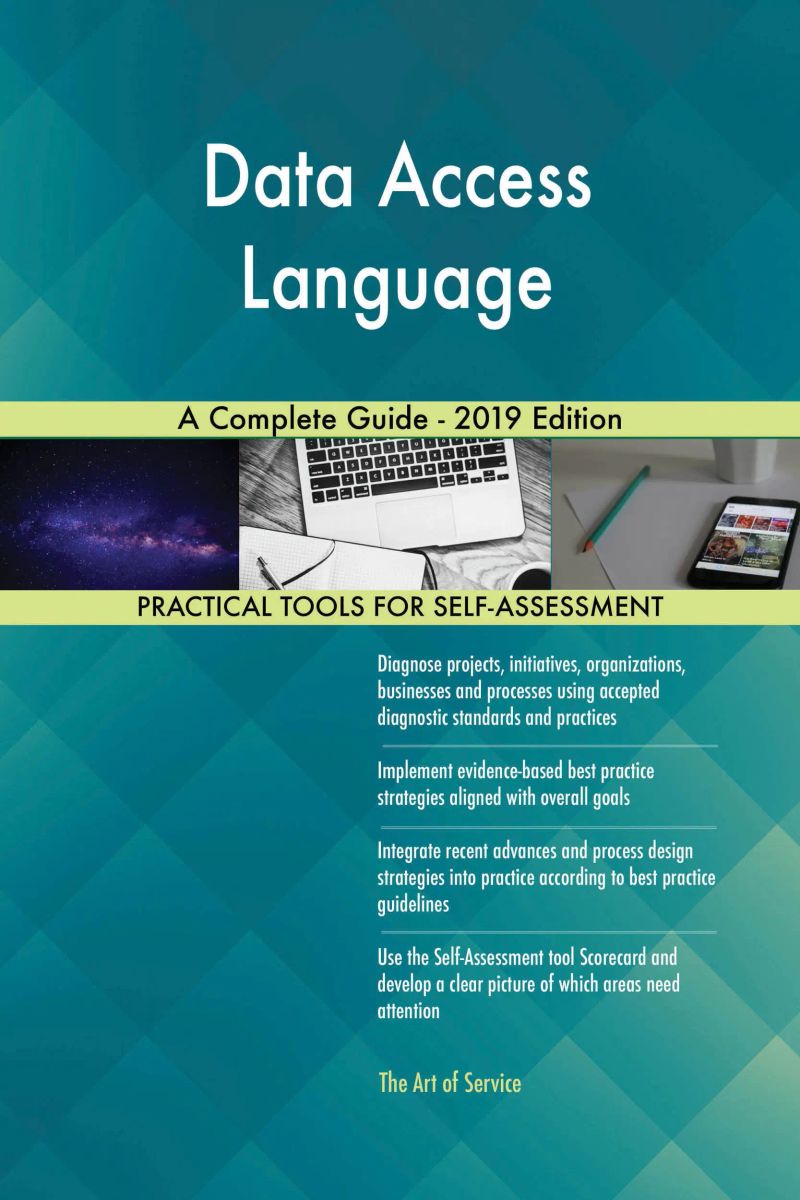
Data Access Language A Complete Guide - 2019 Edition
De Gerardus Blokdyk

Duração3h 46m
Sobre este audiolivro
Have you seen any projects using hadoop where data integration issues led to significant problems? Is it generally accepted on real-time data integration projects that a canonical model is needed? Is a plan for Data Management required if a project is not expected to generate data or samples? When do you use batch data integration versus real-time data integration in a big data project? Who ensures that the data architecture will be updated as evolving data types and needs arise?
Defining, designing, creating, and implementing a process to solve a challenge or meet an objective is the most valuable role… In EVERY group, company, organization and department.
Unless you are talking a one-time, single-use project, there should be a process. Whether that process is managed and implemented by humans, AI, or a combination of the two, it needs to be designed by someone with a complex enough perspective to ask the right questions. Someone capable of asking the right questions and step back and say, 'What are you really trying to accomplish here? And is there a different way to look at it?'
This Self-Assessment empowers people to do just that - whether their title is entrepreneur, manager, consultant, (Vice-)President, CxO etc... - they are the people who rule the future. They are the person who asks the right questions to make Data Access Language investments work better.
This Data Access Language All-Inclusive Self-Assessment enables You to be that person.
All the tools you need to an in-depth Data Access Language Self-Assessment. Featuring 540 new and updated case-based questions, organized into seven core areas of process design, this Self-Assessment will help you identify areas in which Data Access Language improvements can be made.
In using the questions you will be better able to:
- diagnose Data Access Language projects, initiatives, organizations, businesses and processes using accepted diagnostic standards and practices
- implement evidence-based best practice strategies aligned with overall goals
- integrate recent advances in Data Access Language and process design strategies into practice according to best practice guidelines
Using a Self-Assessment tool known as the Data Access Language Scorecard, you will develop a clear picture of which Data Access Language areas need attention.
Your purchase includes access details to the Data Access Language self-assessment dashboard download which gives you your dynamically prioritized projects-ready tool and shows your organization exactly what to do next. You will receive the following contents with New and Updated specific criteria:
- The latest quick edition of the book in PDF
- The latest complete edition of the book in PDF, which criteria correspond to the criteria in...
- The Self-Assessment Excel Dashboard
- Example pre-filled Self-Assessment Excel Dashboard to get familiar with results generation
- In-depth and specific Data Access Language Checklists
- Project management checklists and templates to assist with implementation
INCLUDES LIFETIME SELF ASSESSMENT UPDATES
Every self assessment comes with Lifetime Updates and Lifetime Free Updated Books. Lifetime Updates is an industry-first feature which allows you to receive verified self assessment updates, ensuring you always have the most accurate information at your fingertips.
Detalhes do audiolivro
GêneroBusiness and Economics
Duração3 h 46 min
Narrado porOuça com mais de 1.000 vozes
FormatoeBook com áudio
Data de publicação18 de mar. de 2019
IdiomaInglês
Sumário
1About The Art of Service
2Acknowledgments
3Included Resources - how to access
4Your feedback is invaluable to us
5Purpose of this Self-Assessment
Mostrar todos os capítulosVer menos
6How to use the Self-Assessment
7Data Access LanguageScorecard Example
8Data Access LanguageScorecard
9BEGINNING OF THE SELF-ASSESSMENT:
10CRITERION #1: RECOGNIZE
11CRITERION #2: DEFINE:
12CRITERION #3: MEASURE:
13CRITERION #4: ANALYZE:
14CRITERION #5: IMPROVE:
15CRITERION #6: CONTROL:
16CRITERION #7: SUSTAIN:
17Data Access Language and Managing Projects, Criteria for Project Managers:
181.0 Initiating Process Group: Data Access Language
191.1 Project Charter: Data Access Language
201.2 Stakeholder Register: Data Access Language
211.3 Stakeholder Analysis Matrix: Data Access Language
222.0 Planning Process Group: Data Access Language
232.1 Project Management Plan: Data Access Language
242.2 Scope Management Plan: Data Access Language
252.3 Requirements Management Plan: Data Access Language
262.4 Requirements Documentation: Data Access Language
272.5 Requirements Traceability Matrix: Data Access Language
282.6 Project Scope Statement: Data Access Language
292.7 Assumption and Constraint Log: Data Access Language
302.8 Work Breakdown Structure: Data Access Language
312.9 WBS Dictionary: Data Access Language
322.10 Schedule Management Plan: Data Access Language
332.11 Activity List: Data Access Language
342.12 Activity Attributes: Data Access Language
352.13 Milestone List: Data Access Language
362.14 Network Diagram: Data Access Language
372.15 Activity Resource Requirements: Data Access Language
382.16 Resource Breakdown Structure: Data Access Language
392.17 Activity Duration Estimates: Data Access Language
402.18 Duration Estimating Worksheet: Data Access Language
412.19 Project Schedule: Data Access Language
422.20 Cost Management Plan: Data Access Language
432.21 Activity Cost Estimates: Data Access Language
442.22 Cost Estimating Worksheet: Data Access Language
452.23 Cost Baseline: Data Access Language
462.24 Quality Management Plan: Data Access Language
472.25 Quality Metrics: Data Access Language
482.26 Process Improvement Plan: Data Access Language
492.27 Responsibility Assignment Matrix: Data Access Language
502.28 Roles and Responsibilities: Data Access Language
Certified Professional Organizer A Complete Guide - 2020 EditionGerardus Blokdyk4h 42min$78
IT Strategy A Complete Guide - 2021 EditionGerardus Blokdyk4h 39min$78
Business Process Redesign A Complete Guide - 2020 EditionGerardus Blokdyk4h 40min$78
Enterprise Security Management A Complete Guide - 2020 EditionGerardus Blokdyk4h 43min$71
Response Architecture And Operations A Complete Guide - 2019 EditionGerardus Blokdyk4h 45min$71
organizational structure A Complete Guide - 2019 EditionGerardus Blokdyk4h 26min$71
Third Party Risk Management Solutions A Complete Guide - 2021 EditionGerardus Blokdyk4h 51min$78
Omni Channel Supply Chain A Complete Guide - 2020 EditionGerardus Blokdyk4h 38min$71
Oracle NetSuite ERP A Complete GuideGerardus Blokdyk4h 8min$71
Software map Complete Self-Assessment GuideGerardus Blokdyk1h 54min$42
Application Deployment A Complete Guide - 2019 EditionGerardus Blokdyk4h 37min$71
Third Party Vendors A Complete Guide - 2020 EditionGerardus Blokdyk4h 27min$71
Salesforce.com Complete Self-Assessment GuideGerardus Blokdyk1h 57min$42
Cloud Content Management A Complete Guide - 2020 EditionGerardus Blokdyk4h 30min$71
Communications Engineering A Complete Guide - 2020 EditionGerardus Blokdyk4h 36min$78
Work Breakdown Schedule A Complete Guide - 2020 EditionGerardus Blokdyk4h 38min$78
Qualitative Analysis Financial A Complete Guide - 2021 EditionGerardus Blokdyk4h 39min$78
Chief Sustainability Officer A Complete Guide - 2020 EditionGerardus Blokdyk4h 42min$78
Core Banking System A Complete Guide - 2019 EditionGerardus Blokdyk5h 37min$71
Inspection Management A Complete Guide - 2020 EditionGerardus Blokdyk4h 39min$78
Never Split the DifferenceChris Voss, Tahl Raz8h 7min4.4 (277.7K)$26 · $0.00
The Intelligent Investor Rev Ed.Benjamin Graham17h 48min4.3 (191.5K)$40 · $0.00
The Hard Thing About Hard ThingsBen Horowitz7h 57min4.2 (134.3K)$26 · $0.00
Boundaries for LeadersHenry Cloud7h 36min4.3 (3.6K)$26 · $0.00
Good to GreatJim Collins9h 59min4.1 (325.2K)$29 · $0.00
The Way of ExcellenceBrad Stulberg6h 46min4.2 (1.1K)$24 · $0.00

Trillion Dollar CoachEric Schmidt, Jonathan Rosenberg, Alan Eagle5h 40min4.1 (22.2K)$24 · $0.00
Be ExceptionalJoe Navarro, Toni Sciarra Poynter9h 11min4.0 (1.3K)$29 · $0.00
The Power of the OtherHenry Cloud5h 52min4.2 (3.5K)$24 · $0.00
BuildTony Fadell11h 5min4.5 (14.3K)$8 · $0.00
The Joys Of CompoundingGautam Baid17h 34min4.5 (2.5K)$18 · $0.00
Basic EconomicsThomas Sowell18h 32min4.5 (29.3K)$28 · $0.00

The Ambuja StoryNarotam Sekhsaria13h 59min4.5 (830)$33 · $0.00

The Secret Door to SuccessFlorence Scovel Shinn2h 25min4.5 (2.1K)$1.20 · $0.00

This Is Going to HurtAdam Kay5h 47min4.4 (444.7K)$24 · $0.00
Big TrustShadé Zahrai, Fayçal Sekkouah8h 36min4.6 (406)$26 · $0.00
The Intelligent Investor Third EditionBenjamin Graham, Jason Zweig20h4.4 (156.6K)$46 · $0.00
Bottle of LiesKatherine Eban14h 25min4.4 (12K)$33 · $0.00

The Antiracist Business BookTrudi Lebrón6h 10min4.6 (275)$17 · $0.00

The FormulaJoshua Robinson, Jonathan Clegg10h 41min4.4 (6.9K)$29 · $0.00
Você também pode gostar
Business Continuity Management Process A Complete Guide - 2020 EditionGerardus Blokdyk4h 45min$71
Continuous Improvement Process A Complete Guide - 2020 EditionGerardus Blokdyk4h 41min$78
Data For Threat Detection A Complete Guide - 2019 EditionGerardus Blokdyk4h 30min$71
Chief Supply Chain Officers Second EditionGerardus Blokdyk4h 15min$71
ITIL® 4 Create, Deliver and Support (CDS)Claire Agutter3h 36min4.6 (23)$40 · $0.00
ITIL® 4 Essentials: Your essential guide for the ITIL 4 Foundation exam and beyond, second editionClaire Agutter4h4.2 (50)$40 · $0.00
Enhancing Deep Learning Performance Using Displaced Rectifier Linear UnitDavid Macêdo1h 49min$10 · $0.00
The Client Wants AI, but Doesn't Know What They're Responsible For - How to Agree on the Scope of AI Use in a Project, Rules for Handling Data, and Ways to Verify Results Without Promising That the Tool Will Take Responsibility for MistakesMax Paradox6h 24min$5.10

CubismGuillaume Apollinaire, Dorothea Eimert3h 41min$15

Blockchain for Business: Complete Guide to AdoptionUnknown Author1h 4min$17 · $0.00
Who Owns What? The Definitive Legal Guide for Musicians, Writers, Film-Makers and Content CreatorsXerxes Ranina3h 33min$18 · $0.00

Art and architecture of the late 20th centuryDorothea Eimert7h 23min$16
IoT Security A Complete Guide - 2019 EditionGerardus Blokdyk4h 34min$71
Defensive Computing A Complete Guide - 2020 EditionGerardus Blokdyk4h 33min$78
Hybrid System A Complete Guide - 2020 EditionGerardus Blokdyk4h 29min$71
Network Mapping A Complete Guide - 2020 EditionGerardus Blokdyk4h 29min$78
Operational Database Management A Complete Guide - 2019 EditionGerardus Blokdyk4h 45min$71
Load User Interface Complete Self-Assessment GuideGerardus Blokdyk4h 7min$71
Media development A Complete GuideGerardus Blokdyk4h 7min$42
CDP A Complete Guide - 2021 EditionGerardus Blokdyk4h 23min$78