
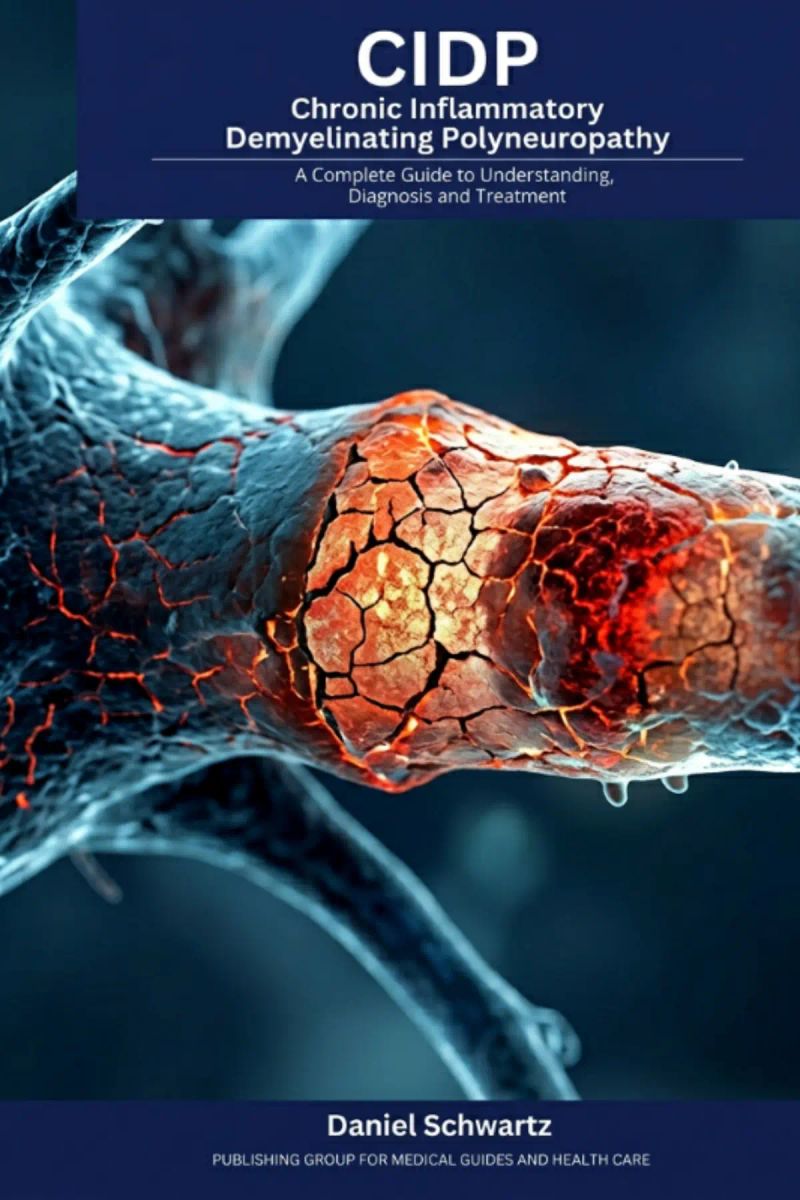
CIDP
Chronic Inflamatory Demyelinating PolyneuropathyDe Daniel Schwartz


Duração2h 47m
Sobre este audiolivro
CIDP: Chronic Inflammatory Demyelinating Polyneuropathy — A Complete Guide by Daniel Schwartz is a comprehensive, accessible 2026 guide to one of the most underdiagnosed autoimmune nerve diseases. CIDP occurs when the immune system mistakenly attacks the myelin sheath surrounding peripheral nerves, causing progressive weakness, numbness, pain, and loss of balance that unfolds over months to years — distinguishing it from the acute, self-limited Guillain-Barré Syndrome it closely resembles. Schwartz walks readers through the full arc of the disease. Written for patients, families, nursing and medical students, and curious non-specialists alike, the book pairs clear plain-language explanations with comparison tables, a full glossary, and practical appendices — symptom diaries, medication logs, and a guide to reading nerve conduction reports — empowering readers to understand their diagnosis and participate meaningfully in their own care.
Detalhes do audiolivro
GêneroHealth and Wellness
Duração2 h 47 min
Narrado porOuça com mais de 1.000 vozes
FormatoeBook com áudio
Data de publicação13 de abr. de 2026
IdiomaInglês
Sumário
1Introduction
2Foreword: A Note to Readers
3Chapter 1: What Is CIDP?
41.1 The Big Picture
51.2 Peripheral Nerves: What Are They?
Mostrar todos os capítulosVer menos
61.3 The Word "Demyelinating" — What It Means
71.4 Chronic vs. Acute: How CIDP Differs from GBS
81.5 Why CIDP Is Often Underdiagnosed
9Chapter 2: A History of CIDP
102.1 Early Observations of Peripheral Nerve Disease
112.2 Guillain, Barré, and Strohl (1916)
122.3 The 1950s and 1960s: A Chronic Form Emerges
132.4 Peter Dyck and the Formal Definition (1975)
142.5 The 1980s–1990s: New Treatments and Confirmation
152.6 The 2000s–2010s: Subtypes and Biological Targets
162.7 The 2020s: Targeted Therapies and Personalized Medicine
17Chapter 3: Epidemiology — Who Gets CIDP?
183.1 How Common Is CIDP?
193.2 Age and Sex Distribution
203.3 Geographic and Ethnic Distribution
213.4 Risk Factors and Associated Conditions
223.5 Economic and Social Burden
23Chapter 4: Pathology — What Happens Inside the Nerve?
244.1 The Immune Attack: An Overview
254.2 The Blood-Nerve Barrier
264.3 The Node of Ranvier: Architecture and Vulnerability
274.4 Demyelination, Remyelination, and Onion Bulbs
284.5 What the Nerve Biopsy Shows
294.6 Key Antibody Targets: A New Era of Understanding
304.7 Recognized Clinical Subtypes of CIDP
31Chapter 5: Symptoms — What Does CIDP Feel Like?
325.1 The Typical Presentation
335.2 Motor Symptoms — Weakness and Movement Problems
345.3 Sensory Symptoms — Abnormal Feelings
355.4 Balance and Gait Problems
365.5 Less Common Symptoms
375.6 Clinical Courses Over Time
385.7 Impact on Daily Life and Quality of Life
39Chapter 6: Diagnosis — How Is CIDP Identified?
406.1 Why Diagnosis Is Challenging
416.2 Clinical History and Neurological Examination
426.3 Nerve Conduction Studies (NCS) and Electromyography (EMG)
436.4 Cerebrospinal Fluid (CSF) Analysis
446.5 MRI of the Spine and Peripheral Nerves
456.6 Blood Tests
466.7 Nerve Biopsy
476.8 Diagnostic Certainty Levels and the Treatment Trial: 6.8.1 How Many Nerves Must Be Abnormal? The 2021 NCS Demyelination Criteria
48Chapter 7: Treatment — Managing and Treating CIDP
497.1 The Goals and Philosophy of CIDP Treatment
507.2 First-Line Treatments
Mais de Daniel Schwartz

THE FORTY DAYS BETWEEN RESURRECTION AND ASCENSIONDaniel Schwartz8h 37min$2.99 · $0.00

LOST IN TRANSLATIONDaniel Schwartz3h 34min4.6 (1.4K)$2.99 · $0.00
JUMOR Laughing Through the Ages:Daniel Schwartz1h 12min$2.99 · $0.00

FINDING CHRIST IN THE PASSOVERDaniel Schwartz2h 29min4.6 (50)$2.99 · $0.00

The unseen Spiritual WorldDaniel Schwartz1h 49min4.8 (198)$2.99 · $0.00

REFUTING ANTI-MISSIONARIESDaniel Schwartz1h 50min$2.99 · $0.00

One Covenant, One BodyDaniel Schwartz3h 30min4.9 (267)$2.99 · $0.00

THE AMERICAN RESTORATION MANIFESTODan Schwartz5h 29min$2.99

When Heaven is SilentDaniel Schwartz2h4.7 (89)$2.99

Advents of the Jewish MessiahDaniel Schwartz3h 13min4.8 (156)$2.99 · $0.00
Paul ReconsideredDaniel Schwartz1h 55min$2.99 · $0.00

Hour of the HeartIrvin D. Yalom, Benjamin Yalom8h 19min4.6 (2.3K)$26 · $0.00

The Yoga Sutras of PatanjaliPatanjali4h 8min4.5 (18.5K)$6 · $0.00

The Lost VoiceGreta Morgan8h 30min4.7 (285)$26 · $0.00

Healthy Kids, Happy KidsElisa Song14h 18min4.6 (760)$33 · $0.00

Eat It!Jordan Syatt, Michael Vacanti4h 40min4.6 (1.5K)$20 · $0.00

Consent Laid BareChanel Contos7h 11min4.5 (1.7K)$24 · $0.00
How to Make Disease DisappearRangan Chatterjee5h 26min4.5 (3.5K)$24 · $0.00

The Complete Herbal (Annotated)Nicholas Culpeper29h 8min4.5 (1.4K)$2 · $0.00

A Plague Upon Our HouseScott W. Atlas MD10h 37min4.5 (3.4K)$20 · $0.00

The Gift of TherapyIrvin Yalom7h 39min4.5 (38.8K)$26 · $0.00

EarlySarah DiGregorio9h 47min4.5 (1.3K)$29 · $0.00

Bottle of LiesKatherine Eban14h 25min4.4 (12K)$33 · $0.00
The 36-Hour DayNancy L. Mace, Peter V. Rabins17h 13min4.4 (9.2K)$28 · $0.00

FlooredSara Reardon10h 36min4.5 (1K)$29 · $0.00
Radical RemissionKelly A. Turner9h 26min4.4 (8.1K)$29 · $0.00
The Sinatra SolutionStephen T. Sinatra MD9h4.5 (899)$20 · $0.00

The Songaminute ManSimon McDermott6h 12min4.5 (280)$24 · $0.00
Sometimes BrilliantLarry Brilliant12h 27min4.5 (954)$29 · $0.00

Live Your LifeAmanda Kloots, Anna Kloots10h 54min4.4 (13.7K)$29 · $0.00

All in Her HeadElizabeth Comen13h 25min4.4 (18.2K)$33 · $0.00
Você também pode gostar
Smarter Not HarderDave Asprey8h 32min3.9 (3.6K)$26 · $0.00
Clean GutAlejandro Junger5h 20min3.9 (4.5K)$24 · $0.00

The Diet MythTim Spector12h 44min4.2 (7.6K)$20

The Beautiful CureDaniel M. Davis8h 24min4.2 (2.2K)$20 · $0.00
Radical RemissionKelly A. Turner9h 26min4.4 (8.1K)$29 · $0.00

Goodbye to InflammationSandra Monino5h 46min4.1 (3.3K)$24 · $0.00

Great by ChoiceJim Collins, Morten T. Hansen8h 45min4.2 (26.1K)$26 · $0.00
Change by DesignTim Brown6h 48min4.0 (12.9K)$24 · $0.00

An Elegant DefenseMatt Richtel12h 33min4.2 (15.3K)$33 · $0.00

Rookie SmartsLiz Wiseman7h 45min4.1 (1.1K)$26 · $0.00
EndureAlexander Hutchinson11h 9min4.2 (27K)$8 · $0.00

The Reason WhyJohn Long and The Dasilva Theatre Players9min$2 · $0.00

SignalsDr. Saira Hameed10h 6min$29 · $0.00
Medically Unexplained SymptomsRobert W. Baloh13h 7min3.7 (14)$23

The Power of Preconception- Unlocking Your Fertility PotentialAurora Brooks1h 17min$3.50 · $0.00

The Omega Rx ZoneBarry Sears2h 30min3.9 (261)$18 · $0.00

PainScientific American9h 15min$20

The Mysteries of LoveVictoria The Love Guru Foster5h 5min$6.40 · $0.00

The Lettsomian Lectures on Diseases and Disorders of the Heart and ArteriesJ. Mitchell Bruce1h 12min$2 · $0.00

The Limits of Consciousness - A Conversation with Martin MontiHoward Burton1h 43min$3