
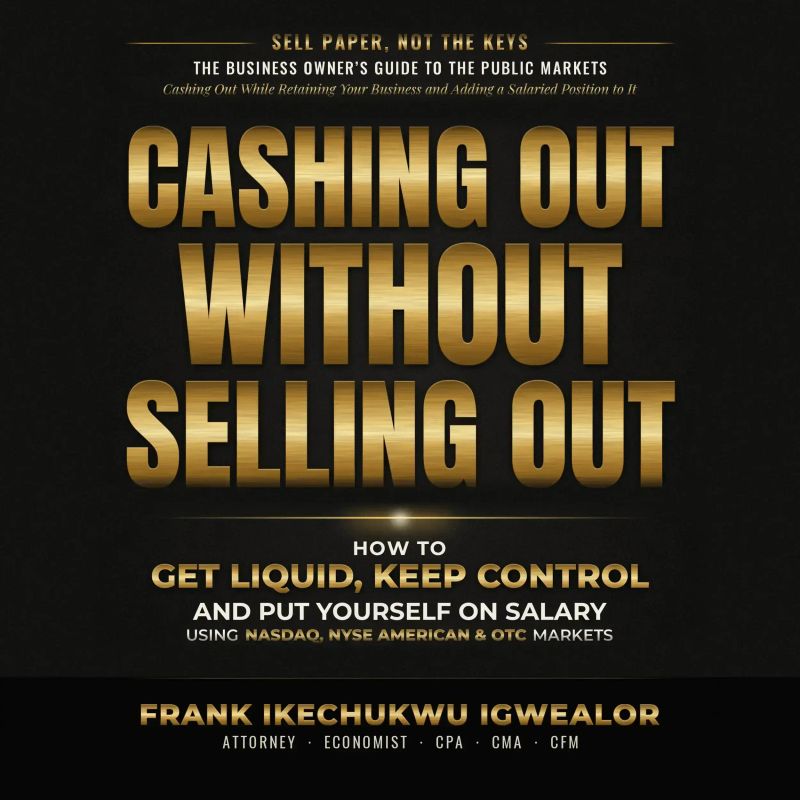
CASHING OUT WITHOUT SELLING OUT
How Business Owners Can Use the Capital Markets to Unlock Wealth and Liquidity, Keep Control, and Stay CompensatedDe Frank Ikechukwu IgwealorFaixa gravadaDuração13h 39m
Sobre este audiolivro
You built something valuable, yet nearly everything you own is locked inside one company. Everyone tells you there are only two choices: keep the business and stay illiquid, or sell it and walk away.
There is a third door.
In Cashing Out Without Selling Out shows established business owners how to sell a slice of the company to public investors, keep control of the whole, and pay themselves a real, board-approved salary to run what they built. The principle is simple: sell paper, not the keys. Liquidity is a percentage. Control is a structure. Salary is a contract.
why a listing is a financing system rather than an ATM.
Situation-based playbooks, case studies, a step-by-step blueprint, and eleven practical appendices turn the ideas into action. The appendices include a readiness scorecard, a founder employment term sheet, and a dilution worksheet.
For owners with real revenue and audited or auditable books who want cash without giving up the company.
Cash out. Stay in. Keep building.
Detalhes do audiolivro
GêneroBusiness and Economics, Self-Help
Duração13 h 39 min
Narrado porFaixa gravada
FormatoAudiolivro
Data de publicação16 de out. de 2026
IdiomaInglês
Sumário
1CASHING OUT WITHOUT SELLING OUT
2Chapter 1. The Liquidity Trap and the Conventional Ways Out
3Chapter 3. Public Company, Capital-Market Ladder, and Listing Standards
4Chapter 4. The OTC Markets, the Buyers, and the Purpose of Public Capital
5Chapter 5. What Your Business Is Worth, Privately and Publicly
Mostrar todos os capítulosVer menos
6Chapter 7. Public-Market Readiness and Cleaning the Corporate House
7Part V — Engineering the Transaction
8Chapter 10. The Secondary Component and the Hybrid Transaction
9Chapter 11. The Menu of Doors, the Underwritten IPO, and Form S-1
10Chapter 13. SPAC Mergers, Uplisting, and Choosing Your Pathway
11Chapter 15. The Board, Protective Provisions, and the Limits of Control
12Chapter 19. Trading Plans, Registered Secondaries, and Borrowing Against Shares Part 1
13Chapter 19. Trading Plans, Registered Secondaries, and Borrowing Against Shares Part 2
14Chapter 19. Trading Plans, Registered Secondaries, and Borrowing Against Shares Part 3
15Chapter 30. The Blueprint, Phases I–III: Goals, Readiness, and Advisers
163. Quality of Earnings and Audit Readiness — 15 Points
174. Internal Controls and Finance Function — 10 Points
187. Corporate Records and Capitalization — 10 Points
1910. Owner Temperament and Alignment — 5 Points
20Chapter 31. Executing the Blueprint: Calendar, Term Sheet, and Decision Rule
Mais de Frank Ikechukwu Igwealor
PAPER RICH, CASH POORFrank Ikechukwu Igwealor & Kareem Davis14h 1min$9.99
BILLIONAIRE TRADER’S CODEFrank Ikechukwu Igwealor25h 34min$19.99

STEPS OF FAITHFrank Ikechukwu Igwealor11h 15min$9.99

FEEDING THE WOLFFrank Ikechukwu Igwealor19h 28min$9.99
OPPORTUNISTIC - Spotting Fleeting Moments and Striking While the Iron Is HotFrank Ikechukwu Igwealor26h 46min$9.99
The Fallacy of Reciprocity of GenerosityFrank Ikechukwu Igwealor13h 1min$9.99

WHY CHRISTIANS CANNOT IN GOOD CONSCIENCE SUPPORT OR VOTE FOR THE DEMOCRATIC PARTYFrank Ikechukwu Igwealor8h 17min5.0 (1)$9.99

THE BEAUTIFUL LIEFrank Ikechukwu Igwealor16h 11min$9.99

The 10X Stock FinderFrank Ikechukwu Igwealor29h 2min$9.99
Never Split the DifferenceChris Voss, Tahl Raz8h 7min4.4 (277.7K)$26 · $0.00
The Intelligent Investor Rev Ed.Benjamin Graham17h 48min4.3 (191.5K)$40 · $0.00
The Hard Thing About Hard ThingsBen Horowitz7h 57min4.2 (134.3K)$26 · $0.00
Boundaries for LeadersHenry Cloud7h 36min4.3 (3.6K)$26 · $0.00
Good to GreatJim Collins9h 59min4.1 (325.2K)$29 · $0.00
The Way of ExcellenceBrad Stulberg6h 46min4.2 (1.1K)$24 · $0.00
Trillion Dollar CoachEric Schmidt, Jonathan Rosenberg, Alan Eagle5h 40min4.1 (22.2K)$24 · $0.00
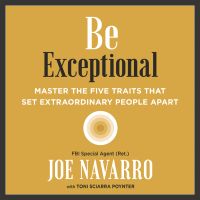
Be ExceptionalJoe Navarro, Toni Sciarra Poynter9h 11min4.0 (1.3K)$29 · $0.00

The Power of the OtherHenry Cloud5h 52min4.2 (3.5K)$24 · $0.00
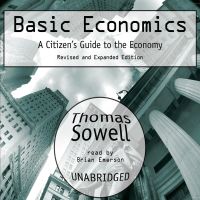
Basic EconomicsThomas Sowell18h 32min4.5 (29.3K)$28 · $0.00

The Ambuja StoryNarotam Sekhsaria13h 59min4.5 (830)$33 · $0.00

The Secret Door to SuccessFlorence Scovel Shinn2h 25min4.5 (2.1K)$1.20 · $0.00

This Is Going to HurtAdam Kay5h 47min4.4 (444.7K)$24 · $0.00

Big TrustShadé Zahrai, Fayçal Sekkouah8h 36min4.6 (406)$26 · $0.00
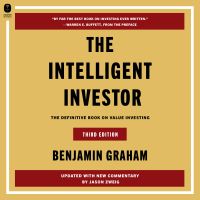
The Intelligent Investor Third EditionBenjamin Graham, Jason Zweig20h4.4 (156.6K)$46 · $0.00

Bottle of LiesKatherine Eban14h 25min4.4 (12K)$33 · $0.00

The Antiracist Business BookTrudi Lebrón6h 10min4.6 (275)$17 · $0.00
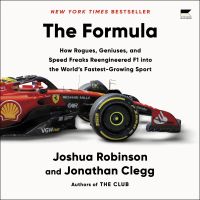
The FormulaJoshua Robinson, Jonathan Clegg10h 41min4.4 (6.9K)$29 · $0.00

Let Them LeadJohn U. Bacon7h 10min4.5 (1.4K)$24 · $0.00

Secrets of the Millionaire MindT. Harv Eker5h 11min4.4 (301.4K)$24 · $0.00

A Different WayChristopher A. Hall10h 45min4.5 (165)$29 · $0.00
The Hard Thing About Hard ThingsBen Horowitz7h 57min4.2 (134.3K)$26 · $0.00

10% Happier 10th AnniversaryDan Harris9h 28min4.1 (137.1K)$29 · $0.00
The Power of the OtherHenry Cloud5h 52min4.2 (3.5K)$24 · $0.00

What You Are Looking For Is in the LibraryMichiko Aoyama7h 19min4.1 (156.7K)$24 · $0.00
The Way of ExcellenceBrad Stulberg6h 46min4.2 (1.1K)$24 · $0.00

The AlchemistPaulo Coelho4h 1min4.1 (3.9M) · 1215$23 · $0.00

Change the RecipeJosé Andrés, Richard Wolffe4h 57min4.1 (2K)$20 · $0.00

The Lucky RideYasushi Kitagawa4h 26min4.1 (1.8K)$20 · $0.00
Be ExceptionalJoe Navarro, Toni Sciarra Poynter9h 11min4.0 (1.3K)$29 · $0.00

The Subtle Art of Not Giving a F*ckMark Manson5h 18min3.9 (1.7M)$24 · $0.00

HomeschooledStefan Merrill Block7h 10min3.6 (18.5K)$28 · $0.00

Autoimmunity and the Good GirlsSara Hirsh Bordo7h 51min$26 · $0.00

The Purpose Driven® Liferick warren9h 23min4.0 (896.8K) Só no Ultra

Your Desired FutureHenry Cloud6h 43min$24 · $0.00
Learning to PrayJames Martin13h 24min4.5 (3.4K)$33 · $0.00

The Happiest Man on EarthEddie Jaku3h 48min4.6 (178K)$7 · $0.00

Finding MeViola Davis9h 15min4.6 (256.4K)$29 · $0.00

Spiritual AnatomyDaaji Kamlesh D. Patel9h 47min4.7 (319)$29 · $0.00

The Dangerous Truth about Today’s MarijuanaLaura Stack CSP, MBA9h 57min4.7 (385)$20 · $0.00
Você também pode gostar

SucceedHeidi Grant Halvorson PhD8h 25min4.4 (4.4K)$17 · $0.00

Maxims and ReflectionsJohann Wolfgang von Goethe3h 23min4.2 (1.4K)$2.30

The Critique of Practical ReasonImmanuel Kant6h 30min4.1 (24.6K)$1.20 · $0.00

The Ethics of AristotleAristotle10h 7min4.2 (70.6K)$2
The Joys Of CompoundingGautam Baid17h 34min4.5 (2.5K)$18 · $0.00

Fundamental Principles of the Metaphysic of MoralsImmanuel Kant3h 21min4.0 (24.5K)$0.60 · $0.00

How to Analyze People on Sight - Through the Science of Human Analysis: The Five Human Types (Annotated)Ralph Paine Benedict, Elsie Lincoln Benedict7h 28min3.6 (4.1K)$1.99 · $0.00

Nicomachean EthicsAristotle8h 51min4.3 (63.3K)$1.80 · $0.00

Charlie's Good TonightPaul Sexton7h 11min4.3 (1.1K)$24 · $0.00

THE LIFE OF SAMUEL JOHNSON - All 6 Volumes in One Edition (Annotated)James Boswell, Grosvenor Osgood117h 17min4.6 (1.2K)$2 · $0.00

The CurtainMilan Kundera4h 40min4.0 (3.8K)$20 · $0.00
Marketing for Dummies 2nd Ed.Alexander Hiam3h 6min3.8 (321)$18 · $0.00

Project Manager Technology SuiteDawn Jones, Sherry Prindle4h 25min$75

Business BrandingAnthony Ekanem59min5.0 (1)$4 · $0.00

Why Are We So Different? Your Guide to the 16 Personality TypesJarosław Jankowski11h$14

Turn the TablesJ.M. Snyder18min3.9 (17)$1 · $0.00

Selecting Projects WiselySteve Pavlina15min$4 · $0.00

Spend SmartOwen J. Kim4h 3min$4 · $0.00

The Pragmatic Philosophy of John Dewey – Premium Collection: 20+ Books in One Volume (Annotated)John Dewey88h 49min4.5 (17)$1.99 · $0.00

I Don't Know What I Think Until I Check the Internet - How to Form Your Own Opinion First, Use the Web to Check and Broaden Your Thinking, and Stop Outsourcing Every Little Decision to a Search EngineMax Paradox6h 25min4.6 (56)$7.50