
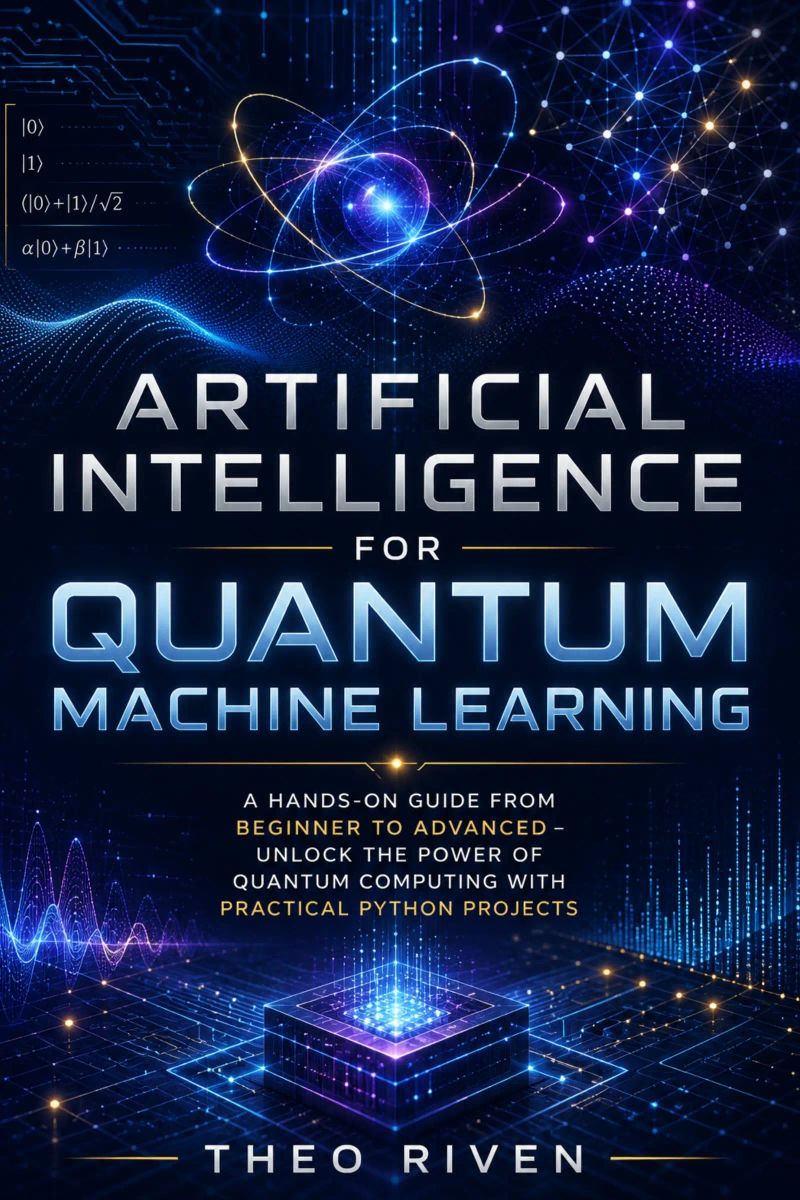
Artificial Intelligence for Quantum Machine Learning
A Hands-On Guide from Beginner to Advanced – Unlock the Power of Quantum Computing with Practical Python ProjectsBy Theo Riven


Length4h 25m
About this audiobook
Discover the future of intelligent computing through the powerful combination of artificial intelligence, machine learning, and quantum technology.
Artificial Intelligence for Quantum Machine Learning is a structured guide for readers who want to understand how AI and quantum computing work together to solve complex problems. Starting with the foundations of artificial intelligence and classical machine learning, this book introduces key concepts such as supervised learning, unsupervised learning, reinforcement learning, data preprocessing, model training, and Python-based machine learning tools.
Readers are then guided into quantum computing fundamentals, including quantum bits, gates, circuits, algorithms, and quantum-enhanced learning models. With practical explanations and project-based learning, the book helps bridge the gap between advanced theory and real-world implementation.
Perfect for AI learners, Python programmers, data science students, researchers, and technology professionals, this book offers a clear path into one of the most exciting areas of modern computing.
Audiobook details
GenreTechnology
Length4 hrs 25 mins
Narrated byListen with 1,000+ voices
FormateBook with Audio
Publish dateJun 12, 2026
LanguageEnglish
Table of contents
1Chapter 1: Foundations of Artificial Intelligence and Machine Learning
2Introduction: Why Start Here?
3A Brief History of Artificial Intelligence: From Dreams to Reality
4Key Paradigms in Machine Learning: The Building Blocks
5Supervised Learning: Learning with a Teacher
Mostrar todos os capítulosVer menos
6Unsupervised Learning: Discovering Hidden Patterns
7Reinforcement Learning: Learning Through Trial and Error
8Setting Up Essential Python Tools: Your ML Toolkit
9Why These Tools?
10Installation and Environment Setup
11Quick NumPy Primer
12Pandas: Data Wrangling Basics
13Scikit-learn: Your Model Factory
14Data Preprocessing and Exploratory Analysis: Cleaning Before Cooking
15Why Preprocess?
16Step 1: Loading and Inspecting Data
17Step 2: Handling Missing Values and Outliers
18Step 3: Feature Scaling and Encoding
19Step 4: Feature Engineering and Selection
20Building Your First ML Model: Linear Regression in Action
21Understanding Linear Regression
22Step-by-Step Implementation
23Summary: Key Takeaways and Next Steps
24Chapter 2: Core Classical Machine Learning Algorithms
25Introduction: From Basics to Building Blocks
26Supervised Learning: Making Predictions from Labeled Examples
27Decision Trees: Branching Decisions Like a Flowchart
28Random Forests: Strength in Numbers
29Support Vector Machines: Drawing the Line in High Dimensions
30Unsupervised Learning: Finding Structure in the Chaos
31K-Means Clustering: Forming Natural Groups
32Principal Component Analysis (PCA): Compressing the Essence
33Model Evaluation Metrics and Overfitting Prevention: Building Reliable Models
34Key Metrics: Beyond Accuracy
35Overfitting Prevention: Generalize, Don't Memorize
36Hands-On: Train and Tune a Classification Model on Real Datasets
37Step 1: Load and Preprocess
38Step 2: Train Baseline Models
39Step 3: Tune with Grid Search
40Step 4: Evaluate and Compare
41Summary: Key Takeaways and Next Steps
42Chapter 3: Introduction to Quantum Computing: The Basics
43Introduction: Bridging Classical ML to Quantum Frontiers
44Why Quantum Computing Revolutionizes AI: Speedups and New Possibilities
45Core Reasons for the Revolution
46Real-World Applications in AI
47Classical vs. Quantum Bits: From Bits to Qubits
48Classical Bits: The Binary Backbone
49Qubits: Superposition and the Probability Party
50Measurement: The Reality Check
More from Theo Riven
JavaScript Programming for Mobile App DevelopmentTheo Riven4h 34m$5
Artificial Intelligence for Business StrategyTheo Riven3h 11m$5
Artificial Intelligence for Cloud ComputingTheo Riven3h 59m$5
Artificial Intelligence for Prompt EngineeringTheo Riven4h 17m4.8 (11)$5
C++ Programming for Natural Language ProcessingTheo Riven5h 6m$5
Artificial Intelligence for IoT Development SubtitleTheo Riven3h 54m$5
JavaScript Programming for Blockchain DevelopmentTheo Riven4h 15m$5
Artificial Intelligence for Game DevelopmentTheo Riven4h 41m$5
Artificial Intelligence for Natural Language ProcessingTheo Riven3h 33m$5
Artificial Intelligence for Workflow AutomationTheo Riven3h 25m$5

The Honey BusMeredith May9h 31m4.4 (16.6K)$25 · $0.00

Collected Writings of Nikola TeslaThomas Commerford Martin, Nikola Tesla19h 42m4.4 (2.8K)$1.99 · $0.00

Operation PedestalMax Hastings12h 29m4.4 (5.2K)$29 · $0.00

When the Heavens Went on SaleAshlee Vance18h 20m4.4 (3K)$40 · $0.00

Everybody Has a Podcast (Except You)Justin McElroy, Travis McElroy, Griffin McElroy5h 9m4.3 (2.3K)$24 · $0.00

Hands of TimeRebecca Struthers8h 8m4.4 (1.3K)$26 · $0.00

Never Lost AgainBill Kilday10h 1m4.4 (805)$29 · $0.00

How the Internet HappenedBrian McCullough13h 28m4.3 (2.7K)$23 · $0.00

Collected Writings of Nikola TeslaNikola Tesla, Thomas Commerford Martin21h 50m4.3 (1.7K)$1 · $0.00

Just AspireAjai Chowdhry9h 13m4.4 (260)$29 · $0.00

The Little Book of AliensAdam Frank8h 20m4.3 (1.3K)$26 · $0.00

The inventions, researches and writings of Nikola Tesla (Annotated)Thomas Commerford Martin16h 59m4.3 (1.3K)$2 · $0.00

KargilV.P. Malik15h 18m4.3 (2K)$24 · $0.00

Experiments with Alternating CurrentsNikola Tesla9h 16m4.3 (874)$1.99 · $0.00

Fire on the HorizonTom Shroder, John Konrad8h 23m4.3 (858)$26 · $0.00

The Smell of Kerosene (Annotated)National Aeronautics and Space Administration, Donald L. Mallick, Peter W. Merlin11h 32m4.3 (523)$2 · $0.00

The Boy Who Harnessed the WindWilliam Kamkwamba, Bryan Mealer10h 5m4.2 (78.9K)$29 · $0.00

Across the Airless WildsEarl Swift10h 8m4.3 (1.3K)$29 · $0.00

Console WarsBlake J. Harris20h 41m4.2 (13.7K)$46 · $0.00

Improvised Munitions HandbookU.S. Department of Defense4h 49m4.3 (1.6K)$0.99 · $0.00
You may also like
Reengineering the CorporationMichael Hammer, James Champy1h 29m3.8 (7.3K)$16 · $0.00
Practical SQL; Query & Manage DatabaseStephen Hart5h 56m$7 · $0.00
Optimal Design and Control MathHenrik Solberg14h 48m$90
DCF BudgetingIsabella S. Lee8h 1m$6.30 · $0.00
C++ Programming for Natural Language ProcessingTheo Riven5h 6m$5
Modern Data EngineeringOwen Fletcher7h 33m$6.50 · $0.00
Optical Transceivers and Photonic CircuitsAmara Okonkwo13h 9m$75
Claude Code for Modern DevelopersLeon Grant8h 21m$6.50 · $0.00
Decoding DCFPenelope B. Wellington7h 36m$6.30 · $0.00
EFT Investing: A Comprehensive Guide to Understanding Real Estate Syndications Accredited Investor Banking (A Complete Guide to Options Trading Binary Options Stock Options Currency Index Options EFT)Charles Thompson2h 34m$3.50 · $0.00
Forallx - An Introduction to Formal LogicP.D. Magnus5h 23m3.6 (63)$1 · $0.00
C++ for 3D Game Development with Unreal EngineGideon Drake4h 13m$6
Artificial Intelligence for Cloud ComputingTheo Riven3h 59m$5
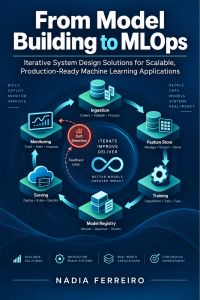
From Model Building to MLOpsNadia Ferreiro13h 33m$65

Artificial Intelligence for Web DevelopmentJaxen Holt, Nadia Valentine4h 5m$6
Introduction manual to S&OPCristina Peña1h 34m4.4 (15)$23 · $0.00
Fair GameRob Collie9h 39m3.9 (32)$20 · $0.00
The Golden BitcoinMichael A. Duniec6h 43m5.0 (1)$14.99 · $0.00

The Enigma of the Mars PyramidBoris Bigalke7h 31m$19 · $0.00
Appreciating Analytic Philosophy - A Conversation with Scott SoamesHoward Burton1h 27m$3 · $0.00