
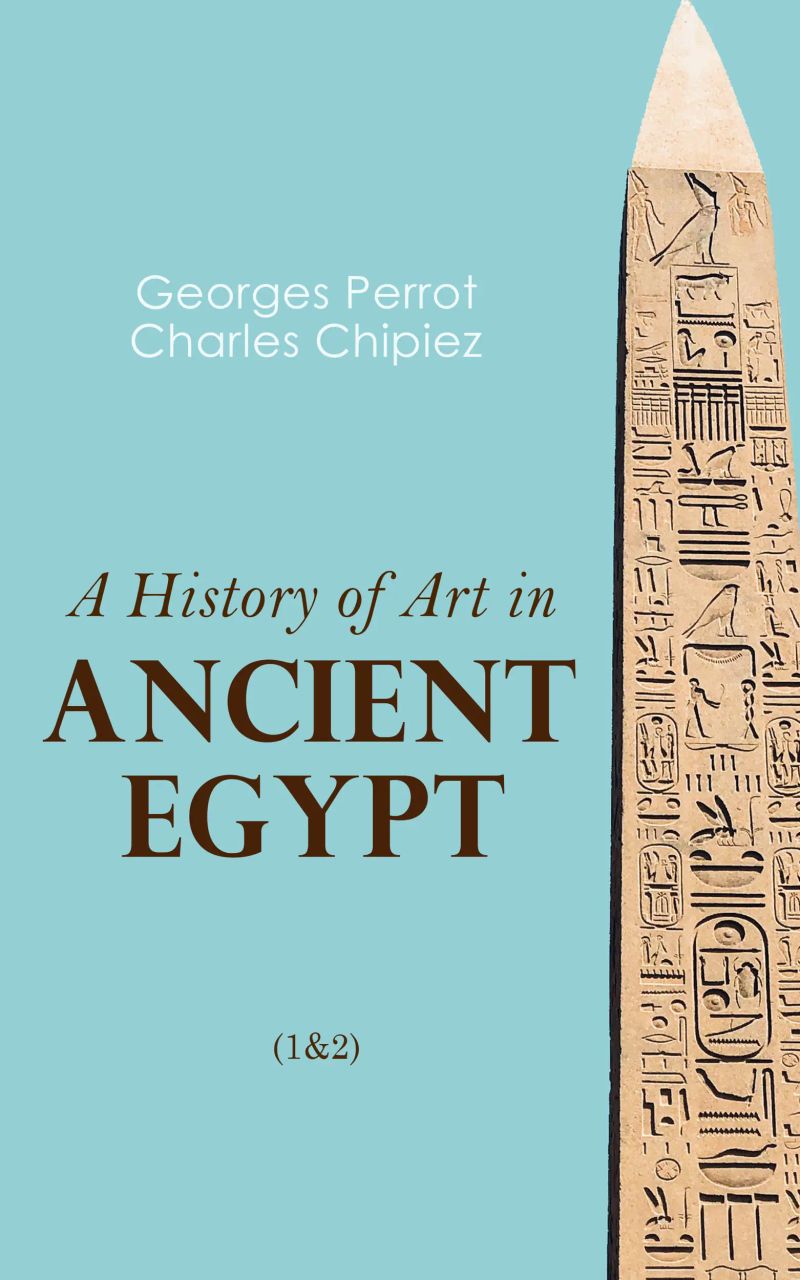
A History of Art in Ancient Egypt (1&2)
Illustrated EditionDe Georges Perrot, Charles Chipiez


Duração24h 42m
Sobre este audiolivro
A History of Art in Ancient Egypt in two volumes is a study of Egyptian arts and of their connection with the national religion and civilization written by French archeologists and historians Georges Perrot and Charles Chipiez. The aim of the work was to trace the course of the great evolution which culminated in the age of Pericles and came to an end in that of Marcus Aurelius. That evolution forms a complete entirety – an unbroken chain of cause and effect uniting the two eras. Using carefully selected examples authors prove that the art of the Egyptians went through the same process of development as those of other nationalities, earlier and later ones, and that the unique quality of the sculptures and paintings of the Nile Valley was a persistent affinity to simplification, which comes in part from the habit created by writing the hieroglyphic and in part from the materials used.
Detalhes do audiolivro
Avaliação★★★★ 4,3 (23)
Inclui Goodreads, Amazon
GêneroOther, Literary Classics
Duração24 h 42 min
Narrado porOuça com mais de 1.000 vozes
FormatoeBook com áudio
Data de publicação26 de jun. de 2020
IdiomaInglês
Sumário
1A History of Art in Ancient Egypt (1&2)
2INTRODUCTION.
3I.
4II.
5III.
Mostrar todos os capítulosVer menos
6IV.
7V.
8VI.
9TO THE READER.
10CHAPTER I.
11§ 1. Egypt's Place in The History of the World.
12§ 2. The Valley of the Nile and its Inhabitants.
13§ 3. The Great Divisions of Egyptian History.
14§ 4. The Constitution of Egyptian Society—Influence of that Constitution upon Monuments of Art.
15§ 5. The Egyptian Religion and its Influence upon the Plastic Arts.
16§ 6. That Egyptian Art did not escape the Law of Change, and that its History may therefore be written.
17§ 7. Of the place held in this work by the monuments of the Memphite period, and of the limits of our inquiry.
18CHAPTER II.
19§ 1. Method to be Employed by us in our Study of this Architecture.
20§ 2. General Principles of Form.
21§ 3. General Principles of Construction.—Materials.
22§ 4. Dressed Construction.
23§ 5. Compact Construction.
24§ 6. Construction by Assemblage.
25§ 7. Decoration.
26CHAPTER III.
27§ 1. The Egyptian Belief as to a Future Life and its Influence upon their Sepulchral Architecture.
28§ 2. The Tomb under the Ancient Empire.
29THE MASTABAS OF THE NECROPOLIS OF MEMPHIS.
30THE PYRAMIDS.
31§ 3. The Tomb under the Middle Empire.
32§ 4. The Tomb under the New Empire.
33CHAPTER IV.
34§ 1. The Temple under the Ancient Empire.
35§ 2. The Temple under the Middle Empire.
36§ 3. The Temple under the New Empire.
37§ 4. General Characteristics of the Egyptian Temple.
38FOOTNOTES:
39CHAPTER I.
40§ 1.—The Graphic Processes employed by the Egyptians in their representations of Buildings.
41§ 2. The Palace.
42§ 3.—The Egyptian House.
43§ 4. Military Architecture.
44CHAPTER II.
45§ 1. An Analysis of Architectural Forms necessary.
46§ 2. Materials.
47§ 3. Construction.
48§ 4. The Arch.
49§ 5 The Pier and Column.—The Egyptian Orders.
50THEIR ORIGIN.
Mais de Georges Perrot, Charles Chipiez

The Holy Bible - 1 SamuelKing James2h 13min4.8 (1.6K)$3 · $0.00

The American Standard Bible — The Gospel of MatthewMatthew3h 56min4.7 (3K)$2 · $0.00

Bad Fat Black GirlSesali Bowen6h 32min4.7 (2.8K)$24 · $0.00
The King James Audio Bible New Testament CompleteChristopher Glyn20h 2min4.7 (2.6K)$10 · $0.00
Faiths CheckbookCharles Spurgeon12h 44min4.7 (3.2K)$11 · $0.00

Ten Things I Wish You Knew About Your Child's Mental HealthDr. Billy Garvey4h 53min4.7 (2.4K)$20 · $0.00
Designing Terry Pratchett’s DiscworldPaul Kidby3h 52min4.7 (343)$20 · $0.00

The Lives of BrianBrian Johnson9h 45min4.6 (3.5K)$29 · $0.00
Expository Thoughts on the Gospel of LukeJ.C. Ryle27h 13min4.7 (536)$18 · $0.00

CrossroadsKaleb Dahlgren7h 56min4.6 (4.9K)$26 · $0.00

Across the RiverKent Babb11h 40min4.6 (927)$29 · $0.00

Brain Training for RidersAndrea Monsarrat Waldo5h 56min4.7 (550)$19 · $0.00

My Effin' LifeGeddy Lee17h 11min4.6 (13.1K)$40 · $0.00

Kings and PawnsHoward Bryant10h 9min4.6 (678)$29 · $0.00

The Elementia Chronicles #2: The New OrderSean Fay Wolfe11h 17min4.6 (841)$29 · $0.00
The ActsLuke2h 55min4.6 (19.7K)$12 · $0.00

New Testament - Easy NavigationWorld English Bible19h 35min4.6 (1.3K)$1.30 · $0.00

Woodcraft and Camping (Annotated)George Washington Sears3h 30min4.6 (1.2K)$1.99 · $0.00

The Hate U GiveAngie Thomas11h 50min4.5 (1.1M)$8 · $0.00
The King of AttoliaMegan Whalen Turner10h 23min4.5 (61.3K)$29 · $0.00

Demon CopperheadBarbara Kingsolver21h 3min4.5 (949.4K)$46 · $0.00

To Kill a MockingbirdHarper Lee12h 18min4.5 (7.4M)$29 · $0.00

These Precious DaysAnn Patchett11h 14min4.5 (45.2K)$29 · $0.00

The Gulag Archipelago Volume 3Aleksandr I. Solzhenitsyn21h 56min4.7 (8.9K)$46 · $0.00

This Side of Paradise - The Original 1920 Edition (Annotated)F. Scott Fitzgerald11h 30min4.6 (1.6K)$2 · $0.00

The Great Gatsby: Original 1925 Edition (An F. Scott Fitzgerald Classic NovelFrancis Scott Fitzgerald4h 45min4.6 (9.3K)$15 · $0.00

Your Faith Is Your FortuneNeville Goddard, Ale.mar.sas3h 43min4.6 (6K)$4.50 · $0.00

TWELFTH NIGHTWilliam Shakespeare, Sidney Lee16h 38min4.6 (2.8K)$1.99 · $0.00

The Complete Histories / History Plays of William Shakespeare (Annotated)William Shakespeare29h 42min4.6 (2.3K)$1.99 · $0.00

Braving the TruthRachel Held Evans11h 31min4.7 (359)$29 · $0.00

The Old Man and the Sea (Annotated)Ernest Hemingway4h 27min4.6 (1.4K)$2 · $0.00

The House at Pooh CornerAlan Alexander Milne2h 44min4.5 (107.8K)$4 · $0.00

Henry V (The Play, Historical Background and Analysis of the Character in the Play)William Shakespeare, William Hazlitt8h 50min4.6 (1.3K)$1.99 · $0.00

H. P. LOVECRAFT Ultimate Collection: Novellas, Short Stories, Poetry & Essays (Annotated)H. P. Lovecraft12h 28min4.6 (2.3K)$2 · $0.00

Time RegainedMarcel Proust16h 8min4.5 (10.6K)$1.99 · $0.00

The Mis-Education of the NegroCarter Goodwin Woodson4h 32min4.5 (28.4K)$10 · $0.00

TORAH - Bilingual Edition: English/Hebrew (Annotated)Max Margolis, JPS28h 26min4.6 (1K)$2 · $0.00

Betty Crocker picture cooky bookBetty Crocker, Inc. General Mills2h 13min4.5 (6.5K)$1 · $0.00

The Complete Tales of Beatrix PotterBeatrix Potter3h 36min4.5 (75K)$3 · $0.00

Anne of Green GablesL. M. Montgomery11h 1min4.5 (1.2M)$2.30 · $0.00
Você também pode gostar
Mysteries Of MithraFranz Cumont5h 19min4.1 (1.6K)$1.20 · $0.00
Egyptian Archaeology (Annotated)Gaston Maspero8h 53min3.9 (67)$2 · $0.00
Apollonius Of TyanaG. R.3h 21min4.0 (94)$3.50 · $0.00
Manual of Egyptian Archaeology and Guide to the Study of Antiquities in EgyptG. Maspero8h 39min3.9 (67)$1 · $0.00
History of the Ancient Chaldea (Summarized Edition)George Rawlinson2h 26min$2
A History of Art in Ancient Egypt (1&2)Georges Perrot, Charles Chipiez30h 24min4.2 (45)$1 · $0.00
Mesopotamian ArchaeologyPercy S. P. Handcock10h 58min$1 · $0.00
Ancient Egypt and the PyramidsKidsChoice1h 1min$12 · $0.00

The Thousand Buddhas (Annotated)Aurel Sir Stein6h 9min$2 · $0.00

The Seven Wonders of the Modern WorldKidsChoice43min$12 · $0.00

Children's Stories in American HistoryHenrietta Christian Wright5h 58min$2 · $0.00

Exploring the essence of Gothic artVictoria Charles, Klaus H. Carl1h 32min3.7 (22)$13
The Collected Works of George Rawlinson (Illustrated Edition)George Rawlinson145h 41min4.6 (11)$2 · $0.00
1000 Sculptures of GeniusJoseph Manca, Patrick Bade, Sarah Costello15h 28min4.1 (18)$18 · $0.00

Five Years' Explorations at Thebes (Annotated)Earl of George Edward Stanhope Molyneux Herbert Carnarvon, Howard Carter4h 16min$2 · $0.00
The Essential Works of George Rawlinson (Annotated)George Rawlinson145h 34min$2 · $0.00
The Rise and Fall of Ancient Empires: 15 History BooksTheodor Mommsen, Edward Gibbon, George Rawlinson, L. W. King, John Bagnell Bury, Arrian, Charles Oman455h 5min4.4 (14)$1.99

Dynasties Of DevotionDeepa Mandlik, Aboli Mandlik6h 5min4.1 (16)$24 · $0.00
Ancient Media (Annotated)George Rawlinson6h 32min$2 · $0.00
The Greatest Empires & Civilizations of the Ancient EastGeorge Rawlinson145h 53min4.4 (23)$1 · $0.00