
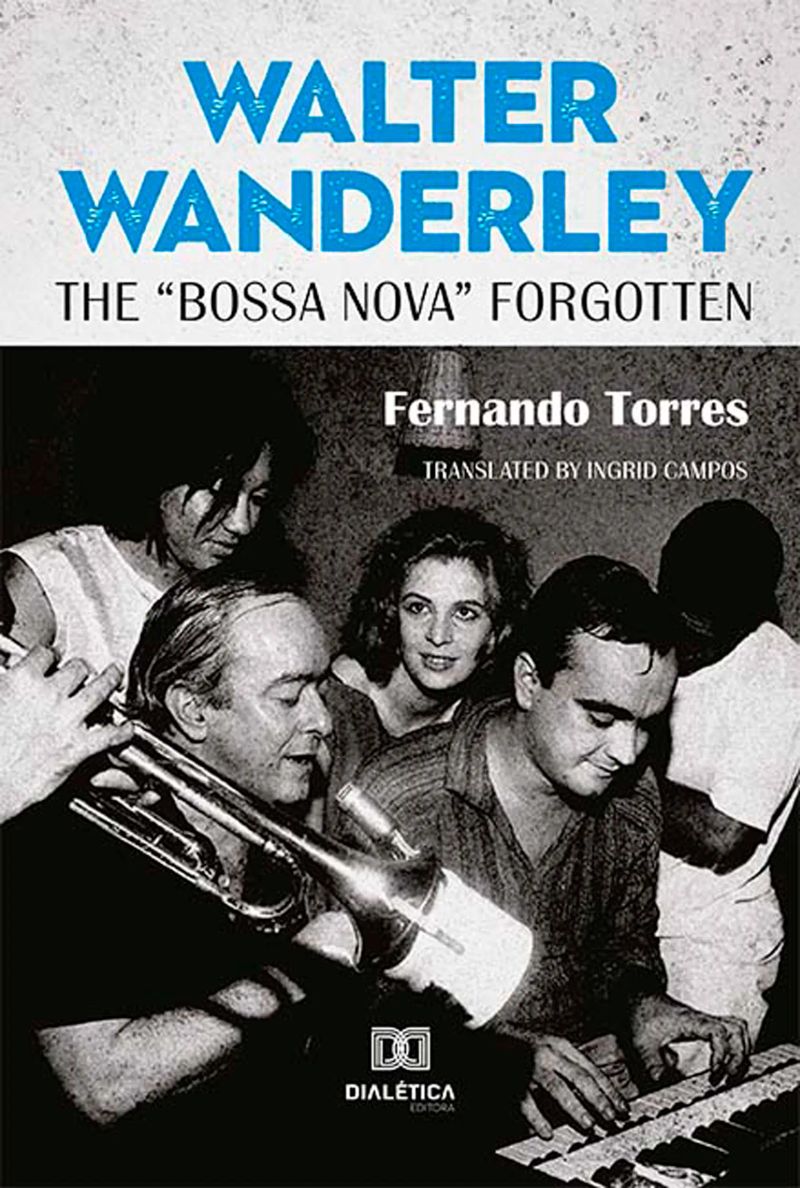
Walter Wanderley
The "Bossa Nova" ForgottenBy Fernando Torres


Length10h 25m
About this audiobook
This book is characterized as the result of an ethnomusicological and historical research by Recife musician Walter Wanderley (1932-1986), known as a representative of Bossa Nova. Organist, pianist, arranger and sporadic composer, Walter Wanderley has released dozens of records on record labels such as Odeon, Philips, the American company Verve and many others, both as an instrumentalist and arranger for singers and as solo instrumental albums. Even with such a robust record production, Walter Wanderley seems to have been forgotten by most records in the History of Brazilian Popular Music. This book tries to help understand how this success happened predominantly only outside his country of origin and the reasons why his name was practically omitted by historiography and by important references of Bossa Nova. As was his performance in other genres such as Samba, Bolero, Sambalanço and Sambajazz, which are much more present in his work than Bossa Nova itself, a genre for which the artist came to be labeled as representative, especially after his death. The book makes a contribution to the construction of knowledge for Ethnomusicology, Musicology and other areas of study of Brazilian Popular Music in its relations with the cultural industry and with the aspects between Memory and Forgetfulness.
Audiobook details
GenreBiography and Memoir
Length10 hrs 25 mins
Narrated byListen with 1,000+ voices
FormateBook with Audio
Publish dateNov 29, 2021
LanguageEnglish
Table of contents
1Introduction
2INTRODUCTION
31. WALTER WANDERLEY
41.1 WHO WAS WALTER WANDERLEY?
51.2 THE INFORMATION ON THE DISCS
Show all chaptersShow less
62. WALTER WANDERLEY´S DISCOGRAPHIC PRODUCTION IN BRAZIL
73. WALTER WANDERLEY IN THE USA
83.1 RECORD PRODUCTION IN THE USA
93.2 PHONOGRAPHIC INTERVAL
104. BOSSA NOVA, SAMBALANÇO & SAMBAJAZZ
114.1 BOSSA NOVA
124.2 SAMBALANÇO
134.3 SAMBAJAZZ
144.4 THE “SONORITY” WALTER WANDERLEY
155. CULTURAL INDUSTRY
165.1 PHONOGRAPHIC AND CULTURAL INDUSTRY IN THE 1950s AND 1960s.
175.2 AGAINST THE GRAIN OF THE HISTORY
186. CONCLUSIONS
197. BIBLIOGRAPHY
20ANNEX I
21ANNEXES II
22ANNEXES III

The StepsSylvester Stallone9h 4m4.8 (635)$29 · $0.00

How to Test Negative for StupidJohn Kennedy8h 13m4.7 (9.7K)$28 · $0.00

Bad Fat Black GirlSesali Bowen6h 32m4.7 (2.8K)$24 · $0.00

Send MeMarty Skovlund, Joe Kent8h 10m4.7 (1.6K)$26 · $0.00

John Muir: The Story of My Boyhood and Youth & Letters to a Friend (Annotated)John Muir10h 13m4.7 (1.1K)$0.99 · $0.00

Invisible StormJason Kander6h 48m4.7 (3.2K)$24 · $0.00

Forever BoyKate Swenson9h 27m4.7 (5K)$29 · $0.00

You Are Worth ItKyle Carpenter, Don Yaeger8h 53m4.7 (4.8K)$29 · $0.00

The Happiest Man on EarthEddie Jaku3h 48m4.6 (178K)$7 · $0.00

MotherlandJulia Ioffe17h 52m4.7 (2.5K)$40 · $0.00

Evidence Not SeenDarlene Deibler Rose11h 11m4.6 (11.9K)$29 · $0.00

Where Cowards Go to DieBenjamin Sledge8h 42m4.7 (351)$20 · $0.00

Will You Love Me?Cathy Glass9h 5m4.6 (9.3K)$29 · $0.00

Designing Terry Pratchett’s DiscworldPaul Kidby3h 52m4.7 (343)$20 · $0.00

HostageEli Sharabi5h 25m4.6 (10.8K)$24 · $0.00

Finding MeViola Davis9h 15m4.6 (256.4K)$29 · $0.00

The Dangerous Truth about Today’s MarijuanaLaura Stack CSP, MBA9h 57m4.7 (385)$20 · $0.00

Birdie & HarlowTaylor Wolfe7h 50m4.6 (6.5K)$26 · $0.00
The Lives of BrianBrian Johnson9h 45m4.6 (3.5K)$29 · $0.00

I Am The StormJanice Dean9h4.6 (1.5K)$8 · $0.00
You may also like

The Gilded PageMary Wellesley9h 15m4.3 (915)$20

History in English WordsOwen Barfield6h 31m4.2 (734)$2.40
Hollywood: The Oral HistoryJeanine Basinger, Sam Wasson28h 50m4.2 (1.5K)$53 · $0.00

ShakespeareBill Bryson5h 29m4.0 (58.6K)$24 · $0.00

Australia: A History - How an ancient land became a great democracyTony Abbott14h 26m4.3 (863)$33 · $0.00

The Cooking GeneMichael W. Twitty15h 21m4.2 (10.2K)$33 · $0.00

Between Past and FutureHannah Arendt11h 57m4.2 (3.8K)$20

A People's History of ChristianityDiana Butler Bass9h 29m4.0 (2.1K)$29 · $0.00

Hegel: The Science of LogicGeorg Wilhelm Friedrich Hegel17h 53m4.3 (4.5K)$1.99 · $0.00
MetaphysicsAristotle11h 38m4.2 (21.9K)$1.20 · $0.00

Who We Are and How We Got HereDavid Reich10h 51m4.3 (10.5K)$23
Poverty Point: A Culture of the Lower Mississippi Valley (Annotated)Jon L. Gibson1h 13m$2 · $0.00
Vermeer and His TimePhilip L. Hale3h 5m$18 · $0.00

Sandro BotticelliVictoria Charles1h 19m4.3 (45)$8 · $0.00

A Dictionary of the First or Oldest Words in the English LanguageHerbert Coleridge8h 56m$1 · $0.00

Women Writing MusicalsJennifer Ashley Tepper11h 58m4.1 (47)$25
The Trouble with TomPaul Collins9h 8m3.8 (327)$20
Notmsparker's Berlin CompanionBeata Gontarczyk-Krampe8h 26m4.4 (40)$17 · $0.00

The Lives and Theories of Eminent Philosophers (Annotated)Diogenes Laertius17h 35m$2 · $0.00

The Aboriginal Population of the North Coast of CaliforniaSherburne Friend Cook4h 27m$2 · $0.00