
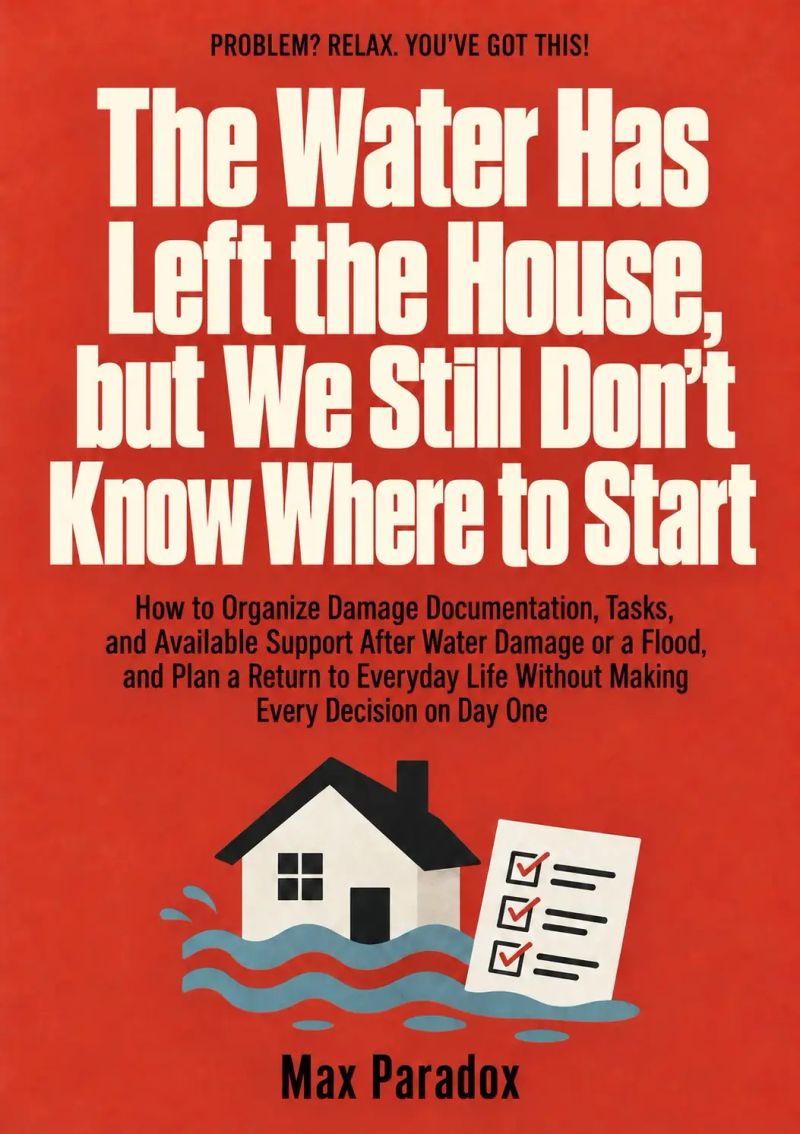
The Water Has Left the House, but We Still Don't Know Where to Start - How to Organize Damage Documentation, Tasks, and Available Support After Water Damage or a Flood, and Plan a Return to Everyday Life Without Making Every Decision on Day One
By Max Paradox


Length6h 40m
About this audiobook
The water is gone. The furniture is ruined. The paperwork appears to be reproducing. And someone has just asked when you're planning to move back home.
Wonderful question. Perhaps they could ask the walls.
After a flood or serious water damage, the hardest part isn't always the water itself. It's everything that happens afterward. The building needs assessing, damaged belongings need sorting, insurance questions demand answers, contractors have conflicting schedules, and ordinary life continues as though nothing unusual has happened.
Meanwhile, you're expected to make expensive decisions while exhausted, overwhelmed, and increasingly suspicious of every damp-looking surface.
The Water Has Left the House, but We Still Don't Know Where to Start is a practical, witty guide to navigating the complicated aftermath of flooding without trying to solve your entire future before breakfast.
In his characteristic style, Max Paradox combines useful explanations, realistic examples, intelligent humour, and a healthy respect for the fact that disaster recovery rarely follows a convenient timetable.
This book helps you understand how to approach the first assessment of damage, recognise situations requiring qualified professionals, and distinguish genuine emergencies from decisions that can responsibly wait. You'll discover how to organize photographs, receipts, correspondence, and other evidence so that important information doesn't disappear into a phone containing four hundred nearly identical pictures of a damaged wall.
You'll also explore the practical challenges of insurance claims, available assistance, repair quotations, contractor coordination, and unexpected expenses. Because a restoration budget has an unfortunate tendency to become outdated approximately eleven minutes after somebody calls it final.
But recovering a home involves more than buildings and money.
What happens when your family needs temporary accommodation for much longer than expected? How do you accept useful help without turning your driveway into an unofficial donation warehouse? What if relatives disagree about repairs, precious belongings cannot be saved, or a problem reappears after the work supposedly finished?
And what if returning home is no longer the most realistic option?
Across twenty substantial chapters, the book examines these difficult situations with practical insight and humour directed at the absurdities of the process, never at people experiencing genuine hardship.
Rather than promising miraculous solutions, it shows you how to identify what is known, understand what still needs checking, organise responsibilities, ask more useful questions, and make decisions suited to your actual circumstances.
The final chapters address the challenges that continue after renovation: persistent exhaustion, future flood concerns, unfinished administrative obligations, and the gradual return to independent everyday living.
This isn't a book about becoming the world's greatest flood-recovery manager. It's about eventually being able to stop being one.
You won't find a magical formula that makes contractors arrive simultaneously, insurers agree with every estimate, or damaged furniture repair itself out of embarrassment.
You will find a clearer way to approach difficult decisions, avoid unnecessary confusion, and recover some control over a situation that may initially feel impossible to manage.
Because when water has disrupted your home, you deserve more than another person telling you to stay calm.
You deserve to know what actually makes sense to do next.
This publication was prepared using tools that support the creative process, including artificial intelligence solutions. The final concept, structure and editing are the responsibility of the author.
Audiobook details
GenreOther
Length6 hrs 40 mins
Narrated byListen with 1,000+ voices
FormateBook with Audio
Publish dateNov 1, 2026
LanguageEnglish
Table of contents
1INTRO
2Chapter 1 - The Water Is Gone. Why Doesn't the House Feel Safe Yet?
3Chapter 2 - When Everything Is Urgent, Nothing Has a Proper Place in the Queue
4Chapter 3 - The Most Expensive Words After a Flood: "Let's Just Get Something Done"
5Chapter 4 - Four Hundred Photos, No Useful Evidence, and a Phone Full of Mud
Show all chaptersShow less
6Chapter 5 - Your House Is Uninhabitable, but Everyday Life Didn't Get the Memo
7Chapter 6 - Help Has Arrived. Now Who Is Going to Organize It?
8Chapter 7 - The Walls Look Dry. Unfortunately, Moisture Hasn't Agreed to Leave
9Chapter 8 - We're Fighting About a Cupboard. The Cupboard Is Innocent
10Chapter 9 - I've Filed the Insurance Claim. Why Hasn't Anyone Sent the Money?
11Chapter 10 - The Repair Budget: How Much Will Something Cost When Nobody Knows What It Is Yet?
12Chapter 11 - Five Contractors, Three Deadlines, and One Bathroom: How to Keep the Renovation Under Control
13Chapter 12 - The Application for Assistance: How to Survive the Form and Its Seventeen Attachments
14Chapter 13 - What Can Be Saved, What Must Go, and Why Is There a Toaster in the Garden?
15Chapter 14 - We're Moving Back Home. But Is the House Ready for Us?
16Chapter 15 - We Fixed It. So Why Is Something Wrong Again?
17Chapter 16 - What If We Can't Go Back? When the Original Plan Stops Making Sense
18Chapter 17 - I'm Exhausted. Unfortunately, the Flood Still Has Plenty of Energy
19Chapter 18 - Rain Again: How to Stay Prepared Without Living on High Alert
20Chapter 19 - The Last Invoice, the Last Phone Call, and the Things That Refuse to End
21Chapter 20 - You Don't Have to Know Everything Anymore. You Just Need to Know What to Do Next

Pracuję Dobrze, Ale Nikt Tego Nie Widzi - Jak budować widoczność swojej pracy, komunikować efekty i dbać o własną karierę bez zamieniania się w chodzącą prezentację sukcesówMax Paradox4h 44m4.5 (44)$5.10
The Building Association Raises the Repair Fund, and I Raise My Blood Pressure - How to Read Your Building's Budget, Ask Questions About Repairs, and Take Part in Building Decisions Without Voting Based Solely on the Latest Argument at the Owners' MeMax Paradox6h 47m$5.10

Dziecko Mówi Dwoma Językami, a Dziadkowie Mają Sto Teorii - Jak budować rodzinny plan używania języków, współpracować ze szkołą i wybierać rzetelne wsparcie bez robienia z każdej rozmowy egzaminu z dwujęzycznościMax Paradox6h 17m$5.10
My Bike Should Take Me to Work, Not Stand in the Hallway - How to Plan Your Route, Gear, Parking, and Bad-Weather Options, and Gradually Make Cycling Part of Your Everyday Commute Without Buying a Pro Cyclist Identity Along with Your HelmetMax Paradox6h 21m$5.10

Dzielimy Mieszkanie po Rodzicach i Każdy Ma Inny Kalkulator - Jak uzgadniać korzystanie z odziedziczonej nieruchomości, koszty i kierunek dalszych decyzji oraz przygotować się do mediacji bez rodzinnej licytacji na zasługiMax Paradox6h 18m$5.10
The Hearing Aid Didn't Fix Every Conversation - How to Agree on Communication Conditions with Loved Ones and Coworkers, Use Available Accommodations, and Stay Connected Without Pretending You Heard EverythingMax Paradox6h 25m$5.10

My Child Has an Allergy, and Everyone Has Good Advice and a Cookie - How to Agree on a Daily Safety Plan with Specialists, School, and Loved Ones, Share Instructions, and Organize Outings Without Explaining Everything from Scratch Every Time SomeoneMax Paradox6h 37m$5.10

I Can't Drive Anymore, but Life Is Still Twenty Kilometers Away - How to Organize Shopping, Appointments, and Social Connections After Giving Up Driving and Build a Transportation Support Network Without Letting Others Control Your Entire CalendarMax Paradox6h 30m$5.10

Nie Mogę Już Prowadzić, a Życie Nadal Jest Dwadzieścia Kilometrów Dalej - Jak zorganizować zakupy, wizyty i kontakty po rezygnacji z prowadzenia auta oraz stworzyć sieć transportowego wsparcia bez oddawania całego kalendarza innym ludziomMax Paradox6h 19m$5.10

W Domu Jest Trzydzieści Stopni, a Klimatyzacja Jest w Planach - Jak organizować mieszkanie, obowiązki i pomoc dla bardziej narażonych domowników podczas upałów oraz planować potrzebne dostosowania bez czekania na kolejne rekordowe latoMax Paradox5h 55m4.7 (30)$5.10

My Child Has a Special Education Ruling, but the School Has Its Own Interpretation - How to Organize Recommendations, Prepare for Meetings, and Monitor Agreed Educational Accommodations Without Fighting a Daily Battle Over Every Need Your Child HasMax Paradox6h 37m$5.10

Nasze Dziecko Jest Pierwsze w Rodzinie, Które Idzie na Studia - Jak wspierać wybór uczelni, przeprowadzkę i samodzielność, poznawać akademickie zasady oraz rozmawiać o kosztach bez udawania rodzinnego doświadczenia, którego jeszcze nie maMax Paradox6h 7m$5.10

Woda Wyszła z Domu, a My Nadal Nie Wiemy, od Czego Zacząć - Jak uporządkować dokumentację szkód, zadania i dostępne wsparcie po zalaniu lub powodzi oraz planować powrót do codzienności bez podejmowania wszystkich decyzji pierwszego dniaMax Paradox6h 20m$5.10

Rodzice Się Rozwodzą, a Ja Mam Czterdzieści Lat - Jak nie zostać mediatorem, powiernikiem i kurierem pretensji, ustalić własne relacje z obojgiem rodziców oraz odnaleźć się w zmianie rodzinnego układuMax Paradox6h 12m4.7 (19)$5.10

The Heat Pump Is New, and I Still Don't Know What to Set - How to Gather Installation Documentation, Understand Basic Settings and Energy Consumption, and Work with Your Installer to Optimize Performance Without Experimenting with the Entire HeatingMax Paradox6h 31m$5.10
The Adult Child Moves Back Home and Brings Their Own Rulebook - How to Agree on Costs, Responsibilities, Privacy, and the Ground Rules for Living Together Again Without Recreating the Parent-and-Teenager DynamicMax Paradox6h 36m4.9 (18)$5.10

Kupujemy Mieszkanie Razem, Ale Nie Jesteśmy Małżeństwem - Jak przygotować rozmowy o wkładach, odpowiedzialności i możliwym rozstaniu oraz zebrać pytania do specjalistów bez zakładania, że miłość zastępuje wszystkie ustaleniaMax Paradox6h 12m$5.10

Studiuję, Pracuję i Podobno To Ma Być Najlepszy Czas Życia - Jak łączyć wymagania uczelni z zarabianiem, planować sesję i szukać dostępnego wsparcia bez finansowania studiów wyłącznie własnym snemMax Paradox6h 28m$5.10

My Partner Is from Another Country, and Our Families Have Two Recipes for Everything - How to Navigate Traditions, Language, and Family Expectations as an Intercultural Couple Without Deciding Whose Family Is Right at Every HolidayMax Paradox6h 51m$5.10

My Father Has Fallen in Love Again, and I Have No Ready-Made Role for This - How to Talk to Your Parent About a New Relationship, Sort Through Your Emotions, and Build a Connection with His Partner Without Taking Responsibility for Other Adults' LiveMax Paradox6h 33m$5.10

The Holy Bible - 1 SamuelKing James2h 13m4.8 (1.6K)$3 · $0.00

The American Standard Bible — The Gospel of MatthewMatthew3h 56m4.7 (3K)$2 · $0.00

Bad Fat Black GirlSesali Bowen6h 32m4.7 (2.8K)$24 · $0.00

The King James Audio Bible New Testament CompleteChristopher Glyn20h 2m4.7 (2.6K)$10 · $0.00

Faiths CheckbookCharles Spurgeon12h 44m4.7 (3.2K)$11 · $0.00

Ten Things I Wish You Knew About Your Child's Mental HealthDr. Billy Garvey4h 53m4.7 (2.4K)$20 · $0.00

Designing Terry Pratchett’s DiscworldPaul Kidby3h 52m4.7 (343)$20 · $0.00

The Lives of BrianBrian Johnson9h 45m4.6 (3.5K)$29 · $0.00

Expository Thoughts on the Gospel of LukeJ.C. Ryle27h 13m4.7 (536)$18 · $0.00

CrossroadsKaleb Dahlgren7h 56m4.6 (4.9K)$26 · $0.00

Across the RiverKent Babb11h 40m4.6 (927)$29 · $0.00

Brain Training for RidersAndrea Monsarrat Waldo5h 56m4.7 (550)$19 · $0.00

My Effin' LifeGeddy Lee17h 11m4.6 (13.1K)$40 · $0.00

Kings and PawnsHoward Bryant10h 9m4.6 (678)$29 · $0.00

The Elementia Chronicles #2: The New OrderSean Fay Wolfe11h 17m4.6 (841)$29 · $0.00

The ActsLuke2h 55m4.6 (19.7K)$12 · $0.00

New Testament - Easy NavigationWorld English Bible19h 35m4.6 (1.3K)$1.30 · $0.00

Woodcraft and Camping (Annotated)George Washington Sears3h 30m4.6 (1.2K)$1.99 · $0.00

The Hate U GiveAngie Thomas11h 50m4.5 (1.1M)$8 · $0.00

The King of AttoliaMegan Whalen Turner10h 23m4.5 (61.3K)$29 · $0.00
You may also like

Small CuresDella Hicks-Wilson41m4.5 (571)$4

ShatteredHanif Kureishi6h 9m4.3 (1.4K)$24 · $0.00

Tell Me Everything You Don't RememberChristine Hyung-Oak Lee7h 26m3.7 (1.6K)$24 · $0.00

The Adrenal Thyroid RevolutionAviva Romm8h 40m4.1 (2.6K)$26 · $0.00

THE CONSOLATION OF PHILOSOPHY (The Cooper Translation)Anicius Manlius Severinus Boethius6h 7m4.2 (23.6K)$0.99 · $0.00

CensusJesse Ball4h 52m3.6 (5.1K)$20 · $0.00

My Bright AbyssChristian Wiman5h 44m4.2 (4.7K)$20 · $0.00

Unf*ck Your BrainFaith G. Harper PhD3h 39m3.8 (30.4K)$15

In Memoriam A. H. HAlfred Tennyson3h 39m4.2 (13K)$1 · $0.00

Until I Say Good-ByeSusan Spencer-Wendel9h 16m4.2 (9.5K)$29 · $0.00

PoemsWilliam Ernest Henley3h 22m4.0 (93)$1 · $0.00
The Noise Between Your Ears - How Overthinking Became the Emergency You Can't Turn OffMax Paradox5h 23m$7.70
Cruising Through CalamityBev Aisbett3h 3m3.4 (62)$18 · $0.00

Anxiety Relief for Racing ThoughtsEmotional Healing Studio1h 30m$6 · $0.00

The Comfort BookBriefly Summaries14m$15 · $0.00
The Noise Between Your Ears - How Overthinking Became the Emergency You Can't Turn OffMax Paradox5h 23m$5.10 · $0.00

Soft Thorns: The Audiobook CollectionBridgett Devoue2h 26m$15

The Color of a Great CityTheodore Dreiser8h 13m3.9 (145)$2.30

HEALINGJackson Michael47m5.0 (34) Only with Ultra

Poems (Annotated)William Ernest Henley3h 31m4.0 (95)$2 · $0.00