
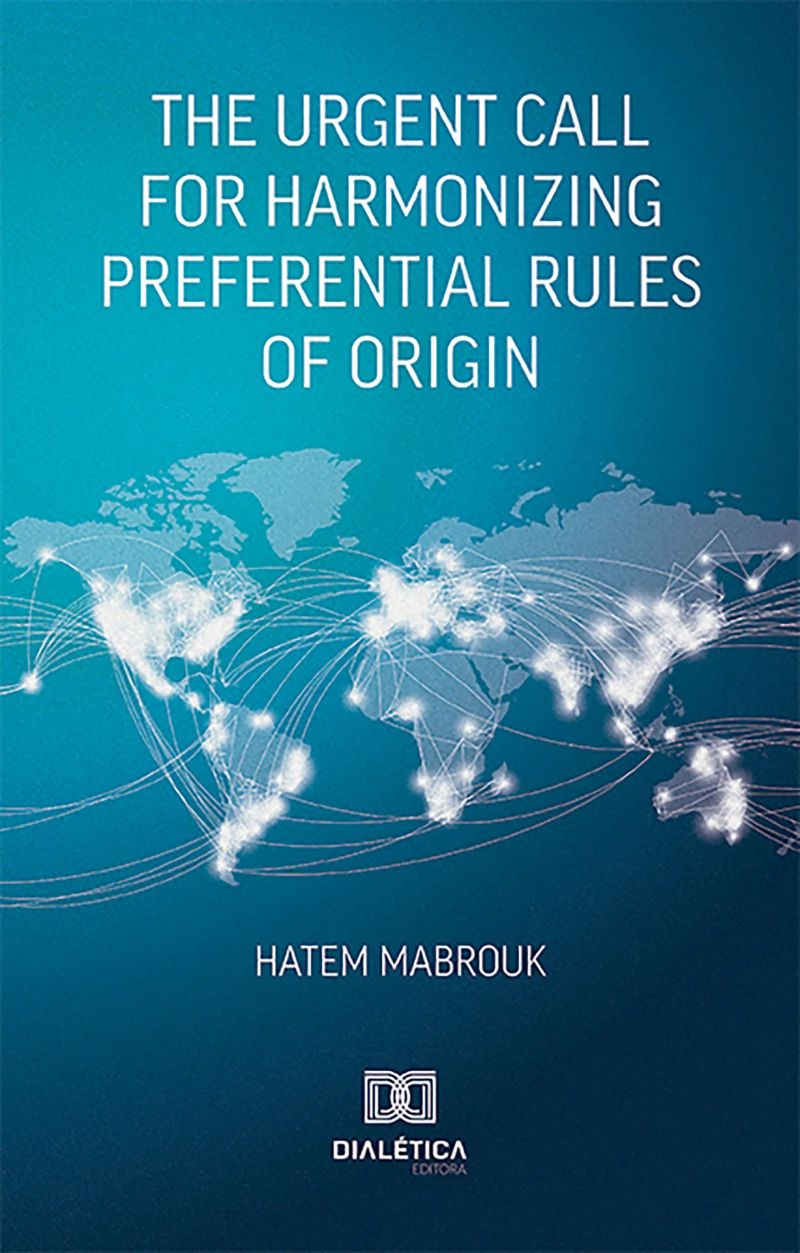
The Urgent Call for Harmonizing Preferential Rules of Origin
By Hatem Mabrouk

Length5h 6m
About this audiobook
In an increasingly interconnected world, rules of origin—laws determining the national source of a product—play a crucial role in international trade. Yet, with each country setting its own standards, the global market faces a complex web of regulations that often impedes rather than facilitates trade. "The Urgent Call for Harmonizing Preferential Rules of Origin" by Hatem Mabrouk delves into these complexities and challenges.
The book reveals how preferential rules of origin, designed to determine eligibility for tariff preferences under trade agreements, are often manipulated for protectionist and political aims, creating significant obstacles for global producers and traders. Through rigorous analysis and case studies, Mabrouk explores the detrimental impacts of these systems and proposes a harmonized approach aligned with the World Trade Organization to streamline and improve international trade practices.
Mabrouk's proposal offers a robust blueprint for policymakers and trade bodies to refine global trade mechanisms. "The Urgent Call for Harmonizing Preferential Rules of Origin" is essential reading for anyone involved in international trade or global economics, advocating for clearer and fairer trade regulations to enhance global economic prosperity.
Audiobook details
GenreBusiness and Economics
Length5 hrs 6 mins
Narrated byListen with 1,000+ voices
FormateBook with Audio
Publish dateJun 12, 2024
LanguageEnglish
Table of contents
1ABBREVIATIONS
2CHAPTER I: INTRODUCTION
31.1 ARTICLE I, III AND XXIV OF THE GATT 1994.
41.2 RULES OF ORIGIN IN GENERAL.
51.3 RULES OF ORIGIN IN PREFERENTIAL TRADE AGREEMENTS.
Show all chaptersShow less
61.4 ADDRESSING THE BOOK ISSUE.
71.4.1 Protectionism.
81.4.2 Trade Diversion.
91.4.3 The Propagation of Rules of Origin Worldwide.
101.4.4 Political Purposes.
111.5 THE BOOK QUESTION.
121.6 TESTING THE BOOK HYPOTHESIS.
13CHAPTER II: THE MISUSE OF PREFERENTIAL RULES OF ORIGIN
142.1. DO PREFERENTIAL RULES OF ORIGIN LEND THEMSELVES TO BEING USED FOR PROTECTIONIST PURPOSES?
152.1.1 The WTO Agreement on Rules of Origin.
162.1.2 The USMCA.
172.1.2.1 Automobiles.
182.1.2.2 Ketchup.
192.1.2.3 The Triple Transformation under the USMCA.
202.1.3 The EU GSP Rules of Origin.
212.1.4 What should be done to Face Protectionist Rules of Origin?
222.2 RULES OF ORIGIN AS TRIGGERS TO TRADE DIVERSION.
232.2.1 The Possible Trade-Diverting Consequences of Preferential Trade Agreements.
242.2.2 The Trade-Diverting Consequences of Preferential Trade Agreements Rules of Origin.
252.2.3 The Relation between the Imposition of Protectionist Rules of Origin and Trade Diversion.
262.2.4 North America vs. Asia and the Caribbean: An Emphasis on Historical Data.
272.2.5 The EU double transformation rule and trade diversion.
282.2.6 The Negative Effects of Article XXIV of the GATT 1994.
292.3 THE USAGE OF RULES OF ORIGIN FOR POLITICAL PURPOSES.
302.3.1 The Issue of Recognition.
312.3.2 Using Preferential Rules of Origin to Pursue Political Objectives.
322.4 THE WORLDWIDE PROPAGATION OF PREFERENTIAL RULES OF ORIGIN.
332.5 SUMMARY.
34CHAPTER III: THE HARMONIZATION OF PREFERENTIAL RULES OF ORIGIN
353.1 THE HARMONIZATION OF NON-PREFERENTIAL RULES OF ORIGIN.
363.1.1 The Outstanding Issues Obstructing the Completion of the Harmonization Process of Non-preferential Rules of Origin.
373.1.2 Problems Concerning the Application of Rules of Origin Worldwide and Suggestions to Overcome Remaining Obstacles.
383.2 HARMONIZING PREFERENTIAL RULES OF ORIGIN.
393.2.1 The Calculation of the Number and Using the Denominator.
403.2.2 Product-Specific Rules of Origin.
413.2.3 Cumulation Rules: The Baits.
423.2.4 The Basic Required Origin Method to be applied under the Last Substantial Transformation Norm.
433.2.5 Proposed Harmonized Set of Preferential Rules of Origin.
443.2.6 Commentary on the Proposal.
453.2.7 The Position of WTO Member States.
463.2.8 The Prospects for Agreement on Harmonized Preferential Rules of Origin.
47CHAPTER IV: TESTING THE HARMONIZED PREFERENTIAL RULES OF ORIGIN
484.1 PROTECTIONISM.
494.2 TRADE DIVERSION.
504.3 POLITICAL PURPOSES.

Never Split the DifferenceChris Voss, Tahl Raz8h 7m4.4 (277.7K)$26 · $0.00
The Intelligent Investor Rev Ed.Benjamin Graham17h 48m4.3 (191.5K)$40 · $0.00

The Hard Thing About Hard ThingsBen Horowitz7h 57m4.2 (134.3K)$26 · $0.00
Boundaries for LeadersHenry Cloud7h 36m4.3 (3.6K)$26 · $0.00
Basic EconomicsThomas Sowell18h 32m4.5 (29.3K)$28 · $0.00

The Ambuja StoryNarotam Sekhsaria13h 59m4.5 (830)$33 · $0.00

The Secret Door to SuccessFlorence Scovel Shinn2h 25m4.5 (2.1K)$1.20 · $0.00

This Is Going to HurtAdam Kay5h 47m4.4 (444.7K)$24 · $0.00

Big TrustShadé Zahrai, Fayçal Sekkouah8h 36m4.6 (406)$26 · $0.00
The Intelligent Investor Third EditionBenjamin Graham, Jason Zweig20h4.4 (156.6K)$46 · $0.00

Bottle of LiesKatherine Eban14h 25m4.4 (12K)$33 · $0.00

The Antiracist Business BookTrudi Lebrón6h 10m4.6 (275)$17 · $0.00
The FormulaJoshua Robinson, Jonathan Clegg10h 41m4.4 (6.9K)$29 · $0.00

Let Them LeadJohn U. Bacon7h 10m4.5 (1.4K)$24 · $0.00

Secrets of the Millionaire MindT. Harv Eker5h 11m4.4 (301.4K)$24 · $0.00

The Person You Mean to BeDolly Chugh9h 6m4.4 (7.2K)$29 · $0.00
BoundlessNick Kostov, Sean McLain9h 17m4.5 (1.1K)$29 · $0.00

Everyday DharmaSuneel Gupta5h 2m4.5 (761)$20 · $0.00

Let's Talk Mutual FundsMonika Halan7h 5m4.4 (2.4K)$16 · $0.00

Secret PowerDwight Lyman Moody3h 7m4.4 (1.4K)$1.20 · $0.00
You may also like
The Golden ThreadColin Meloy9m4.2 (267)$4 · $0.00

The Lion and the Unicorn (Annotated)Eric Arthur Blair4h 9m4.1 (3.9K)$1.99 · $0.00

The Constitution of Japan, 1946Japan2h 12m4.2 (287)$2 · $0.00
Essays in persuasionJohn Maynard Keynes9h 45m4.1 (608)$3

The League of Nations and Its Problems: Three LecturesL. Oppenheim56m$1 · $0.00

The Future of International LawL. Oppenheim3h 9m3.6 (29)$2 · $0.00

Opportunities in EngineeringCharles M. Horton47m$2 · $0.00

In Search of Peace (Annotated)Neville Chamberlain12h 9m$1.99 · $0.00
WASHINGTON AND THE RIDDLE OF PEACEH. G. Wells7h 35m3.5 (12)$0.99 · $0.00
Uniting AmericaPeter Shinkle16h 5m4.3 (65)$25

The Elements of Reconstruction (The original unabridged edition)H. G. Wells2h 15m$2 · $0.00
Great Speeches by the Presidents of the United States, Vol. 3SpeechWorks9h 43m$20

Independent BohemiaVladimir Nosek5h 46m$2.30
A Practical International ProgramJay William Hudson1h 2m$2 · $0.00
WASHINGTON AND THE HOPE OF PEACEH. G. Wells7h 36m3.7 (23)$0.99 · $0.00
The Progressive Democracy of James M. CoxCharles E. Morris2h 39m$2 · $0.00

This Troubled WorldEleanor Roosevelt51m4.0 (56)$2 · $0.00
The War That Will End WarH. G. Wells2h 38m3.1 (124)$5 · $0.00

Merchant, Soldier, SageDavid Priestland13h 13m3.9 (702)$23 · $0.00
Washington and the Hope of Peace (Unabridged, aka "Washington and the Riddle of Peace")H. G. Wells6h3.4 (45)$2 · $0.00