
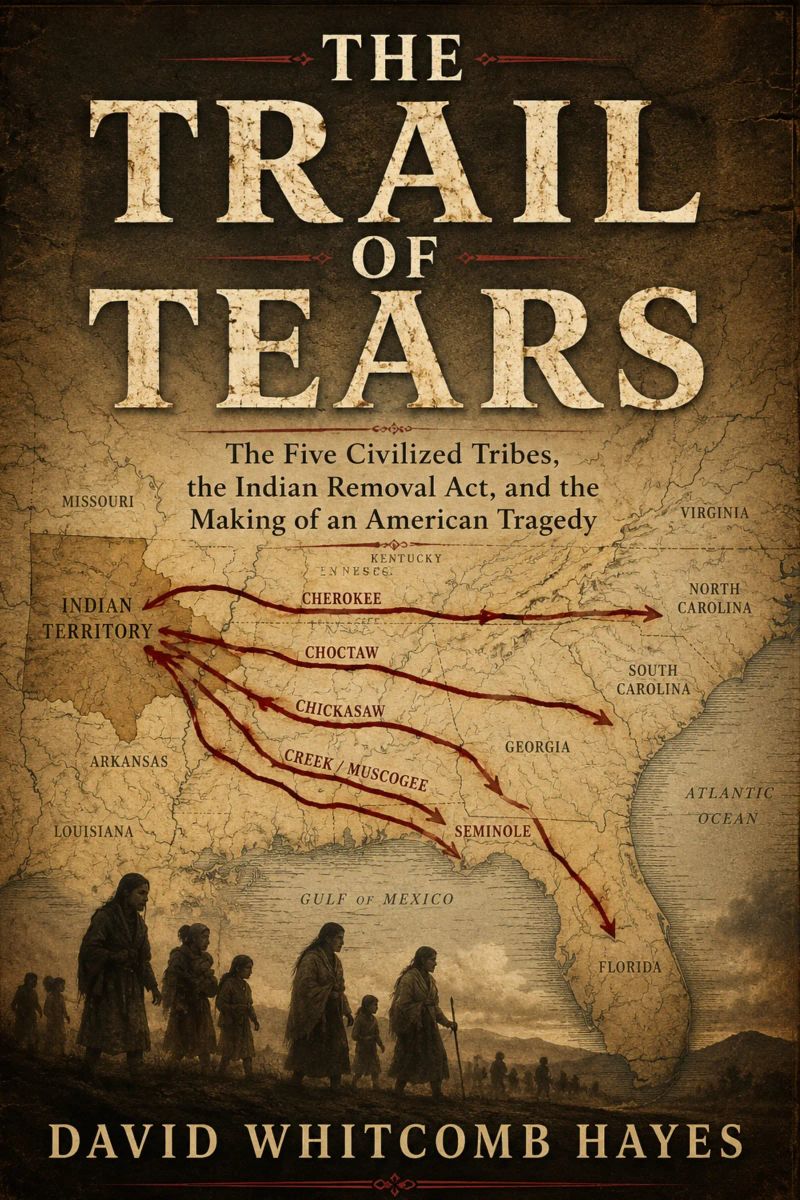
THE TRAIL OF TEARS
The Five Civilized Tribes, the Indian Removal Act, and the Making of an American TragedyBy David Whitcomb Hayes


Length6h 27m
About this audiobook
Trail of Tears history — the Five Civilized Tribes, the Indian Removal Act of 1830, Andrew Jackson, and the complete narrative history of America's forced relocation of 60,000 indigenous people.
Private John G. Burnett was twenty-eight years old in the autumn of 1838 when he supervised the Cherokee removal. He had grown up on the Tennessee-Georgia border and learned Cherokee as a boy. Sixty years later, dying at eighty, he wrote it down for his children: "Men working in the fields were arrested and driven to the stockades. Women were dragged from their homes by soldiers whose language they could not understand." He estimated four thousand died. "I fought through the Civil War and have seen men shot to pieces and slaughtered by thousands, but the Cherokee removal was the cruelest work I ever knew."
This is the history of how that cruelty became federal policy. Historian David Whitcomb Hayes traces the Indian removal across twenty-four chapters — following Andrew Jackson, John Ross, Major Ridge, Senator Frelinghuysen, and General Winfield Scott through the political battles, Supreme Court victories that went unenforced, and the fraudulent Treaty of New Echota signed by only 500 of 17,000 Cherokee. The Choctaw walked first in the winter of 1831-1832 when Alexis de Tocqueville watched them cross the Mississippi: "misery and misfortune painted in such livid colors." They were followed by the Creek, Chickasaw, Seminole, and finally the Cherokee.
Inside this American history of Indian removal:
Georgia's assault on Cherokee sovereignty — the 1828 law voiding Cherokee courts, the gold rush that brought 10,000 prospectors to Dahlonega ($35 million extracted; the Cherokee received nothing), and the lottery distributing Cherokee land before removal was complete (Chapters 5-6)
The Indian Removal Act of 1830 — passed by five votes in the House after Frelinghuysen asked "Do the obligations of justice change with the color of the skin?" and the 100,000-signature petition campaign (Chapter 6)
Worcester v. Georgia — the Supreme Court ruling in the Cherokee's favor that Jackson refused to enforce (Chapter 10)
John Ross's resistance — thirty-eight years defending Cherokee sovereignty; his wife Quatie died on the march after giving her blanket to a sick child (Chapter 7)
The Choctaw template of failure — fraudulent food rations, blizzard conditions, estimated mortality of 12-28 percent of 21,000 people (Chapter 8)
The Second Seminole War — the only removal the government could not complete, fought in the Florida swamps for seven years (Chapter 15)
The Trail of Tears is not only a story of destruction. The Cherokee, Creek, Choctaw, Chickasaw, and Seminole nations maintained their governmental structures, cultural traditions, and political identity through nearly two centuries of continued pressure. Their descendants live in Indian Territory still. The road west ended at a destination from which there was no return — but it did not end the people.
Audiobook details
GenreHistory
Length6 hrs 27 mins
Narrated byListen with 1,000+ voices
FormateBook with Audio
LanguageEnglish
Table of contents
1Introduction
2Author’s Note
3Prologue: The Road West
4PART ONE: NATIONS WITHIN A NATION (1776–1820)
5Chapter 1: The Five Civilized Tribes and the American Frontier
Show all chaptersShow less
6Chapter 2: The Civilization Program — Acculturation and Its Limits
7Chapter 3: Cherokee Phoenix — A Nation Writes Itself into Existence
8Chapter 4: The Creek Confederacy in the Age of Jackson
9PART TWO: THE PRESSURE BUILDS (1820–1830)
10Chapter 5: Georgia Moves Against the Cherokee
11Chapter 6: The Indian Removal Act of 1830
12Chapter 7: John Ross and the Politics of Resistance
13Chapter 8: The Choctaw — First to Walk
14PART THREE: THE COURTS AND THE CRISIS (1830–1835)
15Chapter 9: Cherokee Nation v. Georgia
16Chapter 10: Worcester v. Georgia — The Supreme Court Decides
17Chapter 11: Jackson and the Law — A President Who Would Not Enforce
18Chapter 12: The Creek Removal and the War of 1836
19PART FOUR: THE TREATY PARTY AND ITS CONSEQUENCES (1835–1838)
20Chapter 13: The Treaty of New Echota — A Nation Divided
21Chapter 14: The Chickasaw and Seminole Contrasts
22Chapter 15: The Second Seminole War — Resistance in the Swamps
23Chapter 16: Roundup — The Stockades of 1838
24PART FIVE: THE TRAIL (1838–1839)
25Chapter 17: The March West — Routes, Deaths, and Survival
26Chapter 18: General Winfield Scott and the Military Removal
27Chapter 19: Children, Women, and the Elderly — The Human Cost
28Chapter 20: Arriving in Indian Territory
29PART SIX: AFTERMATH AND MEMORY
30Chapter 21: Rebuilding in Indian Territory
31Chapter 22: The Civil War and the Nations
32Chapter 23: The Long Legal Fight — Treaties and Broken Promises
33Chapter 24: The Trail of Tears in American Memory
34Epilogue: What Remained
35Acknowledgments
36Selected Bibliography
37About the Author
More from David Whitcomb Hayes

A Brief History of IntelligenceMax S. Bennett12h 18m4.6 (6.6K)$29 · $0.00

MotherlandJulia Ioffe17h 52m4.7 (2.5K)$40 · $0.00

Where Cowards Go to DieBenjamin Sledge8h 42m4.7 (351)$20 · $0.00

RevolutionariesSanjeev Sanyal11h 23m4.6 (2.6K)$29 · $0.00

We Crossed a Bridge and It TrembledWendy Pearlman6h4.6 (5.2K)$24 · $0.00

Unbroken Bonds of BattleJohnny Joey Jones8h 31m4.6 (2.6K)$8 · $0.00

The Daughter of AuschwitzTova Friedman, Malcolm Brabant7h 54m4.6 (16.7K)$26 · $0.00

Lily's PromiseLily Ebert, Dov Forman8h 54m4.6 (16.1K)$29 · $0.00

On Democracies and Death CultsDouglas Murray10h 38m4.6 (6.5K)$29 · $0.00

Across the RiverKent Babb11h 40m4.6 (927)$29 · $0.00

Balcony Over Jerusalem: A Middle East Memoir - Israel, Palestine and BeyondJohn Lyons12h 37m4.6 (1.4K)$33 · $0.00

BeyondStephen Walker15h 39m4.6 (3.2K)$33 · $0.00
Kings and PawnsHoward Bryant10h 9m4.6 (678)$29 · $0.00

No EscapeNury Turkel9h 30m4.6 (809)$28 · $0.00

Jubal Stone: U.S. Marshal: Blood Trail To Hell: A Western Adventure NovelCasey Nash3h 42m4.6 (3.2K)$18 · $0.00

Fall and RiseMitchell Zuckoff17h 23m4.6 (9.8K)$40 · $0.00
The SurvivorJosef Lewkowicz, Michael Calvin9h 22m4.6 (2.5K)$29 · $0.00

Always FaithfulThomas Schueman, Zainullah Zaki12h 12m4.6 (977)$29 · $0.00

The State of Society in France Before the Revolution of 1789 (Annotated)Alexis de Tocqueville17h 25m4.6 (1.2K)$2 · $0.00

All the Gallant MenDonald Stratton, Ken Gire5h 55m4.6 (11.8K)$24 · $0.00
You may also like

The Desert of WheatZane Grey13h 18m3.8 (1.3K)$3

Bring Back Our GirlsJoe Parkinson, Drew Hinshaw11h 8m4.4 (555)$29 · $0.00

Here in Our Auschwitz, and Other StoriesTadeusz Borowski12h 46m4.3 (2.2K)$23 · $0.00

Journal of a Residence on a Georgian Plantation: 1838-1839 (Annotated)Fanny Kemble12h 46m4.1 (569)$0.99 · $0.00

Waiting for the Long Night MoonAmanda Peters5h 23m4.1 (3.8K)$28 · $0.00

KahloGerry Souter1h 37m4.1 (489)$13.50 · $0.00

The Secret Lives of Baba Segi's WivesLola Shoneyin9h 29m4.1 (20.8K)$29 · $0.00

King CoalUpton Sinclair13h 34m4.0 (1.4K)$2 · $0.00

The Known WorldEdward P. Jones14h 18m4.0 (56.9K)$33 · $0.00

Adivasi Will Not Dance, TheHansda Sowvendra Shekhar5h 20m4.1 (3.3K)$8
The Great HungerCecil Woodham-Smith18h 23m4.3 (2.3K)$28

A Diary from DixieMary Chesnut14h 27m3.9 (1.4K)$10 · $0.00

The Complete WorksFrederick Douglass61h 49m4.5 (272)$2 · $0.00

A Diary From Dixie (Civil War Memoir)Mary Boykin Chesnut15h 50m4.0 (1.9K)$1.99 · $0.00

As I Lay DyingWilliam Faulkner7h 11m4.0 (230.1K)$2 · $0.00

Fall of the FloriosStefania Auci13h 54m4.3 (336)$33 · $0.00

10 Civil War DiariesMary Ann Loughborough, Adam Gurowski, Sarah Morgan Dawson, Lawrence Van Alstyne, Mary Boykin Chesnut, John Beauchamp Jones, Lemuel Abijah Abbott, William Howard Russell, Mary Rhodes Waring Henagan, Susan R. Jervey, Charlotte St. J. Ravenel, Eliza Frances Andrews146h 5m4.4 (10)$0.99

Trail of Death: The Potawatomi Removal of 1838Marcus Whitfield3h 57m$6

Gold and Ashes: California's Indians and the Rush That Remade the WestDaniel R. Hollister4h 12m$6

Tales by Polish AuthorsAnonymous5h 11m$2 · $0.00