
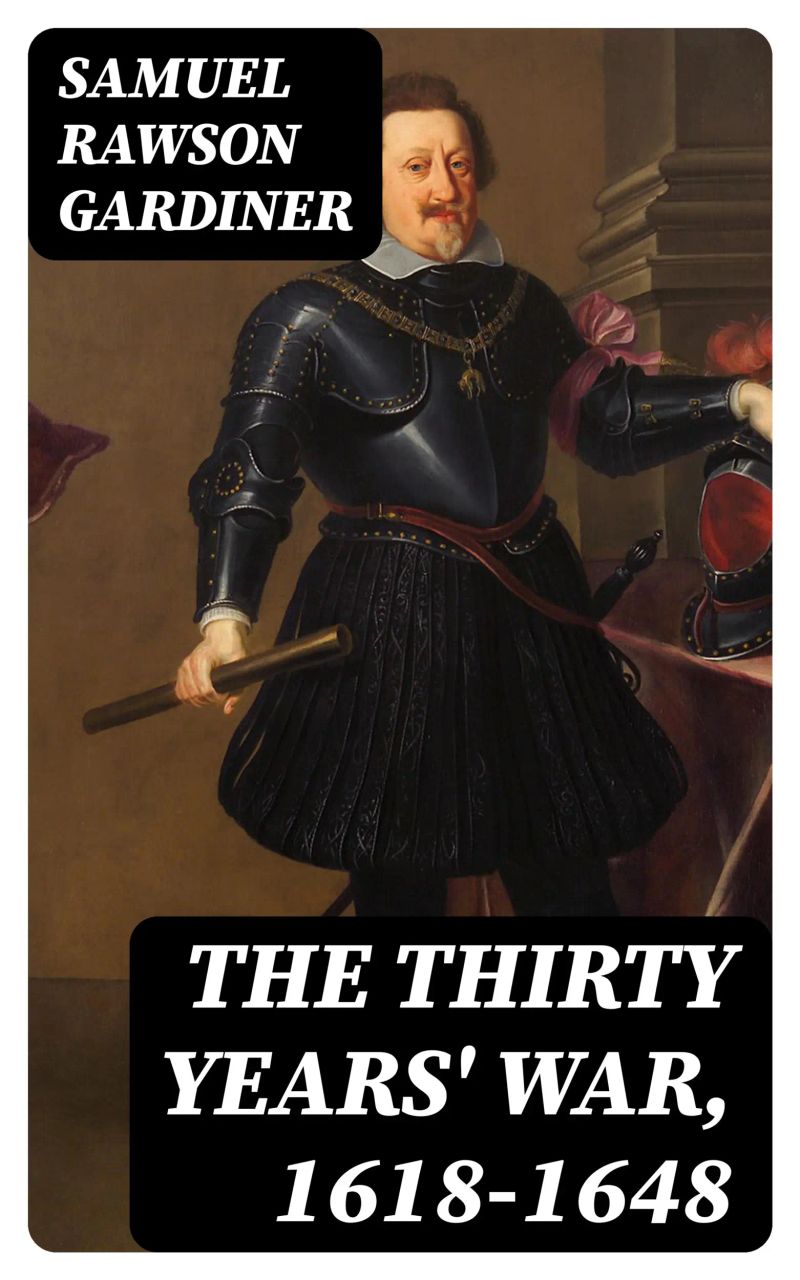
The Thirty Years' War, 1618-1648
By Samuel Rawson Gardiner


Length8h 47m
About this audiobook
In "The Thirty Years' War, 1618-1648," Samuel Rawson Gardiner presents a meticulous and expansive historical analysis of one of Europe's most devastating conflicts. Gardiner employs a scholarly narrative style that weaves together primary sources and contemporaneous accounts, offering readers an in-depth exploration of the political, social, and religious dimensions of the war. He contextualizes the war not only as a series of battles but as a transformative period in European history that tested allegiances and ideologies, ultimately reshaping the continent's political landscape. Samuel Rawson Gardiner, a renowned English historian and member of the Royal Historical Society, dedicated much of his academic career to the study of the English Civil War and its broader European implications. His profound understanding of the historical ramifications of this tumultuous era is informed by his extensive research and robust scholarship. Gardiner's ability to synthesize complex historical events into coherent narratives stems from his background in law and history, allowing him to approach historical events analytically and comprehensively. This seminal work is highly recommended for history enthusiasts and scholars alike, as it provides a thorough understanding of the Thirty Years' War, its causes, and its consequences. Gardiner's insightful analysis and engaging prose make this book an essential resource for anyone interested in early modern European history, the interplay of religious and political conflicts, and the legacy of warfare.
Audiobook details
Rating★★★★ 3.7 (164)
Includes Goodreads, LibraryThing, Amazon
GenreHistory
Length8 hrs 47 mins
Narrated byListen with 1,000+ voices
FormateBook with Audio
Publish dateNov 21, 2022
LanguageEnglish
Table of contents
1Introduction
2PREFACE.
3CONTENTS.
4THE THIRTY YEARS' WAR.
5Section I.—Political Institutions of Germany.
Show all chaptersShow less
6Section II.—Protestantism in Germany.
7Section III.—Reaction against Protestantism.
8Section IV.—Three Parties and Three Leaders.
9Section I.—The House of Austria and its Subjects.
10Section II.—The Revolution at Prague.
11Section III.—The War in Bohemia.
12Section IV.—Ferdinand on his Defence.
13Section I.—The Attack upon Frederick.
14Section II.—The War in the Upper Palatinate.
15Section III.—Frederick's Allies.
16Section IV.—The Fight for the Lower Palatinate.
17Section I.—Mansfeld's March into the Netherlands.
18Section II.—Christian of Brunswick in Lower Saxony.
19Section III.—Danger of the Lower Saxon Circle.
20Section IV.—England and France.
21Section V.—Rise of Richelieu.
22Section I.—Christian IV. and Gustavus Adolphus.
23Section II.—English Diplomacy.
24Section III.—Wallenstein's Armament.
25Section IV.—Defeat of Mansfeld and Christian IV.
26Section I.—Fresh Successes of Wallenstein.
27Section II.—Resistance to Wallenstein in the Empire.
28Section III.—The Siege of Stralsund.
29Section IV.—The Siege of Rochelle.
30Section I.—Oppression of the Protestants.
31Section II.—French Intervention in Italy.
32Section III.—Wallenstein deprived of his Command.
33Section IV.—The Swedes establish themselves on the Coast of the Baltic.
34Section V.—The Fall of Magdeburg.
35Section I.—Alliance between the Swedes and the Saxons.
36Section II.—The Battle of Breitenfeld.
37Section III.—March of Gustavus into South Germany.
38Section IV.—Wallenstein's Restoration to Command.
39Section V.—The Struggle between Gustavus and Wallenstein.
40Section VI.—The Battle of Lützen.
41Section I.—French Influence in Germany.
42Section II.—Wallenstein's Attempt to dictate Peace.
43Section III.—Resistance to Wallenstein's Plans.
44Section IV.—Assassination of Wallenstein.
45Section V.—Imperialist Victories and the Treaty of Prague.
46Section I.—Open Intervention of France.
47Section II.—Spanish Successes.
48Section III.—The Struggle for Alsace.
49Section IV.—French Successes.
50Section V.—Aims and Character of Richelieu.
More from Samuel Rawson Gardiner



A Brief History of IntelligenceMax S. Bennett12h 18m4.6 (6.6K)$29 · $0.00

RevolutionariesSanjeev Sanyal11h 23m4.6 (2.6K)$29 · $0.00

We Crossed a Bridge and It TrembledWendy Pearlman6h4.6 (5.2K)$24 · $0.00

Unbroken Bonds of BattleJohnny Joey Jones8h 31m4.6 (2.6K)$8 · $0.00

The Daughter of AuschwitzTova Friedman, Malcolm Brabant7h 54m4.6 (16.7K)$26 · $0.00

Lily's PromiseLily Ebert, Dov Forman8h 54m4.6 (16.1K)$29 · $0.00

On Democracies and Death CultsDouglas Murray10h 38m4.6 (6.5K)$29 · $0.00

Across the RiverKent Babb11h 40m4.6 (927)$29 · $0.00

Balcony Over Jerusalem: A Middle East Memoir - Israel, Palestine and BeyondJohn Lyons12h 37m4.6 (1.4K)$33 · $0.00

BeyondStephen Walker15h 39m4.6 (3.2K)$33 · $0.00

Kings and PawnsHoward Bryant10h 9m4.6 (678)$29 · $0.00

No EscapeNury Turkel9h 30m4.6 (809)$28 · $0.00

Jubal Stone: U.S. Marshal: Blood Trail To Hell: A Western Adventure NovelCasey Nash3h 42m4.6 (3.2K)$18 · $0.00

Fall and RiseMitchell Zuckoff17h 23m4.6 (9.8K)$40 · $0.00

The SurvivorJosef Lewkowicz, Michael Calvin9h 22m4.6 (2.5K)$29 · $0.00

Always FaithfulThomas Schueman, Zainullah Zaki12h 12m4.6 (977)$29 · $0.00

The State of Society in France Before the Revolution of 1789 (Annotated)Alexis de Tocqueville17h 25m4.6 (1.2K)$2 · $0.00

All the Gallant MenDonald Stratton, Ken Gire5h 55m4.6 (11.8K)$24 · $0.00

Saint Joan (Annotated)George Bernard Shaw6h 20m4.6 (1.2K)$1.20 · $0.00

Medgar and MyrlieJoy-Ann Reid10h 52m4.5 (27.8K)$29 · $0.00
You may also like

The History of Moors in Spain: From the Islamic Conquest until the Fall of Kingdom of GranadaStanley Lane-Poole7h 47m4.0 (1.9K)$1.99 · $0.00

The PrinceNiccolò Machiavelli3h 24m4.0 (451.2K)$3 · $0.00

The PrinceNiccolo Machiavelli3h 10m4.0 (468.6K)$3.50 · $0.00

History of The Decline and Fall of The Roman Empire Vol IEdward Gibbon30h 34m4.4 (6.2K)$2.30

The French RevolutionIan Davidson11h 52m3.9 (2.4K)$23

The Search for Modern ChinaJonathan D. Spence36h 49m4.3 (5.2K)$30

The Art of War in the Middle Ages (378-1515)Charles Oman6h 10m4.0 (674)$1.99 · $0.00

Chats on Cottage and Farmhouse FurnitureArthur Hayden3h 22m$2 · $0.00

The Antiquities of Bridgnorth; With Some Historical Notices of the Town and CastleGeorge Bellett5h 42m$2 · $0.00

An Introduction to the History of Western EuropeJames Harvey Robinson19h 4m3.8 (165)$1 · $0.00

The Jacobite Rebellions (1689-1746) (Bell's Scottish History Source Books.) (Annotated)J. Pringle Thomson6h 6m$3 · $0.00

Baroque ArtVictoria Charles, Klaus H. Carl3h 16m3.7 (12)$15 · $0.00

CheshireCharles E. Kelsey5h 8m$2 · $0.00

The American Nation: A History, Vol. 5Charles Mclean Andrews, Albert Bushnell Hart8h 25m$20

Lectures on the constitution and laws of EnglandFrancis Stoughton Sullivan18h 31m$2 · $0.00

Battle Of Rethel, 1650, Of The Fronde In FranceAndré Geraque Kiffer2h 1m$5 · $0.00
Julius CaesarJ. F. C. Fuller14h 6m3.9 (677)$25 · $0.00

Sixty Years a QueenHerbert Sir Maxwell6h 32m$1 · $0.00

The History of the Reformation of Religion in Scotland (Annotated)John Knox15h 32m4.4 (224)$0.99 · $0.00

Manual of Ship Subsidies. An Historical Summary of the Systems of All NationsEdwin M. Bacon2h 47m$1 · $0.00