


Length13h 21m
About this audiobook
He could not hit a curveball. He could see everything else.
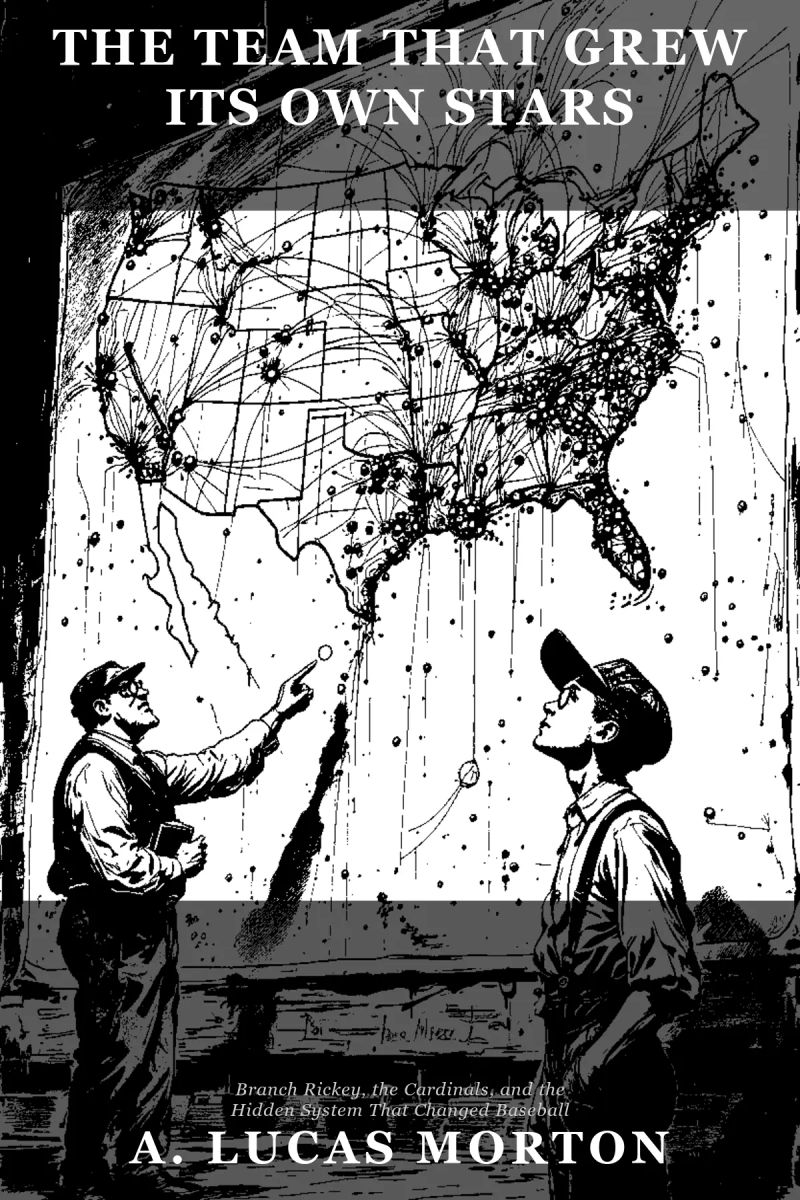
Mason City, Missouri, 1921. Sam Bell keeps the scorebook for a team that will never matter, filling the margins with a private notation only he can read — the pitcher whose arm is failing, the fielder who can't move left, the hitter who chases what he can't reach. When a Cardinals scout in road-dusty shoes notices what the boy is really writing down, Sam is drawn into the strangest experiment in baseball: Branch Rickey's plan to stop buying players and start growing them.
What follows is the building of a machine — tryout camps, contracts, a map of the country pinned with circles — that will produce champions and change the sport forever. But the machine runs on boys. One of them is Sam's brother.
A novel about the price of building something that works.
Audiobook details
GenreHistorical Fiction
Length13 hrs 21 mins
Narrated byListen with 1,000+ voices
FormateBook with Audio
Publish dateJun 1, 2026
LanguageEnglish
Table of contents
1The Team That Grew Its Own Stars: Prologue
2Part I: The Poor Team’s Problem
3Chapter 1: The Boy Who Kept Score
4Chapter 2: The Scout with Dust on His Shoes
5Chapter 3: St. Louis Is Broke
Show all chaptersShow less
6Chapter 4: The Failed Manager
7— Interlude: January 1921: The Commissioner —
8Chapter 5: The Price of a Prospect
9Chapter 6: The Map on the Wall
10Chapter 7: Not Stars Yet
11Part II: Building the Machine
12Chapter 8: Signed for a Train Ticket
13Chapter 9: The Lowest Rung
14Chapter 10: Teaching Baseball
15Chapter 11: The Notebook
16Chapter 12: Numbers No One Asked For
17Chapter 13: Tommy Tries Out
18Chapter 14: Too Many Boys
19Chapter 15: The Old Baseball Men
20Chapter 16: The Commissioner Notices
21— Interlude: November 1929: What Landis Sees —
22Chapter 17: Buck Learns to Pitch
23Chapter 18: Eli Changes His Swing
24Part III: Proof, Pressure, and Backlash
25Chapter 19: First Crop
26Chapter 20: The Boy from the System
27Chapter 21: Everybody Wants In
28Chapter 22: Landis Cuts the Wires
29— Interlude: March 1932: The Hearing —
30Chapter 23: Rickey’s Defense
31Chapter 24: Tommy’s Release
32Chapter 25: Sam Quits the Notebook
33Chapter 26: The Gashouse Future
34Chapter 27: Cheap or Smart?
35Part IV: The Game Changes
36Chapter 28: The Cardinals Arrive Early
37Chapter 29: A Different Kind of Scout
38Chapter 30: The Player No One Liked
39Chapter 31: The Pennant Machine
40— Interlude: October 1934: The Gashouse Gang —
41Chapter 32: The Cost of Being First
42Chapter 33: Tommy Comes Home
43Chapter 34: The Report
44Chapter 35: What Everybody Copies
45— Interlude: 1936–1941: What Everybody Copies —
46Chapter 36: The Field Behind the Field
47Epilogue
48Author’s Note
49A Note on the History
50What the Farm System Was
More from A. Lucas Morton

GenesisAndrew Morton10h 10m$9.99

RevelationAndrew Morton8h 36m$9.99

EntropyAndrew Morton13h 42m$9.99

FibonacciAndrew Morton16h 14m$9.99

ObserverAndrew Morton10h 12m$9.99

The Labyrinth of the SpiritsCarlos Ruiz Zafon27h 55m4.5 (77.2K)$53 · $0.00

The Things We Cannot SayKelly Rimmer13h 48m4.5 (359.1K)$33 · $0.00

Lieutenant Hornblower (Annotated)C. S. Forester11h 41m4.5 (2.9K)$2 · $0.00

Rilla of InglesideLucy Maud Montgomery11h 44m4.5 (48.2K)$2 · $0.00

The Viennese DressmakerKathryn Gauci11h 46m4.5 (2.1K)$23 · $0.00

The Man in the Brown Suit & They Came to BaghdadAgatha Christie15h 43m4.6 (495)$33 · $0.00

Under the Light of the Italian MoonJennifer Anton12h 28m4.5 (5.3K)$23 · $0.00

Jubilee, 50th Anniversary EditionMargaret Walker15h 43m4.5 (9.5K)$25 · $0.00

Pride and PrejudiceJane Austen14h 44m4.4 (4.7M)$2 · $0.00

Flying Colours (Annotated)Cecil Louis Troughton Smith9h 26m4.4 (10.1K)$2 · $0.00

With Love from HarlemReShonda Tate13h 48m4.5 (2K)$6 · $0.00

Sweet Home Highland ChristmasMay McGoldrick, Jan Coffey2h 54m4.5 (1.4K)$7 · $0.00

Rilla of InglesideL. M. Montgomery12h 25m4.4 (67.5K)$2 · $0.00

Death Comes for the Archbishop (Annotated)Willa Cather9h 13m4.4 (4.7K)$2 · $0.00

The Alice NetworkKate Quinn15h 7m4.4 (887.1K)$33 · $0.00

The Goddess of WarsawLisa Barr13h 4m4.4 (36.4K)$33 · $0.00

The Ohio River Trilogy: Betty Zane, The Spirit of the Border & The Last TrailZane Grey29h 8m4.4 (1.8K)$1 · $0.00

The Attic ChildLola Jaye14h 46m4.4 (21K)$33 · $0.00

Martyr of the CatacombsJames De Mille3h 41m4.5 (744)$1 · $0.00

Quo VadisHenryk Sienkiewicz22h 52m4.4 (62K)$21 · $0.00
You may also like

The Autobiography of Benjamin FranklinBenjamin Franklin7h 12m4.0 (127.5K)$1.20 · $0.00

The Age of ReasonThomas Paine36h 41m4.2 (14.4K)$2 · $0.00
The Autobiography of Benjamin FranklinBenjamin Franklin7h 4m4.0 (111.9K)$2.30

John CalvinLifeInk Press1h 49m4.6 (500)$4 · $0.00

Discoveries and Opinions of GalileoGalileo Galilei10h 7m4.0 (1.2K)$20

Jefferson and the Rights of ManDumas Malone18h 55m4.3 (1K)$30

Albert GallatinJohn Austin Stevens10h 32m3.6 (13)$1 · $0.00

Trailblazers of Learning: 3 Classic Books on Educational PioneersElizabeth Raikes, Charles E. Putney Memorial Association, J. Harold Putman24h 58m$1.99 · $0.00

Ten Years' Exile (Annotated)Madame de Staël9h 10m3.9 (143)$1.99 · $0.00

Decision in PhiladelphiaChristopher Collier, James Lincoln Collier13h 3m3.9 (986)$30

A Journey to Meet BeethovenPat Champness5h 24m$4 · $0.00

Chaplin’s Vintage YearMichael J. Hayde5h 23m4.3 (12)$20

MalevichGerry Souter5h 29m4.2 (16)$18 · $0.00

China, Culturally Speaking - A Conversation with Michael BerryHoward Burton2h 22m$3 · $0.00

Benjamin FranklinJohn S. C. Abbott7h 15m3.7 (34)$2 · $0.00

Fichte's Science of Knowledge (Annotated)Charles Carroll Everett8h 20m$1.99 · $0.00

The Age of Invention: A Chronicle of Mechanical ConquestHolland Thompson5h 10m3.7 (39)$2 · $0.00
Comrade KropotkinVictor Robinson2h 54m$2 · $0.00
THEODORE ROOSEVELT Boxed SetTheodore Roosevelt, Henry Cabot Lodge179h 53m$1 · $0.00

New Ideas in India During the Nineteenth CenturyJohn Morrison4h 6m$1 · $0.00