
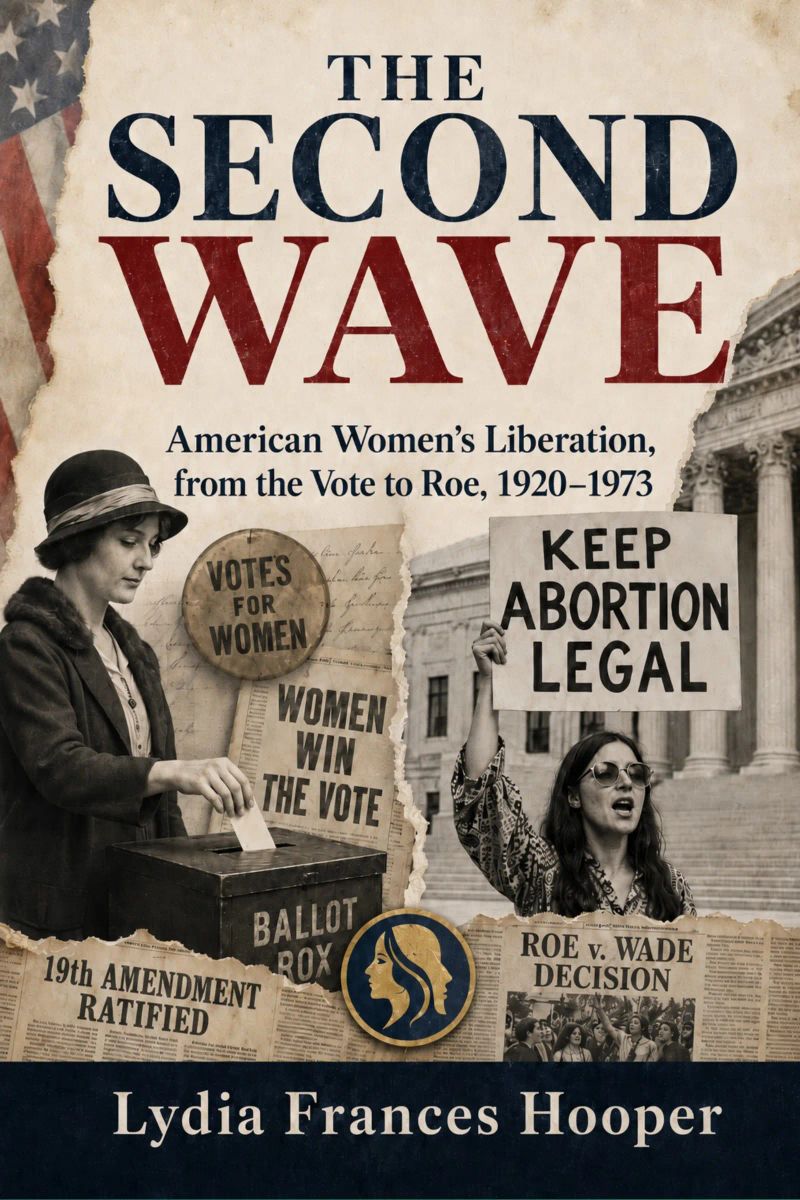
THE SECOND WAVE
American Women's Liberation, from the Vote to Roe, 1920-1973By Lydia Frances Hooper


Length5h 46m
About this audiobook
The complete narrative history of women's liberation, 1920-1973 — from the Nineteenth Amendment to Roe v. Wade, Betty Friedan's Feminine Mystique, Title VII, the ERA, and the second wave of American feminism.
In 1957, Betty Friedan mailed a questionnaire to her fellow Smith College graduates, class of 1942. What she found — and published six years later as The Feminine Mystique — was a pervasive, unarticulated dissatisfaction among educated women following the prescribed path of marriage and motherhood. She called it "the problem that has no name." The book sold three million copies in its first three years and sent a generation of women looking for the remedies. This is the history of how they found them — and what they built and failed to build in the process.
Lydia Frances Hooper traces the full arc of American women's liberation from the Nineteenth Amendment's 1920 ratification through Roe v. Wade in 1973: the legal framework of coverture that the vote did not touch, the New Deal's Frances Perkins and Eleanor Roosevelt opening federal power to women while building a Social Security system that treated wives as dependents, the wartime Rosie the Riveter breakthrough and its postwar reversal, and the 1960s explosion — Title VII of the Civil Rights Act, NOW, consciousness-raising, the Miss America protest of 1968, the birth control pill, Griswold v. Connecticut, and the ERA's 84-8 Senate passage — that transformed law, medicine, and education within a decade.
Inside this women's liberation history:
• The problem with no name — Friedan's Smith College questionnaire, the three million copies, and what the book concealed about its author's own labor-journalist past (Chapter 5)
• Title VII and the EEOC — how sex discrimination was added to the Civil Rights Act of 1964 and how the EEOC's initial refusal to enforce it produced NOW (Chapter 10)
• The birth control pill — six million users by 1965, ten million by 1970; Barbara Seaman's 1969 exposure of the cardiovascular risks manufacturers had hidden; the congressional hearings where feminists demanded women be heard on a drug only women used (Chapter 17)
• Phyllis Schlafly's STOP ERA — how one conservative organizer, founding her campaign in October 1972, held the ERA at 35 of the required 38 states and killed it by 1982 (Chapter 22)
• Our Bodies, Ourselves — the twelve Boston women who met at a 1969 conference and compiled the book that sold millions and changed women's relationship to medical authority (Chapter 18)
• Roe v. Wade — the 1973 decision, its Griswold v. Connecticut foundation, and the lasting controversy the ruling produced (Chapter 20)
The second wave was not unified — it split over the ERA, over pornography, over race and class, over whether women needed equal treatment or different treatment. Those disagreements were productive: they forced harder thinking about what equality meant. Within a decade, women changed the law, changed medicine, changed education, and changed the language. The changes were incomplete, as all revolutions are, and they provoked a counterreaction that shaped American politics for the next half century. Both are still unfolding.
For readers of Ruth Rosen's THE WORLD SPLIT OPEN and Gail Collins's WHEN EVERYTHING CHANGED.
Audiobook details
GenreHistory, Psychology
Length5 hrs 46 mins
Narrated byListen with 1,000+ voices
FormateBook with Audio
Publish dateJun 1, 2026
LanguageEnglish
Table of contents
1Introduction
2Prologue: More Than the Vote
3PART ONE: AFTER THE VOTE (1920-1945)
4Chapter 1: The Vote Won — What the Nineteenth Amendment Did and Didn't Achieve
5Chapter 2: The Twenties Woman — Flappers, Careers, and the Limits of the New Freedom
Show all chaptersShow less
6Chapter 3: The Depression and the New Deal — Women, Work, and the Family Economy
7Chapter 4: World War II — Rosie the Riveter and Women in the Wartime Workforce
8PART TWO: THE FIFTIES — CONSTRAINT AND DISCONTENT (1945-1963)
9Chapter 5: The Feminine Mystique — Betty Friedan and the Problem with No Name
10Chapter 6: The Suburban Trap — Housewifery, the Baby Boom, and the Hidden Discontent
11Chapter 7: Working Women in the Fifties — The Women Who Never Left the Labor Force
12Chapter 8: The Civil Rights Movement and Women — The Schooling in Activism
13PART THREE: THE SECOND WAVE BEGINS (1963-1968)
14Chapter 9: The President's Commission on the Status of Women — Kennedy, Esther Peterson, and the Report
15Chapter 10: Title VII and the EEOC — Sex Discrimination and the Civil Rights Act of 1964
16Chapter 11: NOW — The National Organization for Women and Mainstream Feminism
17Chapter 12: The New Left and Women — SNCC, SDS, and the Sexism That Radicalized Women
18PART FOUR: RADICAL FEMINISM AND THE LIBERATION MOVEMENT (1968-1973)
19Chapter 13: The Miss America Protest — Radical Feminism Enters the Public Stage
20Chapter 14: Consciousness-Raising — The Politics of the Personal
21Chapter 15: Women's Liberation Groups — Radical Feminism's Diverse Strands
22Chapter 16: The ERA — The Equal Rights Amendment and Its Passage Through Congress
23PART FIVE: BODIES, MEDICINE, AND REPRODUCTIVE RIGHTS
24Chapter 17: The Birth Control Pill — Technology, Freedom, and the Sexual Revolution
25Chapter 18: Our Bodies, Ourselves — Health, Medicine, and Women's Knowledge
26Chapter 19: Griswold v. Connecticut — Privacy, Contraception, and the Constitutional Foundation
27Chapter 20: Roe v. Wade — Abortion, the Supreme Court, and the Lasting Controversy
28PART SIX: LEGACIES
29Chapter 21: Title IX — Education, Sports, and the Law That Changed Women's Opportunity
30Chapter 22: The Anti-Feminist Backlash — Phyllis Schlafly, the STOP ERA Campaign, and the Culture Wars
31Chapter 23: Women and Work — The Transformation of the Female Labor Force
32Chapter 24: The Unfinished Revolution — Gender Equality and Its Continuing Struggles
33Epilogue: The Revolution Continues
34Acknowledgments
35Selected Bibliography
36About the Author
More from Lydia Frances Hooper

A Brief History of IntelligenceMax S. Bennett12h 18m4.6 (6.6K)$29 · $0.00

Black AF HistoryMichael Harriot15h 43m4.7 (14.6K)$33 · $0.00

The Gulag Archipelago Volume 3Aleksandr I. Solzhenitsyn21h 56m4.7 (8.9K)$46 · $0.00

Pearl of Great PriceJoseph Smith3h 8m4.7 (7.2K)$1.20 · $0.00

The Happiest Man on EarthEddie Jaku3h 48m4.6 (178K)$7 · $0.00

MotherlandJulia Ioffe17h 52m4.7 (2.5K)$40 · $0.00

Where Cowards Go to DieBenjamin Sledge8h 42m4.7 (351)$20 · $0.00

RevolutionariesSanjeev Sanyal11h 23m4.6 (2.6K)$29 · $0.00

We Crossed a Bridge and It TrembledWendy Pearlman6h4.6 (5.2K)$24 · $0.00

Unbroken Bonds of BattleJohnny Joey Jones8h 31m4.6 (2.6K)$8 · $0.00

The Daughter of AuschwitzTova Friedman, Malcolm Brabant7h 54m4.6 (16.7K)$26 · $0.00

Lily's PromiseLily Ebert, Dov Forman8h 54m4.6 (16.1K)$29 · $0.00

On Democracies and Death CultsDouglas Murray10h 38m4.6 (6.5K)$29 · $0.00

Across the RiverKent Babb11h 40m4.6 (927)$29 · $0.00

Balcony Over Jerusalem: A Middle East Memoir - Israel, Palestine and BeyondJohn Lyons12h 37m4.6 (1.4K)$33 · $0.00

BeyondStephen Walker15h 39m4.6 (3.2K)$33 · $0.00
Kings and PawnsHoward Bryant10h 9m4.6 (678)$29 · $0.00

No EscapeNury Turkel9h 30m4.6 (809)$28 · $0.00

Jubal Stone: U.S. Marshal: Blood Trail To Hell: A Western Adventure NovelCasey Nash3h 42m4.6 (3.2K)$18 · $0.00

Fall and RiseMitchell Zuckoff17h 23m4.6 (9.8K)$40 · $0.00
What to Make of a LifeJim Collins13h 31m4.4 (794)$33 · $0.00

Matters of the HeartJacinta Nampijinpa Price9h 35m4.8 (359)$29 · $0.00
Black AF HistoryMichael Harriot15h 43m4.7 (14.6K)$33 · $0.00
Bad Fat Black GirlSesali Bowen6h 32m4.7 (2.8K)$24 · $0.00

Invisible StormJason Kander6h 48m4.7 (3.2K)$24 · $0.00

I Am The StormJanice Dean9h4.6 (1.5K)$8 · $0.00
On Democracies and Death CultsDouglas Murray10h 38m4.6 (6.5K)$29 · $0.00

TerraformPropaganda5h 39m4.7 (594)$24 · $0.00

Southern Horrors: Lynch Law in All Its Phases (Annotated)Ida B. Wells-Barnett2h 44m4.6 (1.3K)$2 · $0.00
Hour of the HeartIrvin D. Yalom, Benjamin Yalom8h 19m4.6 (2.3K)$26 · $0.00
Braving the TruthRachel Held Evans11h 31m4.7 (359)$29 · $0.00
Level UpRob Dial7h 42m4.6 (3.3K)$26 · $0.00

As a JewSarah Hurwitz8h 36m4.6 (1.2K)$26 · $0.00

Saint Joan (Annotated)George Bernard Shaw6h 20m4.6 (1.2K)$1.20 · $0.00
Burn the HaystackJennie Young, PhD9h 30m4.6 (543)$29 · $0.00

Woman and the New Race (Annotated)Margaret Sanger6h 30m4.6 (1K)$0.99 · $0.00

Good InsideBecky Kennedy9h 55m4.5 (59.3K)$29 · $0.00
The Mis-Education of the NegroCarter Godwin Woodson5h 4m4.5 (29.4K)$1.20 · $0.00

Du Bois: EssaysW.E.B. Du Bois6h 22m4.6 (1.5K)$1 · $0.00

The North American Indian (Illustrated Edition)Edward S. Curtis, Frederick Webb Hodge5h 59m4.6 (1.4K)$2 · $0.00
You may also like

My Own StoryEmmeline Pankhurst13h 15m4.2 (3.7K)$1 · $0.00
The Women's History of the Modern WorldRosalind Miles12h 3m4.0 (1.3K)$29 · $0.00

My Own StoryEmmeline Pankhurst10h 29m4.4 (2.6K)$20
SmoketownMark Whitaker13h 29m4.5 (676)$23

UnassimilableBianca Mabute-Louie6h 33m4.1 (413)$24 · $0.00
Notorious RBG Young Readers' EditionIrin Carmon, Shana Knizhnik2h 59m4.4 (2.6K)$18 · $0.00
A God in RuinsLeon Uris6h 6m3.7 (4K)$24 · $0.00

MY OWN STORY (Illustrated)Emmeline Pankhurst10h 26m4.2 (3K)$1 · $0.00

My Own Story: The Memoirs of an Influential Suffragette (Illustrated Edition)Emmeline Pankhurst11h 58m4.2 (3.3K)$1.99 · $0.00
The Golden ThreadColin Meloy9m4.2 (267)$4 · $0.00

THE KINGDOM OF GOD IS WITHIN YOULeo Tolstoy21h 28m4.3 (14K)$1.99 · $0.00
The Complete History of the Suffragette Movement - All 6 Books in One Edition)Elizabeth Cady Stanton, Susan B. Anthony, Matilda Gage, Harriot Stanton Blatch, Ida H. Harper305h 47m4.4 (44)$1.99 · $0.00

The Lion of PolandPaul Hume, Ruth Fox Hume3h4.4 (18)$1 · $0.00
The Women of the Suffrage MovementJane Addams, Elizabeth Cady Stanton, Ida Husted Harper, Anna Howard Shaw, Millicent Garrett Fawcett, Emmeline Pankhurst, Alice Stone Blackwell409h 49m4.5 (12)$1.99 · $0.00

The Suffragettes – Complete History Of the Movement (6 Volumes in One Edition) (Annotated)Elizabeth Cady Stanton, Susan B. Anthony, Matilda Gage, Harriot Stanton Blatch, Ida H. Harper305h 34m4.5 (36)$0.99 · $0.00
The History of the Women's Suffrage: The Origin of the Movement (Illustrated Edition) (Annotated)Harriot Stanton Blatch, Elizabeth Cady Stanton, Susan B. Anthony, Matilda Gage176h 30m$2 · $0.00

Woman's Voice : An anthologyVarious8h 25m$2 · $0.00
Lucy Stone: Pioneer of Women's RightsAlice Stone Blackwell7h 22m4.3 (15)$1 · $0.00

Woman TriumphantRudolf Cronau10h 52m$1 · $0.00

Why Women Deserve BetterDaria Gałek1h 52m$2.80 · $0.00