
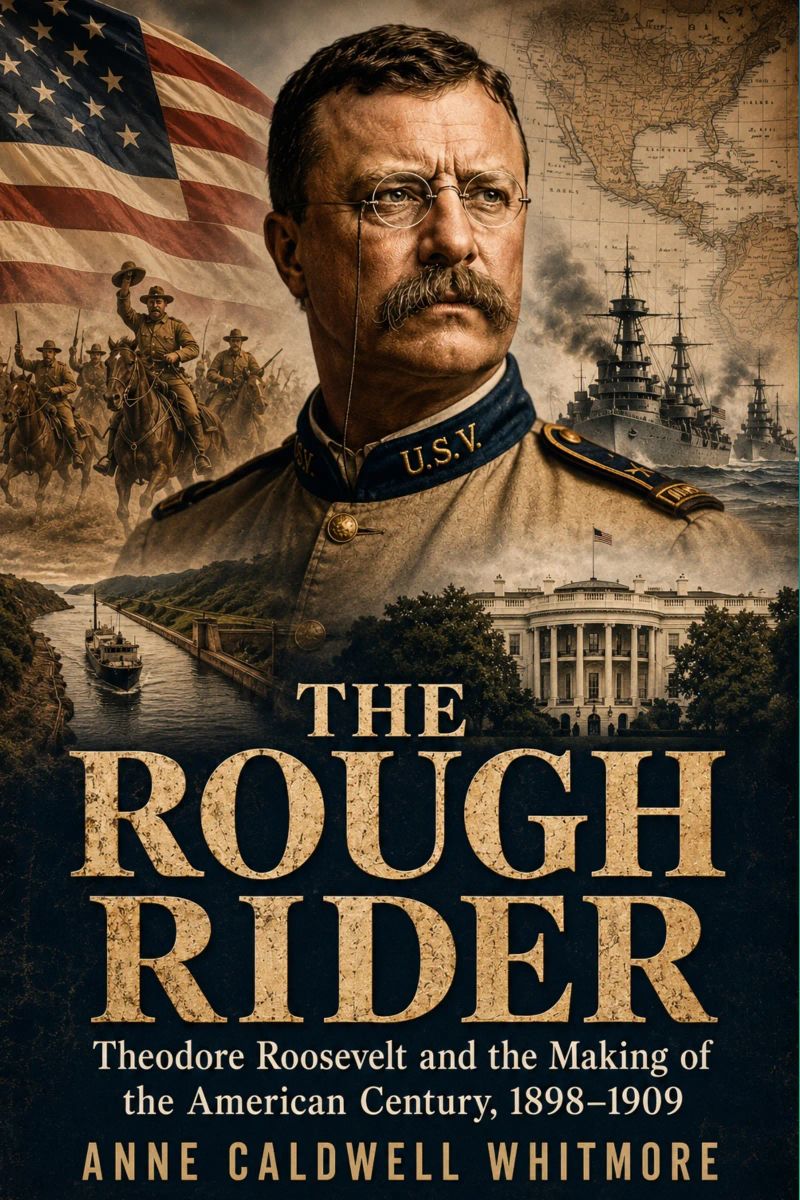
THE ROUGH RIDER
Theodore Roosevelt and the Making of the American Century, 1898-1909By Anne Caldwell Whitmore


Length6h 19m
About this audiobook
The definitive narrative history of Theodore Roosevelt — trust-busting, the Panama Canal, 150 million acres of conservation, the Nobel Peace Prize, and the making of the American presidency, 1898-1909.
On the night of February 14, 1884, Theodore Roosevelt drew a large X in his diary and wrote: "The light has gone out of my life." In eleven hours he had lost both his wife and his mother. He was twenty-five. What happened next revealed the man his father had made: Roosevelt finished the legislative session, arranged for his infant daughter to be raised by his sister, and rode west into the Dakota Badlands—into terrain that could kill the unprepared with cold, thirst, or simple disorientation—and rebuilt himself.
Historian Anne Caldwell Whitmore follows Theodore Roosevelt from this defining moment of grief through eight years as the most consequential president between Lincoln and FDR. Across twenty-four chapters she traces how a sickly asthmatic child from a Manhattan brownstone—ordered by his father to build his body or watch his mind go to waste—became the man who busted the Northern Securities railroad trust, built the Panama Canal, mediated the Russo-Japanese War (winning the Nobel Peace Prize), and set aside more land for conservation than all previous presidents combined.
Inside this Theodore Roosevelt biography:
The Square Deal and trust-busting — how a $4.50 revolver elevated Roosevelt to the presidency at forty-two, and how he used the Sherman Antitrust Act against J.P. Morgan's Northern Securities railroad combine (Chapters 5-6)
The Coal Strike of 1902 — the first time a president intervened in a labor dispute on behalf of workers, threatening to seize the mines if the operators refused arbitration (Chapter 7)
Panama: taking the canal zone — an engineered revolution, seventy-two-hour diplomatic recognition, a $375 million construction project, and a workforce of 40,000 men that Roosevelt himself visited in 1906—the first president to leave the country while in office (Chapter 14)
Conservation: 150 million acres — the Antiquities Act's presidential proclamation authority used to protect the Grand Canyon when Congress would not, and Roosevelt's night in Yosemite with John Muir, waking to snow under the Sierra Nevada stars (Chapters 11-12)
The Portsmouth Peace — persuading Japan to drop its indemnity demand from Russia in exchange for territorial concessions neither side could publicly call defeat, earning the first Nobel Peace Prize won by an American (Chapter 15)
The honest reckoning — the Brownsville affair's collective punishment of Black soldiers, the Filipino independence movement suppressed, and the imperial habits the Roosevelt Corollary established that Latin America would not forget (Chapters 13, 18, 24)
Roosevelt left behind the regulatory state, the national parks, and an internationalist foreign policy the United States still operates within—alongside genuine failures in race and empire. Whitmore's Theodore Roosevelt biography holds both: the achievement and the cost, the energy and the blindness, the man who was the most alive person in any room he occupied.
For readers of Doris Kearns Goodwin's THE BULLY PULPIT and Edmund Morris's THE RISE OF THEOD
Audiobook details
GenreBiography and Memoir, History
Length6 hrs 19 mins
Narrated byListen with 1,000+ voices
FormateBook with Audio
Publish dateJun 1, 2026
LanguageEnglish
Table of contents
1Introduction
2Prologue: Bully!
3PART ONE: THE MAKING OF THEODORE ROOSEVELT (1858-1898)
4Chapter 1: The Sickly Child — Roosevelt's Early Years and the Will to Self-Transformation
5Chapter 2: Harvard, the West, and Tragedy — Death, Ranching, and the Birth of the Man
Show all chaptersShow less
6Chapter 3: The Rise — Civil Service, Police Commissioner, and the Navy Department
7Chapter 4: San Juan Hill — The Spanish-American War and Roosevelt's Triumph
8PART TWO: THE ACCIDENTAL PRESIDENT (1901-1904)
9Chapter 5: McKinley's Assassination — Roosevelt Takes Office at Forty-Two
10Chapter 6: The Square Deal — Trust-Busting and the Northern Securities Case
11Chapter 7: The Coal Strike of 1902 — Government Intervention and the New Presidency
12Chapter 8: The Election of 1904 — Roosevelt Wins His Own Mandate
13PART THREE: THE REFORMER'S AGENDA (1905-1909)
14Chapter 9: The Jungle and the Pure Food and Drug Act — Muckraking and Reform
15Chapter 10: The Hepburn Act — Railroad Regulation and the Interstate Commerce Commission
16Chapter 11: Conservation — Yosemite, the National Forests, and Gifford Pinchot
17Chapter 12: The National Parks — Roosevelt's Gift to American Landscape
18PART FOUR: ROOSEVELT'S FOREIGN POLICY
19Chapter 13: The Roosevelt Corollary — The Monroe Doctrine Expanded
20Chapter 14: Panama — Taking the Canal Zone and Building the Ditch
21Chapter 15: The Portsmouth Peace — Mediating the Russo-Japanese War
22Chapter 16: The Great White Fleet — American Naval Power Projected Worldwide
23PART FIVE: THE MAN BEHIND THE LEGEND
24Chapter 17: Roosevelt as Writer and Intellectual — The Historian-President
25Chapter 18: Race and Empire — Roosevelt's Complicated Views on Civilization
26Chapter 19: Family and Personal Life — Edith, the Children, and Sagamore Hill
27Chapter 20: After the Presidency — Africa, the Amazon, and the Bull Moose Campaign
28PART SIX: LEGACIES
29Chapter 21: The Regulatory State — Roosevelt's Permanent Contribution to American Government
30Chapter 22: The Conservation Legacy — National Parks and the American Land
31Chapter 23: American Power — Roosevelt's Vision of the United States in the World
32Chapter 24: TR's Place in History — The Progressive Tradition and Its Conservative Champion
33Epilogue: The Roosevelt Legacy
34Acknowledgments
35Selected Bibliography
36About the Author
More from Anne Caldwell Whitmore

Matters of the HeartJacinta Nampijinpa Price9h 35m4.8 (359)$29 · $0.00
The StepsSylvester Stallone9h 4m4.8 (635)$29 · $0.00
How to Test Negative for StupidJohn Kennedy8h 13m4.7 (9.7K)$28 · $0.00

Bad Fat Black GirlSesali Bowen6h 32m4.7 (2.8K)$24 · $0.00

Send MeMarty Skovlund, Joe Kent8h 10m4.7 (1.6K)$26 · $0.00
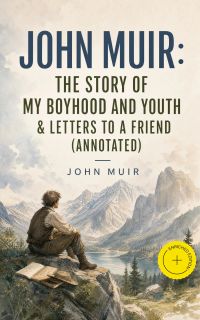
John Muir: The Story of My Boyhood and Youth & Letters to a Friend (Annotated)John Muir10h 13m4.7 (1.1K)$1.99 · $0.00

Invisible StormJason Kander6h 48m4.7 (3.2K)$24 · $0.00

Forever BoyKate Swenson9h 27m4.7 (5K)$29 · $0.00

You Are Worth ItKyle Carpenter, Don Yaeger8h 53m4.7 (4.8K)$29 · $0.00

The Happiest Man on EarthEddie Jaku3h 48m4.6 (178K)$7 · $0.00

MotherlandJulia Ioffe17h 52m4.7 (2.5K)$40 · $0.00
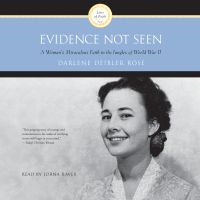
Evidence Not SeenDarlene Deibler Rose11h 11m4.6 (11.9K)$29 · $0.00

Where Cowards Go to DieBenjamin Sledge8h 42m4.7 (351)$20 · $0.00

Will You Love Me?Cathy Glass9h 5m4.6 (9.3K)$29 · $0.00

Designing Terry Pratchett’s DiscworldPaul Kidby3h 52m4.7 (343)$20 · $0.00
HostageEli Sharabi5h 25m4.6 (10.8K)$24 · $0.00

Finding MeViola Davis9h 15m4.6 (256.4K)$29 · $0.00

The Dangerous Truth about Today’s MarijuanaLaura Stack CSP, MBA9h 57m4.7 (385)$20 · $0.00

Birdie & HarlowTaylor Wolfe7h 50m4.6 (6.5K)$26 · $0.00
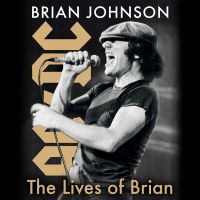
The Lives of BrianBrian Johnson9h 45m4.6 (3.5K)$29 · $0.00

A Brief History of IntelligenceMax S. Bennett12h 18m4.6 (6.6K)$29 · $0.00

The Gulag Archipelago Volume 3Aleksandr I. Solzhenitsyn21h 56m4.7 (8.9K)$46 · $0.00
Pearl of Great PriceJoseph Smith3h 8m4.7 (7.2K)$1.20 · $0.00
The Happiest Man on EarthEddie Jaku3h 48m4.6 (178K)$7 · $0.00
MotherlandJulia Ioffe17h 52m4.7 (2.5K)$40 · $0.00
Where Cowards Go to DieBenjamin Sledge8h 42m4.7 (351)$20 · $0.00
RevolutionariesSanjeev Sanyal11h 23m4.6 (2.6K)$29 · $0.00

We Crossed a Bridge and It TrembledWendy Pearlman6h4.6 (5.2K)$24 · $0.00

Unbroken Bonds of BattleJohnny Joey Jones8h 31m4.6 (2.6K)$8 · $0.00

The Daughter of AuschwitzTova Friedman, Malcolm Brabant7h 54m4.6 (16.7K)$26 · $0.00
Lily's PromiseLily Ebert, Dov Forman8h 54m4.6 (16.1K)$29 · $0.00
On Democracies and Death CultsDouglas Murray10h 38m4.6 (6.5K)$29 · $0.00

Across the RiverKent Babb11h 40m4.6 (927)$29 · $0.00

Balcony Over Jerusalem: A Middle East Memoir - Israel, Palestine and BeyondJohn Lyons12h 37m4.6 (1.4K)$33 · $0.00
BeyondStephen Walker15h 39m4.6 (3.2K)$33 · $0.00
Kings and PawnsHoward Bryant10h 9m4.6 (678)$29 · $0.00
No EscapeNury Turkel9h 30m4.6 (809)$28 · $0.00
Jubal Stone: U.S. Marshal: Blood Trail To Hell: A Western Adventure NovelCasey Nash3h 42m4.6 (3.2K)$18 · $0.00
Fall and RiseMitchell Zuckoff17h 23m4.6 (9.8K)$40 · $0.00
The SurvivorJosef Lewkowicz, Michael Calvin9h 22m4.6 (2.5K)$29 · $0.00
You may also like
WolfJames L. Haley12h 33m4.1 (708)$23 · $0.00

Walden, and On The Duty Of Civil DisobedienceHenry David Thoreau11h 44m4.0 (73.3K)Free
Race to the Bottom of the EarthRebecca E. F. Barone5h 15m4.2 (446)$17

A Life on the EdgeJim Whittaker9h 45m4.3 (1.3K)$20
SmokejumperJason A. Ramos, Julian Smith5h 26m4.1 (3K)$22 · $0.00

Farthest North (The Complete Two-Volume Edition)Fridtjof Nansen31h 27m4.3 (729)$3 · $0.00
Eat And RunScott Jurek, Steve Friedman8h 21m4.2 (45.7K)$26 · $0.00
The Reluctant Mr. DarwinDavid Quammen7h 45m4.1 (3.4K)$26

Trespassing across AmericaKen Ilgunas7h 44m4.0 (3K)$20 · $0.00
The Rescue, A Romance of the ShallowsJoseph Conrad14h 51m3.8 (1.1K)$2.30 · $0.00
The making of a mountaineerGeorge Ingle Finch12h 2m$2 · $0.00

Fruits of the EarthFrederick Philip Grove12h 41m3.5 (208)$2 · $0.00

The Spinster, the Rebel, and the GovernorCharlene Bell Dietz12h 30m4.1 (21)$25 · $0.00

NonstopBoris Herrmann3h 35m4.3 (153)$10 · $0.00

Across Patagonia (Annotated)Lady Florence Dixie5h 31m3.9 (149)$2 · $0.00
A Voyage to AbyssiniaJerónimo Lobo4h 24m3.6 (48)$21 · $0.00

History of the American Foreign Missions to the Oriental Churches (Annotated)Rufus Anderson23h 44m$2 · $0.00
The Snake CharmerJamie James8h 18m$17 · $0.00
Canada and its ProvincesVarious15h 45m$1 · $0.00

Trans-Himalaya – Discoveries and Adventurers in Tibet (Vol. 1&2) (Annotated)Sven Hedin35h 25m4.2 (169)$2 · $0.00