
Audio only


Length9h
About this audiobook
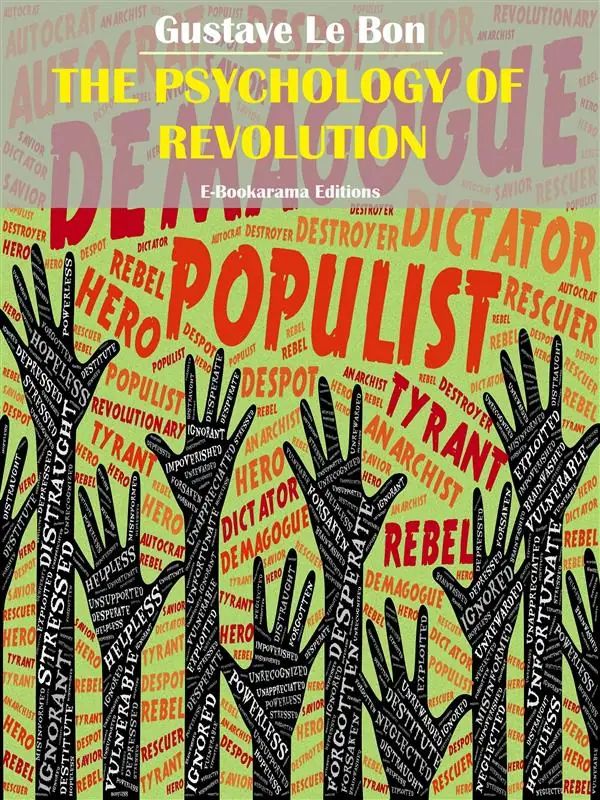
As reflected in Gustave Le Bon´s masterpiece "The Psychology of Revolution," the author disparaged the Revolution and the revolutionary legacy because he distrusted the common person, particularly when making collective decisions. His analysis of revolutionary crowds pictured them as primitive animals devoid of good decision–making abilities who had to be reigned in by a "strong man" or dictatorial figure.
Le Bon who grew up in France during the revolutionary wave that was pravelent in Europe in the mid 19th century uses in this book the French Revolution as his study case.
Gustave Le Bon was a French polymath whose areas of interest included anthropology, psychology, sociology, medicine, invention, and physics.
Audiobook details
Rating★★★★ 3.9 (1.1K)
Includes Goodreads, Amazon, LibraryThing
GenrePsychology, History, Politics and Government
Length9 hrs
Narrated byListen with 1,000+ voices
FormateBook with Audio
Publish dateMay 31, 2019
LanguageEnglish
Table of contents
1Introduction: The Revision Of History
2PART 1. THE PSYCHOLOGICAL ELEMENTS OF REVOLUTIONARY MOVEMENTS
3BOOK 1. GENERAL CHARACTERISTICS OF REVOLUTIONS
4Chapter 1. Scientific And Political Revolutions
5Chapter 2. Religious Revolutions
Show all chaptersShow less
6Chapter 3. The Action Of Governments In Revolutions
7Chapter 4. The Part Played By The People In Revolutions
8BOOK 2. THE FORMS OF MENTALITY PREVALENT DURING REVOLUTION
9Chapter 1. Individual Variations Of Character In Time Of Revolution
10Chapter 2. The Mystic Mentality And The Jacobin Mentality
11Chapter 3. The Revolutionary And Criminal Mentalities
12Chapter 4. The Psychology OF Revolutionary Crowds
13Chapter 5. The Psychology Of The Revolutionary Assemblies
14PART 2. THE FRENCH REVOLUTION
15BOOK 1. THE ORIGINS OF THE FRENCH REVOLUTION
16Chapter 1. The Opinions Of Historians Concerning The French Revolution
17Chapter 2. The Psychological Foundations Of The Ancien Regime
18Chapter 3. Mental Anarchy At The Time Of The Revolution And The Influence Attributed To The Philosophers
19Chapter 4. Psychological Illusions Respecting The French Revolution
20BOOK 2. THE RATIONAL, AFFECTIVE, MYSTIC, AND COLLECTIVE INFLUENCES ACTIVE DURING THE REVOLUTION
21Chapter 1. The Psychology Of The Constituent Assembly
22Chapter 2. The Psychology Of The Legislative Assembly
23Chapter 3. The Psychology Of The Convention
24Chapter 4. The Government Of The Convention
25Chapter 5. Instances Of Revolutionary Violence
26Chapter 6. The Armies Of The Revolution
27Chapter 7. Psychology Of The Leaders Of The Revolution
28BOOK 3. THE CONFLICT BETWEEN ANCESTRAL INFLUENCES AND REVOLUTIONARY PRINCIPLES
29Chapter 1. The Last Convulsions Of Anarchy—The Directory
30Chapter 2. The Restoration Of Order. The Consular Republic
31Chapter 3. Political Consequences Of The Conflict Between Traditions And Revolutionary Principles During The Last Century
32PART 3. THE RECENT EVOLUTION OF THE REVOLUTIONARY PRINCIPLES
33Chapter 1. The Progress Of Democratic Beliefs Since The Revolution
34Chapter 2. The Results Of Democratic Evolution
35Chapter 3. The New Forms Of Democratic Belief
36Conclusions
More from Gustave Le Bon

Psychologie der massenGustave Le Bon2h 55m4.0 (27.2K)$4.70 · $0.00

Psicología de las masasGustave Le Bon2h 44m4.0 (26.4K)$4.60 · $0.00

Psicologia delle folleGustave Le Bon2h 41m4.1 (26K)$4.60 · $0.00

The CrowdGustave Le Bon5h 3m4.0 (25.7K)$4.60 · $0.00

Psychologie des foulesGustave Le Bon2h 45m4.0 (26.7K)$4.60 · $0.00

Psicologia das multidõesGustave Le Bon2h 40m3.9 (26K)$4.60 · $0.00

What to Make of a LifeJim Collins13h 31m4.4 (794)$33 · $0.00

Braving the TruthRachel Held Evans11h 31m4.7 (359)$29 · $0.00
Level UpRob Dial7h 42m4.6 (3.3K)$26 · $0.00

As a JewSarah Hurwitz8h 36m4.6 (1.2K)$26 · $0.00

Saint Joan (Annotated)George Bernard Shaw6h 20m4.6 (1.2K)$1.20 · $0.00

Burn the HaystackJennie Young, PhD9h 30m4.6 (543)$29 · $0.00

Woman and the New Race (Annotated)Margaret Sanger6h 30m4.6 (1K)$1.99 · $0.00

Good InsideBecky Kennedy9h 55m4.5 (59.3K)$29 · $0.00

The Mis-Education of the NegroCarter Godwin Woodson5h 4m4.5 (29.4K)$1.20 · $0.00

Du Bois: EssaysW.E.B. Du Bois6h 22m4.6 (1.5K)$1 · $0.00

The North American Indian (Illustrated Edition)Edward S. Curtis, Frederick Webb Hodge5h 59m4.6 (1.4K)$2 · $0.00

Valley of the BirdtailAndrew Stobo Sniderman, Douglas Sanderson10h 1m4.6 (2.4K)$29 · $0.00

Lies My Therapist Told MeGreg E. Gifford9h 3m4.6 (503)$29 · $0.00

Disturbed in Their NestsAlephonsion Deng, Judy A. Bernstein11h 22m4.6 (595)$23 · $0.00

No Name in the StreetJames Baldwin5h4.5 (8.5K)$20 · $0.00
Narrative of the Life of Frederick DouglassFrederick Douglass4h 13m4.5 (309.9K)$1.20 · $0.00

Magic SeasonWade Rouse6h 41m4.6 (855)$24 · $0.00

Consent Laid BareChanel Contos7h 11m4.5 (1.7K)$24 · $0.00

The Big RevealSasha Velour6h 15m4.5 (2.1K)$24 · $0.00

EssaysGeorge Orwell26h 38m4.5 (8.4K)$4 · $0.00

A Brief History of IntelligenceMax S. Bennett12h 18m4.6 (6.6K)$29 · $0.00

The Daughter of AuschwitzTova Friedman, Malcolm Brabant7h 54m4.6 (16.7K)$26 · $0.00

Lily's PromiseLily Ebert, Dov Forman8h 54m4.6 (16.1K)$29 · $0.00

On Democracies and Death CultsDouglas Murray10h 38m4.6 (6.5K)$29 · $0.00

Across the RiverKent Babb11h 40m4.6 (927)$29 · $0.00

Balcony Over Jerusalem: A Middle East Memoir - Israel, Palestine and BeyondJohn Lyons12h 37m4.6 (1.4K)$33 · $0.00

BeyondStephen Walker15h 39m4.6 (3.2K)$33 · $0.00

Kings and PawnsHoward Bryant10h 9m4.6 (678)$29 · $0.00

No EscapeNury Turkel9h 30m4.6 (809)$28 · $0.00

Jubal Stone: U.S. Marshal: Blood Trail To Hell: A Western Adventure NovelCasey Nash3h 42m4.6 (3.2K)$18 · $0.00

Fall and RiseMitchell Zuckoff17h 23m4.6 (9.8K)$40 · $0.00

The SurvivorJosef Lewkowicz, Michael Calvin9h 22m4.6 (2.5K)$29 · $0.00

Always FaithfulThomas Schueman, Zainullah Zaki12h 12m4.6 (977)$29 · $0.00

The State of Society in France Before the Revolution of 1789 (Annotated)Alexis de Tocqueville17h 25m4.6 (1.2K)$2 · $0.00

All the Gallant MenDonald Stratton, Ken Gire5h 55m4.6 (11.8K)$24 · $0.00
Saint Joan (Annotated)George Bernard Shaw6h 20m4.6 (1.2K)$1.20 · $0.00

Medgar and MyrlieJoy-Ann Reid10h 52m4.5 (27.8K)$29 · $0.00

The History of the Peloponnesian War (Annotated)Thucydides24h 3m4.6 (1.1K)$2 · $0.00

Where the Birds Never SingJack Sacco10h 31m4.6 (3.8K)$29 · $0.00

Serviceman J: The Untold Story of an NZSAS SoldierJamie Pennell5h 51m4.6 (452)$24 · $0.00
Balcony Over Jerusalem: A Middle East Memoir - Israel, Palestine and BeyondJohn Lyons12h 37m4.6 (1.4K)$33 · $0.00

RiggedMollie Hemingway12h 48m4.6 (4.2K)$23 · $0.00

SledgehammerDavid Friedman8h 21m4.7 (589)$26 · $0.00

Citizenship in a Republic (Annotated)Theodore Roosevelt2h 44m4.6 (1.4K)$2 · $0.00
No EscapeNury Turkel9h 30m4.6 (809)$28 · $0.00
Always FaithfulThomas Schueman, Zainullah Zaki12h 12m4.6 (977)$29 · $0.00

UnthinkableJamie Raskin15h 8m4.5 (9.3K)$8 · $0.00

My Fourth Time, We DrownedSally Hayden13h 59m4.6 (2.9K)$23 · $0.00

A Revolution of Common SenseScott Jennings9h 29m4.6 (528)$29 · $0.00

Statement From the Dock at the Rivonia TrialNelson Mandela2h 18m4.6 (1.3K)$1 · $0.00

Lessons from the EdgeMarie Yovanovitch17h 11m4.5 (5.9K)$40 · $0.00

To Rescue the American SpiritBret Baier10h 12m4.5 (2.7K)$8 · $0.00

StonewalledSharyl Attkisson15h 19m4.5 (4.3K)$33 · $0.00
The World According to Orwell: 1984 & Animal FarmGeorge Orwell15h 42m4.6 (1.1K)$1 · $0.00

Basic EconomicsThomas Sowell18h 32m4.5 (29.3K)$28 · $0.00

To Rescue the RepublicBret Baier, Catherine Whitney11h 42m4.5 (8.6K)$29 · $0.00

Modern WarriorsPete Hegseth7h 10m4.5 (4.7K)$24 · $0.00

Philosophy and Opinions of Marcus Garvey (Annotated)Marcus Mosiah Garvey4h 42m4.5 (1.7K)$1.99 · $0.00

A Plague Upon Our HouseScott W. Atlas MD10h 37m4.5 (3.4K)$20 · $0.00

One Bright MoonAndrew Kwong12h 21m4.5 (813)$29 · $0.00
You may also like

The Mob MentalityGustave Le Bon16h 48m3.9 (34.1K)$1 · $0.00

Off with Her HeadEleanor Herman10h 58m4.0 (3.5K)$29 · $0.00

The Everlasting ManG. K. Chesterton10h 27m4.4 (15.3K)$2.30 · $0.00

THE SOCIAL CONTRACTJean-Jacques Rousseau8h 16m4.1 (119.7K)$1.99 · $0.00

The Religion of the SamuraiKaiten Nukariya7h 36m4.1 (733)$1.20 · $0.00
The Complete Works of Plato (Annotated)Plato141h 48m4.5 (3.1K)$2 · $0.00

The History of Rome (Vol. 1-4)Livy102h 18m4.1 (10.2K)$1 · $0.00
Domination and the Arts of ResistanceJames C. Scott10h 44m4.2 (819)$25

LeviathanThomas Hobbes22h4.0 (64.5K)$12 · $0.00

A History of Freedom of ThoughtJ. B. Bury5h 52m4.0 (789)$1 · $0.00

The Color of ChristEdward J. Blum, Paul Harvey12h 24m4.1 (699)$20 · $0.00

THE ANNALSTacitus19h 7m4.2 (15.2K)$1.99 · $0.00

Russian PaintingPeter Leek5h 26m$18 · $0.00

The Unicorn from the Stars and Other PlaysLady Gregory, W. B. Yeats3h 18m3.5 (18)$1 · $0.00
The Viennese SecessionVictoria Charles, Klaus Carl4h 1m3.4 (18)$15 · $0.00

Phases of Irish HistoryEoin Mac Neill8h 15m4.1 (59)$1 · $0.00

Science and Pseudoscience - A Conversation with Michael GordinHoward Burton2h 17m$3 · $0.00

The Russian OperaRosa Newmarch10h 9m$1 · $0.00

THE HISTORY OF THE DEVILDaniel Defoe19h 5m3.8 (698)$1.99 · $0.00

Religion in the Heavens; Or, Mythology Unveiled in a Series of LecturesLogan Mitchell8h 33m$2 · $0.00