
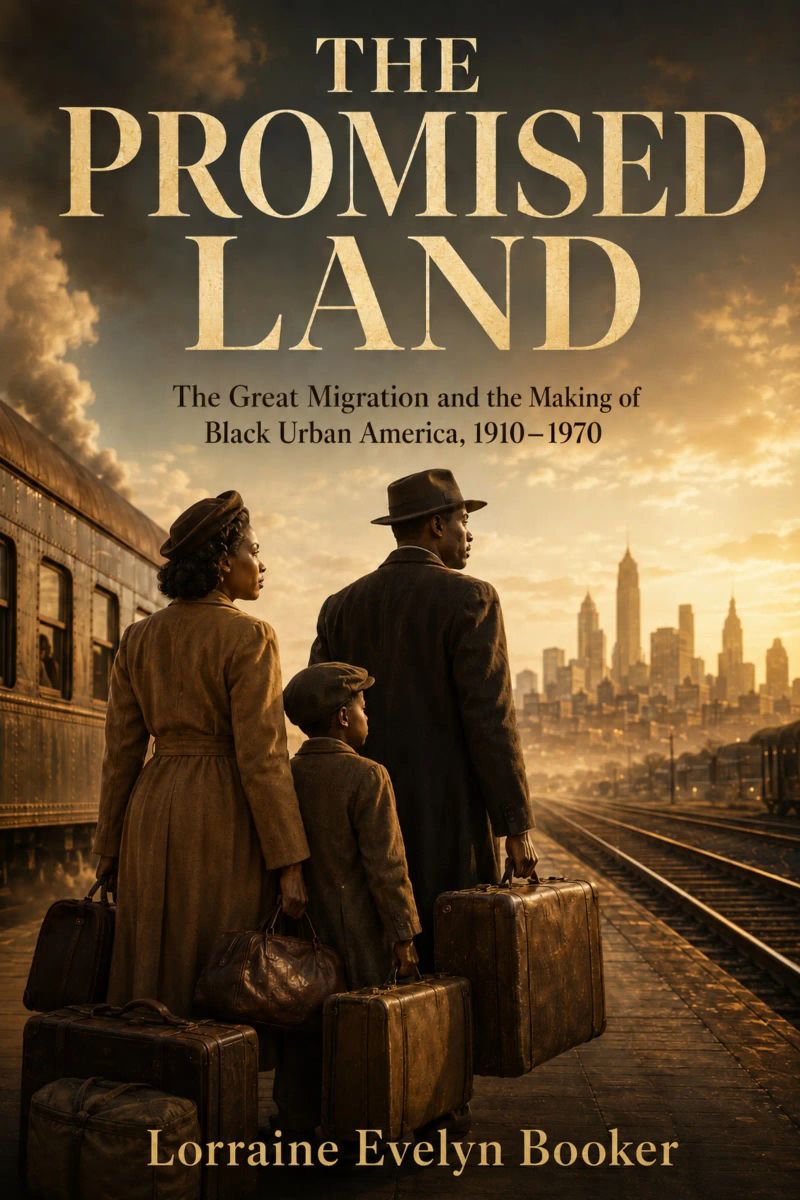
THE PROMISED LAND
The Great Migration and the Making of Black Urban America, 1910-1970By Lorraine Evelyn Booker


Length5h 47m
About this audiobook
The complete narrative history of the Great Migration — six million Black Americans, the Chicago Defender, Jim Crow's South, redlining, the Chicago blues, and the making of Black urban America, 1910-1970.
Between 1910 and 1970, six million Black Americans left the South for the cities of the North and West. They carried copies of the Chicago Defender passed hand to hand at real personal risk. They left Mississippi Delta cotton fields devastated by the boll weevil and arrived in Chicago and Detroit seeking wages instead of sharecrop debts. Their decisions, multiplied six million times, remade the geography of African American life and forced racial equality onto the national stage.
Historian Lorraine Evelyn Booker, granddaughter of Georgia migrants who arrived in Detroit in 1944, traces the full arc of the Great Migration from the boll weevil's destruction of the Delta cotton economy through the deindustrialization that hollowed out Black neighborhoods in the 1960s and 1970s. Across twenty-four chapters she follows the migrants through the Jim Crow South that drove them out, the northern cities that received them, and the extraordinary Black urban culture they built.
Inside this African American history book:
• Jim Crow's architecture — more than 4,000 lynchings between 1880 and 1940, poll-tax disenfranchisement, and sharecropping debt cycles that replicated slavery in nominally free form (Chapter 1)
• The boll weevil's push — a beetle from Mexico destroyed fifty-percent-plus cotton yields by the 1920s, eliminating the slim margin that made staying tolerable (Chapter 2)
• Redlining and the northern ghetto — restrictive covenants, the 1919 Chicago race riot, and how white exclusion—not Black preference—created segregated neighborhoods in every receiving city (Chapter 13)
• Muddy Waters at Chess Records — McKinley Morganfield, born in Rolling Fork, Mississippi in 1913, recorded acoustic Delta blues for the Library of Congress in 1941, plugged in at Chess in 1948, and turned a regional music into the sound of the century (Chapter 17)
• Mahalia Jackson's dream — the gospel tradition migrants carried north from New Orleans reached the Lincoln Memorial in 1963 when she called out: "Tell them about the dream, Martin!" (Chapter 15)
• Black Wall Street destroyed — Tulsa's Greenwood District, thirty-five blocks burned and three hundred killed in 1921, and what it meant for Black wealth-building (Chapter 14)
The Great Migration built the communities that organized the civil rights movement and gave American music its most enduring forms. Understanding contemporary America requires understanding this migration and what it cost. The African American history of the twentieth century begins here.
For readers of Isabel Wilkerson's THE WARMTH OF OTHER SUNS and Clint Smith's HOW THE WORD IS PASSED.
Audiobook details
GenreHistory, Psychology
Length5 hrs 47 mins
Narrated byListen with 1,000+ voices
FormateBook with Audio
Publish dateJun 1, 2026
LanguageEnglish
Table of contents
1Introduction
2Prologue: Going North
3PART ONE: THE WORLD THAT DROVE THE MIGRATION
4Chapter 1: Jim Crow's South — Segregation, Sharecropping, and Daily Terror
5Chapter 2: The Boll Weevil — Agricultural Disruption and the Push to Leave
Show all chaptersShow less
6Chapter 3: The Pull of the North — Labor Recruitment, the Chicago Defender, and Black Networks
7Chapter 4: The First Wave — 1910-1930 and the Initial Movement
8PART TWO: THE DESTINATION CITIES
9Chapter 5: Chicago — The Black Metropolis and the South Side
10Chapter 6: New York — Harlem, Bedford-Stuyvesant, and the City
11Chapter 7: Detroit — The Auto Industry and Black Industrial Labor
12Chapter 8: Philadelphia, Pittsburgh, and the Industrial North's Black Communities
13PART THREE: THE SECOND GREAT MIGRATION (1940-1970)
14Chapter 9: World War II and Black Labor — Defense Industries and the Urban Opportunity
15Chapter 10: The Western Migration — Los Angeles, Oakland, and the Pacific Coast
16Chapter 11: The Postwar North — Returning Veterans and the Civil Rights Connection
17Chapter 12: The Final Wave — 1950-1970 and the Transformation of Northern Cities
18PART FOUR: LIFE IN THE NORTHERN CITY
19Chapter 13: The Ghetto — Housing Segregation, Redlining, and Restricted Neighborhoods
20Chapter 14: Black Business — The Separate Economy Within the Segregated City
21Chapter 15: The Black Church in the North — Spiritual Life and Community Institution
22Chapter 16: Violence and Resistance — Race Riots, Police Brutality, and Urban Struggle
23PART FIVE: THE CULTURE OF THE MIGRATION
24Chapter 17: The Blues Goes North — Chicago Blues and the Electrification of Black Music
25Chapter 18: The Black Press — The Chicago Defender, the Pittsburgh Courier, and Journalism
26Chapter 19: Ida B. Wells, Richard Wright, and the Literature of Migration
27Chapter 20: Food, Language, and Custom — Southern Culture in the Northern City
28PART SIX: LEGACIES
29Chapter 21: The Civil Rights Movement's Urban Roots — How the Migration Built Black Political Power
30Chapter 22: Deindustrialization — When the Jobs Left and the Cities Declined
31Chapter 23: The Reverse Migration — Black Americans Return to the South
32Chapter 24: The Great Migration's Legacy — A Transformation That Remade America
33Epilogue: What the Migration Made
34Acknowledgments
35Selected Bibliography
36About the Author
More from Lorraine Evelyn Booker


A Brief History of IntelligenceMax S. Bennett12h 18m4.6 (6.6K)$29 · $0.00

The Happiest Man on EarthEddie Jaku3h 48m4.6 (178K)$7 · $0.00

MotherlandJulia Ioffe17h 52m4.7 (2.5K)$40 · $0.00

Where Cowards Go to DieBenjamin Sledge8h 42m4.7 (351)$20 · $0.00

RevolutionariesSanjeev Sanyal11h 23m4.6 (2.6K)$29 · $0.00

We Crossed a Bridge and It TrembledWendy Pearlman6h4.6 (5.2K)$24 · $0.00

Unbroken Bonds of BattleJohnny Joey Jones8h 31m4.6 (2.6K)$8 · $0.00

The Daughter of AuschwitzTova Friedman, Malcolm Brabant7h 54m4.6 (16.7K)$26 · $0.00

Lily's PromiseLily Ebert, Dov Forman8h 54m4.6 (16.1K)$29 · $0.00

On Democracies and Death CultsDouglas Murray10h 38m4.6 (6.5K)$29 · $0.00

Across the RiverKent Babb11h 40m4.6 (927)$29 · $0.00

Balcony Over Jerusalem: A Middle East Memoir - Israel, Palestine and BeyondJohn Lyons12h 37m4.6 (1.4K)$33 · $0.00

BeyondStephen Walker15h 39m4.6 (3.2K)$33 · $0.00
Kings and PawnsHoward Bryant10h 9m4.6 (678)$29 · $0.00

No EscapeNury Turkel9h 30m4.6 (809)$28 · $0.00

Jubal Stone: U.S. Marshal: Blood Trail To Hell: A Western Adventure NovelCasey Nash3h 42m4.6 (3.2K)$18 · $0.00

Fall and RiseMitchell Zuckoff17h 23m4.6 (9.8K)$40 · $0.00

The SurvivorJosef Lewkowicz, Michael Calvin9h 22m4.6 (2.5K)$29 · $0.00

Always FaithfulThomas Schueman, Zainullah Zaki12h 12m4.6 (977)$29 · $0.00

The State of Society in France Before the Revolution of 1789 (Annotated)Alexis de Tocqueville17h 25m4.6 (1.2K)$2 · $0.00

What to Make of a LifeJim Collins13h 31m4.4 (794)$33 · $0.00

Invisible StormJason Kander6h 48m4.7 (3.2K)$24 · $0.00

I Am The StormJanice Dean9h4.6 (1.5K)$8 · $0.00
On Democracies and Death CultsDouglas Murray10h 38m4.6 (6.5K)$29 · $0.00

TerraformPropaganda5h 39m4.7 (594)$24 · $0.00

Southern Horrors: Lynch Law in All Its Phases (Annotated)Ida B. Wells-Barnett2h 44m4.6 (1.3K)$2 · $0.00

Hour of the HeartIrvin D. Yalom, Benjamin Yalom8h 19m4.6 (2.3K)$26 · $0.00

Braving the TruthRachel Held Evans11h 31m4.7 (359)$29 · $0.00
Level UpRob Dial7h 42m4.6 (3.3K)$26 · $0.00

As a JewSarah Hurwitz8h 36m4.6 (1.2K)$26 · $0.00

Saint Joan (Annotated)George Bernard Shaw6h 20m4.6 (1.2K)$1.20 · $0.00

Burn the HaystackJennie Young, PhD9h 30m4.6 (543)$29 · $0.00

Woman and the New Race (Annotated)Margaret Sanger6h 30m4.6 (1K)$0.99 · $0.00

Good InsideBecky Kennedy9h 55m4.5 (59.3K)$29 · $0.00

The Mis-Education of the NegroCarter Godwin Woodson5h 4m4.5 (29.4K)$1.20 · $0.00

Du Bois: EssaysW.E.B. Du Bois6h 22m4.6 (1.5K)$1 · $0.00

The North American Indian (Illustrated Edition)Edward S. Curtis, Frederick Webb Hodge5h 59m4.6 (1.4K)$2 · $0.00

Valley of the BirdtailAndrew Stobo Sniderman, Douglas Sanderson10h 1m4.6 (2.4K)$29 · $0.00

Lies My Therapist Told MeGreg E. Gifford9h 3m4.6 (503)$29 · $0.00

Disturbed in Their NestsAlephonsion Deng, Judy A. Bernstein11h 22m4.6 (595)$23 · $0.00
You may also like

The State Must ProvideAdam Harris7h 15m4.5 (775)$24 · $0.00

AntifaMark Bray7h 37m4.1 (5.6K)$20

City of JasmineOlga Grjasnowa6h 32m4.1 (1.3K)$20 · $0.00

Cradles of the ReichJennifer Coburn11h 10m4.1 (11.9K)$20 · $0.00

The India WayS. Jaishankar8h 18m4.1 (5.3K)$20 · $0.00

The History of the Jews (All Six Volumes)Heinrich Graetz118h 6m4.5 (274)$2.99 · $0.00

BauhausMichael Siebenbrodt, Lutz Schöbe7h 22m4.2 (265)$18 · $0.00

The Housemaid’s DaughterBarbara Mutch14h 54m4.0 (10.1K)$23

The Rest Is NoiseAlex Ross23h 8m4.2 (16.1K)$32
Susan, Linda, Nina & CokieLisa Napoli10h 47m4.0 (4.9K)$20
UP FROM SLAVERY (An Autobiography)Booker T. Washington9h 19m4.3 (42.5K)$2 · $0.00

The Big ChangeFrederick Lewis Allen11h 48m4.2 (607)$2 · $0.00
The DefenderEthan Michaeli22h 6m4.5 (720)$30

Story of My Experiments with Truth, TheM.K. Gandhi12h 4m4.2 (85.1K)$21

The Girl Bandits of the Warsaw GhettoElizabeth R. Hyman9h 1m4.3 (1K)$29 · $0.00

A History of the Arab PeoplesAlbert Hourani21h 5m4.1 (7.3K)$32

History of the United States (Annotated)Charles A. Beard, Mary R. Beard22h 59m4.2 (607)$0.99 · $0.00

America FirstDanny Toma9h 12m$20 · $0.00

New NegroDavid Marcus Wheeler5h 28m$10 · $0.00

The Beginnings of New EnglandJohn Fiske7h 42m4.0 (98)$0.99 · $0.00