
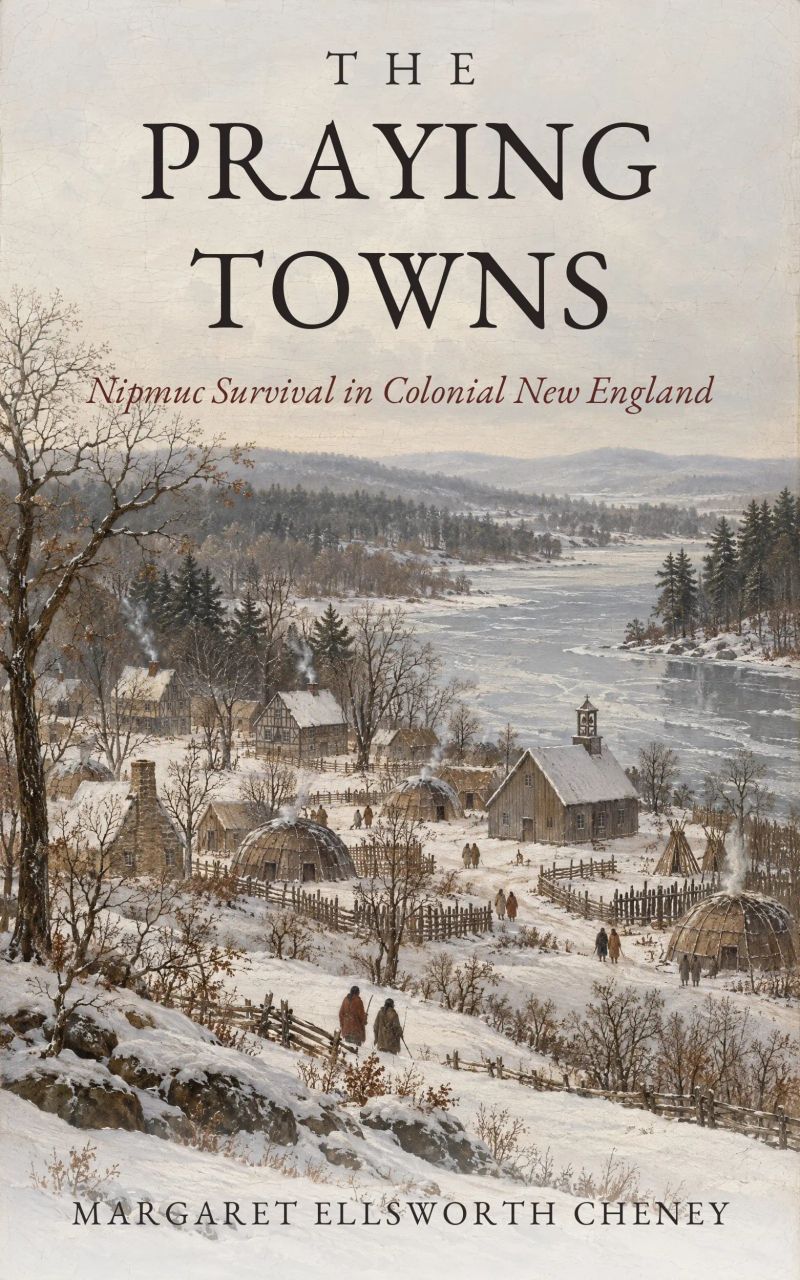
The Praying Towns: Nipmuc Survival in Colonial New England
By Margaret Ellsworth Cheney

Length4h 30m
About this audiobook
What startled the people gathered at Nonantum on October 28, 1646, was not the sermon. It was that the Englishman giving it had bothered to learn their language. John Eliot spoke to Waban's people in Massachusett, heavily accented and stopping now and then to be corrected, about one God who made all things. His listeners kept their own counsel. They had heard English promises before, and a sickness had already emptied their villages once.
Out of that morning grew fourteen praying towns by the early 1670s, and a Bible that Eliot and his Native collaborators printed in Massachusett in 1663, the first complete Bible printed anywhere in the Americas. Deeds and fences came with them, then the death of John Sassamon and King Philip's War. Nipmuc men who would not pray fought the English; Christian Indians, trusted by neither side, were shipped to Deer Island in Boston Harbor, where many died that winter. Many of the survivors went home to Natick and spent the next century defending what land they had left, and today the language of Eliot's Bible is being spoken again. In Grafton, a few acres of old Hassanamesit remain Nipmuc land.
Audiobook details
GenreHistory
Length4 hrs 30 mins
Narrated byListen with 1,000+ voices
FormateBook with Audio
Publish dateSep 19, 2026
LanguageEnglish
Table of contents
1Chapter 1: The Water and the Word
2Chapter 2: A Language Made Printable
3Chapter 3: The Seven Praying Towns and the Nipmuc Sachems
4Chapter 4: Deeds, Fences, and the Losing of Hassanamesit
5Chapter 5: John Sassamon and the Road to War
Show all chaptersShow less
6Chapter 6: The Men Who Would Not Pray: Nipmuc in the War
7Chapter 7: Deer Island
8Chapter 8: The Weight of the Bible
9Chapter 9: Natick and the Survivors
10Chapter 10: The Nipmuc and the Question of Land in the 18th Century
11Chapter 11: The Bible in the Language of the People
12Chapter 12: Wabanay Aquene: Still Here
13About the Author

A Brief History of IntelligenceMax S. Bennett12h 18m4.6 (6.6K)$29 · $0.00

Ghosts of HiroshimaCharles Pellegrino8h 59m4.5 (877)$23

Lily's PromiseLily Ebert, Dov Forman8h 54m4.6 (16.1K)$29 · $0.00

On Democracies and Death CultsDouglas Murray10h 38m4.6 (6.5K)$29 · $0.00

Across the RiverKent Babb11h 40m4.6 (927)$29 · $0.00

Balcony Over Jerusalem: A Middle East Memoir - Israel, Palestine and BeyondJohn Lyons12h 37m4.6 (1.4K)$33 · $0.00

BeyondStephen Walker15h 39m4.6 (3.2K)$33 · $0.00
Kings and PawnsHoward Bryant10h 9m4.6 (678)$29 · $0.00

No EscapeNury Turkel9h 30m4.6 (809)$28 · $0.00

Jubal Stone: U.S. Marshal: Blood Trail To Hell: A Western Adventure NovelCasey Nash3h 42m4.6 (3.2K)$18 · $0.00

Fall and RiseMitchell Zuckoff17h 23m4.6 (9.8K)$40 · $0.00

The SurvivorJosef Lewkowicz, Michael Calvin9h 22m4.6 (2.5K)$29 · $0.00

Always FaithfulThomas Schueman, Zainullah Zaki12h 12m4.6 (977)$29 · $0.00

The State of Society in France Before the Revolution of 1789 (Annotated)Alexis de Tocqueville17h 25m4.6 (1.2K)$2 · $0.00

All the Gallant MenDonald Stratton, Ken Gire5h 55m4.6 (11.8K)$24 · $0.00

Medgar and MyrlieJoy-Ann Reid10h 52m4.5 (27.8K)$29 · $0.00

The History of the Peloponnesian War (Annotated)Thucydides24h 3m4.6 (1.1K)$2 · $0.00

Where the Birds Never SingJack Sacco10h 31m4.6 (3.8K)$29 · $0.00

Serviceman J: The Untold Story of an NZSAS SoldierJamie Pennell5h 51m4.6 (452)$24 · $0.00

Valley of the BirdtailAndrew Stobo Sniderman, Douglas Sanderson10h 1m4.6 (2.4K)$29 · $0.00
You may also like

Heart and SoulKadir Nelson1h 38m4.2 (6.1K)$16 · $0.00

Twenty-Two Years a Slave and Forty Years a FreemanAustin Steward8h 53m4.2 (255)$1 · $0.00

Life Among the Piutes: The First Autobiography of a Native American WomanSarah Winnemucca Hopkins9h4.1 (1.1K)$1 · $0.00

The Last BalladWiley Cash14h 7m4.1 (14.4K)$33 · $0.00

How Dare the Sun RiseSandra Uwiringiyimana, Abigail Pesta6h 25m4.4 (9.7K)$24 · $0.00

Reconstruction Updated EditionEric Foner31h 33m4.4 (11.8K)$53 · $0.00

GoliathMax Blumenthal22h 19m4.3 (1.6K)$30

We're Better Than ThisElijah Cummings, James Dale10h 35m4.4 (2.6K)$29 · $0.00

South to AmericaImani Perry16h 33m4.1 (10.7K)$40 · $0.00

We Want Our Bodies Backjessica Care moore2h 2m4.5 (899)$16 · $0.00

Impossible Takes LongerDaniel Gordis11h 59m4.2 (488)$29 · $0.00

Geronimo's Story of His Life (Illustrated Edition) (Annotated)Geronimo5h 30m4.2 (5.4K)$1.99 · $0.00

Crear en peligroEdwidge Danticat5h 53m4.3 (4.7K)$12 · $0.00

Tall Order: The Goh Chok Tong Story Volume 1Peh Shing Huei7h 53m4.2 (668)$9 · $0.00

Do it Like a WomanCaroline Criado-Perez8h 6m4.2 (1.5K)$20

Sketches of Southern lifeFrances Ellen Watkins Harper2h 1m4.2 (345)$2 · $0.00

Beneath the Tamarind TreeIsha Sesay12h 16m4.1 (2.1K)$29 · $0.00

Fight like a MotherShannon Watts8h 13m4.2 (1K)$26 · $0.00
Of Blood and SweatClyde W. Ford12h 35m4.5 (235)$33 · $0.00

American GrammarJarvis R. Givens15h 38m3.7 (64)$33 · $0.00