
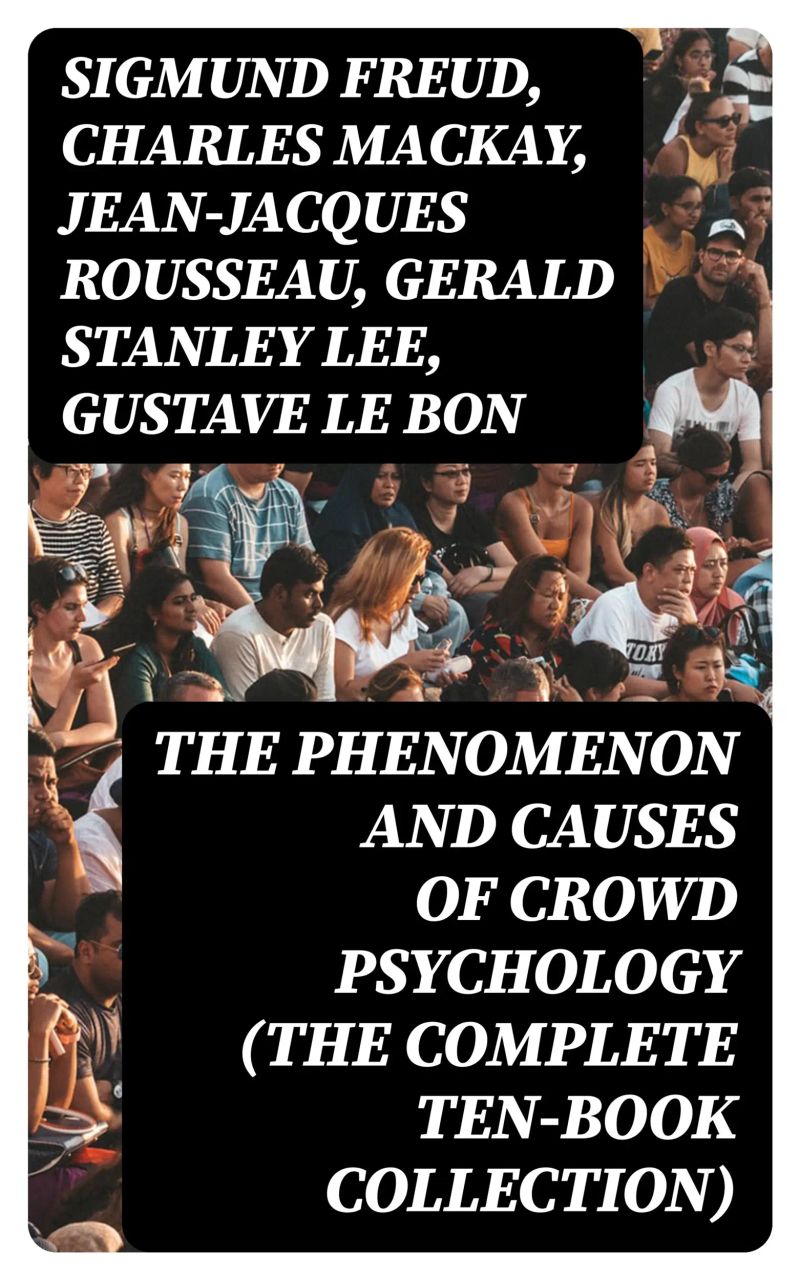
The Phenomenon and Causes of Crowd Psychology (The Complete Ten-Book Collection)
By Sigmund Freud, Charles Mackay, Jean-Jacques Rousseau, Gerald Stanley Lee, Gustave Le Bon, Walter Lippmann, William McDougall, Everett Dean Martin, Wilfred Trotter


Length122h 55m
About this audiobook
The Phenomenon and Causes of Crowd Psychology (The Complete Ten-Book Collection) offers an exhaustive exploration of the intricate workings of collective behavior through a tapestry of perspectives and styles. Spanning multiple disciplines, this anthology delves into themes of mass influence, societal instincts, and the nuanced forces that drive human congregations. Each piece contributes to building a comprehensive understanding of crowd dynamics, with standout essays illustrating pivotal insights into how individual judgments intermingle with and are often subsumed by the collective consciousness. These works collectively enrich the ongoing discourse on collective behavior, illuminating the timeless relevance of crowd psychology. This collection brings together luminaries such as Sigmund Freud, Charles Mackay, and Jean-Jacques Rousseau, each contributing unique analytical lenses shaped by their disciplinary backgrounds in psychology, sociology, and philosophy. The anthology traverses various historic epochs and intellectual movements, illustrating the evolution of thought regarding collective human behavior. Through these varied voices, the anthology captures a spectrum of insights from analytical to theoretical, demonstrating how each figure grapples with the complexities of the crowd psyche, enriching the reader's understanding of individual versus collective influence. Ideal for scholars and general readers alike, The Phenomenon and Causes of Crowd Psychology provides an unparalleled opportunity to explore the origins and implications of crowd behavior. The anthology is not only an academic resource but a stimulating journey through diverse intellectual terrains, inviting readers to reflect upon the dialogue between competing ideas and approaches. The collection's diversity of perspectives and the synthesis of groundbreaking theories it presents make it an essential addition to any library dedicated to psychology, sociology, or cultural studies.
Audiobook details
Rating★★★★ 4.2 (17)
Includes Amazon, Goodreads
GenrePsychology, Literary Classics
Length122 hrs 55 mins
Narrated byListen with 1,000+ voices
FormateBook with Audio
Publish dateNov 13, 2022
LanguageEnglish
Table of contents
1Introduction
2Foreword
3Book I
4Chapter I. Subject of the First Book
5Chapter II. The First Societies
Show all chaptersShow less
6Chapter III. The Right of the Strongest
7Chapter IV. Slavery
8Chapter V. That We Must Always Go Back to a First Convention
9Chapter VI. The Social Compact
10Chapter VII. The Sovereign
11Chapter VIII. The Civil State
12Chapter IX. Real Property
13Book II
14Chapter I. That Sovereignty is Inalienable
15Chapter II. That Sovereignty is Indivisible
16Chapter III. Whether the General Will is Fallible
17Chapter IV. The Limits of the Sovereign Power
18Chapter V. The Right of Life and Death
19Chapter VI. Law
20Chapter VII. The Legislator
21Chapter VIII. The People
22Chapter IX. The People (continued)
23Chapter X. The People (continued)
24Chapter XI. The Various Systems of Legislation
25Chapter XII. The Division of the Laws
26Book III
27Chapter I. Government in General
28Chapter II. The Constituent Principle in the Various Forms of Government
29Chapter III. The Division of Governments
30Chapter IV. Democracy
31Chapter V. Aristocracy
32Chapter VI. Monarchy
33Chapter VII. Mixed Governments
34Chapter VIII. That All Forms of Government Do Not Suit All Countries
35Chapter IX. The Marks of a Good Government
36Chapter X. The Abuse of Government and Its Tendency to Degenerate
37Chapter XI. The Death of the Body Politic
38Chapter XII. How the Sovereign Authority Maintains Itself
39Chapter XIII. The Same (continued)
40Chapter XIV. The Same (continued)
41Chapter XV. Deputies or Representatives
42Chapter XVI. That the Institution of Government is Not a Contract
43Chapter XVII. The Institution of Government
44Chapter XVIII. How to Check the Usurpations of Government
45Book IV
46Chapter I. That the General Will is Indestructible
47Chapter II. Voting
48Chapter III. Elections
49Chapter IV. The Roman Comitia
50Chapter V. The Tribunate

Die TraumdeutungSigmund Freud22h 30m4.1 (94.3K)$18 · $0.00

Sigmund Freud: Das Ich und das EsSigmund Freud3h 24m4.1 (31.4K)$1 · $0.00

Sigmund Freud: Die TraumdeutungSigmund Freud26h 52m4.0 (92.4K)$1.50 · $0.00

Sigmund Freud: Über PsychoanalyseSigmund Freud3h 45m3.9 (4.1K)$2 · $0.00

Sigmund Freud: Drei Abhandlungen zur SexualtheorieSigmund Freud5h 50m3.9 (10.9K)$2.50 · $0.00

Ausgewählte Werke über die Sexualität von Sigmund FreudSigmund Freud9h 55m4.2 (38)$1 · $0.00

Sigmund Freud: Jenseits des LustprinzipsSigmund Freud3h 56m4.1 (30K)$1.50 · $0.00

A General Introduction to Psychoanalysis & Dream Psychology (Psychoanalysis for Beginners)Sigmund Freud24h 49m4.0 (15K)$1.99 · $0.00
The UnconsciousSigmund Freud, H. W. Chase40h 2m4.1 (2.9K)$1.99 · $0.00
Sigmund Freud: Briefe, Psychoanalytische Schriften, Studien und mehrSigmund Freud195h 26m4.6 (11)$1 · $0.00

Zur Geschichte der psychoanalytischen BewegungSigmund Freud4h 15m3.9 (2K)$1 · $0.00

Sigmund Freud: Massenpsychologie und Ich-AnalyseSigmund Freud4h 37m4.1 (17.3K)$2 · $0.00

Studien über HysterieSigmund Freud, Josef Breuer14h 1m4.0 (2.8K)$1 · $0.00

The Interpretation of DreamsSigmund Freud23h 56m4.0 (144.4K)$1.99 · $0.00

Zur Psychopathologie des Alltagslebens (Kommentiert)Sigmund Freud5h 50m4.0 (10K)$1 · $0.00

Hemmung, Symptom, Angst (Kommentiert)Sigmund Freud4h 57m4.2 (3.7K)$1 · $0.00
TOTEM & TABOO: Resemblances between the Mental Lives of Savages and Neurotics (Annotated)Sigmund Freud8h 44m4.1 (27.3K)$2 · $0.00
BEYOND THE PLEASURE PRINCIPLE (Unabridged) (Annotated)Sigmund Freud4h 1m4.5 (1.2K)$2 · $0.00

Triebe und Triebschicksale - Die Unterscheidung vom Triebreiz und anderen physiologischen Reizen (Kommentiert)Sigmund Freud3h 28m4.6 (11)$1 · $0.00
THE "UNCONSCIOUS" TRILOGY: The Interpretation of Dreams, Psychopathology of Everyday Life & Wit and Its Relation to the Unconscious (Annotated)Sigmund Freud, H. W. Chase40h 1m$2 · $0.00
What to Make of a LifeJim Collins13h 31m4.4 (794)$33 · $0.00

Black AF HistoryMichael Harriot15h 43m4.7 (14.6K)$33 · $0.00

Bad Fat Black GirlSesali Bowen6h 32m4.7 (2.8K)$24 · $0.00

Invisible StormJason Kander6h 48m4.7 (3.2K)$24 · $0.00

I Am The StormJanice Dean9h4.6 (1.5K)$8 · $0.00

On Democracies and Death CultsDouglas Murray10h 38m4.6 (6.5K)$29 · $0.00

TerraformPropaganda5h 39m4.7 (594)$24 · $0.00

Southern Horrors: Lynch Law in All Its Phases (Annotated)Ida B. Wells-Barnett2h 44m4.6 (1.3K)$2 · $0.00

Hour of the HeartIrvin D. Yalom, Benjamin Yalom8h 19m4.6 (2.3K)$26 · $0.00

Braving the TruthRachel Held Evans11h 31m4.7 (359)$29 · $0.00
Level UpRob Dial7h 42m4.6 (3.3K)$26 · $0.00

As a JewSarah Hurwitz8h 36m4.6 (1.2K)$26 · $0.00

Saint Joan (Annotated)George Bernard Shaw6h 20m4.6 (1.2K)$1.20 · $0.00

Burn the HaystackJennie Young, PhD9h 30m4.6 (543)$29 · $0.00

Woman and the New Race (Annotated)Margaret Sanger6h 30m4.6 (1K)$0.99 · $0.00

Good InsideBecky Kennedy9h 55m4.5 (59.3K)$29 · $0.00
The Mis-Education of the NegroCarter Godwin Woodson5h 4m4.5 (29.4K)$1.20 · $0.00

Du Bois: EssaysW.E.B. Du Bois6h 22m4.6 (1.5K)$1 · $0.00

The North American Indian (Illustrated Edition)Edward S. Curtis, Frederick Webb Hodge5h 59m4.6 (1.4K)$2 · $0.00

Valley of the BirdtailAndrew Stobo Sniderman, Douglas Sanderson10h 1m4.6 (2.4K)$29 · $0.00

To Kill a MockingbirdHarper Lee12h 18m4.5 (7.4M)$29 · $0.00

These Precious DaysAnn Patchett11h 14m4.5 (45.2K)$29 · $0.00

The Jeeves and Wooster Stories: The Complete Collection (33 Books)P. G. Wodehouse21h 57m4.7 (2.8K)$15 · $0.00

The Gulag Archipelago Volume 3Aleksandr I. Solzhenitsyn21h 56m4.7 (8.9K)$46 · $0.00

This Side of Paradise - The Original 1920 Edition (Annotated)F. Scott Fitzgerald11h 30m4.6 (1.6K)$2 · $0.00
The Great Gatsby: Original 1925 Edition (An F. Scott Fitzgerald Classic NovelFrancis Scott Fitzgerald4h 45m4.6 (9.3K)$18 · $0.00

TWELFTH NIGHTWilliam Shakespeare, Sidney Lee16h 38m4.6 (2.8K)$1.99 · $0.00

The Complete Histories / History Plays of William Shakespeare (Annotated)William Shakespeare29h 42m4.6 (2.3K)$0.99 · $0.00
Braving the TruthRachel Held Evans11h 31m4.7 (359)$29 · $0.00

The Old Man and the Sea (Annotated)Ernest Hemingway4h 27m4.6 (1.4K)$2 · $0.00

Henry V (The Play, Historical Background and Analysis of the Character in the Play)William Shakespeare, William Hazlitt8h 50m4.6 (1.3K)$1.99 · $0.00

H. P. LOVECRAFT Ultimate Collection: Novellas, Short Stories, Poetry & Essays (Annotated)H. P. Lovecraft12h 28m4.6 (2.3K)$2 · $0.00

Time RegainedMarcel Proust16h 8m4.5 (10.6K)$1.99 · $0.00

The Mis-Education of the NegroCarter Goodwin Woodson4h 32m4.5 (28.4K)$10 · $0.00
Lessons in TruthH. Emilie3h 50m4.6 (1.4K)$4.70 · $0.00

TORAH - Bilingual Edition: English/Hebrew (Annotated)Max Margolis, JPS28h 26m4.6 (1K)$2 · $0.00

Betty Crocker picture cooky bookBetty Crocker, Inc. General Mills2h 13m4.5 (6.5K)$1 · $0.00

The Complete Tales of Beatrix PotterBeatrix Potter3h 36m4.5 (75K)$3 · $0.00

Anne of Green GablesL. M. Montgomery11h 1m4.5 (1.2M)$2.30 · $0.00

Crime and Punishment (The Unabridged Garnett Translation) (Annotated)Fyodor Dostoevsky24h 25m4.5 (15.4K)$0.99 · $0.00
You may also like

Psychology of CrowdsGustave le Bon6h 21m3.9 (26.8K)$3.50 · $0.00
Knowledge and DecisionsThomas Sowell20h 53m4.5 (2.8K)$30

Why Men Fight: A method of abolishing the international duelBertrand Russell6h 2m4.1 (503)$2 · $0.00
CAPITAL (All 3 Books)Karl Marx92h 37m4.5 (16.5K)$2.99 · $0.00

A Contribution to The Critique Of The Political Economy (Annotated)Karl Marx11h 7m4.0 (480)$0.99 · $0.00

The Essays of Arthur Schopenhauer; On Human NatureArthur Schopenhauer4h 22m4.2 (923)$2 · $0.00

The Psychic Soviet, and Other WorksIan F. Svenonius6h 8m4.3 (536)$17 · $0.00
Capital (Das Kapital)Karl Marx98h 11m4.4 (40.9K)$1.99 · $0.00
The Republican BrainChris Mooney10h 54m3.8 (1.8K)$23 · $0.00

What Is Property?Pierre Joseph Proudhon13h 48m3.9 (1.9K)$15 · $0.00

LeviathanThomas Hobbes23h3.9 (68.7K)$2.30

The Nature of the Judicial ProcessBenjamin N. Cardozo3h 39m4.1 (365)$20

Off with Her HeadEleanor Herman10h 58m4.0 (3.5K)$29 · $0.00

"The Kingdom of God Is Within You" (Annotated)Leo graf Tolstoy12h 57m4.3 (18.1K)$2 · $0.00

Suicidal EmpathyGad Saad8h 24m4.1 (734)$28 · $0.00

The Capital & The Communist ManifestoKarl Marx98h 5m4.3 (2.7K)$1.99 · $0.00

10 Books Every Conservative Must ReadBenjamin Wiker PhD10h 34m4.2 (827)$20 · $0.00

On LibertyJohn Stuart Mill5h 9m4.2 (112.9K)$20 · $0.00

A Critique of SocialismGeorge R. Sims42m$2 · $0.00

The Source and Aim of Human Progress (A study in social psychology and social pathology)Boris Sidis3h 15m$1 · $0.00