
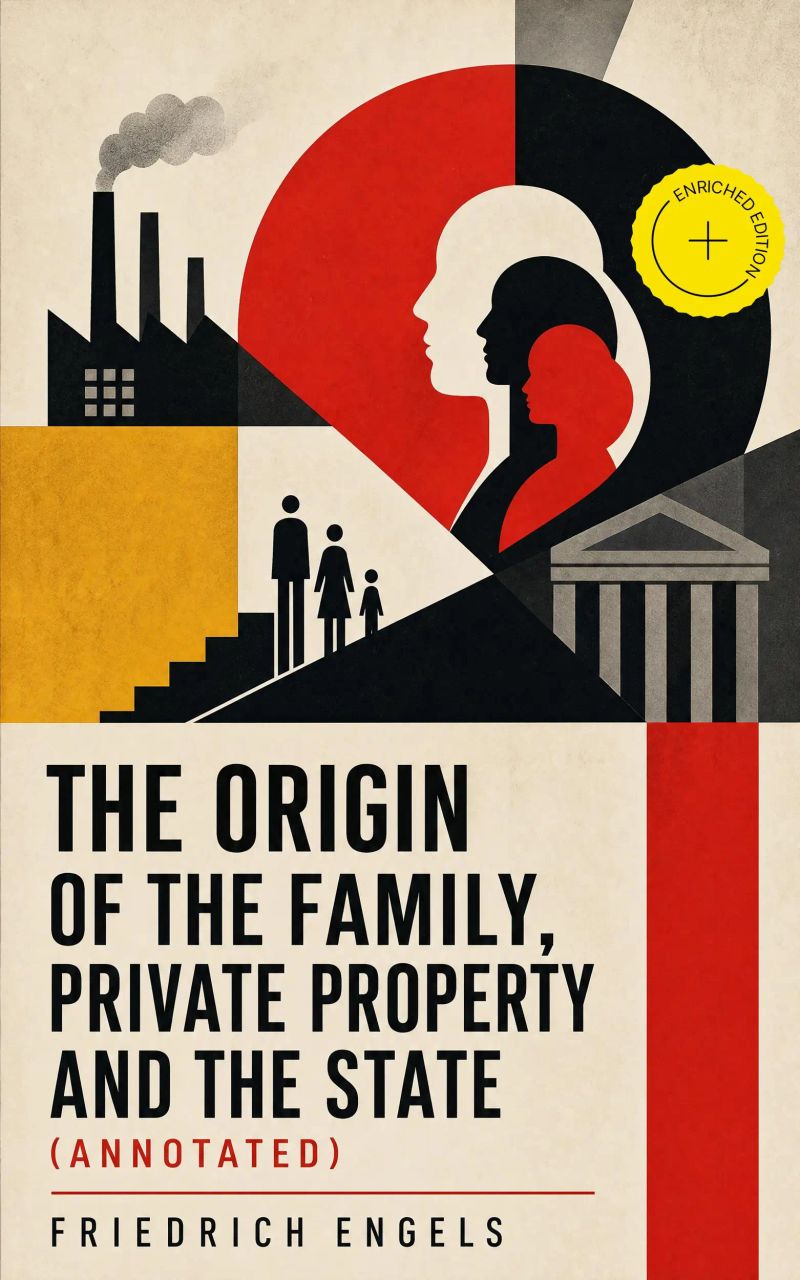
The Origin of the Family, Private Property and the State (Annotated)
Enriched Edition. A Marxist Study of Kinship, Inheritance, Patriarchy, and State FormationBy Friedrich Engels


Length8h 51m
About this audiobook
In The Origin of the Family, Private Property and the State (1884), Friedrich Engels offers a sweeping materialist account of social development, tracing the transformation of kinship, property relations, gender hierarchy, and political authority from communal societies to class-based civilization. Drawing heavily on Lewis H. Morgan's anthropological studies, Engels writes in a polemical yet systematic style, extending Marxist historical analysis beyond economics into the intimate structures of family and law. The book belongs to the nineteenth-century tradition of evolutionary social theory, but its enduring force lies in its insistence that institutions often treated as natural are historical products. Engels, Marx's closest collaborator and one of the principal architects of socialist theory, wrote the work after Marx's death, using Marx's notes on Morgan and his own long engagement with political economy, industrial capitalism, and class struggle. His observations of bourgeois family life, women's subordination, and property accumulation shaped his conviction that social relations are inseparable from material conditions. This book is essential for readers interested in Marxism, feminism, anthropology, and political theory. Though some ethnographic assumptions are now dated, its central questions remain provocative and intellectually generative.
This enriched edition has been carefully crafted to add value to your reading experience.
- A succinct Introduction situates the work's timeless appeal and themes.
- The Synopsis outlines the central plot, highlighting key developments without spoiling critical twists.
- A detailed Historical Context immerses you in the era's events and influences that shaped the writing.
- An Author Biography reveals milestones in the author's life, illuminating the personal insights behind the text.
- A thorough Analysis dissects symbols, motifs, and character arcs to unearth underlying meanings.
- Reflection questions prompt you to engage personally with the work's messages, connecting them to modern life.
- Hand‐picked Memorable Quotes shine a spotlight on moments of literary brilliance.
- Interactive footnotes clarify unusual references, historical allusions, and archaic phrases for an effortless, more informed read.
Audiobook details
Rating★★★★ 4.2 (9.9K)
Includes Goodreads, Amazon, StoryGraph, LibraryThing
GenrePsychology
Length8 hrs 51 mins
Narrated byListen with 1,000+ voices
FormateBook with Audio
Publish dateNov 20, 2023
LanguageEnglish
Table of contents
1Introduction
2Introduction
3Synopsis
4Historical Context
5Author Biography
Show all chaptersShow less
6TRANSLATOR'S PREFACE.
7AUTHOR'S PREFACE TO THE FIRST EDITION, 1884.
8AUTHOR'S PREFACE TO THE FOURTH EDITION, 1891.
9CHAPTER I. PREHISTORIC STAGES.
10I. SAVAGERY.
11II. BARBARISM.
12CHAPTER II. THE FAMILY.
131. THE CONSANGUINE FAMILY.
142. THE PUNALUAN FAMILY.
153. THE PAIRING FAMILY.
164. THE MONOGAMOUS FAMILY.
17CHAPTER III. THE IROQUOIS GENS.
18CHAPTER IV. THE GRECIAN GENS.
19CHAPTER V. ORIGIN OF THE ATTIC STATE.
20CHAPTER VI. GENS AND STATE IN ROME.
21CHAPTER VII. THE GENS AMONG CELTS AND GERMANS.
22CHAPTER VIII. THE RISE OF THE STATE AMONG GERMANS.
23CHAPTER IX. BARBARISM AND CIVILIZATION.
24Analysis
25Reflection
26Memorable Quotes
More from Friedrich Engels

Der deutsche BauernkriegFriedrich Engels4h 58m4.1 (4.3K)$2 · $0.00

Dialektik der Natur (Kommentiert)Friedrich Engels13h 4m4.2 (1.7K)$1.50 · $0.00

Ludwig Feuerbach und der Ausgang der klassischen deutschen Philosophie (Kommentiert)Friedrich Engels3h 51m$1 · $0.00

Zur Urgeschichte der Deutschen (Kommentiert)Friedrich Engels4h 5m$1 · $0.00

Herrn Eugen Dührings Umwälzung der Wissenschaft oder: Anti-Dühring (Kommentiert)Friedrich Engels17h4.3 (3.2K)$1 · $0.00

Landmarks of Scientific Socialism: "Anti-Duehring"Friedrich Engels6h 17m$1 · $0.00

The Condition of the Working-Class in England in 1844 with a Preface written in 1892Friedrich Engels11h 13m4.1 (5.8K)$1 · $0.00

Manifesto of the Communist PartyFriedrich Engels, Karl Marx2h 34m3.8 (255.7K)$1 · $0.00

Die Lage EnglandsFriedrich Engels1h 24m4.0 (20)$2 · $0.00

Herrn Eugen Dührings Umwälzung der Wissenschaft oder: Anti-DühringFriedrich Engels14h 46m4.4 (1.7K)$2 · $0.00

Der deutsche Bauernkrieg (Zusammengefasste Ausgabe)Friedrich Engels2h 16m$2

The Condition of the Working-Class in England in 1844 with a Preface written in 1892Friedrich Engels14h 37m4.2 (6.6K)$2 · $0.00

Ludwig Feuerbach und der Ausgang der klassischen deutschen PhilosophieFriedrich Engels3h 46m4.2 (883)$1 · $0.00

Der deutsche Bauernkrieg (Kommentiert)Friedrich Engels6h 34m4.1 (1.3K)$1 · $0.00

Umrisse zu einer Kritik der Nationalökonomie (Kommentiert)Friedrich Engels3h 3m4.1 (175)$1 · $0.00

Über historischen Materialismus (Kommentiert)Friedrich Engels2h 53m4.2 (91)$2 · $0.00
What to Make of a LifeJim Collins13h 31m4.4 (794)$33 · $0.00

Southern Horrors: Lynch Law in All Its Phases (Annotated)Ida B. Wells-Barnett2h 44m4.6 (1.3K)$2 · $0.00

Hour of the HeartIrvin D. Yalom, Benjamin Yalom8h 19m4.6 (2.3K)$26 · $0.00

Braving the TruthRachel Held Evans11h 31m4.7 (359)$29 · $0.00
Level UpRob Dial7h 42m4.6 (3.3K)$26 · $0.00

As a JewSarah Hurwitz8h 36m4.6 (1.2K)$26 · $0.00

Saint Joan (Annotated)George Bernard Shaw6h 20m4.6 (1.2K)$1.20 · $0.00

Burn the HaystackJennie Young, PhD9h 30m4.6 (543)$29 · $0.00

Woman and the New Race (Annotated)Margaret Sanger6h 30m4.6 (1K)$0.99 · $0.00

Good InsideBecky Kennedy9h 55m4.5 (59.3K)$29 · $0.00
The Mis-Education of the NegroCarter Godwin Woodson5h 4m4.5 (29.4K)$1.20 · $0.00

Du Bois: EssaysW.E.B. Du Bois6h 22m4.6 (1.5K)$1 · $0.00

The North American Indian (Illustrated Edition)Edward S. Curtis, Frederick Webb Hodge5h 59m4.6 (1.4K)$2 · $0.00

Valley of the BirdtailAndrew Stobo Sniderman, Douglas Sanderson10h 1m4.6 (2.4K)$29 · $0.00

Lies My Therapist Told MeGreg E. Gifford9h 3m4.6 (503)$29 · $0.00

Disturbed in Their NestsAlephonsion Deng, Judy A. Bernstein11h 22m4.6 (595)$23 · $0.00

No Name in the StreetJames Baldwin5h4.5 (8.5K)$20 · $0.00
Narrative of the Life of Frederick DouglassFrederick Douglass4h 13m4.5 (309.9K)$1.20 · $0.00

Magic SeasonWade Rouse6h 41m4.6 (855)$24 · $0.00

Consent Laid BareChanel Contos7h 11m4.5 (1.7K)$24 · $0.00
You may also like

Free to ChooseMilton Friedman, Rose D. Friedman12h 16m4.2 (11.4K)$23

Becoming AbolitionistsDerecka Purnell14h 24m4.5 (4.3K)$23

Kingdom of Olives and AshMichael Chabon, Ayelet Waldman16h 5m4.3 (760)$33 · $0.00

Revolution for DummiesBassem Youssef7h 13m4.3 (3.5K)$24 · $0.00

Family UnfriendlyTimothy P. Carney11h 40m4.1 (1.1K)$29 · $0.00

Areopagitica John Milton1h 53m4.0 (4.1K)Free

The Cotton KingdomFrederick Law Olmsted24h 29m4.2 (526)$30
The Subjection of WomenJohn Stuart Mill4h 42m4.2 (5K)Free

Hulme's Journal, 1818-19Richard Flower, John Woods, Thomas Hulme9h 34m$1 · $0.00

The Evolution of Steel: 3 Classic Books on Steel ManufacturingPhilip W. Bishop, Charles R. Walker, Fred H. Colvin, K. A. Juthe14h 54m$0.99 · $0.00

The Trump Survival GuideGene Stone4h 31m3.9 (537)$20 · $0.00
This Misery of BootsH. G. Wells48m3.5 (30)$8

A Short History of Women's RightsEugene A. Hecker5h 49m4.0 (27)$1 · $0.00
The Mayflower Society HouseWalter Merriam Pratt42m$2 · $0.00

Japanese Girls and Women (Annotated)Alice Mabel Bacon8h 46m4.4 (103)$1.20 · $0.00

The Ethics of Urban LeaseholdsJohn Thomas Emmett1h 45m$1 · $0.00

Inside the Orphan Drug RevolutionJames A. Geraghty7h 39m4.3 (31)$30

Woman's Voice : An anthologyVarious8h 25m$2 · $0.00

The Century of the ChildEllen Key6h 5m3.6 (49)$1 · $0.00

THE SECOND WAVELydia Frances Hooper5h 2m$10 · $0.00