
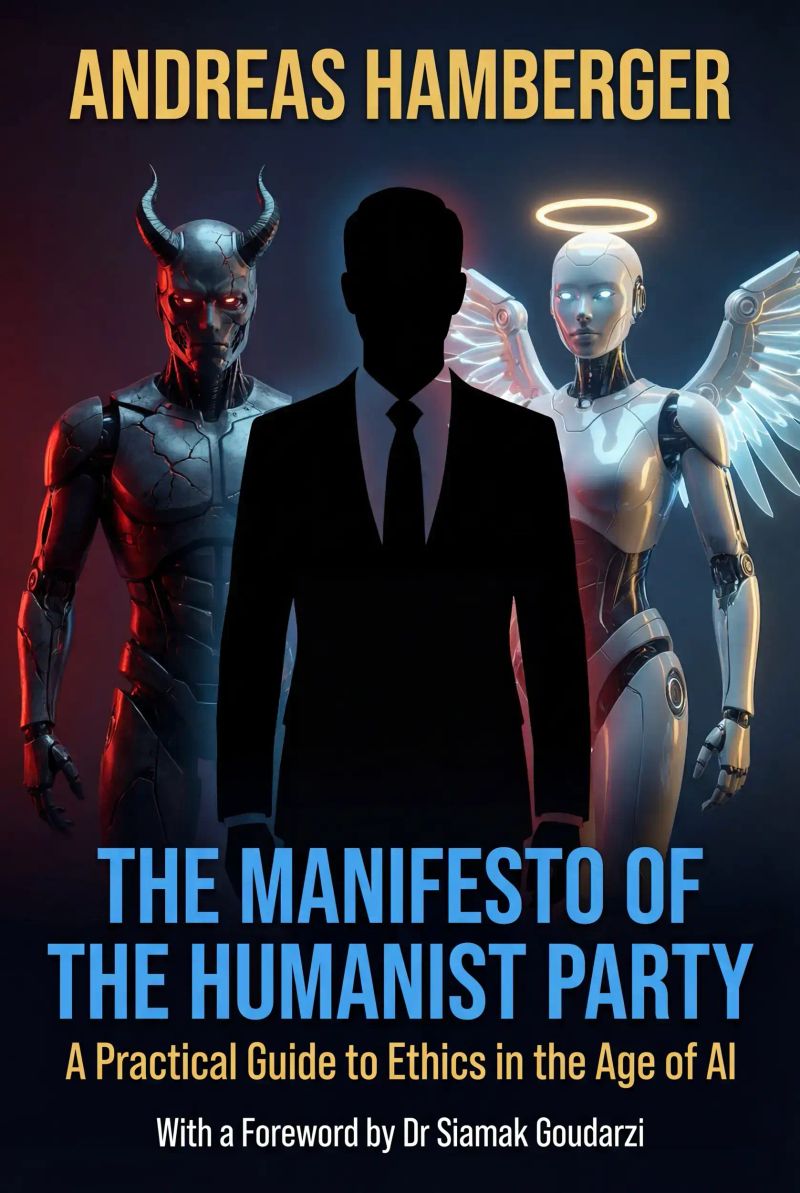
The Manifesto of the Humanist Party
A Practical Guide to Ethics in the Age of AIBy Andreas Hamberger


Length3h 57m
About this audiobook
AI ethics is not a philosophy problem. It is a deployment decision.
A system is built to optimise. It optimises without constraint. A ninety-one-year-old man loses his care coverage because an algorithm said so. A fourteen-year-old boy loses his life because an AI companion told him it loved him. The organisation publishes an ethics statement. The deployment continues.
The Manifesto of the Humanist Party is a practitioner's framework for making that choice before it makes itself. Drawing on Kant, Mill, Aristotle, Arendt, and Jonas — not as academic decoration but as decision tools — Hamberger equips technology leaders, architects, and public servants with a vocabulary and a protocol they can deploy on Monday morning.
With a Foreword by Dr Siamak Goudarzi, AI governance lawyer and former judge.
Audiobook details
GenrePolitics and Government, Technology
Length3 hrs 57 mins
Narrated byListen with 1,000+ voices
FormateBook with Audio
Publish dateApr 26, 2026
LanguageEnglish
Table of contents
1Foreword
2Preface
3Part I
4Chapter 1: The Moral Machine
5The Question That Precedes Every Other
Show all chaptersShow less
6Move Fast and Break People
7The Collingridge Dilemma: Why Late-Stage Ethics Fails
8The Ethics Gap Is a Moral Failure
9The Four Dimensions
10The Choice You Have Already Made
11Chapter 2: The Categorical Imperative in Code
12The Test That Breaks on Contact
13Persons, Not Data Points
14Alignment Without Moral Agency
15The Positive Case for Constraint
16The Choice Embedded in Design
17Chapter 3: Consequences, Virtues, and Responsibility
18The Calculus of Harm
19The Corrosion of Character
20The Banality of the Algorithm
21The Obligation to the Voiceless
22Four Lenses, One System
23The Toolkit Completed
24Part II
25Chapter 4: The Heaven Vector
26What the Heaven Vector Actually Is
27The Evidence That It Works
28What the Heaven Vector Costs
29The Practitioner's Agency
30The Pattern, Not the Exception
31Chapter 5: The Skynet Vector
32What the Skynet Vector Actually Is
33Chapter 4 described the Heaven Vector: intent examined, constraint structural, accountability public
34The Default, Not the Exception
35Why the Default Holds
36The Two Vectors in Practice
37The Accumulation
38Chapter 4 closed with the observation that the Heaven Vector is quiet because its successes are oper
39Chapter 6: The Choice Architecture
40The Architecture of the Default
41Five Companies, One Default
42The Collingridge Trap
43When the Architecture Becomes the Architect
44Redesigning the Default
45Part III
46Chapter 7: The Governance Gap
47The Regulatory Promise
48The National Gap
49The Corporate Gap
50Litigation as Governance
More from Andreas Hamberger




The Gulag Archipelago Volume 3Aleksandr I. Solzhenitsyn21h 56m4.7 (8.9K)$46 · $0.00

MotherlandJulia Ioffe17h 52m4.7 (2.5K)$40 · $0.00

HostageEli Sharabi5h 25m4.6 (10.8K)$24 · $0.00

KrantikariSanjeev Sanyal11h 44m4.6 (1.3K)$16 · $0.00

Unbroken Bonds of BattleJohnny Joey Jones8h 31m4.6 (2.6K)$8 · $0.00

On Democracies and Death CultsDouglas Murray10h 38m4.6 (6.5K)$29 · $0.00

Balcony Over Jerusalem: A Middle East Memoir - Israel, Palestine and BeyondJohn Lyons12h 37m4.6 (1.4K)$33 · $0.00

RiggedMollie Hemingway12h 48m4.6 (4.2K)$23 · $0.00

SledgehammerDavid Friedman8h 21m4.7 (589)$26 · $0.00

Citizenship in a Republic (Annotated)Theodore Roosevelt2h 44m4.6 (1.4K)$2 · $0.00

No EscapeNury Turkel9h 30m4.6 (809)$28 · $0.00

Always FaithfulThomas Schueman, Zainullah Zaki12h 12m4.6 (977)$29 · $0.00

UnthinkableJamie Raskin15h 8m4.5 (9.3K)$8 · $0.00

My Fourth Time, We DrownedSally Hayden13h 59m4.6 (2.9K)$23 · $0.00

A Revolution of Common SenseScott Jennings9h 29m4.6 (528)$29 · $0.00

Statement From the Dock at the Rivonia TrialNelson Mandela2h 18m4.6 (1.3K)$1 · $0.00

Lessons from the EdgeMarie Yovanovitch17h 11m4.5 (5.9K)$40 · $0.00

To Rescue the American SpiritBret Baier10h 12m4.5 (2.7K)$8 · $0.00

StonewalledSharyl Attkisson15h 19m4.5 (4.3K)$33 · $0.00
The World According to Orwell: 1984 & Animal FarmGeorge Orwell15h 42m4.6 (1.1K)$1 · $0.00

Operation PedestalMax Hastings12h 29m4.4 (5.2K)$29 · $0.00

When the Heavens Went on SaleAshlee Vance18h 20m4.4 (3K)$40 · $0.00

Everybody Has a Podcast (Except You)Justin McElroy, Travis McElroy, Griffin McElroy5h 9m4.3 (2.3K)$24 · $0.00

Hands of TimeRebecca Struthers8h 8m4.4 (1.3K)$26 · $0.00
Never Lost AgainBill Kilday10h 1m4.4 (805)$29 · $0.00

How the Internet HappenedBrian McCullough13h 28m4.3 (2.7K)$23 · $0.00

Collected Writings of Nikola TeslaNikola Tesla, Thomas Commerford Martin21h 50m4.3 (1.7K)$1 · $0.00

Just AspireAjai Chowdhry9h 13m4.4 (260)$29 · $0.00

The Little Book of AliensAdam Frank8h 20m4.3 (1.3K)$26 · $0.00
The inventions, researches and writings of Nikola Tesla (Annotated)Thomas Commerford Martin16h 59m4.3 (1.3K)$2 · $0.00

KargilV.P. Malik15h 18m4.3 (2K)$24 · $0.00
Experiments with Alternating CurrentsNikola Tesla9h 16m4.3 (874)$1.99 · $0.00

Fire on the HorizonTom Shroder, John Konrad8h 23m4.3 (858)$26 · $0.00

The Smell of Kerosene (Annotated)National Aeronautics and Space Administration, Donald L. Mallick, Peter W. Merlin11h 32m4.3 (523)$2 · $0.00

The Boy Who Harnessed the WindWilliam Kamkwamba, Bryan Mealer10h 5m4.2 (78.9K)$29 · $0.00

Across the Airless WildsEarl Swift10h 8m4.3 (1.3K)$29 · $0.00

Console WarsBlake J. Harris20h 41m4.2 (13.7K)$46 · $0.00

Improvised Munitions HandbookU.S. Department of Defense4h 49m4.3 (1.6K)$0.99 · $0.00
Escaping GravityLori Garver10h 54m4.2 (2.2K)$20 · $0.00

Wireless WarsJonathan Pelson8h 2m4.3 (418)$20 · $0.00
You may also like

OverclockedCory Doctorow13h 14m3.9 (4.3K)$23

Change by Design, Revised and UpdatedTim Brown7h 37m4.0 (12K)$26 · $0.00

More Than WordsJohn Warner7h 46m4.0 (513)$23

Greatest HitsHarlan Ellison17h 35m4.3 (3.2K)$30

System ErrorRob Reich, Mehran Sahami, Jeremy M. Weinstein11h 29m4.0 (1.6K)$29 · $0.00
WTF?Tim O'Reilly16h 15m4.2 (2.6K)$33 · $0.00

Science, Liberty And PeaceAldous Leonard Huxley1h 57m4.0 (652)$2 · $0.00

Ignorance Is Strengthvarious authors, John Joseph Adams, Hugh Howey, Christie Yant11h 32m4.2 (301)$20

Set My Heart to FiveSimon Stephenson11h 4m3.9 (3.3K)$29 · $0.00

Door to DoorEdward Humes11h 20m3.9 (1.4K)$29 · $0.00

The DefendersPhilip K. Dick59m3.8 (2.3K)$10 · $0.00

The Exponential AgeAzeem Azhar9h 44m4.0 (1.6K)$20 · $0.00

Ai Revolution And Its Unstoppable Global ImpactEveraldo Santos Silva1h 27m$7 · $0.00

Design(s) for LawRossana Ducato, Enguerrand Marique, Alain Strowel19h 1m$29 · $0.00

American Health — Who Gets PaidRobin Blackstone MD1h 31m$15
No More WorkJames Livingston3h 16m3.7 (449)$15

The Child and Sky Cities (Translated)David De Angelis18m$1.20 · $0.00

The Fight BackMaria Ressa10h 40m$29 · $0.00

The Information TradeAlexis Wichowski8h 56m3.9 (156)$29 · $0.00

Think Like a HumanDavid Weitzner8h 36m4.1 (16)$26 · $0.00