
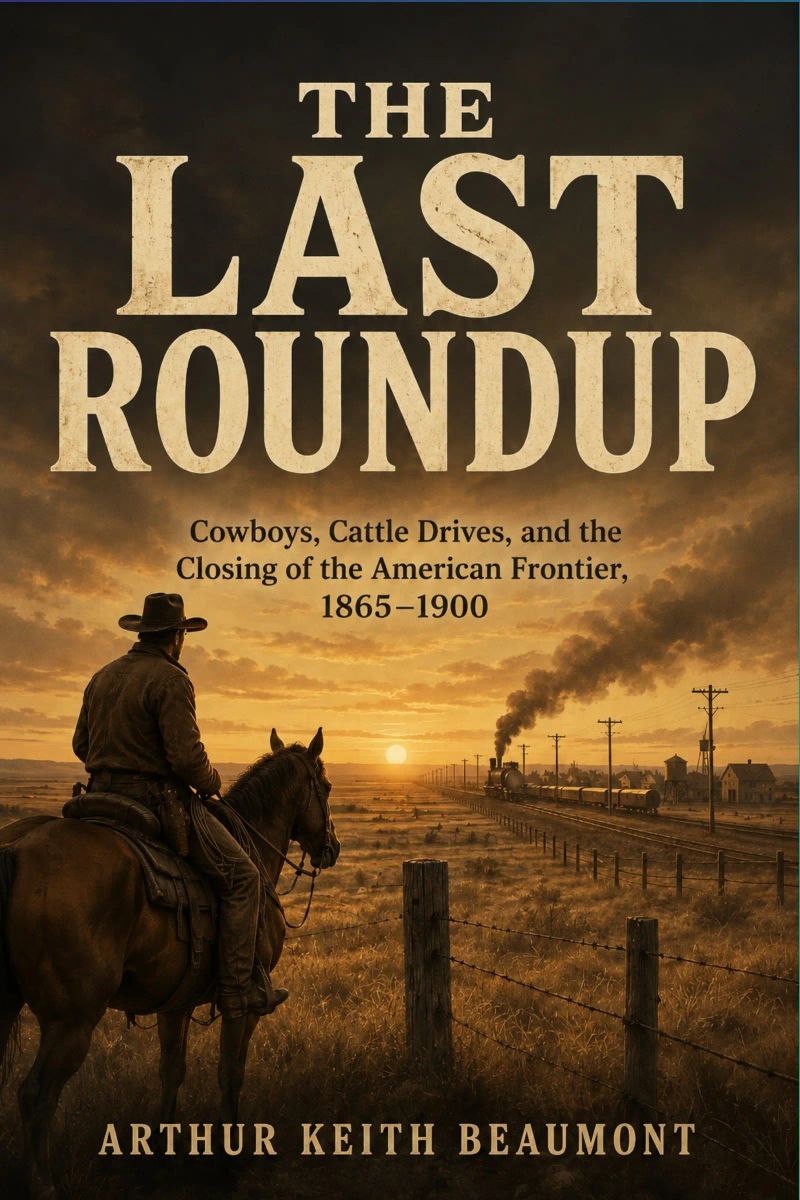
THE LAST ROUNDUP
Cowboys, Cattle Drives, and the Closing of the American Frontier, 1865-1900By Arthur Keith Beaumont


Length5h 32m
About this audiobook
American West history — cowboys, cattle drives, the open range, Black cowboys, vaqueros, the frontier myth debunked: the complete narrative history of the cattle kingdom, 1865-1900.
For roughly two decades after the Civil War, the Great Plains were the most consequential economic frontier in American history — and the cowboys who worked them were not the blue-eyed Anglo heroes of the dime novels. A significant proportion were Black freedmen who found in the Texas cattle industry an opportunity the post-war South denied them. Many were vaqueros, Mexican horsemen whose skills predated the Anglo cattle industry by centuries. Some were women. Some were former Confederate soldiers working alongside former Union men on drives where old allegiances had no value. The open range lasted barely a generation. The mythology built on it has lasted more than a century.
In this narrative history of the cattle kingdom, historian Arthur Keith Beaumont follows the full arc from the five-dollar Texas longhorn to the blizzard of 1886-1887 that killed hundreds of thousands of cattle and broke the open range financially. He names the real figures: Nat Love, who published his autobiography as "Deadwood Dick" in 1907; Bill Pickett, who performed bulldogging before the Prince of Wales; Henrietta King, who ran one million acres of the King Ranch for thirty-six years; and Frederick Jackson Turner, whose 1893 frontier thesis shaped American self-understanding for a century.
Inside this American West history:
• Texas longhorns and the Chisholm Trail — how five-dollar cattle became forty-dollar cattle at the Kansas railheads, the economics of the trail drive, and why the longhorn was bred out of existence once the railroad reached Texas (Chapters 1-2)
• Black cowboys and the African American West — Nat Love's thirty-year riding career, Bill Pickett's bulldogging innovation, the Buffalo Soldiers' frontier service, and the all-Black towns of Indian Territory that Oklahoma statehood destroyed (Chapter 18)
• The vaquero's erased legacy — every major cowboy skill, from the lasso (lazo) to chaps (chaparreras) to the rodeo, inherited from Mexican ranching traditions the mythology buried (Chapter 17)
• The range wars and barbed wire — the Johnson County War in Wyoming, Billy the Kid and the Lincoln County War, and how a single technology fenced 400 million acres of open range (Chapters 9-12)
• The blizzard of 1886-1887 — the winter that killed cattle across the northern plains and broke the open range industry financially, ending in three seasons what the mythology said was timeless (Chapter 13)
• The destruction of the buffalo herds — General Sheridan's strategy, 7.5 million animals killed in three years, and Hornaday's 1886 census finding fewer than 1,000 bison alive (Chapter 16)
• Turner, Buffalo Bill, and the manufactured myth — how the frontier thesis, the Wild West Show, and the dime novel turned complex history into ideology (Chapters 21-23)
The last roundup ended in 1890. Who actually rode those drives — and who was written out — is more relevant to questions of land, race, and identity than the mythology that replaced it.
For readers of S. C. Gwynne's EMPIRE OF THE SUMMER MOON and David Grann's KILLERS OF THE FLOWER MOON.
Audiobook details
GenreHistory
Length5 hrs 32 mins
Narrated byListen with 1,000+ voices
FormateBook with Audio
Publish dateJun 2, 2026
LanguageEnglish
Table of contents
1Introduction
2Prologue: The Open Range
3PART ONE: THE CATTLE KINGDOM (1865-1880)
4Chapter 1: Texas Longhorns — The Cattle That Built an Industry
5Chapter 2: The Chisholm Trail — The Long Drive North to the Kansas Railheads
Show all chaptersShow less
6Chapter 3: Abilene and Dodge City — The Cattle Towns and Their Rough Justice
7Chapter 4: The Open Range — Free Grass, Water Rights, and the Cattle Baron
8PART TWO: THE COWBOY'S LIFE
9Chapter 5: Who Were the Cowboys — Veterans, Freedmen, Mexicans, and the Diverse West
10Chapter 6: The Work — Roundups, Branding, and the Skills of the Range
11Chapter 7: The Trail Drive — Daily Life on the Long Drive
12Chapter 8: The Frontier Town — Saloons, Violence, and the Mythology of the Wild West
13PART THREE: THE RANGE WARS
14Chapter 9: Barbed Wire — The Technology That Ended the Open Range
15Chapter 10: Sheepherders vs. Cattlemen — The Range Wars of the Plains
16Chapter 11: The Johnson County War — Wyoming, the Cattle Barons, and Hired Guns
17Chapter 12: Billy the Kid and the Lincoln County War — Violence in New Mexico
18PART FOUR: THE DECLINE OF THE OPEN RANGE (1880-1900)
19Chapter 13: The Blizzard of 1886-1887 — The Winter That Ended the Open Range Cattle Industry
20Chapter 14: Homesteaders and Farmers — The Settlers Who Fenced the West
21Chapter 15: The Railroads Reach — How the Iron Road Changed the Cattle Industry
22Chapter 16: The Last Buffalo — The Destruction of the Plains Herds
23PART FIVE: THE WEST'S DIVERSE PEOPLES
24Chapter 17: The Vaquero — Mexican Ranching Traditions and the Cowboy's True Origins
25Chapter 18: Black Cowboys — Nat Love, Bill Pickett, and the African American West
26Chapter 19: Women of the West — Ranchers, Homesteaders, and the Female Frontier
27Chapter 20: The Chinese in the West — Miners, Railroad Workers, and Anti-Chinese Violence
28PART SIX: LEGACIES
29Chapter 21: Frederick Jackson Turner and the Frontier Thesis — The Idea That Shaped American History
30Chapter 22: Buffalo Bill's Wild West Show — The Manufactured Myth
31Chapter 23: The Western as American Art — Dime Novels, Film, and the Cowboy in Culture
32Chapter 24: The American West Today — Ranching, Public Lands, and the Living Frontier
33Epilogue: The Myth of the West
34Acknowledgments
35Selected Bibliography
36About the Author
More from Arthur Keith Beaumont

A Brief History of IntelligenceMax S. Bennett12h 18m4.6 (6.6K)$29 · $0.00

The Gulag Archipelago Volume 3Aleksandr I. Solzhenitsyn21h 56m4.7 (8.9K)$46 · $0.00

Pearl of Great PriceJoseph Smith3h 8m4.7 (7.2K)$1.20 · $0.00

The Happiest Man on EarthEddie Jaku3h 48m4.6 (178K)$7 · $0.00

MotherlandJulia Ioffe17h 52m4.7 (2.5K)$40 · $0.00

Where Cowards Go to DieBenjamin Sledge8h 42m4.7 (351)$20 · $0.00

RevolutionariesSanjeev Sanyal11h 23m4.6 (2.6K)$29 · $0.00

Days of Love and Rage: A Story of RevolutionAnand Gopal22h 36m4.7 (584)$34 · $0.00

We Crossed a Bridge and It TrembledWendy Pearlman6h4.6 (5.2K)$24 · $0.00

Unbroken Bonds of BattleJohnny Joey Jones8h 31m4.6 (2.6K)$8 · $0.00

The Daughter of AuschwitzTova Friedman, Malcolm Brabant7h 54m4.6 (16.7K)$26 · $0.00

Lily's PromiseLily Ebert, Dov Forman8h 54m4.6 (16.1K)$29 · $0.00

On Democracies and Death CultsDouglas Murray10h 38m4.6 (6.5K)$29 · $0.00

Across the RiverKent Babb11h 40m4.6 (927)$29 · $0.00

Balcony Over Jerusalem: A Middle East Memoir - Israel, Palestine and BeyondJohn Lyons12h 37m4.6 (1.4K)$33 · $0.00

BeyondStephen Walker15h 39m4.6 (3.2K)$33 · $0.00
Kings and PawnsHoward Bryant10h 9m4.6 (678)$29 · $0.00

No EscapeNury Turkel9h 30m4.6 (809)$28 · $0.00
Jubal Stone: U.S. Marshal: Blood Trail To Hell: A Western Adventure NovelCasey Nash3h 42m4.6 (3.2K)$18 · $0.00

Fall and RiseMitchell Zuckoff17h 23m4.6 (9.8K)$40 · $0.00
You may also like

Glimpses of Unfamiliar Japan: First SeriesLafcadio Hearn9h 31m4.2 (510)$1 · $0.00

The Just So Stories for Little Children (Illustrated Edition)Rudyard Kipling4h 33m4.2 (126.2K)$2 · $0.00

Earth KeeperN. Scott Momaday52m4.3 (2.6K)$6 · $0.00

The Origin and Situation of the GermansTacitus1h 5m4.0 (3.9K)$1 · $0.00

Periodic TalesHugh Aldersey-Williams13h 36m3.9 (6.1K)$33 · $0.00

The Indigenous Peoples of America: 4 Classic BooksJoseph K. Dixon, Charles A. Curtis, Comalk-Hawk-Kih, J. Wm. Lloyd, Daniel G. Brinton20h 16m$0.99 · $0.00

Coffee in the GourdJ. Frank Dobie, L.W. Payne Jr., Max Sylvius Handman, W. H. Thomas, Victor J. Smith, J. R. Craddock, W. P. Webb, A. W. Eddins, Dorothy Scarborough, Julia Estill, Florence Johnson Scott, Mary A. Sutherland3h 43m$0.99 · $0.00

A Study of Pueblo Pottery as Illustrative of Zuñi Culture GrowthFrank Hamilton Cushing2h 17m$1 · $0.00
The Siouan IndiansW J McGee2h 34m$2 · $0.00

In Troubadour-Land: A Ramble in Provence and LanguedocS. Baring-Gould9h 34m3.0 (15)$1 · $0.00

The Ports, Harbours, Watering-places and Picturesque Scenery of Great Britain (Vol. 1&2) (Annotated)W. Finden11h 2m$2 · $0.00
The Myths of the North American IndiansLewis Spence11h 53m3.8 (923)$2.30
Pictographs of the North American IndiansGarrick Mallery11h 24m$1 · $0.00

Canadian Wild Flowers (Annotated)Catharine Parr Traill2h 39m$1.99 · $0.00

The Native Races (Vol. 1-5)Hubert Howe Bancroft166h 47m4.1 (30)$0.99 · $0.00

An Outline of Russian LiteratureMaurice Baring5h 6m3.1 (27)$2.30

Textile FabricsDaniel Rock3h 52m$2 · $0.00
Song of the BirdsRobert Vennell7h 52m$29 · $0.00

The Tomol People: A History of the Chumash of the Channel CoastDaniel R. Avelar4h 20m4.3 (10)$6

A Life on the American Frontiers: Collected Works of Henry SchoolcraftHenry Schoolcraft95h 53m$1 · $0.00