
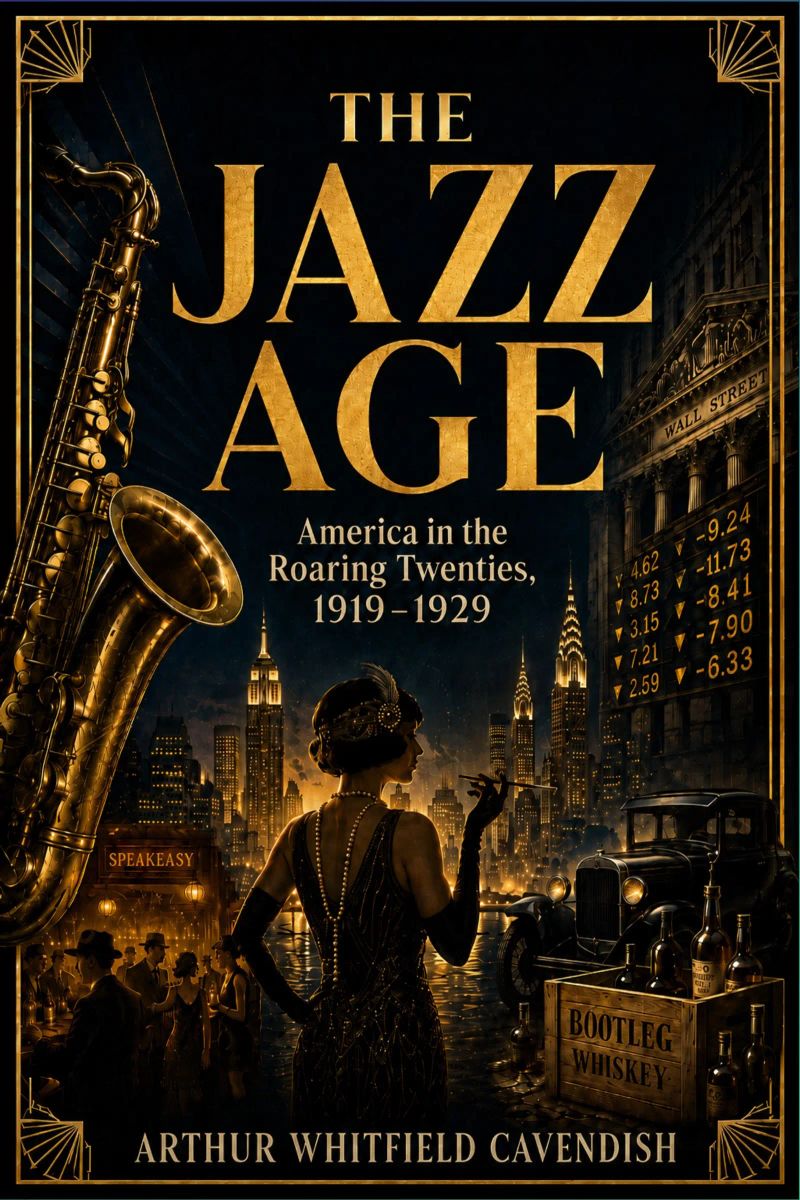
THE JAZZ AGE
America in the Roaring Twenties, 1919–1929By Arthur Whitfield Cavendish


Length6h 40m
About this audiobook
Roaring Twenties history — the Jazz Age, Harlem Renaissance, Prohibition, the 1929 stock market crash, and the complete narrative history of America in the 1920s, 1919-1929.
On the night of November 11, 1918, strangers embraced on Broadway and factory whistles blew across New York's boroughs as the Armistice ended the First World War. America had emerged as the world's dominant economic power — and then chose, emphatically, to turn inward. The decade that followed would be at once brilliant and ugly, creative and fearful, free and violently repressive. It was called, later and with some nostalgia, the Roaring Twenties. The roar was real. So was the silence underneath it.
This is the complete story of the Jazz Age — from the Red Summer of 1919, when race riots erupted in 26 cities and the Tulsa Race Massacre destroyed Black Wall Street, to Black Tuesday on October 29, 1929, when the Dow Jones fell and broker loan debt of $8.5 billion began its cascade collapse. Historian Arthur Whitfield Cavendish traces six parts across 24 chapters, following Warren Harding's Teapot Dome corruption, Al Capone's bootleg empire, Alain Locke's Harlem Renaissance, Charles Lindbergh's transatlantic flight, and Herbert Hoover's failed bid to halt the speculation that had pushed the Dow from 63.9 in 1921 to 381.17 in September 1929 — a 497% gain built on 10% margin accounts.
Inside this Roaring Twenties history:
The Red Summer and Tulsa Massacre — 26 race riots in 1919; white mobs and deputized gunmen burn 35 blocks of Greenwood, killing between 100 and 300 Black Tulsans, leaving 8,000 homeless (Chapters 1, 4)
Prohibition and organized crime — from the Noble Experiment's passage to Al Capone's $60-million Chicago operation, and the structural corruption that made Prohibition unenforceable (Chapter 3, 15)
The Harlem Renaissance — Philip Payton's Afro-American Realty Company fills Harlem; Alain Locke's 1925 anthology The New Negro names a movement; Langston Hughes, Zora Neale Hurston, and Duke Ellington build a culture (Chapter 9)
Radio, film, and the Model T — KDKA's 1920 election broadcast; David Sarnoff builds NBC; Al Jolson's 1927 Jazz Singer makes silent film obsolete; Ford's five-dollar day and 143,000 filling stations reshape American geography (Chapters 6, 7)
The stock market boom and crash — Goldman Sachs Trading Corporation falls from $104 to $1.75; Roger Babson's ignored September 1929 warning; Black Tuesday and the $8.5 billion call-money collapse (Chapters 8, 19-20)
The Scopes Trial and culture wars — fundamentalism versus modernism in Dayton, Tennessee, and the immigration restriction laws that closed the Golden Door (Chapters 12, 13)
The decade's honest reckoning — what the Ku Klux Klan's four-million-member revival, the Sacco-Vanzetti case, and the farmers' forgotten depression reveal about the America the mythology left out (Chapters 4, 14, 16)
The Jazz Age created the mass media, the consumer economy, and a racial reckoning that took another generation to reach. Its prosperity was real; its foundations were not. Understanding both is essential to understanding the America that followed.
For readers of Erik Larson's THE DEVIL IN THE WHITE CITY and Isabel Wilkerson's THE WARMTH OF OTHER SUNS.
Audiobook details
GenreHistory
Length6 hrs 40 mins
Narrated byListen with 1,000+ voices
FormateBook with Audio
Publish dateJun 2, 2026
LanguageEnglish
Table of contents
1Introduction
2Prologue: The Morning After the War
3PART ONE: THE NEW AMERICA (1919–1924)
4Chapter 1: The Red Summer — Race Violence and the Great Migration
5Chapter 2: Harding's America — Normalcy and Its Corruption
Show all chaptersShow less
6Chapter 3: Prohibition and the Bootleggers — The Noble Experiment's Dark Side
7Chapter 4: The Ku Klux Klan's Revival — White Supremacy Goes Mainstream
8PART TWO: PROSPERITY AND ITS DISCONTENTS (1921–1929)
9Chapter 5: Coolidge Prosperity — The Business of America
10Chapter 6: The Automobile Age — Ford, Highways, and the New Mobility
11Chapter 7: Radio and the Movies — Mass Culture and the Entertainment Revolution
12Chapter 8: The Stock Market Boom — Speculation and the Road to Disaster
13PART THREE: THE JAZZ AGE CULTURE (1920–1929)
14Chapter 9: The Harlem Renaissance — Black Art, Literature, and Music
15Chapter 10: The Lost Generation — American Writers in Exile
16Chapter 11: Flappers and the New Woman — Gender and Generational Change
17Chapter 12: Fundamentalism vs. Modernism — The Scopes Trial and the Culture War
18PART FOUR: AMERICA'S SHADOW SIDE (1919–1929)
19Chapter 13: Immigration Restriction — Closing the Golden Door
20Chapter 14: The Sacco-Vanzetti Case — Justice and Injustice in the Twenties
21Chapter 15: Organized Crime — Al Capone and the Prohibition Underworld
22Chapter 16: The Farmers' Decade — Rural America Left Behind
23PART FIVE: THE END OF THE PARTY (1927–1929)
24Chapter 17: Lindbergh's Flight — The Hero of the Jazz Age
25Chapter 18: The Election of 1928 — Hoover, Smith, and the Culture War
26Chapter 19: Black Tuesday — The Crash of 1929
27Chapter 20: Why the Crash — The Structural Weaknesses of the Twenties Economy
28PART SIX: LEGACIES
29Chapter 21: The Twenties in American Memory — Myth and Reality
30Chapter 22: What the Twenties Created — Lasting Cultural Innovations
31Chapter 23: The Twenties and Today — Parallels and Lessons
32Chapter 24: The Decade That Shaped Modern America
33Epilogue: The Party's End
34Acknowledgments
35Selected Bibliography
36About the Author
More from Arthur Whitfield Cavendish

A Brief History of IntelligenceMax S. Bennett12h 18m4.6 (6.6K)$29 · $0.00

The Gulag Archipelago Volume 3Aleksandr I. Solzhenitsyn21h 56m4.7 (8.9K)$46 · $0.00
Pearl of Great PriceJoseph Smith3h 8m4.7 (7.2K)$1.20 · $0.00

The Happiest Man on EarthEddie Jaku3h 48m4.6 (178K)$7 · $0.00

MotherlandJulia Ioffe17h 52m4.7 (2.5K)$40 · $0.00

Where Cowards Go to DieBenjamin Sledge8h 42m4.7 (351)$20 · $0.00

RevolutionariesSanjeev Sanyal11h 23m4.6 (2.6K)$29 · $0.00

We Crossed a Bridge and It TrembledWendy Pearlman6h4.6 (5.2K)$24 · $0.00

Unbroken Bonds of BattleJohnny Joey Jones8h 31m4.6 (2.6K)$8 · $0.00

The Daughter of AuschwitzTova Friedman, Malcolm Brabant7h 54m4.6 (16.7K)$26 · $0.00

Lily's PromiseLily Ebert, Dov Forman8h 54m4.6 (16.1K)$29 · $0.00

On Democracies and Death CultsDouglas Murray10h 38m4.6 (6.5K)$29 · $0.00

Across the RiverKent Babb11h 40m4.6 (927)$29 · $0.00

Balcony Over Jerusalem: A Middle East Memoir - Israel, Palestine and BeyondJohn Lyons12h 37m4.6 (1.4K)$33 · $0.00

BeyondStephen Walker15h 39m4.6 (3.2K)$33 · $0.00
Kings and PawnsHoward Bryant10h 9m4.6 (678)$29 · $0.00

No EscapeNury Turkel9h 30m4.6 (809)$28 · $0.00

Jubal Stone: U.S. Marshal: Blood Trail To Hell: A Western Adventure NovelCasey Nash3h 42m4.6 (3.2K)$18 · $0.00

Fall and RiseMitchell Zuckoff17h 23m4.6 (9.8K)$40 · $0.00

The SurvivorJosef Lewkowicz, Michael Calvin9h 22m4.6 (2.5K)$29 · $0.00
You may also like
The Collected WorksThomas Paine78h 17m4.3 (1.8K)$2 · $0.00
A Brief History of EqualityThomas Piketty8h 44m4.2 (4.1K)$20 · $0.00

The Age of ReasonThomas Paine6h 53m4.1 (38.4K)$1.20 · $0.00
Proposed Roads to FreedomBertrand Russell5h 53m4.1 (1.1K)$1.99 · $0.00

Leo Tolstoy: A Letter to a HinduLeo Tolstoy, M. K. Gandhi3h 24m4.0 (1.4K)$1 · $0.00

The Knowledge of the Holy (Annotated)A. W. Tozer5h 17m4.5 (12.3K)$2 · $0.00

Together We RiseThe Women's March Organizers, Condé Nast5h 50m4.3 (833)$24 · $0.00
The Invention of ScienceDavid Wootton22h 3m4.0 (2K)$30

The State and RevolutionVladimir lenin4h 10m4.3 (19.8K)$4 · $0.00

Too Much GlueJason Lefebvre5m4.3 (2.3K)$5 · $0.00
The Social Principles of Jesus (Summarized Edition)Walter Rauschenbusch2h 46m4.2 (102)$1

The Greatest Works of Jane Addams (Annotated)Jane Addams26h 18m4.5 (28)$1.99 · $0.00
JOHN STUART MILL - Ultimate Collection: Works on Philosophy, Politics & Economy (Including Memoirs & Essays) (Annotated)John Stuart Mill139h 17m4.5 (22)$1.99 · $0.00

William MorrisArthur Clutton-Brock5h 53m3.9 (43)$18 · $0.00
The Abolition Of Slavery The Right Of The Government Under The War PowerVarious56m3.3 (16)$2 · $0.00
Constitution of the Commonwealth of Massachusetts (1780) (Annotated)Samuel Adams, John Adams, James Bowdoin4h 5m$1.99 · $0.00

Third State of the Union AddressBenjamin Harrison1h 49m$1 · $0.00

The Essential Faith of the Universal Church; Deduced from the Sacred RecordsHarriet Martineau4h 29m$2 · $0.00

Christianity Unveiledbaron d' Paul Henri Thiry Holbach5h 10m4.3 (51)$1 · $0.00
American RevolutionCharles Howard McIlwain5h 16m3.6 (17)$1.99 · $0.00