
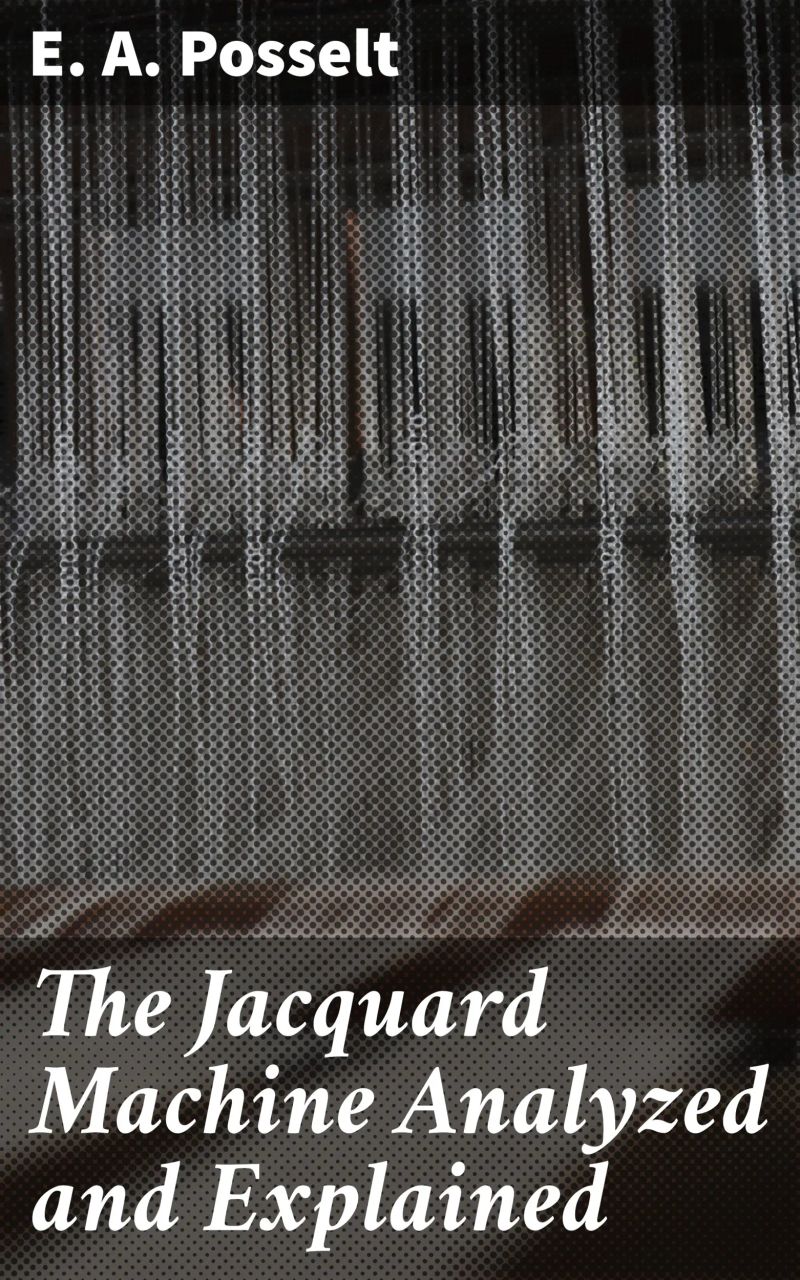
The Jacquard Machine Analyzed and Explained
With an appendix on the preparation of jacquard cards, and practical hints to learners of jacquard designingBy E. A. Posselt


Length3h 37m
About this audiobook
In "The Jacquard Machine Analyzed and Explained," E. A. Posselt delves into the intricate workings of the Jacquard loom, a pivotal invention in the history of textile manufacturing. Posselt employs a meticulous and didactic literary style, seamlessly intertwining technical analysis with accessible explanations suitable for both scholars and industry practitioners. The text situates the Jacquard machine within the broader context of the Industrial Revolution, exploring its impact on labor, design, and the genesis of modern computing through the use of punched cards, thus elucidating its significance beyond mere fabric production. E. A. Posselt, an engineer and educator with a profound commitment to the advancement of textile technology, draws from his extensive expertise and background in mechanics to craft this comprehensive exploration. His passion for both teaching and the intricacies of weaving technology is evident, fostering an appreciation for the machine's innovation. Posselt'Äôs work not only serves as an academic resource but also reflects his own journey through the evolving landscape of mechanical engineering and textile manufacturing. This book is highly recommended for anyone interested in the intersections of technology and art, engineering students, historians of industry, or textile enthusiasts seeking to understand the profound implications of the Jacquard machine. Posselt'Äôs insightful analysis is a critical addition to the discourse on technological evolution and its relentless march forward.
Audiobook details
GenreTechnology
Length3 hrs 37 mins
Narrated byListen with 1,000+ voices
FormateBook with Audio
Publish dateDec 5, 2019
LanguageEnglish
Table of contents
1PREFACE.
2HISTORY OF The Jacquard Machine.
3The Jacquard Machine.—General Arrangement and Application.
4Illustrations of the Different Parts of the Jacquard Machine.—Method of Operation, etc.
5THE FRAME.
Show all chaptersShow less
6THE PERFORATED BOARD.
7THE PLUNGER.
8THE CATCHES.
9THE GRIFFE.
10THE HOOK.
11THE NEEDLE.
12THE BATTEN MOTION.
13THE CYLINDER.
14THE HAMMER.
15THE NEEDLE-BOARD.
16THE JACQUARD CARDS.
17THE JACQUARD HARNESS.
18The Comber-board and Methods of Figuring for it.
19Comber-boards Made of a Solid Piece of Material.
20The Changing of Solid Comber-boards for Different Textures.
21Comber-boards made in Strips and Adjusted afterwards in a Frame.
22Divisions of the Comber-board.
23Heddles for the Jacquard Harness.
24The “Leasing” of the Harness.
25TYING-UP OF JACQUARD HARNESS.
261. The Straight-Through Tie-up.
271st. The Jacquard Harness threaded on the machine in the direction from Front to Rear.
282d. The Jacquard Harness threaded on the machine from Rear to Front.
293d. The Straight-Through Tie-up on the English System.
30II. Straight-Through Tie-up for Repeated Effects, in one Repeat of the Design.
31III. Straight-Through Tie-up of a Jacquard Loom having Front Harness Attached.
32IV. The Centre Tie-up.
33V. “Straight-Through” and “Point” Tie-ups Combined.
34Straight-Through and Point Tie-ups Combined.
35Straight-Through and Point Tie-ups Combined.
36Straight-Through and Point Tie-ups Combined.
37Straight-Through and Point Tie-ups Combined.
38VI. The Straight-Through Tie-up in Two Sections.
39A.—Using machine and comber-board in two equal sections.
40B. Using two machines and a comber-board having equal sections.
41C.—Using one machine and one comber-board: the machine unequally divided and the comber-board equally divided.
42VII. Tying-up a Jacquard Harness for Figuring Part of the Design with an Extra Warp, (part for Two Sections, part for Single).
43VIII. The Straight-Through Tie-up in Three Sections.
44IX. The Point Tie-up in Three Sections.
45X. Combination Tie-up in Two Sections. (“Tie-up Amalgamate.”)
46XI. The Straight-Through Tie-up in Four Sections.
47XII. Tying-up of Jacquard Looms with Compound Harness attached.
48The Kind of Heddles Required for Compound Harness.
49Working the Compound Harness by a Separate Machine.
50Number of Compound Harness to Use.
Hands of TimeRebecca Struthers8h 8m4.4 (1.3K)$26 · $0.00

Never Lost AgainBill Kilday10h 1m4.4 (805)$29 · $0.00

How the Internet HappenedBrian McCullough13h 28m4.3 (2.7K)$23 · $0.00

Collected Writings of Nikola TeslaNikola Tesla, Thomas Commerford Martin21h 50m4.3 (1.7K)$1 · $0.00

Just AspireAjai Chowdhry9h 13m4.4 (260)$29 · $0.00

The Little Book of AliensAdam Frank8h 20m4.3 (1.3K)$26 · $0.00
The inventions, researches and writings of Nikola Tesla (Annotated)Thomas Commerford Martin16h 59m4.3 (1.3K)$2 · $0.00

KargilV.P. Malik15h 18m4.3 (2K)$24 · $0.00

Experiments with Alternating CurrentsNikola Tesla9h 16m4.3 (874)$1.99 · $0.00

Fire on the HorizonTom Shroder, John Konrad8h 23m4.3 (858)$26 · $0.00

The Smell of Kerosene (Annotated)National Aeronautics and Space Administration, Donald L. Mallick, Peter W. Merlin11h 32m4.3 (523)$2 · $0.00

The Boy Who Harnessed the WindWilliam Kamkwamba, Bryan Mealer10h 5m4.2 (78.9K)$29 · $0.00

Across the Airless WildsEarl Swift10h 8m4.3 (1.3K)$29 · $0.00

Console WarsBlake J. Harris20h 41m4.2 (13.7K)$46 · $0.00

Improvised Munitions HandbookU.S. Department of Defense4h 49m4.3 (1.6K)$0.99 · $0.00

Escaping GravityLori Garver10h 54m4.2 (2.2K)$20 · $0.00

Wireless WarsJonathan Pelson8h 2m4.3 (418)$20 · $0.00

Let There Be WaterSeth M. Siegel8h 36m4.2 (2.3K)$20 · $0.00

The PerfectionistsSimon Winchester11h 46m4.2 (9.9K)$29 · $0.00

Rethinking NarcissismDr. Craig Malkin6h 7m4.2 (3.4K)$24 · $0.00
You may also like
Hollywood: The Oral HistoryJeanine Basinger, Sam Wasson28h 50m4.2 (1.5K)$53 · $0.00
Metaphysics (Annotated)Aristotle13h 30m4.6 (1.2K)$2 · $0.00

Scientists of Sound, Vol. 1Jake Brown4h 43m3.4 (12)$15
NonesuchBill Brown Jr.13m$1

Serenade no. 4Bill Brown Jr.1h 22m$10

In My Life – Fingerstyle SoloBill Brown Jr.28m$2

German for BeginnersTomas Dvoracek27h 22m2.0 (1)$18 · $0.00

The printers, stationers and bookbinders of Westminster and London from 1476 to 1535E. Gordon Duff8h 23m$1 · $0.00

Hindi Made Easy - Lower beginner - Volume 1 of 3Unknown Author5h 17m$18

Rapid Mandarin, Vols. 1 & 2Earworms Learning2h 26m$20

Mandarin Made Easy - Lower beginner - Volume 1 of 3Unknown Author5h 16m$18

The Hotel St. Francis Cook Book (Annotated)Victor Hirtzler25h 38m3.8 (30)$2 · $0.00
On the Execution of Music, and Principally of Ancient MusicCamille Saint-Saëns34m$2 · $0.00

Vietnamese Made Easy - Lower beginner - Volume 1 of 3Unknown Author6h 2m$18

Waltz in Bm Op. 18 no. 6 (Schubert)Bill Brown Jr.46m$5
Cat Whiskers and Talking FurnitureJohn Rayburn12h 29m$23

Bell's Cathedrals: The Priory Church of St. Bartholomew-the-Great, SmithfieldGeorge Worley38m$2 · $0.00
Lectures on Bible RevisionSamuel Newth7h 37m$2 · $0.00

A Week's Tramp in Dickens-LandWilliam R. Hughes6h 35m$2 · $0.00
The Gourmet's Guide to LondonLieut.-Col. Newnham-Davis11h 16m3.9 (16)$1 · $0.00