
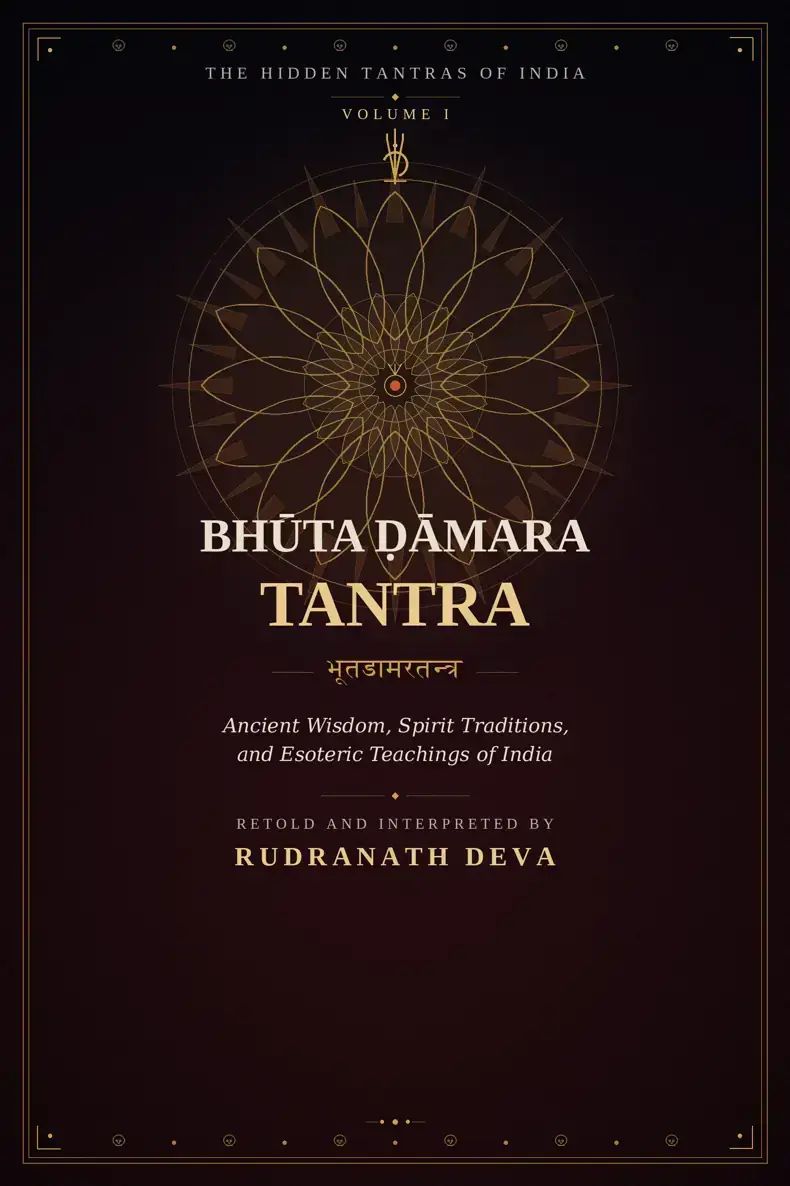
The Hidden Tantras of India - Volume I - Bhuta Damara Tantra
By Rudranath Deva


Length3h 38m
About this audiobook
The Hidden Tantras of India — Volume I: Bhuta Damara Tantra
Step into one of the most enigmatic corners of the Indian tantric tradition. The Bhuta Damara Tantra, literally "the tantra that subdues spirits," is an ancient text attributed to the fierce, world taming form of Shiva. It offers rituals, mantras, and esoteric practices for commanding spirits, overcoming obstacles, and harnessing occult power.
Long overshadowed by more widely translated Shaiva and Shakta tantras, this text has survived mostly in fragments and untranslated manuscripts, feared by some and revered by others. Volume I of this series brings the forgotten scripture into the light, offering translation and commentary alongside historical context and ritual explanation for the modern reader.
This is not a sanitized retelling but an invitation into the raw world of Indian occult tantra, where power is never free of consequence.
Audiobook details
GenreSpirituality and Religion
Length3 hrs 38 mins
Narrated byListen with 1,000+ voices
FormateBook with Audio
Publish dateAug 17, 2026
LanguageEnglish
Table of contents
1Introduction
2Disclaimer
3Foreword by the Translator
4A Note on This Edition and Its Sanskrit
5A Brief Guide to Sanskrit Pronunciation
Show all chaptersShow less
6The Sixteen Petals at a Glance
7Introduction: The World of the Bhuta Damara Tantra
8Tantra Before the Tantras: Roots in Earlier Indian Religion
9Kashmir and the Bhairava Traditions
10How the Text Has Survived: Manuscripts and Modern Editions
11Reputation, Controversy, and How to Read This Material Responsibly
12What Is a Tantra?
13The Name Bhuta Damara
14Bhairava and Bhairavi: The Frame of Revelation
15A World Full of Beings
16A Short Chronology of Tantric Literature in India
17How This Book Is Organized
18Prologue: On the Mountain Beyond Geography
19Chapter 1
20The First Petal: The Dialogue of Bhairava and Bhairavi
21Traditional Iconography
22Teachings of This Patala
23Commentary and Context
24Symbolism for the Modern Reader
25Chapter 2
26The Second Petal: Subjugation, Alchemy, and the Attainment of Gems
27Traditional Iconography
28Teachings of This Patala
29Commentary and Context
30Symbolism for the Modern Reader
31Chapter 3
32The Third Petal: The Practice of Sundari
33Traditional Iconography
34Teachings of This Patala
35Commentary and Context
36Symbolism for the Modern Reader
37Chapter 4
38The Fourth Petal: Pishachini and Chetika, the Spirit Attendants
39Traditional Iconography
40Teachings of This Patala
41Commentary and Context
42Symbolism for the Modern Reader
43Chapter 5
44The Fifth Petal: The Eightfold Katyayani
45Traditional Iconography
46Teachings of This Patala
47Commentary and Context
48Symbolism for the Modern Reader
49Chapter 6
50The Sixth Petal: The Wrathful Lord of the Pramathas
Series

The Holy Qur-an: Text, Translation and CommentaryAbdullah Yusuf Ali22h 16m4.7 (133K)$1 · $0.00

All of Grace (Annotated)Charles Spurgeon5h 1m4.7 (1.3K)$0.99 · $0.00

Steps to ChristEllen G. White3h 12m4.7 (13.8K)$2 · $0.00

The Doctrine and Selected CovenantsJoseph Smith13h 53m4.7 (10.4K)$1.99 · $0.00

Sinners in the Hands of an Angry God & Other Sermons (Annotated)Jonathan Edwards7h 51m4.7 (1.5K)$2 · $0.00

Swayam Ki AwaazPrem Rawat8h 34m4.7 (1.1K)$26 · $0.00

Behind the BadgeAdam Davis10h 18m4.7 (2.7K)$10 · $0.00

The New Human Revolution, vol. 1Daisaku Ikeda7h 46m4.7 (669)$12 · $0.00

You Are Worth ItKyle Carpenter, Don Yaeger8h 53m4.7 (4.8K)$29 · $0.00

Praying GraceDavid A. Holland3h 2m4.7 (658)$10 · $0.00

Evidence Not SeenDarlene Deibler Rose11h 11m4.6 (11.9K)$29 · $0.00

The Christ KeyChad Bird, Chad Bird7h 33m4.7 (592)$17.40 · $0.00

He and IGabrielle Bossis10h 12m4.7 (554)$17 · $0.00

Your Body Already KnowsNidhi Pandya Bhanshali9h 7m4.7 (360)$16 · $0.00

The Complete WorksFlorence Scovel Shinn7h 59m4.6 (6.6K)$2 · $0.00

Driven by EternityJohn Bevere3h 50m4.6 (3.2K)$10 · $0.00

Spiritual AnatomyDaaji Kamlesh D. Patel9h 47m4.7 (319)$29 · $0.00

The Mahabharata of Krishna-Dwaipayana Vyasa Translated into English ProseAnonymous8h 1m4.7 (1.9K)$2 · $0.00

The Chosen Book OneAmanda Jenkins, Kristen Hendricks, Dallas Jenkins3h 8m4.6 (4.9K)$10 · $0.00

The Grace MessageAndrew Farley8h 49m4.7 (433)$20 · $0.00
You may also like
The Corpus HermeticumG. R. S. Mead3h 34m4.3 (1.7K)$4.10 · $0.00

The Corpus HermeticumG. R.3h 34m4.3 (2K)$3.50 · $0.00
The Grand Grimoire with the Great Clavicle of SolomonUnknown Unknown1h 26m4.2 (628)$3.50 · $0.00
The Corpus HermeticumGeorge Robert Stowe Mead3h 34m4.3 (2K)$11 · $0.00

Christmas in Ritual and TraditionClement A. Miles13h 21m4.1 (286)$1 · $0.00

Myths and Legends of Ancient Greece and Rome E. M. Berens11h 1m3.9 (3.4K)Free

The Kabbalah Unveiled (Annotated)S. L. MacGregor Mathers12h 49m4.1 (997)$0.99 · $0.00
Iamblichus on the mysteries of the Egyptians, Chaldeans, and AssyriansIamblichus7h 1m4.1 (368)$1 · $0.00

The Book of Hallowe'en – Origin, Practices & Beliefs (Illustrated Edition) (Annotated)Ruth Edna Kelley3h 37m4.0 (1.8K)$2 · $0.00

The Blue EquinoxAleister Crowley10h 22m4.3 (434)$0.99 · $0.00

Bantu Beliefs and Magic (Annotated)C. W. Hobley10h 30m$2 · $0.00

The Eternal Belief in Immortality & Worship of the DeadJames George Frazer37h 7m4.1 (28)$1.99 · $0.00

The Belief in Immortality and the Worship of the DeadJames George Frazer40h 49m4.2 (38)$2 · $0.00

Serbian Fairy Tales – Folklore & Mystique of the BalkansVarious5h 49m$0.99 · $0.00

Collectanea Hermetica (Volumes 1-10) (Annotated)William Wynn Westcott18h 29m4.5 (30)$2 · $0.00

Folk LoreJames Napier5h 55m3.8 (46)$2 · $0.00

The Chinese DragonL. Newton Hayes1h 15m4.1 (30)$2.30

Egyptian MythologyLewis Spence10h 51m4.0 (682)$1 · $0.00

Latin-American Mythology (Illustrated Edition) (Annotated)Hartley Burr Alexander13h 31m4.0 (11)$3 · $0.00

The lesser Key of Solomon, Goetia, The Book of Evil SpiritsL.W De Laurence2h 4m4.0 (197)Free