
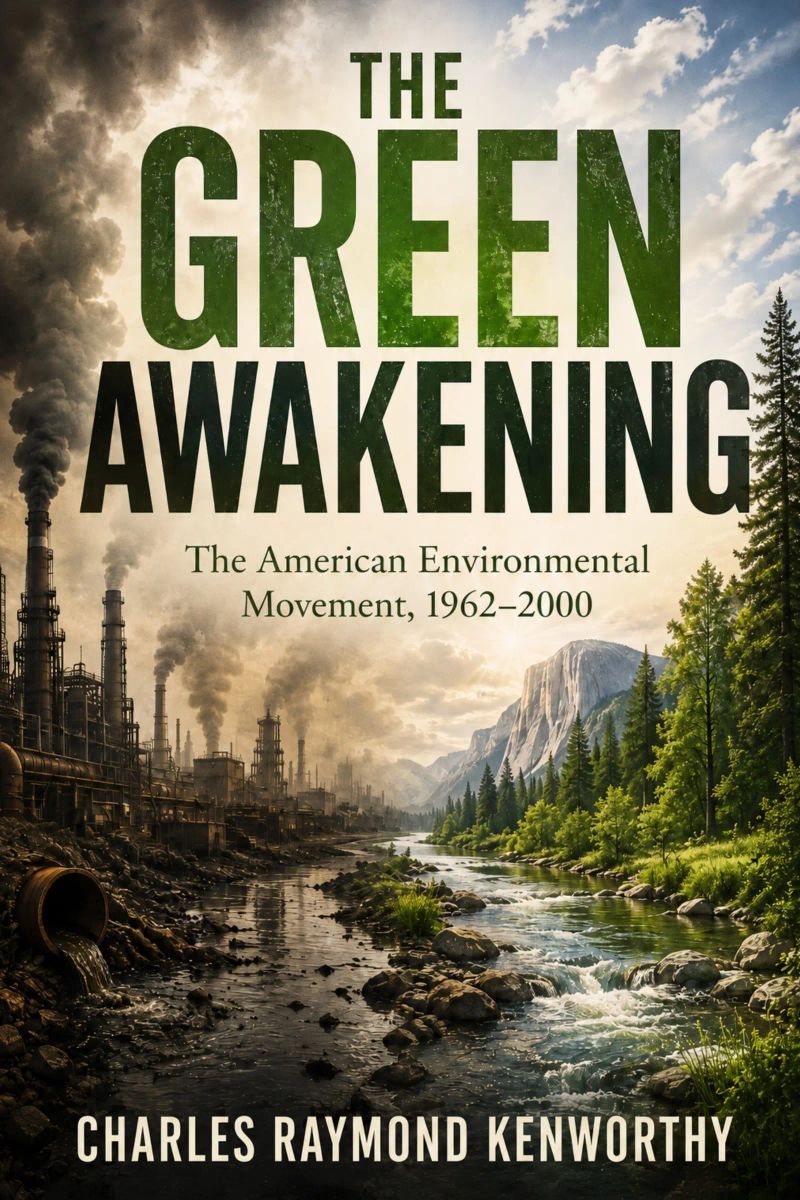
THE GREEN AWAKENING
The American Environmental Movement, 1962-2000By Charles Raymond Kenworthy

Length5h 56m
About this audiobook
The complete narrative history of the American environmental movement — Rachel Carson, Earth Day, the Clean Air Act, and the unfinished fight to protect the natural world, 1962-2000.
On June 22, 1969, a stretch of the Cuyahoga River in Cleveland caught fire. Oil and chemical waste had accumulated on the surface so thickly that a spark from a passing train ignited it. The fire burned for thirty minutes. It was not even the worst fire in the river's history — but it was the one a nation finally saw, and what it saw could not be unseen. Within a year, twenty million Americans took to the streets on Earth Day. Within four years, the EPA, the Clean Air Act, the Clean Water Act, and the Endangered Species Act had been signed into law.
This is the story of how Rachel Carson, David Brower, Gaylord Nelson, Lois Gibbs, Denis Hayes, and the organizers of Earth Day 1970 built the modern environmental movement. Across twenty-four chapters in six parts, historian Charles Raymond Kenworthy traces the full arc of American environmentalism from Silent Spring's publication in September 1962 — when Carson submitted her manuscript knowing she was dying of breast cancer — through the climate reckoning of the late twentieth century and the unfinished work it left behind.
Inside this environmental history book:
• Rachel Carson and Silent Spring — how a marine biologist's four-year investigation into DDT and biomagnification sparked a movement; the bald eagle's recovery from fewer than 500 nesting pairs to nearly 10,000 after the 1972 ban (Chapter 1)
• The Wilderness Act of 1964 — Howard Zahniser's eight-year, sixty-six-draft campaign for the phrase "untrammeled by man," signed four months after Zahniser's death; today 112 million acres protected across 44 states (Chapter 2)
• Earth Day 1970 — twenty million Americans in the streets; Senator Gaylord Nelson's strategy; Denis Hayes's decentralized organizing; Nixon signing the Clean Air Act eight months later (Chapter 4)
• Love Canal and the Superfund law — Lois Gibbs, a homemaker who had never been politically active, organizing the families of Niagara Falls to force a federal response to buried chemical waste (Chapter 14)
• The Endangered Species Act — the snail darter and the Tellico Dam; the spotted owl wars; wolf reintroduction to Yellowstone triggering a trophic cascade that transformed the entire ecosystem (Chapter 8)
• The Exxon Valdez spill — oil-soaked seabirds on Alaskan beaches, corporate accountability, and the public outrage that reshaped federal spill liability law (Chapter 16)
• The honest limits — the Reagan EPA rollback, Anne Gorsuch's resignation, and the manufactured-uncertainty playbook industries used to delay lead regulation for decades (Chapters 21-22)
The environmentalists of this era left institutions that still govern American air, water, and land — but also the question Carson posed in 1962: can industrial civilization live within the natural world rather than dominate it? The Cuyahoga supports recreational fishing. The bald eagle soars. Climate change now answers her question with urgency she could not have imagined.
For readers of Bill Bryson's A WALK IN THE WOODS and Michael Pollan's THE OMNIVORE'S DILEMMA.
Audiobook details
GenreHistory, Science and Nature
Length5 hrs 56 mins
Narrated byListen with 1,000+ voices
FormateBook with Audio
Publish dateJun 2, 2026
LanguageEnglish
Table of contents
1Introduction
2Prologue: A Silent Spring
3PART ONE: THE BIRTH OF MODERN ENVIRONMENTALISM (1962-1970)
4Chapter 1: Rachel Carson and Silent Spring — The Book That Started a Movement
5Chapter 2: The Wilderness Act — Congress Protects What the Market Cannot
Show all chaptersShow less
6Chapter 3: The Cuyahoga Burns — Pollution, Industry, and the Public's Awakening
7Chapter 4: Earth Day 1970 — Twenty Million Americans Take to the Streets
8PART TWO: THE LEGISLATIVE REVOLUTION (1970-1980)
9Chapter 5: The EPA — Creating a Federal Environmental Agency
10Chapter 6: The Clean Air Act — Setting Standards for What Americans Breathe
11Chapter 7: The Clean Water Act — The Right to Fishable and Swimmable Waters
12Chapter 8: The Endangered Species Act — Legal Protection for the Non-Human World
13PART THREE: THE RISE OF ENVIRONMENTAL ORGANIZATIONS
14Chapter 9: The Sierra Club — From Hiking Club to Political Force
15Chapter 10: The Environmental Defense Fund — Lawyers, Scientists, and Legal Activism
16Chapter 11: Greenpeace — Direct Action and the Global Environmental Movement
17Chapter 12: Earth First — Radical Environmentalism and Eco-Sabotage
18PART FOUR: BATTLES AND VICTORIES
19Chapter 13: The Fight for the Grand Canyon — Tourism, Dams, and the Conservation Victory
20Chapter 14: Love Canal — Toxic Waste, Homeowners, and the Superfund Law
21Chapter 15: The Spotted Owl Wars — Old Growth Forests and the Timber Economy
22Chapter 16: The Exxon Valdez — Oil Spills, Corporate Responsibility, and Public Outrage
23PART FIVE: PEOPLE AND IDEAS
24Chapter 17: Rachel Carson — Science, Courage, and the Power of One Book
25Chapter 18: David Brower — The Archdruid and the Limits of Compromise
26Chapter 19: Lois Gibbs — Love Canal, Community Organizing, and Environmental Justice
27Chapter 20: Environmental Justice — Race, Poverty, and the Geography of Pollution
28PART SIX: LEGACIES
29Chapter 21: The Backlash — Property Rights, Wise Use, and the Anti-Environmental Movement
30Chapter 22: Climate Change — From Environmental Issue to Civilizational Challenge
31Chapter 23: International Environmentalism — Rio, Kyoto, and Global Environmental Governance
32Chapter 24: The Green Economy — Environmentalism and the Market
33Epilogue: The Unfinished Work
34Acknowledgments
35Selected Bibliography
36About the Author
More from Charles Raymond Kenworthy

A Brief History of IntelligenceMax S. Bennett12h 18m4.6 (6.6K)$29 · $0.00

Black AF HistoryMichael Harriot15h 43m4.7 (14.6K)$33 · $0.00

The Gulag Archipelago Volume 3Aleksandr I. Solzhenitsyn21h 56m4.7 (8.9K)$46 · $0.00

Pearl of Great PriceJoseph Smith3h 8m4.7 (7.2K)$1.20 · $0.00

The Happiest Man on EarthEddie Jaku3h 48m4.6 (178K)$7 · $0.00

MotherlandJulia Ioffe17h 52m4.7 (2.5K)$40 · $0.00

Where Cowards Go to DieBenjamin Sledge8h 42m4.7 (351)$20 · $0.00

RevolutionariesSanjeev Sanyal11h 23m4.6 (2.6K)$29 · $0.00

We Crossed a Bridge and It TrembledWendy Pearlman6h4.6 (5.2K)$24 · $0.00

Unbroken Bonds of BattleJohnny Joey Jones8h 31m4.6 (2.6K)$8 · $0.00

The Daughter of AuschwitzTova Friedman, Malcolm Brabant7h 54m4.6 (16.7K)$26 · $0.00

Lily's PromiseLily Ebert, Dov Forman8h 54m4.6 (16.1K)$29 · $0.00

On Democracies and Death CultsDouglas Murray10h 38m4.6 (6.5K)$29 · $0.00

Across the RiverKent Babb11h 40m4.6 (927)$29 · $0.00

Balcony Over Jerusalem: A Middle East Memoir - Israel, Palestine and BeyondJohn Lyons12h 37m4.6 (1.4K)$33 · $0.00

BeyondStephen Walker15h 39m4.6 (3.2K)$33 · $0.00
Kings and PawnsHoward Bryant10h 9m4.6 (678)$29 · $0.00

No EscapeNury Turkel9h 30m4.6 (809)$28 · $0.00
Jubal Stone: U.S. Marshal: Blood Trail To Hell: A Western Adventure NovelCasey Nash3h 42m4.6 (3.2K)$18 · $0.00

Fall and RiseMitchell Zuckoff17h 23m4.6 (9.8K)$40 · $0.00
A Brief History of IntelligenceMax S. Bennett12h 18m4.6 (6.6K)$29 · $0.00
The Story of BirdsSteve Brusatte11h 49m4.6 (401)$29 · $0.00

Life On Earth 40th Anniversary EditionSir David Attenborough12h 27m4.6 (6.5K)$29 · $0.00
BeyondStephen Walker15h 39m4.6 (3.2K)$33 · $0.00

LiftoffEric Berger9h 4m4.6 (9.5K)$29 · $0.00
Black Earth WisdomLeah Penniman11h 54m4.6 (577)$8 · $0.00

Total Cat MojoJackson Galaxy10h 13m4.5 (8.4K)$23 · $0.00

My Life Among the UnderdogsTia Torres5h 51m4.5 (4K)$24 · $0.00

What It Takes to Save a LifeKwane Stewart6h4.6 (556)$24 · $0.00

Pastoral SongJames Rebanks8h 35m4.5 (12K)$26 · $0.00

How Stella Learned to TalkChristina Hunger7h4.5 (10.9K)$24 · $0.00

Craig & FredCraig Grossi8h 6m4.5 (9.6K)$26 · $0.00

Celebrating BirdsNatalia Rojas, Ana Maria Martinez6h 47m4.6 (330)$24 · $0.00

Saving JemimaJulie Zickefoose4h 59m4.5 (749)$20 · $0.00

Will's Red CoatTom Ryan8h 23m4.5 (2.3K)$26 · $0.00

Of Time and TurtlesSy Montgomery10h 34m4.5 (5K)$29 · $0.00
THE WOLF TRILOGY: Call of the Wild, White Fang & The Son of the WolfJack London17h 31m4.5 (2.4K)$1.99 · $0.00

Zen and the Art of Saving the PlanetThich Nhat Hanh9h 20m4.5 (3.9K)$29 · $0.00

BLACK BEAUTY (With Original Illustrations)Anna Sewell7h 31m4.5 (1.3K)$1.99 · $0.00

Bottle of LiesKatherine Eban14h 25m4.4 (12K)$33 · $0.00
You may also like

Sacred CowDiana Rodgers RD, Robb Wolf8h 28m4.4 (4.3K)$20
Hippie FoodJonathan Kauffman9h 13m4.1 (1.4K)$29 · $0.00
On the Social ContractJean-Jacques Rousseau5h 2m4.0 (69.6K)$14
The Art of Not Being GovernedJames C. Scott17h 34m4.3 (2.9K)$30
Civil Disobedience and Other Essays on Conscience and FreedomHenry David Thoreau3h 9m4.2 (20.4K)$4.99 · $0.00

A Book Forged in HellSteven Nadler9h 17m4.2 (1.4K)$20

The SlipPrudence Peiffer11h 9m4.3 (577)$29 · $0.00

The PatchChris Turner14h 1m4.3 (260)$23 · $0.00

AntarcticaKim Stanley Robinson19h 10m3.8 (4.2K)$30

The Politically Incorrect Guide to American HistoryWoods, Thomas E.8h 49m4.0 (4K)Free

The Painted WordTom Wolfe2h 6m3.9 (9.1K)$10

The Rebel’s ApothecaryJenny Sansouci7h 47m4.5 (546)$17

The world of Realism unveiledHenri Hymans1h 17m$13 · $0.00
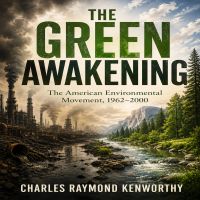
THE GREEN AWAKENINGCharles Raymond Kenworthy5h 14m$10 · $0.00

Norwegian LifeVarious7h 2m$2 · $0.00

Proportional Representation: A Study in Methods of ElectionJohn H. Humphreys11h 53m$2 · $0.00

Business-Englisch lernen Audio - Agiles ProjektmanagementSpotlight Verlag1h 13m$19

The History of Philippine IslandsJoaquín Martínez de Zúñiga11h 55m4.1 (16)$1.99 · $0.00

SpainWentworth Webster5h 34m$2 · $0.00

Antoni GaudíJeremy Roe4h 59m4.1 (27)$18 · $0.00