
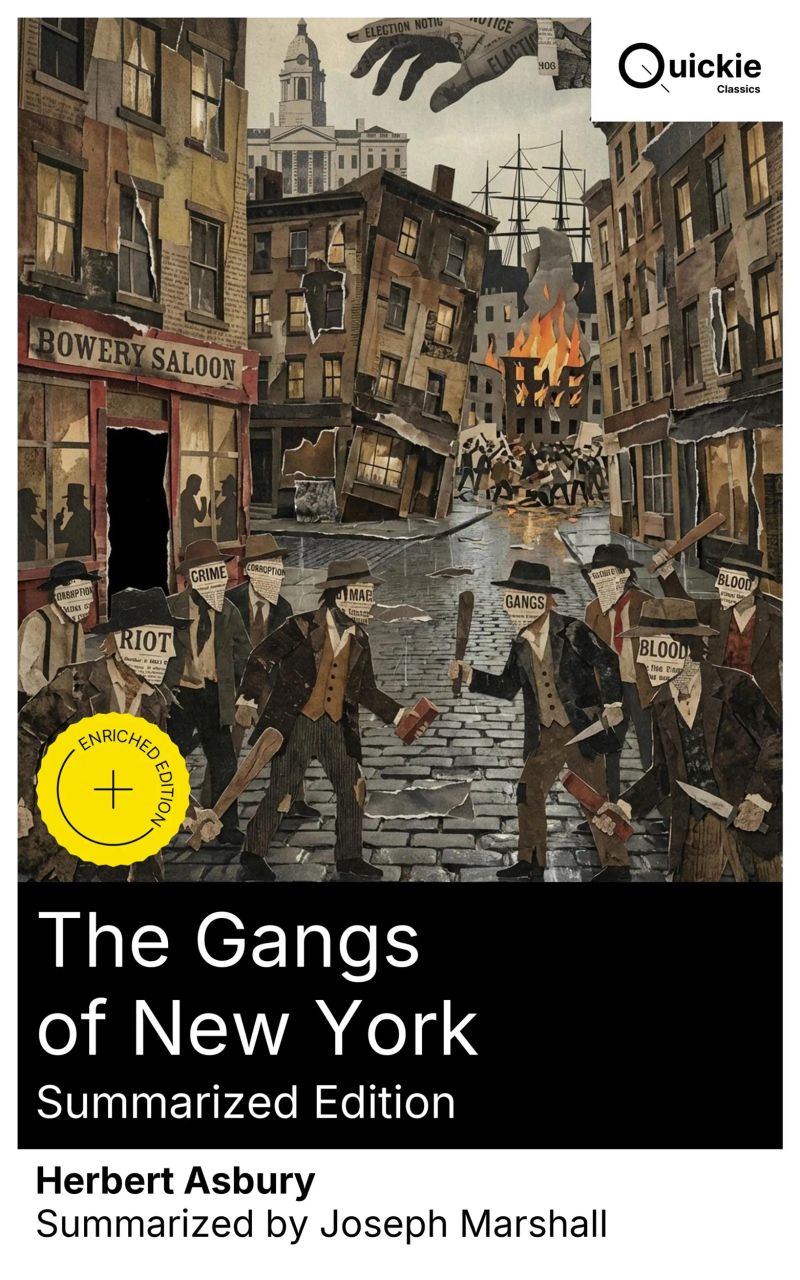
The Gangs of New York (Summarized Edition)
Enriched edition. An informal history of 19th‑century New York City's underworld: Bowery saloons, violent gangs, Tammany Hall, and corrupt politicsBy Herbert Asbury


Length3h 5m
About this audiobook
The Gangs of New York charts nineteenth‑century Manhattan's underworld, from Five Points to the Bowery, profiling the Dead Rabbits, Plug Uglies, river pirates, and ward heelers in the orbit of Tammany Hall. Episodic and vivid, it braids court reports and newspaper lore into a picaresque history that peaks with the 1863 Draft Riots. Asbury's tabloid‑tinted yet controlled prose situates the book between dime‑novel swagger and emerging social history. Missouri‑born and long a New York reporter, Herbert Asbury mined police reminiscences, broadsides, and morgue files, privileging atmosphere over footnotes. Writing amid Jazz Age nostalgia for a rougher city, he sought to preserve the folklore of crime and politics before it vanished. His wider portraits of vice districts nationwide confirm a preoccupation with the junction of poverty, spectacle, and power. Recommend it to readers of urban history and true crime who relish narrative drive informed by research. Best read alongside modern scholarship for verification, the book remains unsurpassed for texture, incident, and civic anatomy. Students of American politics, social history, or even Scorsese's film adaptation will find Asbury's panorama unsettling, propulsive, and unexpectedly instructive.
Quickie Classics summarizes timeless works with precision, preserving the author's voice and keeping the prose clear, fast, and readable—distilled, never diluted. Enriched Edition extras: Introduction · Synopsis · Historical Context · Brief Analysis · 4 Reflection Q&As · Editorial Footnotes.
Audiobook details
GenreHistory
Length3 hrs 5 mins
Narrated byListen with 1,000+ voices
FormateBook with Audio
Publish dateJan 10, 2026
LanguageEnglish
Table of contents
1Introduction
5The Gangs of New York
2Introduction
6Analysis
3Synopsis
7Reflection
4Historical Context

A Brief History of IntelligenceMax S. Bennett12h 18m4.6 (6.6K)$29 · $0.00
RevolutionariesSanjeev Sanyal11h 23m4.6 (2.6K)$29 · $0.00

We Crossed a Bridge and It TrembledWendy Pearlman6h4.6 (5.2K)$24 · $0.00

Unbroken Bonds of BattleJohnny Joey Jones8h 31m4.6 (2.6K)$8 · $0.00

The Daughter of AuschwitzTova Friedman, Malcolm Brabant7h 54m4.6 (16.7K)$26 · $0.00

Lily's PromiseLily Ebert, Dov Forman8h 54m4.6 (16.1K)$29 · $0.00
On Democracies and Death CultsDouglas Murray10h 38m4.6 (6.5K)$29 · $0.00

Across the RiverKent Babb11h 40m4.6 (927)$29 · $0.00

Balcony Over Jerusalem: A Middle East Memoir - Israel, Palestine and BeyondJohn Lyons12h 37m4.6 (1.4K)$33 · $0.00

BeyondStephen Walker15h 39m4.6 (3.2K)$33 · $0.00
Kings and PawnsHoward Bryant10h 9m4.6 (678)$29 · $0.00

No EscapeNury Turkel9h 30m4.6 (809)$28 · $0.00

Jubal Stone: U.S. Marshal: Blood Trail To Hell: A Western Adventure NovelCasey Nash3h 42m4.6 (3.2K)$18 · $0.00
Fall and RiseMitchell Zuckoff17h 23m4.6 (9.8K)$40 · $0.00
The SurvivorJosef Lewkowicz, Michael Calvin9h 22m4.6 (2.5K)$29 · $0.00

Always FaithfulThomas Schueman, Zainullah Zaki12h 12m4.6 (977)$29 · $0.00

The State of Society in France Before the Revolution of 1789 (Annotated)Alexis de Tocqueville17h 25m4.6 (1.2K)$2 · $0.00

All the Gallant MenDonald Stratton, Ken Gire5h 55m4.6 (11.8K)$24 · $0.00
Saint Joan (Annotated)George Bernard Shaw6h 20m4.6 (1.2K)$1.20 · $0.00
Medgar and MyrlieJoy-Ann Reid10h 52m4.5 (27.8K)$29 · $0.00
You may also like
The War on GunsJohn R. Lott Jr.5h 7m4.1 (862)$20
The Third CoastThomas Dyja17h 45m3.8 (2K)$23
Blood DiamondsGreg Campbell7h 3m4.1 (1.9K)$17 · $0.00

The WithdrawalNoam Chomsky, Vijay Prashad4h 40m4.2 (1.4K)$15
Dangerous RhythmsT. J. English15h 9m4.2 (1.4K)$33 · $0.00

The Joy of Home DistillingMorris, Rick6h 33m4.2 (1.3K)Free
Empire of MudJ. D. Dickey9h 21m3.7 (1K)$20
State of the Union AddressesJames Monroe4h 49m4.4 (11)$2 · $0.00
The History of Trade Unionism (Revised edition, extended to 1920)Beatrice Webb, Sidney Webb34h 31m3.7 (26)$2 · $0.00
THE NOBLE EXPERIMENTCharlotte Elizabeth Ramsay6h 49m$8
The Rise of IndustryChristopher Collier, James Lincoln Collier2h 12m4.1 (63)$15

The Great Riots of New York, 1712 to 1873Joel Tyler Headley7h 53m3.7 (54)$2 · $0.00

Second State of the Nation AddressDiosdado Macapagal1h 38m$2 · $0.00

The Enduring World of PiracySantiago Machain6h 36m$25 · $0.00

The Yamasee War: Carolina, the Indian Slave Trade, and the Uprising That Nearly Ended a ColonyMarcus Fulton Reilly3h 37m$6

The United States Lacks Comprehensive Plan to Destroy the Terrorist ThreatThe U.S. Government Accountability Office49m$2 · $0.00
The Kosher CaponesJoe Kraus7h 7m3.8 (188)$17

The Pirate Republic of NassauSantiago Machain5h 38m$25 · $0.00
Third State of the Union AddressJames Buchanan1h 24m$2 · $0.00
Whatever It TakesCongressman J. D. Hayworth, Joseph J. Eule6h 26m3.5 (90)$14