
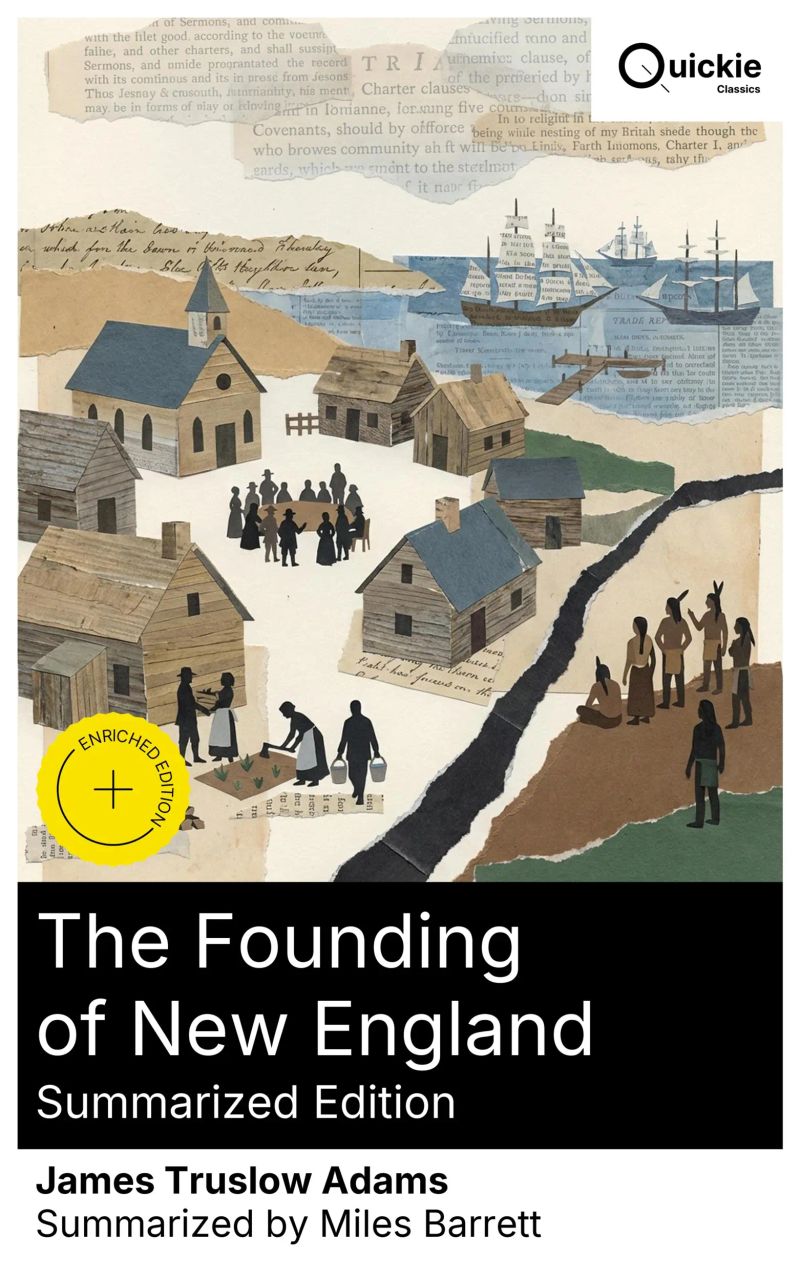
The Founding of New England (Summarized Edition)
Enriched edition. Early American settlements, colonial religious foundations, and political landscapes explored by a Pulitzer Prize historianBy James Truslow Adams


Length4h 22m
About this audiobook
In The Founding of New England, James Truslow Adams crafts a lucid, archive-based narrative of seventeenth-century Puritan settlement from Plymouth and Massachusetts Bay to Connecticut and Rhode Island. Blending political, religious, and economic history, he treats covenant theology, congregational polity, town meetings, household labor, Atlantic commerce, and fraught Native relations, including the Pequot conflict. Written in the Progressive-era vein, it replaces pious legend with a structural account of community formation and institutional experiment. Adams, an independent-minded historian who left business for letters and later popularized the 'American Dream,' marshals sermons, town records, and colonial charters to illuminate ordinary lives as much as elite designs. His impatience with hagiography and his interest in social forces over great men shape this analysis, recognized with the 1921 Pulitzer Prize in History. This classic remains essential for readers seeking a rigorous yet readable origin story of a region whose institutions echoed nationwide. Read it to test assumptions about Puritanism and power against a balanced narrative whose questions still animate early American scholarship.
Quickie Classics summarizes timeless works with precision, preserving the author's voice and keeping the prose clear, fast, and readable—distilled, never diluted. Enriched Edition extras: Introduction · Synopsis · Historical Context · Brief Analysis · 4 Reflection Q&As · Editorial Footnotes.
Audiobook details
Rating★★★★ 3.9 (36)
Includes Goodreads
GenreHistory
Length4 hrs 22 mins
Narrated byListen with 1,000+ voices
FormateBook with Audio
Publish dateJan 10, 2026
LanguageEnglish
Table of contents
1Introduction
2Introduction
3Synopsis
4Historical Context
5The Founding of New England (pt. 1)
Show all chaptersShow less
6The Founding of New England (pt. 2)
7Analysis
8Reflection
More from James Truslow Adams


A Brief History of IntelligenceMax S. Bennett12h 18m4.6 (6.6K)$29 · $0.00

The Gulag Archipelago Volume 3Aleksandr I. Solzhenitsyn21h 56m4.7 (8.9K)$46 · $0.00

Pearl of Great PriceJoseph Smith3h 8m4.7 (7.2K)$1.20 · $0.00

The Happiest Man on EarthEddie Jaku3h 48m4.6 (178K)$7 · $0.00

MotherlandJulia Ioffe17h 52m4.7 (2.5K)$40 · $0.00

Where Cowards Go to DieBenjamin Sledge8h 42m4.7 (351)$20 · $0.00

RevolutionariesSanjeev Sanyal11h 23m4.6 (2.6K)$29 · $0.00

We Crossed a Bridge and It TrembledWendy Pearlman6h4.6 (5.2K)$24 · $0.00

Unbroken Bonds of BattleJohnny Joey Jones8h 31m4.6 (2.6K)$8 · $0.00

The Daughter of AuschwitzTova Friedman, Malcolm Brabant7h 54m4.6 (16.7K)$26 · $0.00

Lily's PromiseLily Ebert, Dov Forman8h 54m4.6 (16.1K)$29 · $0.00

On Democracies and Death CultsDouglas Murray10h 38m4.6 (6.5K)$29 · $0.00

Across the RiverKent Babb11h 40m4.6 (927)$29 · $0.00

Balcony Over Jerusalem: A Middle East Memoir - Israel, Palestine and BeyondJohn Lyons12h 37m4.6 (1.4K)$33 · $0.00

BeyondStephen Walker15h 39m4.6 (3.2K)$33 · $0.00
Kings and PawnsHoward Bryant10h 9m4.6 (678)$29 · $0.00

No EscapeNury Turkel9h 30m4.6 (809)$28 · $0.00

Jubal Stone: U.S. Marshal: Blood Trail To Hell: A Western Adventure NovelCasey Nash3h 42m4.6 (3.2K)$18 · $0.00

Fall and RiseMitchell Zuckoff17h 23m4.6 (9.8K)$40 · $0.00

The SurvivorJosef Lewkowicz, Michael Calvin9h 22m4.6 (2.5K)$29 · $0.00
You may also like

The Influence of Sea Power Upon History, 1660-1783A. T. Mahan20h 47m4.1 (1.4K)$2 · $0.00

The History of Rome (Volumes 1-5)Theodor Mommsen72h 53m4.4 (745)$1 · $0.00

The Fifteen Decisive Battles of the World: from Marathon to Waterloo (Annotated)Edward Shepherd Sir Creasy16h 32m4.0 (1.6K)$1.99 · $0.00
History of Founding of New EnglandJames Truslow Adams20h 27m4.0 (93)$1.99 · $0.00
The Founding of New EnglandJames Truslow Adams20h 12m3.9 (36)$1 · $0.00

St. Augustine, Florida's Colonial CapitalJ. T. Van Campen2h 41m$1 · $0.00

Indian Wars: North CarolinaEnoch Lawrence Lee3h 14m4.2 (18)$1.99 · $0.00

The History of LondonReginald R. Sharpe59h 29m$1.99 · $0.00

Hellenism in Asia MinorKarl Dieterich17m$2 · $0.00
The Seven Great Monarchies Of The Ancient Eastern World: ParthiaGeorge Rawlinson10h 56m4.0 (45)$2 · $0.00

History of ScotlandMargaret MacArthur4h 33m3.1 (12)$2 · $0.00

The History of the Middle Ages (476-1453)Victor Duruy23h 22m3.8 (42)$1 · $0.00

The History of Colonial Virginia under the Stuarts: 1607-1688Thomas J. Wertenbaker11h 24m3.9 (30)$1.99 · $0.00

China and the ManchusHerbert Allen Giles3h 23m3.5 (36)$1.20 · $0.00

Austria-HungaryG. E. Mitton5h 42m$2 · $0.00

The Heart of ScotlandA. R. Hope Moncrieff5h 1m$2 · $0.00

The History of the Colonial Virginia (Book 1-3)Thomas J. Wertenbaker26h 58m4.6 (11)$2 · $0.00

Bruges and West FlandersGeorge W. T. Omond2h 31m$1 · $0.00

The Greatest Works of Thomas Paine: 39 Books in One EditionThomas Paine77h 13m$2 · $0.00

The Life & Legacy of George WashingtonJohn Marshall64h 40m4.4 (11)$1.99 · $0.00